Skip to content
  • Categories
  • Recent
  • Tags
  • Popular
  • World
  • Users
  • Groups
Skins
  • Light
  • Brite
  • Cerulean
  • Cosmo
  • Flatly
  • Journal
  • Litera
  • Lumen
  • Lux
  • Materia
  • Minty
  • Morph
  • Pulse
  • Sandstone
  • Simplex
  • Sketchy
  • Spacelab
  • United
  • Yeti
  • Zephyr
  • Dark
  • Cyborg
  • Darkly
  • Quartz
  • Slate
  • Solar
  • Superhero
  • Vapor

  • Default (Cyborg)
  • No Skin
Collapse
Brand Logo

CIRCLE WITH A DOT

  1. Home
  2. Uncategorized
  3. I’ve been thinking about this for days.

I’ve been thinking about this for days.
Scheduled Pinned Locked Moved Uncategorized
35 Posts 29 Posters 18 Views
  • Oldest to Newest
  • Newest to Oldest
  • Most Votes
Reply
  • Reply as topic
Log in to reply
This topic has been deleted. Only users with topic management privileges can see it.
  • mhoye@cosocial.caM mhoye@cosocial.ca

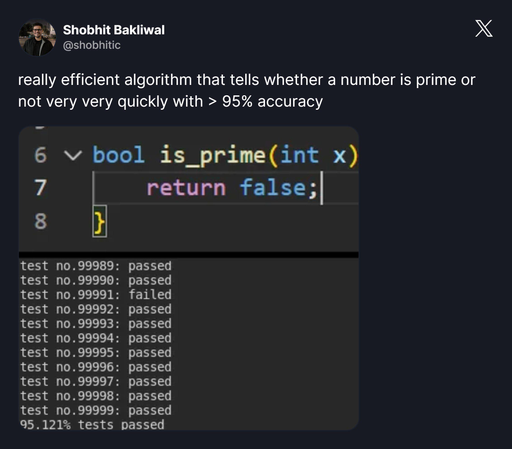
    I’ve been thinking about this for days. Incredible stochastic algorithm, gets more reliable the larger your input, incredibly fast, trivial to implement and deterministic on its inputs. It really has so much going for it.

    (Via @jonathankoren )

    groxx@hachyderm.ioG This user is from outside of this forum
    groxx@hachyderm.ioG This user is from outside of this forum
    groxx@hachyderm.io
    wrote last edited by
    #8

    @mhoye @jonathankoren it's branchless too, and easily parallelized onto a GPU to speed it up

    1 Reply Last reply
    0
    • mhoye@cosocial.caM mhoye@cosocial.ca

      I’ve been thinking about this for days. Incredible stochastic algorithm, gets more reliable the larger your input, incredibly fast, trivial to implement and deterministic on its inputs. It really has so much going for it.

      (Via @jonathankoren )

      ollicle@mastodon.socialO This user is from outside of this forum
      ollicle@mastodon.socialO This user is from outside of this forum
      ollicle@mastodon.social
      wrote last edited by
      #9

      @mhoye @jonathankoren @daedalus I hope the crypto crew catch wind of this. Has potential to save a lot of electricity

      1 Reply Last reply
      0
      • jonathankoren@sfba.socialJ jonathankoren@sfba.social

        @adardis @mhoye there are no bad algorithms. There are only bad use cases.

        eirias@mefi.socialE This user is from outside of this forum
        eirias@mefi.socialE This user is from outside of this forum
        eirias@mefi.social
        wrote last edited by
        #10

        @jonathankoren @adardis @mhoye this is like that weather aphorism, isn't it

        1 Reply Last reply
        0
        • mhoye@cosocial.caM mhoye@cosocial.ca

          I’ve been thinking about this for days. Incredible stochastic algorithm, gets more reliable the larger your input, incredibly fast, trivial to implement and deterministic on its inputs. It really has so much going for it.

          (Via @jonathankoren )

          mdreid@mastodon.socialM This user is from outside of this forum
          mdreid@mastodon.socialM This user is from outside of this forum
          mdreid@mastodon.social
          wrote last edited by
          #11

          @mhoye @jonathankoren @rmondello Surprising fact: exactly the same algorithm works even better for many other problems: perfect numbers, powers of two, busy beaver, etc.

          1 Reply Last reply
          0
          • mhoye@cosocial.caM mhoye@cosocial.ca

            I’ve been thinking about this for days. Incredible stochastic algorithm, gets more reliable the larger your input, incredibly fast, trivial to implement and deterministic on its inputs. It really has so much going for it.

            (Via @jonathankoren )

            tbortels@infosec.exchangeT This user is from outside of this forum
            tbortels@infosec.exchangeT This user is from outside of this forum
            tbortels@infosec.exchange
            wrote last edited by
            #12

            @jonathankoren @mhoye

            The problem is its inaccuracy for smaller input sets involving low-digit-count numbers.

            Trivially fixed by hardcoding the results for 3-digit and lower input. Ship it!

            jonathankoren@sfba.socialJ 1 Reply Last reply
            1
            0
            • R relay@relay.infosec.exchange shared this topic
            • jonathankoren@sfba.socialJ jonathankoren@sfba.social

              @adardis @mhoye there are no bad algorithms. There are only bad use cases.

              drwho@masto.hackers.townD This user is from outside of this forum
              drwho@masto.hackers.townD This user is from outside of this forum
              drwho@masto.hackers.town
              wrote last edited by
              #13

              @jonathankoren @adardis @mhoye Can I quote you on that?

              mhoye@cosocial.caM jonathankoren@sfba.socialJ 2 Replies Last reply
              0
              • drwho@masto.hackers.townD drwho@masto.hackers.town

                @jonathankoren @adardis @mhoye Can I quote you on that?

                mhoye@cosocial.caM This user is from outside of this forum
                mhoye@cosocial.caM This user is from outside of this forum
                mhoye@cosocial.ca
                wrote last edited by
                #14

                @drwho @jonathankoren @adardis It's such a good line.

                1 Reply Last reply
                0
                • mhoye@cosocial.caM mhoye@cosocial.ca

                  I’ve been thinking about this for days. Incredible stochastic algorithm, gets more reliable the larger your input, incredibly fast, trivial to implement and deterministic on its inputs. It really has so much going for it.

                  (Via @jonathankoren )

                  cubeos@hachyderm.ioC This user is from outside of this forum
                  cubeos@hachyderm.ioC This user is from outside of this forum
                  cubeos@hachyderm.io
                  wrote last edited by
                  #15

                  @mhoye @jonathankoren It also provides the script for a math party trick: "Tell me any 100 digit number and I will tell you if it's prime!'

                  1 Reply Last reply
                  0
                  • drwho@masto.hackers.townD drwho@masto.hackers.town

                    @jonathankoren @adardis @mhoye Can I quote you on that?

                    jonathankoren@sfba.socialJ This user is from outside of this forum
                    jonathankoren@sfba.socialJ This user is from outside of this forum
                    jonathankoren@sfba.social
                    wrote last edited by
                    #16

                    @drwho @adardis @mhoye why would I care?

                    1 Reply Last reply
                    0
                    • R relay@relay.an.exchange shared this topic
                    • mhoye@cosocial.caM mhoye@cosocial.ca

                      I’ve been thinking about this for days. Incredible stochastic algorithm, gets more reliable the larger your input, incredibly fast, trivial to implement and deterministic on its inputs. It really has so much going for it.

                      (Via @jonathankoren )

                      gkrnours@mastodon.gamedev.placeG This user is from outside of this forum
                      gkrnours@mastodon.gamedev.placeG This user is from outside of this forum
                      gkrnours@mastodon.gamedev.place
                      wrote last edited by
                      #17

                      @mhoye @jonathankoren are you sure about the more reliable the larger input? Prime number are weird

                      1 Reply Last reply
                      0
                      • mhoye@cosocial.caM mhoye@cosocial.ca

                        I’ve been thinking about this for days. Incredible stochastic algorithm, gets more reliable the larger your input, incredibly fast, trivial to implement and deterministic on its inputs. It really has so much going for it.

                        (Via @jonathankoren )

                        et@mastodon.bayernE This user is from outside of this forum
                        et@mastodon.bayernE This user is from outside of this forum
                        et@mastodon.bayern
                        wrote last edited by
                        #18

                        @mhoye @i0null @jonathankoren How can I unsee this?

                        i0null@infosec.exchangeI 1 Reply Last reply
                        0
                        • mhoye@cosocial.caM mhoye@cosocial.ca

                          I’ve been thinking about this for days. Incredible stochastic algorithm, gets more reliable the larger your input, incredibly fast, trivial to implement and deterministic on its inputs. It really has so much going for it.

                          (Via @jonathankoren )

                          finestructure@mastodon.socialF This user is from outside of this forum
                          finestructure@mastodon.socialF This user is from outside of this forum
                          finestructure@mastodon.social
                          wrote last edited by
                          #19

                          @mhoye @jonathankoren It might be sentient

                          mhoye@cosocial.caM 1 Reply Last reply
                          0
                          • et@mastodon.bayernE et@mastodon.bayern

                            @mhoye @i0null @jonathankoren How can I unsee this?

                            i0null@infosec.exchangeI This user is from outside of this forum
                            i0null@infosec.exchangeI This user is from outside of this forum
                            i0null@infosec.exchange
                            wrote last edited by
                            #20

                            @et @mhoye @jonathankoren
                            bool mark_as_unread() {
                            return true;
                            }

                            1 Reply Last reply
                            0
                            • tbortels@infosec.exchangeT tbortels@infosec.exchange

                              @jonathankoren @mhoye

                              The problem is its inaccuracy for smaller input sets involving low-digit-count numbers.

                              Trivially fixed by hardcoding the results for 3-digit and lower input. Ship it!

                              jonathankoren@sfba.socialJ This user is from outside of this forum
                              jonathankoren@sfba.socialJ This user is from outside of this forum
                              jonathankoren@sfba.social
                              wrote last edited by
                              #21

                              @tbortels @mhoye https://di-mgt.com.au/primes10000.txt

                              1 Reply Last reply
                              0
                              • mhoye@cosocial.caM mhoye@cosocial.ca

                                I’ve been thinking about this for days. Incredible stochastic algorithm, gets more reliable the larger your input, incredibly fast, trivial to implement and deterministic on its inputs. It really has so much going for it.

                                (Via @jonathankoren )

                                ichinin@infosec.exchangeI This user is from outside of this forum
                                ichinin@infosec.exchangeI This user is from outside of this forum
                                ichinin@infosec.exchange
                                wrote last edited by
                                #22

                                @mhoye Algorithms like this are used as a pre-prime testing before you do the actual prime testing that requires CPU heavy computation.

                                1 Reply Last reply
                                0
                                • mhoye@cosocial.caM mhoye@cosocial.ca

                                  I’ve been thinking about this for days. Incredible stochastic algorithm, gets more reliable the larger your input, incredibly fast, trivial to implement and deterministic on its inputs. It really has so much going for it.

                                  (Via @jonathankoren )

                                  arcaneoverflow@techhub.socialA This user is from outside of this forum
                                  arcaneoverflow@techhub.socialA This user is from outside of this forum
                                  arcaneoverflow@techhub.social
                                  wrote last edited by
                                  #23

                                  @mhoye @jonathankoren Snort! 🙂

                                  1 Reply Last reply
                                  0
                                  • mhoye@cosocial.caM mhoye@cosocial.ca

                                    I’ve been thinking about this for days. Incredible stochastic algorithm, gets more reliable the larger your input, incredibly fast, trivial to implement and deterministic on its inputs. It really has so much going for it.

                                    (Via @jonathankoren )

                                    mehrad@fosstodon.orgM This user is from outside of this forum
                                    mehrad@fosstodon.orgM This user is from outside of this forum
                                    mehrad@fosstodon.org
                                    wrote last edited by
                                    #24

                                    @mhoye
                                    @jonathankoren
                                    It is one of the best one-class classifier I've ever seen. Extremely efficient and the computational time doesn't grow the larger the input gets.

                                    1 Reply Last reply
                                    0
                                    • mhoye@cosocial.caM mhoye@cosocial.ca

                                      I’ve been thinking about this for days. Incredible stochastic algorithm, gets more reliable the larger your input, incredibly fast, trivial to implement and deterministic on its inputs. It really has so much going for it.

                                      (Via @jonathankoren )

                                      ingonymous@mastodon.socialI This user is from outside of this forum
                                      ingonymous@mastodon.socialI This user is from outside of this forum
                                      ingonymous@mastodon.social
                                      wrote last edited by
                                      #25

                                      @mhoye @Nephele @jonathankoren
                                      That's prime crime

                                      1 Reply Last reply
                                      0
                                      • mhoye@cosocial.caM mhoye@cosocial.ca

                                        I’ve been thinking about this for days. Incredible stochastic algorithm, gets more reliable the larger your input, incredibly fast, trivial to implement and deterministic on its inputs. It really has so much going for it.

                                        (Via @jonathankoren )

                                        stylus@social.afront.orgS This user is from outside of this forum
                                        stylus@social.afront.orgS This user is from outside of this forum
                                        stylus@social.afront.org
                                        wrote last edited by
                                        #26

                                        @mhoye @silicatefondue @jonathankoren this class of algorithm is called the stopped clock algorithm. It joins the previously identified Monte Carlo and las Vegas algorithms.

                                        1 Reply Last reply
                                        0
                                        • mhoye@cosocial.caM mhoye@cosocial.ca

                                          I’ve been thinking about this for days. Incredible stochastic algorithm, gets more reliable the larger your input, incredibly fast, trivial to implement and deterministic on its inputs. It really has so much going for it.

                                          (Via @jonathankoren )

                                          http@infosec.exchangeH This user is from outside of this forum
                                          http@infosec.exchangeH This user is from outside of this forum
                                          http@infosec.exchange
                                          wrote last edited by
                                          #27

                                          @mhoye @jonathankoren If you change that to:
                                          return !(x&1);
                                          You have improved the probability quite a lot and still fast and won't get optimized away.

                                          1 Reply Last reply
                                          0
                                          Reply
                                          • Reply as topic
                                          Log in to reply
                                          • Oldest to Newest
                                          • Newest to Oldest
                                          • Most Votes


                                          • Login

                                          • Login or register to search.
                                          • First post
                                            Last post
                                          0
                                          • Categories
                                          • Recent
                                          • Tags
                                          • Popular
                                          • World
                                          • Users
                                          • Groups