Have Wikipedia and Mozilla passed a point of inevitable decline?
-
Wikipedia is in a similar bind -- although from the comments, I think it's only obvious to Wikimedia insiders right now. Wikipedia has fallen from a peak of about 5th-biggest web site to about 12th today. Still huge, but trending in the wrong direction.
@evan agree on both. People vote with their hearts, but what's happening is the techno-orcs have sucked the oxygen out of all the heroic old-time projects. Not an insider but I wouldn't be surprised if Wikipedia is dropping because it too is no longer needed as fig leaf. They took some risky bets (I know of abstract Wikipedia, wikibase) but they didn't flourish. Actually I can't think of any growing open project today that touches *mass* audiences. Signal with their 70 mln users comes closest.
-
I don't know, honestly.
My harsh assessment is that Mozilla has developed a culture of quitters -- they kill products long before they've had a chance to thrive.
Wikimedia, on the other hand, is an intrinsically conservative ecosystem. I don't know if it has the culture to try new things. They may try cutting their way to success, too, like with the shutdown of Wikinews.
And I guess that's surfacing something important about both cases -- and a chance to overextend my metaphor. Pulling out of a death spiral in a video game requires a lot of knowledge of the game, and a certain willingness to take risks. You have to sometimes send an expeditionary force through the mountains to find a uranium mining site. Or you put all your barley resources into building a war blimp. If you don't know these long-shot options are possible, you won't try them, and you'll fail.
-
I don't know, honestly.
My harsh assessment is that Mozilla has developed a culture of quitters -- they kill products long before they've had a chance to thrive.
Wikimedia, on the other hand, is an intrinsically conservative ecosystem. I don't know if it has the culture to try new things. They may try cutting their way to success, too, like with the shutdown of Wikinews.
@evan Who decides what needs to be killed? That is key.
-
Mozilla is so dependent on Google today that they begged US courts not to enforce antitrust laws against Google, because it would hurt their only source of revenue. So much for the champions of the open web!

Mozilla’s CEO discusses testimony in U.S. v. Google search case | The Mozilla Blog
Mozilla's CFO testified in the U.S. v. Google LLC search trial, highlighting its potential impact on small and independent browsers.

(blog.mozilla.org)
@evan didn't know about this - but this is really feeding their enemy long-term. Failing US antitrust is a huge part of the issues there is with big tech in these years.
-
And I guess that's surfacing something important about both cases -- and a chance to overextend my metaphor. Pulling out of a death spiral in a video game requires a lot of knowledge of the game, and a certain willingness to take risks. You have to sometimes send an expeditionary force through the mountains to find a uranium mining site. Or you put all your barley resources into building a war blimp. If you don't know these long-shot options are possible, you won't try them, and you'll fail.
What could Mozilla do? Build cloud services attached to your Firefox account -- like Google and Apple have. Use their reputation for openness and privacy to attract a generation of users who are despondent over Big Tech.
What could Wikimedia do? Use public pressure and shame to rewrite those re-use deals. And also disintermediate -- get directly connected to users, with chatbots, search, and voice assistants of their own.
Or maybe even wilder things. I don't know everything; I'm just some guy.
-
What could Mozilla do? Build cloud services attached to your Firefox account -- like Google and Apple have. Use their reputation for openness and privacy to attract a generation of users who are despondent over Big Tech.
What could Wikimedia do? Use public pressure and shame to rewrite those re-use deals. And also disintermediate -- get directly connected to users, with chatbots, search, and voice assistants of their own.
Or maybe even wilder things. I don't know everything; I'm just some guy.
Anyway, I'm going to choose to stay hopeful. I think most of the options for these two big organizations are revolutionary and not evolutionary. But I believe they still exist. I'm going to say Neither, but ask me again next year.
-
And I guess that's surfacing something important about both cases -- and a chance to overextend my metaphor. Pulling out of a death spiral in a video game requires a lot of knowledge of the game, and a certain willingness to take risks. You have to sometimes send an expeditionary force through the mountains to find a uranium mining site. Or you put all your barley resources into building a war blimp. If you don't know these long-shot options are possible, you won't try them, and you'll fail.
@evan the thing that bums me out about firefox is it shouldn't matter if mozilla lives or dies. it's open source! but it got built up so big and the stakes are so high it might not be enough just to have a community of people who give a shit to try to maintain it. i think they crossed the point of no return on accident a long time ago and google has just been keeping them on life support as an anti-anti-trust talisman since then
-
For those of us who depended on Mozilla as a standard bearer for open source and the open web, it's disheartening to see that ember dying. We needed a Mozilla that launched new products, not one that shut them down without moving forward.
@evan if Google funding was withdrawn from Mozilla, do you think the community could maintain the Firefox browser as a viable competitor to Chrome?
-
I played a medieval city-builder last year and worked out that you can resolve your resource issues by building an inn for travellers and then producing enough alcohol to supply them.
-
@evan agree on both. People vote with their hearts, but what's happening is the techno-orcs have sucked the oxygen out of all the heroic old-time projects. Not an insider but I wouldn't be surprised if Wikipedia is dropping because it too is no longer needed as fig leaf. They took some risky bets (I know of abstract Wikipedia, wikibase) but they didn't flourish. Actually I can't think of any growing open project today that touches *mass* audiences. Signal with their 70 mln users comes closest.
@openrisk Signal is a good example. They've mostly managed to pivot from the big one-time donation from the WhatsApp founder and licensing deals with Big Tech for the Signal protocol trademark to user donations, which now make up the majority of their income. Not enough to cover costs, but a good place to be. I think one question is when they diversify what they offer.
-
Have Wikipedia and Mozilla passed a point of inevitable decline?
@evan Mozilla definitely imo. They don't have a large enough user base to recover and they're burning their bridges with the type of people who'd sustain them enough to survive. They're no Apple who found themselves in a similar position. (1/3)
-
@evan Mozilla definitely imo. They don't have a large enough user base to recover and they're burning their bridges with the type of people who'd sustain them enough to survive. They're no Apple who found themselves in a similar position. (1/3)
Wikipedia not inevitable. (I've read your replies). Maybe it'll become inevitable within the next decade but they aren't there yet. And what will LLMs be without being able to perpetually scrape Wikipedia? I don't think you are going to get many people voluntarily correcting LLMs unpaid (and this will become necessary eventually, especially if Wikipedia goes). (2/3)
@evan -
Wikipedia not inevitable. (I've read your replies). Maybe it'll become inevitable within the next decade but they aren't there yet. And what will LLMs be without being able to perpetually scrape Wikipedia? I don't think you are going to get many people voluntarily correcting LLMs unpaid (and this will become necessary eventually, especially if Wikipedia goes). (2/3)
@evanThey're rightly seen by the people who might be willing to do that as ruthless, capitalist US businesses whose sole objective is to make money and shit on people and the rest of the world, not as noble charitable organisations with a global ethos worth helping and preserving. (3/3)
@evan -
@evan the thing that bums me out about firefox is it shouldn't matter if mozilla lives or dies. it's open source! but it got built up so big and the stakes are so high it might not be enough just to have a community of people who give a shit to try to maintain it. i think they crossed the point of no return on accident a long time ago and google has just been keeping them on life support as an anti-anti-trust talisman since then
@aeva I think you have an adorably romantic mental model of how big Open Source works.
-
@aeva I think you have an adorably romantic mental model of how big Open Source works.
@evan i blame christine lol
-
Anyway, I'm going to choose to stay hopeful. I think most of the options for these two big organizations are revolutionary and not evolutionary. But I believe they still exist. I'm going to say Neither, but ask me again next year.
@evan For what its worth, I used to think CBC was a hopeless organization in the face of Netflix and YouTube. But it turns out that it's now one of the few news sources I trust, and they've done more for Canadian sports than Rogers.
Sometimes it takes a catalyst for people to realize why an institution is important. -
It'd be nice to play games where you can have a little barley field and a little wood lot and a little university and you just chill and eat mushroom barley soup and write poetry by your wood fire. But usually in these games, if you don't grow, others will. The world changes around you. And they will overlook you for a while if you keep a low profile, but eventually they'll come take what little you have.
Sounds like Animal Crossing, Stardew Valley, or any number of other "cozy" games that don't focus on combat. (Which doesn't really help your analogy, admittedly)
-
Anyway, I'm going to choose to stay hopeful. I think most of the options for these two big organizations are revolutionary and not evolutionary. But I believe they still exist. I'm going to say Neither, but ask me again next year.
I say all this with deep love and respect. I have lived and will die a believer in wikis. I believe in open source and the open web. I love my friends and colleagues at both organisations and I hope they keep their jobs and thrive. I want them to succeed.
-
What could Mozilla do? Build cloud services attached to your Firefox account -- like Google and Apple have. Use their reputation for openness and privacy to attract a generation of users who are despondent over Big Tech.
What could Wikimedia do? Use public pressure and shame to rewrite those re-use deals. And also disintermediate -- get directly connected to users, with chatbots, search, and voice assistants of their own.
Or maybe even wilder things. I don't know everything; I'm just some guy.
@evan Just some other guy, but it seems game over to me. The land lies in waste. The orcs rule every square of the board and are erecting blood sucking factories, sorry meant "data centers", in each and every one.
There might be some sort of restart, with new rules
 . But it will need outside help. Deus ex machina. Maybe some enlightened democratic government deciding this *is* existential. Maybe a trillionaire in their death bed wishing to pass through the head of a needle.
 -
My friend @luis_in_brief has written a couple of good articles about Wikipedia's collapsing web traffic:
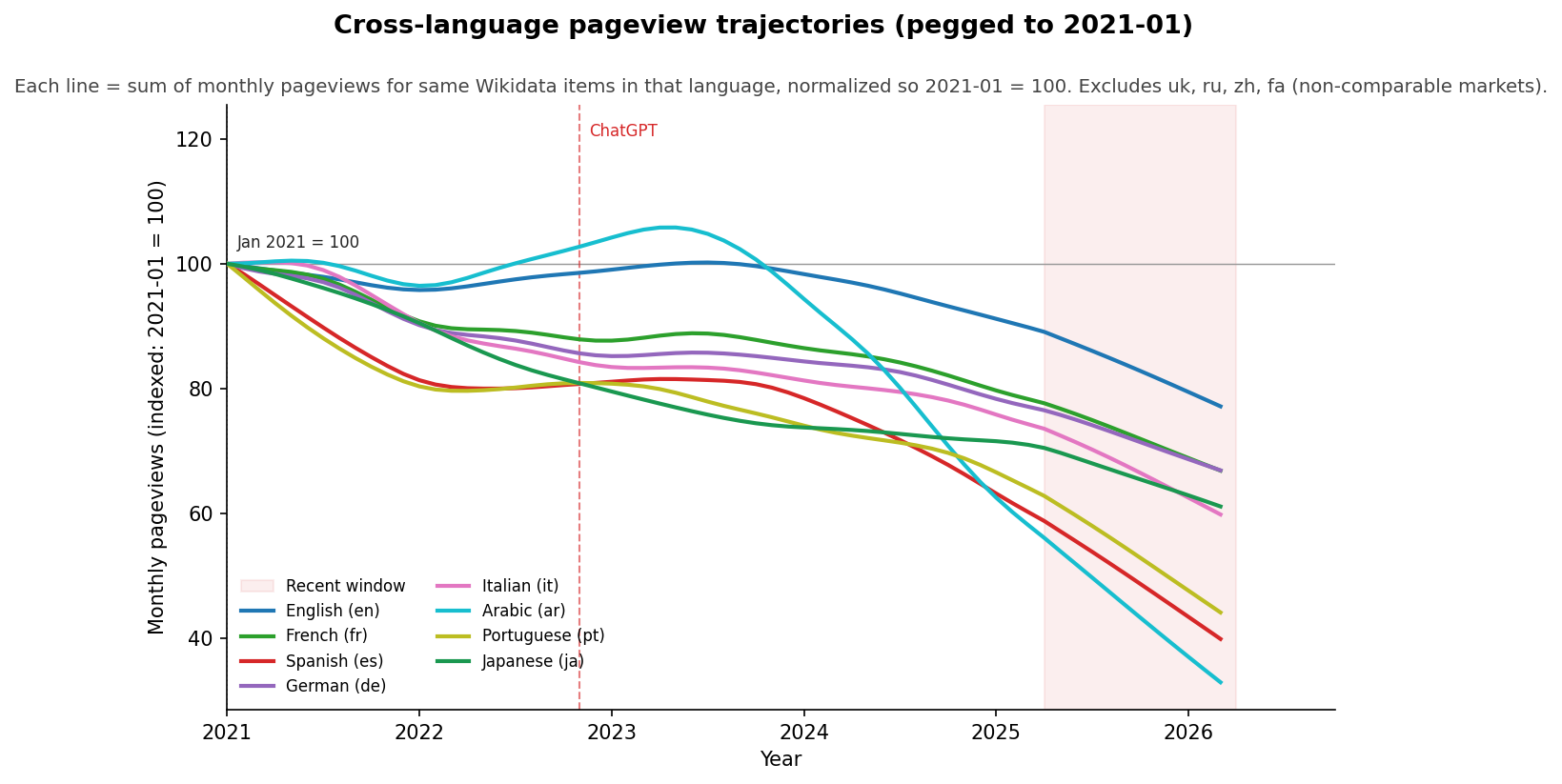
Wikipedia's traffic drop: more on languages and freshness
Following up on last week's post, I looked at 5,000 "Vital Articles" across eight major-language Wikipedias. Articles about math, physical sciences and tech are waaaay down, while people, geography, and history hold up far better—regardless of which language they're in. Article freshness matters too—but not as much.

lu.is (lu.is)
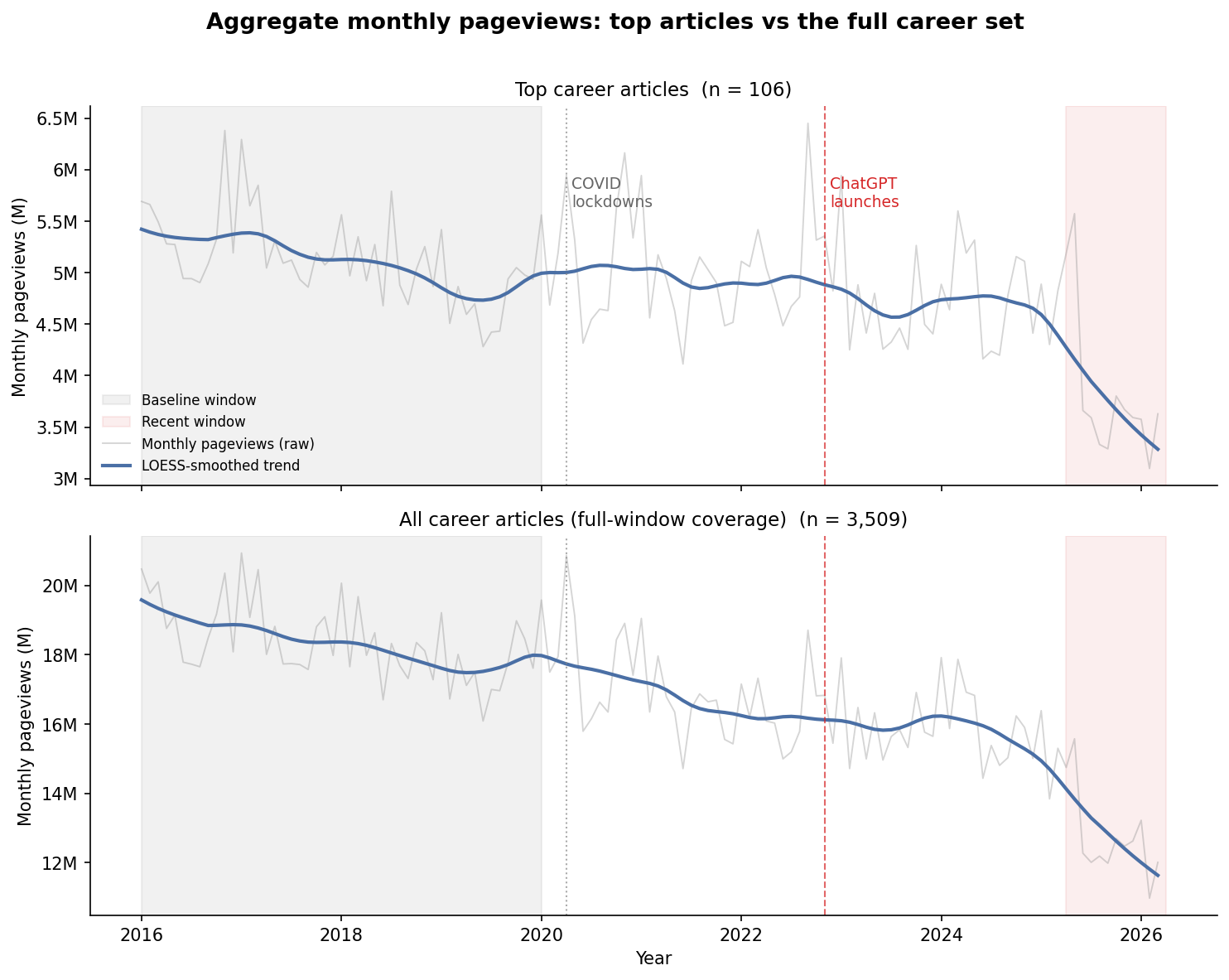
Career articles on Wikipedia: some scary numbers
I took a look at English Wikipedia pageviews for ~4,000 articles about careers. The numbers are grim: the median is down 28% from pre-COVID, with a huge drop in the last year.
lu.is (lu.is)
I especially appreciate this article about how Wikipedia's "flat" traffic growth over the last decade masks a precipitous decline in relative Web traffic:
My former colleague Marshall Miller at WMF wrote about a vertiginous 8% quarterly drop in Wikipedia page views at the end of 2025:

New User Trends on Wikipedia
An update on user trends from the Wikimedia Foundation.

Diff (diff.wikimedia.org)
@evan @luis_in_brief Thank you for sharing!










 .
.