Have Wikipedia and Mozilla passed a point of inevitable decline?
-
@funcrunch @evan Sure, no objection about that.
-
@pizaaman Are we playing Questions?
-
@evan well, you deleted your post, but what I can say after reading some amount of all that is:
if the wikipedia team honestly thinks pageviews is a reliable metric for anything I'm slightly more worried than beforebut I still think the site's in good shape, especially after the recent decision to reject AI contributions
@anime_reference Wikipedia edits depend on page views. People edit the the pages when they read something that's untrue, clumsy, or misspelled. If they don't get page views, they don't get edits.
Wikimedia Foundation revenue depends on page views. People donate to Wikimedia when they land on a Wikipedia page with a donation request banner. If there aren't page views, WMF doesn't get donations.
Page views are a very big deal for Wikimedia.
-
Have Wikipedia and Mozilla passed a point of inevitable decline?
@evan@cosocial.ca Mozilla is cooked, I don't think Wikipedia is out yet despite the challenges it faces due to AI -
-
Have Wikipedia and Mozilla passed a point of inevitable decline?
I like playing video games and board games with an economic component. In these games, you build farms or factories or mines or whatever, and they generate resources that you can use to build armies or research centres or monuments, which in turn let you build more farms and mines and so on.
-
I like playing video games and board games with an economic component. In these games, you build farms or factories or mines or whatever, and they generate resources that you can use to build armies or research centres or monuments, which in turn let you build more farms and mines and so on.
There's a moment, when you're losing this kind of game, that you realize you don't have the resource generation needed to drive growth, or even to maintain what you have. The orc armies are moving in, and you don't have enough manganese to make Armoured Infantry II. So you lose those wheat fields you do have to the orcs, and now you have even less resources, which gives you even less optionality for defence or growth.
-
There's a moment, when you're losing this kind of game, that you realize you don't have the resource generation needed to drive growth, or even to maintain what you have. The orc armies are moving in, and you don't have enough manganese to make Armoured Infantry II. So you lose those wheat fields you do have to the orcs, and now you have even less resources, which gives you even less optionality for defence or growth.
It'd be nice to play games where you can have a little barley field and a little wood lot and a little university and you just chill and eat mushroom barley soup and write poetry by your wood fire. But usually in these games, if you don't grow, others will. The world changes around you. And they will overlook you for a while if you keep a low profile, but eventually they'll come take what little you have.
-
It'd be nice to play games where you can have a little barley field and a little wood lot and a little university and you just chill and eat mushroom barley soup and write poetry by your wood fire. But usually in these games, if you don't grow, others will. The world changes around you. And they will overlook you for a while if you keep a low profile, but eventually they'll come take what little you have.
Technology is not a game, but it kind of also is. Mozilla had a great product, Firefox, which ran on Open Source and open standards. At its peak, in the late 2000s, it had about 30% of the global browser market. That gave Mozilla a lot of optionality for generating resources -- resources it could invest in other projects that reflected its values.
-
It'd be nice to play games where you can have a little barley field and a little wood lot and a little university and you just chill and eat mushroom barley soup and write poetry by your wood fire. But usually in these games, if you don't grow, others will. The world changes around you. And they will overlook you for a while if you keep a low profile, but eventually they'll come take what little you have.
I played a medieval city-builder last year and worked out that you can resolve your resource issues by building an inn for travellers and then producing enough alcohol to supply them.
-
Technology is not a game, but it kind of also is. Mozilla had a great product, Firefox, which ran on Open Source and open standards. At its peak, in the late 2000s, it had about 30% of the global browser market. That gave Mozilla a lot of optionality for generating resources -- resources it could invest in other projects that reflected its values.
But Mozilla hasn't been able to use Firefox to level up. It tried a lot of things -- Firefox OS being the biggest bet -- that for one reason or another didn't pan out. Meanwhile, their resource base was eroding from 30% of all Web users to about 2% today. Their biggest customer, Google, which paid them for access to browser users, built their own Open Source and open standards browser, which became much more popular.
-
But Mozilla hasn't been able to use Firefox to level up. It tried a lot of things -- Firefox OS being the biggest bet -- that for one reason or another didn't pan out. Meanwhile, their resource base was eroding from 30% of all Web users to about 2% today. Their biggest customer, Google, which paid them for access to browser users, built their own Open Source and open standards browser, which became much more popular.
Mozilla is so dependent on Google today that they begged US courts not to enforce antitrust laws against Google, because it would hurt their only source of revenue. So much for the champions of the open web!

Mozilla’s CEO discusses testimony in U.S. v. Google search case | The Mozilla Blog
Mozilla's CFO testified in the U.S. v. Google LLC search trial, highlighting its potential impact on small and independent browsers.

(blog.mozilla.org)
-
Mozilla is so dependent on Google today that they begged US courts not to enforce antitrust laws against Google, because it would hurt their only source of revenue. So much for the champions of the open web!
Mozilla’s CEO discusses testimony in U.S. v. Google search case | The Mozilla Blog
Mozilla's CFO testified in the U.S. v. Google LLC search trial, highlighting its potential impact on small and independent browsers.
(blog.mozilla.org)
I don't know if Mozilla is definitively boxed in at this point. Maybe there's an act 3 for them somewhere. I use their VPN and it's fine. They have a few other paid products.
They've repeatedly failed to leverage their Firefox userbase to build other products -- the mobile OS, of course, but also Mozilla Social, which they shut down without ever really launching it.
Eventually, that userbase is going to be too small to launch anything off of.
-
@evan @pizaaman I dont google, I search
 In fact I do not use google search much at all these days. I am going on international friends/colleagues who train wikipedians, and/ or use WP in their teaching. I am going on the resources it offers and not headline news. I think the AI deals are a massive ethical problem but we soldier on. All this applies to IA as well.
 -
I don't know if Mozilla is definitively boxed in at this point. Maybe there's an act 3 for them somewhere. I use their VPN and it's fine. They have a few other paid products.
They've repeatedly failed to leverage their Firefox userbase to build other products -- the mobile OS, of course, but also Mozilla Social, which they shut down without ever really launching it.
Eventually, that userbase is going to be too small to launch anything off of.
For those of us who depended on Mozilla as a standard bearer for open source and the open web, it's disheartening to see that ember dying. We needed a Mozilla that launched new products, not one that shut them down without moving forward.
-
For those of us who depended on Mozilla as a standard bearer for open source and the open web, it's disheartening to see that ember dying. We needed a Mozilla that launched new products, not one that shut them down without moving forward.
Wikipedia is in a similar bind -- although from the comments, I think it's only obvious to Wikimedia insiders right now. Wikipedia has fallen from a peak of about 5th-biggest web site to about 12th today. Still huge, but trending in the wrong direction.
-
Wikipedia is in a similar bind -- although from the comments, I think it's only obvious to Wikimedia insiders right now. Wikipedia has fallen from a peak of about 5th-biggest web site to about 12th today. Still huge, but trending in the wrong direction.
My friend @luis_in_brief has written a couple of good articles about Wikipedia's collapsing web traffic:
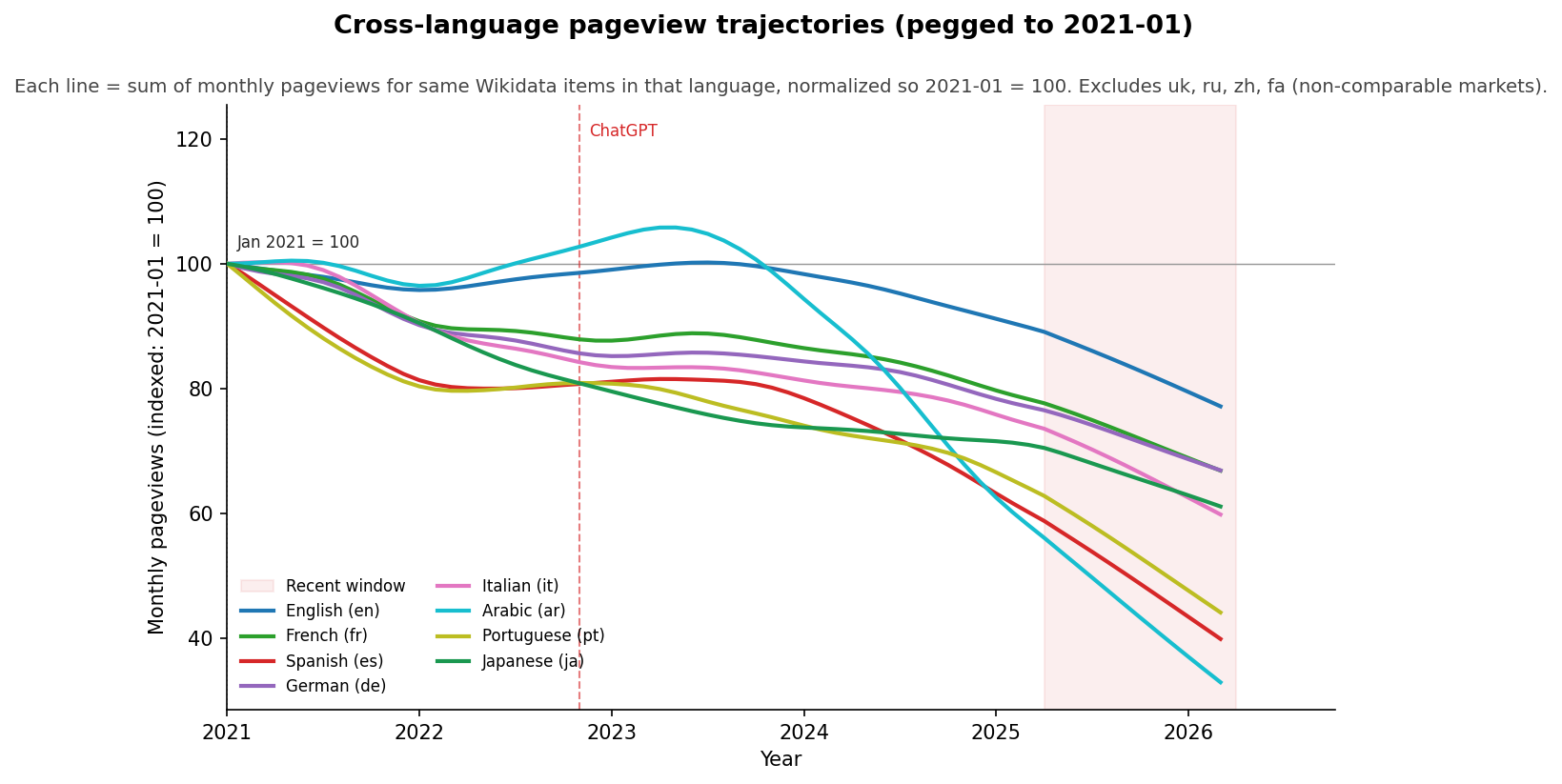
Wikipedia's traffic drop: more on languages and freshness
Following up on last week's post, I looked at 5,000 "Vital Articles" across eight major-language Wikipedias. Articles about math, physical sciences and tech are waaaay down, while people, geography, and history hold up far better—regardless of which language they're in. Article freshness matters too—but not as much.

lu.is (lu.is)
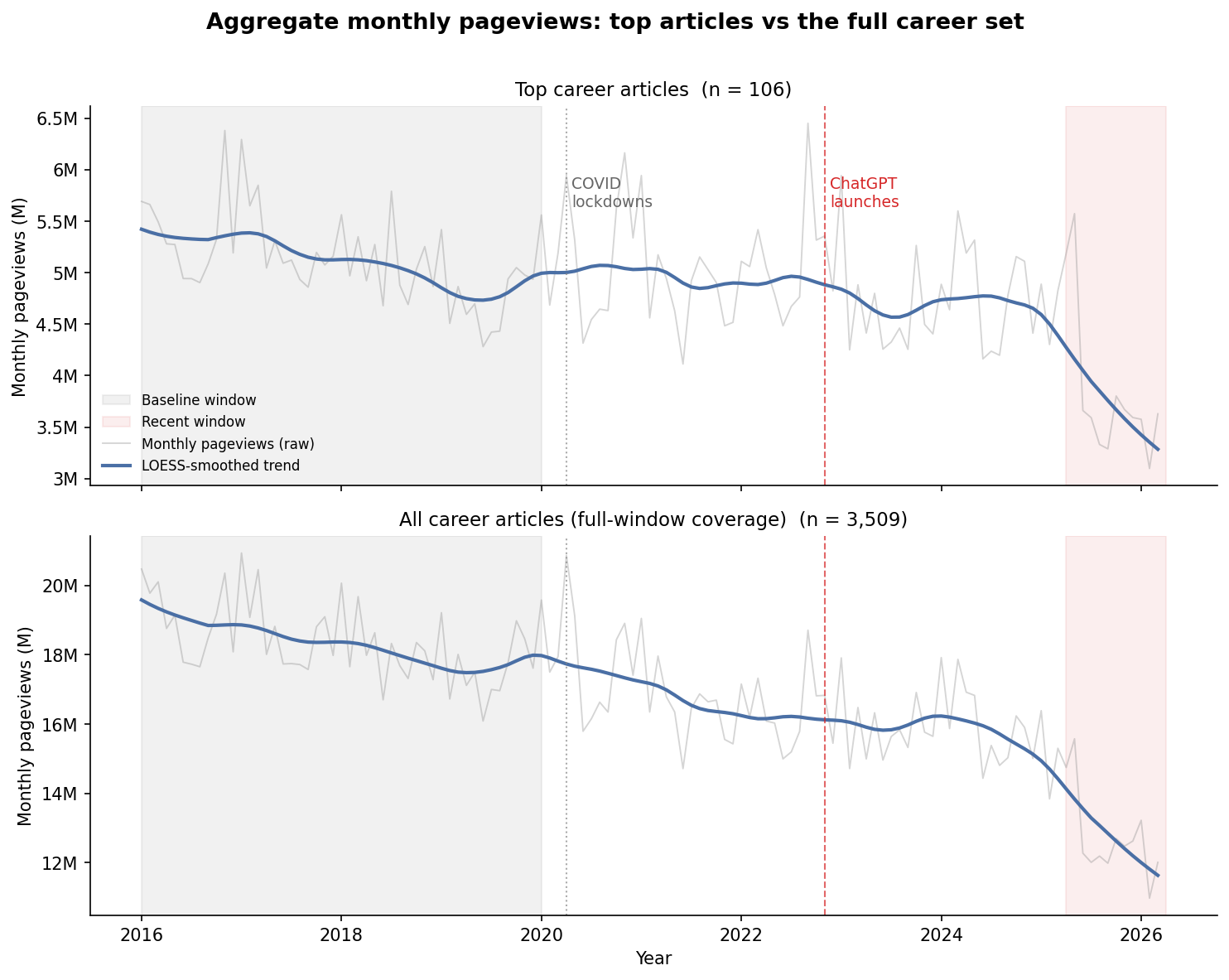
Career articles on Wikipedia: some scary numbers
I took a look at English Wikipedia pageviews for ~4,000 articles about careers. The numbers are grim: the median is down 28% from pre-COVID, with a huge drop in the last year.
lu.is (lu.is)
I especially appreciate this article about how Wikipedia's "flat" traffic growth over the last decade masks a precipitous decline in relative Web traffic:
My former colleague Marshall Miller at WMF wrote about a vertiginous 8% quarterly drop in Wikipedia page views at the end of 2025:

New User Trends on Wikipedia
An update on user trends from the Wikimedia Foundation.

Diff (diff.wikimedia.org)
-
My friend @luis_in_brief has written a couple of good articles about Wikipedia's collapsing web traffic:
Wikipedia's traffic drop: more on languages and freshness
Following up on last week's post, I looked at 5,000 "Vital Articles" across eight major-language Wikipedias. Articles about math, physical sciences and tech are waaaay down, while people, geography, and history hold up far better—regardless of which language they're in. Article freshness matters too—but not as much.
lu.is (lu.is)
Career articles on Wikipedia: some scary numbers
I took a look at English Wikipedia pageviews for ~4,000 articles about careers. The numbers are grim: the median is down 28% from pre-COVID, with a huge drop in the last year.
lu.is (lu.is)
I especially appreciate this article about how Wikipedia's "flat" traffic growth over the last decade masks a precipitous decline in relative Web traffic:
My former colleague Marshall Miller at WMF wrote about a vertiginous 8% quarterly drop in Wikipedia page views at the end of 2025:
New User Trends on Wikipedia
An update on user trends from the Wikimedia Foundation.
Diff (diff.wikimedia.org)
Page views are the lifeblood of Wikipedia. Content generation and revenue derive from this important source. When search summaries or AI chatbots insert themselves between readers and Wikipedia, they cut the project off from that content source and revenue.
Evan Prodromou (@evan@cosocial.ca)
@anime_reference@wetdry.world Wikipedia edits depend on page views. People edit the the pages when they read something that's untrue, clumsy, or misspelled. If they don't get page views, they don't get edits. Wikimedia Foundation revenue depends on page views. People donate to Wikimedia when they land on a Wikipedia page with a donation request banner. If there aren't page views, WMF doesn't get donations. Page views are a very big deal for Wikimedia.

CoSocial (cosocial.ca)
-
Page views are the lifeblood of Wikipedia. Content generation and revenue derive from this important source. When search summaries or AI chatbots insert themselves between readers and Wikipedia, they cut the project off from that content source and revenue.
Evan Prodromou (@evan@cosocial.ca)
@anime_reference@wetdry.world Wikipedia edits depend on page views. People edit the the pages when they read something that's untrue, clumsy, or misspelled. If they don't get page views, they don't get edits. Wikimedia Foundation revenue depends on page views. People donate to Wikimedia when they land on a Wikipedia page with a donation request banner. If there aren't page views, WMF doesn't get donations. Page views are a very big deal for Wikimedia.
CoSocial (cosocial.ca)
I wrote about this in 2017.
-
I wrote about this in 2017.
Since that time, Wikimedia Foundation has made a lot of deals with big companies who reuse Wikipedia and other Wikimedia data. (As a staff member, I was part of the initial product discovery for those deals.) I don't think any of those deals has taken into account the need for editing affordances in re-use products.