Have Wikipedia and Mozilla passed a point of inevitable decline?
-
It'd be nice to play games where you can have a little barley field and a little wood lot and a little university and you just chill and eat mushroom barley soup and write poetry by your wood fire. But usually in these games, if you don't grow, others will. The world changes around you. And they will overlook you for a while if you keep a low profile, but eventually they'll come take what little you have.
I played a medieval city-builder last year and worked out that you can resolve your resource issues by building an inn for travellers and then producing enough alcohol to supply them.
-
Technology is not a game, but it kind of also is. Mozilla had a great product, Firefox, which ran on Open Source and open standards. At its peak, in the late 2000s, it had about 30% of the global browser market. That gave Mozilla a lot of optionality for generating resources -- resources it could invest in other projects that reflected its values.
But Mozilla hasn't been able to use Firefox to level up. It tried a lot of things -- Firefox OS being the biggest bet -- that for one reason or another didn't pan out. Meanwhile, their resource base was eroding from 30% of all Web users to about 2% today. Their biggest customer, Google, which paid them for access to browser users, built their own Open Source and open standards browser, which became much more popular.
-
But Mozilla hasn't been able to use Firefox to level up. It tried a lot of things -- Firefox OS being the biggest bet -- that for one reason or another didn't pan out. Meanwhile, their resource base was eroding from 30% of all Web users to about 2% today. Their biggest customer, Google, which paid them for access to browser users, built their own Open Source and open standards browser, which became much more popular.
Mozilla is so dependent on Google today that they begged US courts not to enforce antitrust laws against Google, because it would hurt their only source of revenue. So much for the champions of the open web!

Mozilla’s CEO discusses testimony in U.S. v. Google search case | The Mozilla Blog
Mozilla's CFO testified in the U.S. v. Google LLC search trial, highlighting its potential impact on small and independent browsers.

(blog.mozilla.org)
-
Mozilla is so dependent on Google today that they begged US courts not to enforce antitrust laws against Google, because it would hurt their only source of revenue. So much for the champions of the open web!
Mozilla’s CEO discusses testimony in U.S. v. Google search case | The Mozilla Blog
Mozilla's CFO testified in the U.S. v. Google LLC search trial, highlighting its potential impact on small and independent browsers.
(blog.mozilla.org)
I don't know if Mozilla is definitively boxed in at this point. Maybe there's an act 3 for them somewhere. I use their VPN and it's fine. They have a few other paid products.
They've repeatedly failed to leverage their Firefox userbase to build other products -- the mobile OS, of course, but also Mozilla Social, which they shut down without ever really launching it.
Eventually, that userbase is going to be too small to launch anything off of.
-
@evan @pizaaman I dont google, I search
 In fact I do not use google search much at all these days. I am going on international friends/colleagues who train wikipedians, and/ or use WP in their teaching. I am going on the resources it offers and not headline news. I think the AI deals are a massive ethical problem but we soldier on. All this applies to IA as well.
 -
I don't know if Mozilla is definitively boxed in at this point. Maybe there's an act 3 for them somewhere. I use their VPN and it's fine. They have a few other paid products.
They've repeatedly failed to leverage their Firefox userbase to build other products -- the mobile OS, of course, but also Mozilla Social, which they shut down without ever really launching it.
Eventually, that userbase is going to be too small to launch anything off of.
For those of us who depended on Mozilla as a standard bearer for open source and the open web, it's disheartening to see that ember dying. We needed a Mozilla that launched new products, not one that shut them down without moving forward.
-
For those of us who depended on Mozilla as a standard bearer for open source and the open web, it's disheartening to see that ember dying. We needed a Mozilla that launched new products, not one that shut them down without moving forward.
Wikipedia is in a similar bind -- although from the comments, I think it's only obvious to Wikimedia insiders right now. Wikipedia has fallen from a peak of about 5th-biggest web site to about 12th today. Still huge, but trending in the wrong direction.
-
Wikipedia is in a similar bind -- although from the comments, I think it's only obvious to Wikimedia insiders right now. Wikipedia has fallen from a peak of about 5th-biggest web site to about 12th today. Still huge, but trending in the wrong direction.
My friend @luis_in_brief has written a couple of good articles about Wikipedia's collapsing web traffic:
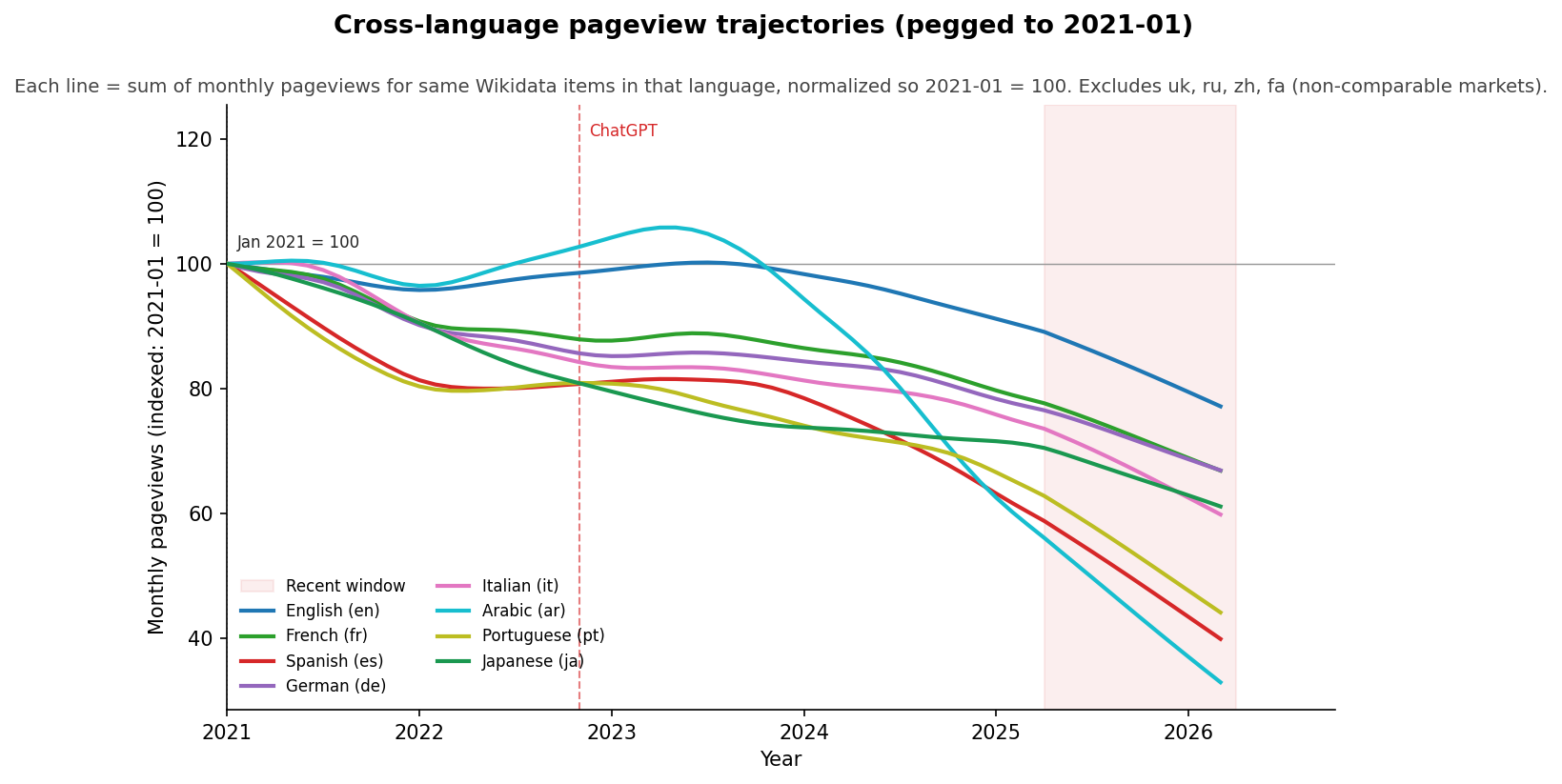
Wikipedia's traffic drop: more on languages and freshness
Following up on last week's post, I looked at 5,000 "Vital Articles" across eight major-language Wikipedias. Articles about math, physical sciences and tech are waaaay down, while people, geography, and history hold up far better—regardless of which language they're in. Article freshness matters too—but not as much.

lu.is (lu.is)
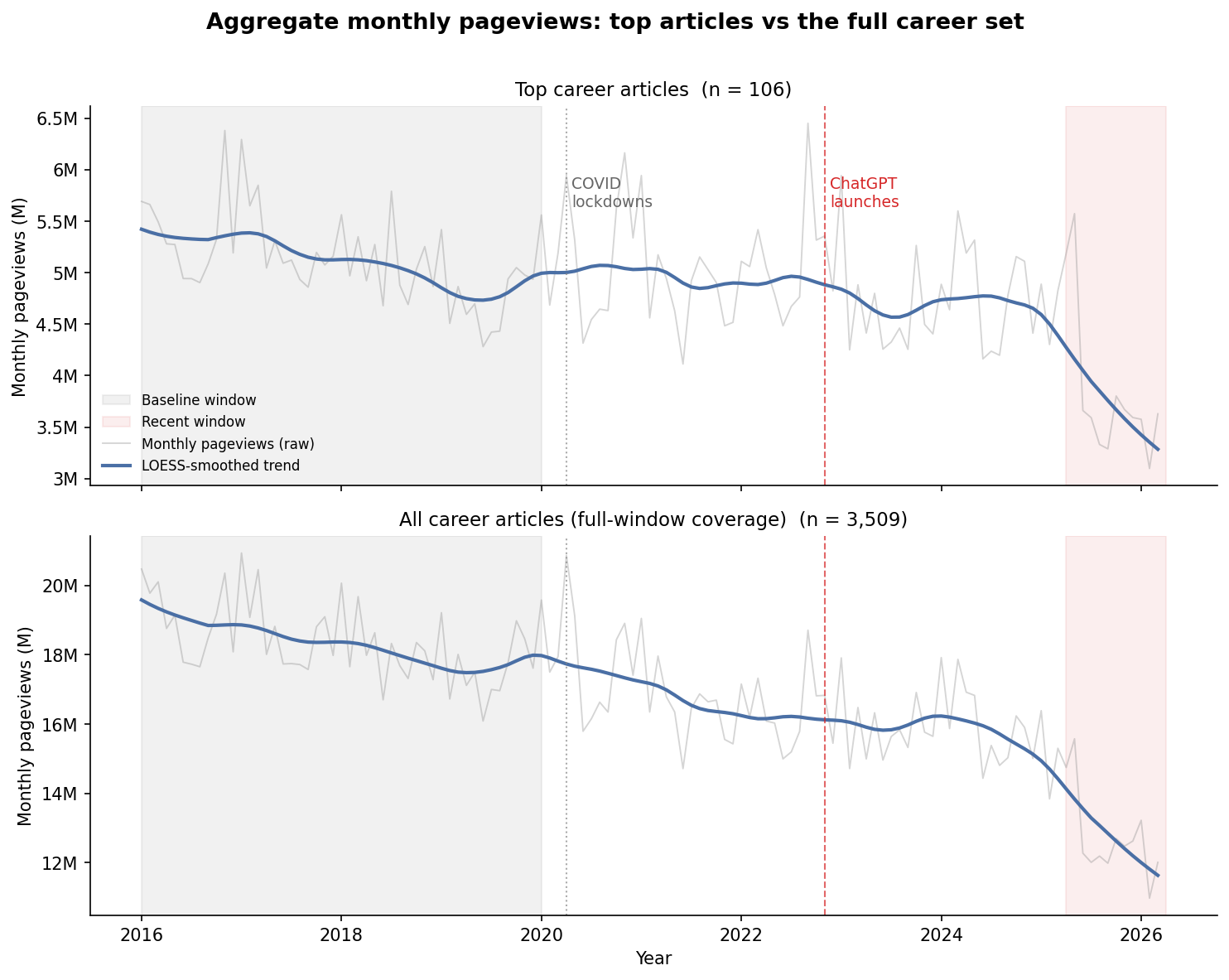
Career articles on Wikipedia: some scary numbers
I took a look at English Wikipedia pageviews for ~4,000 articles about careers. The numbers are grim: the median is down 28% from pre-COVID, with a huge drop in the last year.
lu.is (lu.is)
I especially appreciate this article about how Wikipedia's "flat" traffic growth over the last decade masks a precipitous decline in relative Web traffic:
My former colleague Marshall Miller at WMF wrote about a vertiginous 8% quarterly drop in Wikipedia page views at the end of 2025:

New User Trends on Wikipedia
An update on user trends from the Wikimedia Foundation.

Diff (diff.wikimedia.org)
-
My friend @luis_in_brief has written a couple of good articles about Wikipedia's collapsing web traffic:
Wikipedia's traffic drop: more on languages and freshness
Following up on last week's post, I looked at 5,000 "Vital Articles" across eight major-language Wikipedias. Articles about math, physical sciences and tech are waaaay down, while people, geography, and history hold up far better—regardless of which language they're in. Article freshness matters too—but not as much.
lu.is (lu.is)
Career articles on Wikipedia: some scary numbers
I took a look at English Wikipedia pageviews for ~4,000 articles about careers. The numbers are grim: the median is down 28% from pre-COVID, with a huge drop in the last year.
lu.is (lu.is)
I especially appreciate this article about how Wikipedia's "flat" traffic growth over the last decade masks a precipitous decline in relative Web traffic:
My former colleague Marshall Miller at WMF wrote about a vertiginous 8% quarterly drop in Wikipedia page views at the end of 2025:
New User Trends on Wikipedia
An update on user trends from the Wikimedia Foundation.
Diff (diff.wikimedia.org)
Page views are the lifeblood of Wikipedia. Content generation and revenue derive from this important source. When search summaries or AI chatbots insert themselves between readers and Wikipedia, they cut the project off from that content source and revenue.
Evan Prodromou (@evan@cosocial.ca)
@anime_reference@wetdry.world Wikipedia edits depend on page views. People edit the the pages when they read something that's untrue, clumsy, or misspelled. If they don't get page views, they don't get edits. Wikimedia Foundation revenue depends on page views. People donate to Wikimedia when they land on a Wikipedia page with a donation request banner. If there aren't page views, WMF doesn't get donations. Page views are a very big deal for Wikimedia.

CoSocial (cosocial.ca)
-
Page views are the lifeblood of Wikipedia. Content generation and revenue derive from this important source. When search summaries or AI chatbots insert themselves between readers and Wikipedia, they cut the project off from that content source and revenue.
Evan Prodromou (@evan@cosocial.ca)
@anime_reference@wetdry.world Wikipedia edits depend on page views. People edit the the pages when they read something that's untrue, clumsy, or misspelled. If they don't get page views, they don't get edits. Wikimedia Foundation revenue depends on page views. People donate to Wikimedia when they land on a Wikipedia page with a donation request banner. If there aren't page views, WMF doesn't get donations. Page views are a very big deal for Wikimedia.
CoSocial (cosocial.ca)
I wrote about this in 2017.
Wikipedia is a two-way street
tl;dr Publishers that re-use Wikipedia content, like Apple and Microsoft and Amazon and Google, have an obligation to include an easy way to edit that content. I've had a ton of fun over the last couple of days at the Wikimania 2017 conference in Montreal. The event brought together 900 people from around the world…
Evan Prodromou's Blog (evanp.me)
-
I wrote about this in 2017.
Wikipedia is a two-way street
tl;dr Publishers that re-use Wikipedia content, like Apple and Microsoft and Amazon and Google, have an obligation to include an easy way to edit that content. I've had a ton of fun over the last couple of days at the Wikimania 2017 conference in Montreal. The event brought together 900 people from around the world…
Evan Prodromou's Blog (evanp.me)
Since that time, Wikimedia Foundation has made a lot of deals with big companies who reuse Wikipedia and other Wikimedia data. (As a staff member, I was part of the initial product discovery for those deals.) I don't think any of those deals has taken into account the need for editing affordances in re-use products.
-
Since that time, Wikimedia Foundation has made a lot of deals with big companies who reuse Wikipedia and other Wikimedia data. (As a staff member, I was part of the initial product discovery for those deals.) I don't think any of those deals has taken into account the need for editing affordances in re-use products.
A lot of the commenters on this poll have noted the different approaches to LLMs by both Mozilla and Wikimedia. Mozilla has started https://mozilla.ai/ and is actively working on AI features in Firefox. Wikimedia has been less enthusiastic, and English Wikipedia banned wholesale rewrites of WP articles with AI. https://www.theverge.com/tech/901461/wikipedia-ai-generated-article-ban
-
A lot of the commenters on this poll have noted the different approaches to LLMs by both Mozilla and Wikimedia. Mozilla has started https://mozilla.ai/ and is actively working on AI features in Firefox. Wikimedia has been less enthusiastic, and English Wikipedia banned wholesale rewrites of WP articles with AI. https://www.theverge.com/tech/901461/wikipedia-ai-generated-article-ban
I'm not sure either of those policies is going to matter in the long run.
-
I'm not sure either of those policies is going to matter in the long run.
So, here's the hard part of the poll question: *inevitable* decline. Have these two major projects reached a point where their optionality has run out, and they're going to just keep shrinking, failing to support other projects in the ecosystem, living with less and less? Losing the manganese mine, losing the barley fields, trying to stretch the last of the soup next to a cold fire as the orcs beat down the last walls of the university?
-
So, here's the hard part of the poll question: *inevitable* decline. Have these two major projects reached a point where their optionality has run out, and they're going to just keep shrinking, failing to support other projects in the ecosystem, living with less and less? Losing the manganese mine, losing the barley fields, trying to stretch the last of the soup next to a cold fire as the orcs beat down the last walls of the university?
I don't know, honestly.
My harsh assessment is that Mozilla has developed a culture of quitters -- they kill products long before they've had a chance to thrive.
Wikimedia, on the other hand, is an intrinsically conservative ecosystem. I don't know if it has the culture to try new things. They may try cutting their way to success, too, like with the shutdown of Wikinews.
-
So, here's the hard part of the poll question: *inevitable* decline. Have these two major projects reached a point where their optionality has run out, and they're going to just keep shrinking, failing to support other projects in the ecosystem, living with less and less? Losing the manganese mine, losing the barley fields, trying to stretch the last of the soup next to a cold fire as the orcs beat down the last walls of the university?
@evan We'll still be migrating off jQuery UI at that point, so at least we'll be occupied as the walls fall.
-
Wikipedia is in a similar bind -- although from the comments, I think it's only obvious to Wikimedia insiders right now. Wikipedia has fallen from a peak of about 5th-biggest web site to about 12th today. Still huge, but trending in the wrong direction.
@evan agree on both. People vote with their hearts, but what's happening is the techno-orcs have sucked the oxygen out of all the heroic old-time projects. Not an insider but I wouldn't be surprised if Wikipedia is dropping because it too is no longer needed as fig leaf. They took some risky bets (I know of abstract Wikipedia, wikibase) but they didn't flourish. Actually I can't think of any growing open project today that touches *mass* audiences. Signal with their 70 mln users comes closest.
-
I don't know, honestly.
My harsh assessment is that Mozilla has developed a culture of quitters -- they kill products long before they've had a chance to thrive.
Wikimedia, on the other hand, is an intrinsically conservative ecosystem. I don't know if it has the culture to try new things. They may try cutting their way to success, too, like with the shutdown of Wikinews.
And I guess that's surfacing something important about both cases -- and a chance to overextend my metaphor. Pulling out of a death spiral in a video game requires a lot of knowledge of the game, and a certain willingness to take risks. You have to sometimes send an expeditionary force through the mountains to find a uranium mining site. Or you put all your barley resources into building a war blimp. If you don't know these long-shot options are possible, you won't try them, and you'll fail.
-
I don't know, honestly.
My harsh assessment is that Mozilla has developed a culture of quitters -- they kill products long before they've had a chance to thrive.
Wikimedia, on the other hand, is an intrinsically conservative ecosystem. I don't know if it has the culture to try new things. They may try cutting their way to success, too, like with the shutdown of Wikinews.
@evan Who decides what needs to be killed? That is key.
-
Mozilla is so dependent on Google today that they begged US courts not to enforce antitrust laws against Google, because it would hurt their only source of revenue. So much for the champions of the open web!
Mozilla’s CEO discusses testimony in U.S. v. Google search case | The Mozilla Blog
Mozilla's CFO testified in the U.S. v. Google LLC search trial, highlighting its potential impact on small and independent browsers.
(blog.mozilla.org)
@evan didn't know about this - but this is really feeding their enemy long-term. Failing US antitrust is a huge part of the issues there is with big tech in these years.