I have an issue with mounting a cheap smart watch in #linux: Device is seen by the kernel, but never registered as a storage device /dev/sd*:
-
@root42 Is your USB controller properly listed in `lspci`? And if it is, what kernel options does it use (see with `lspci -s <address of controller> -k`. For example, here's mine:
04:00.3 USB controller: Advanced Micro Devices, Inc. [AMD] Renoir/Cezanne USB 3.1
Subsystem: Advanced Micro Devices, Inc. [AMD] Renoir/Cezanne USB 3.1
Kernel driver in use: xhci_hcd
Kernel modules: xhci_pci@sebastiaanfranken Seems so:
07:00.0 USB controller: Intel Corporation JHL6540 Thunderbolt 3 USB Controller (C step) [Alpine Ridge 4C
2016] (rev 02)
Subsystem: Intel Corporation JHL6540 Thunderbolt 3 USB Controller (C step) [Alpine Ridge 4C 2016]
Kernel driver in use: xhci_hcd -
@sebastiaanfranken Seems so:
07:00.0 USB controller: Intel Corporation JHL6540 Thunderbolt 3 USB Controller (C step) [Alpine Ridge 4C
2016] (rev 02)
Subsystem: Intel Corporation JHL6540 Thunderbolt 3 USB Controller (C step) [Alpine Ridge 4C 2016]
Kernel driver in use: xhci_hcd@root42 Ok, so that's good. Also the fact the proper hcd (xhci_hcd) module is loaded is good. Anything related to it in your system journal? And if you want you can get more output / info with
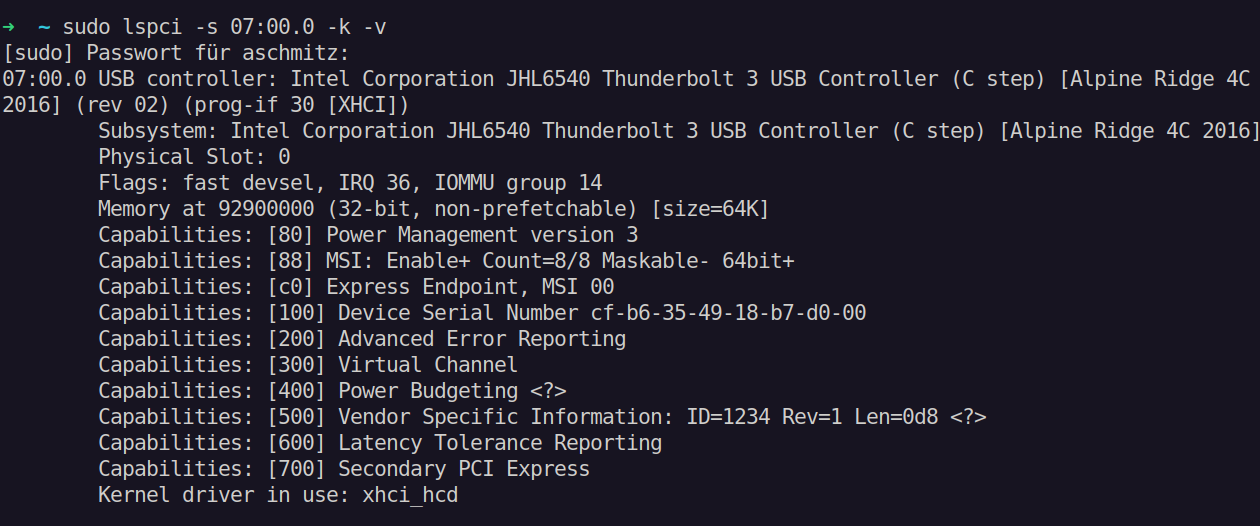
> sudo lspci -s 07:00.0 -k -v
-
@root42 Ok, so that's good. Also the fact the proper hcd (xhci_hcd) module is loaded is good. Anything related to it in your system journal? And if you want you can get more output / info with
> sudo lspci -s 07:00.0 -k -v
@sebastiaanfranken First the lspci output
-
@sebastiaanfranken First the lspci output
-
@dr_laemmerbein lots of reboots...
@root42 Maybe you can get some hints by running `dmesg -w` in a terminal as root. This will show you all the kernel events and if you plug in your USB drive you should see some logs related to that. Maybe you'll get an error message or something like that.
-
Yes, so it seems the controller is stuck in EHCI mode, instead of switching to xHCI for USB3 devices. Bummer... how to switch it back...?
@root42 Check the pins in the connectors. I had a problem like this where in a thumb drive some pins belonging to USB3 were bent / damaged and it would not work in a USB3 port. Although it worked fine in a USB2 port, those 4 pins were not damaged. -
@root42 Check the pins in the connectors. I had a problem like this where in a thumb drive some pins belonging to USB3 were bent / damaged and it would not work in a USB3 port. Although it worked fine in a USB2 port, those 4 pins were not damaged.@root42 with USB-C it could also be the wrong type of cable.
-
@root42 with USB-C it could also be the wrong type of cable.
@robert no. It works in the Live thumbdrive. Only the proper install on the ssd is botched. The ports work fine.
-
@root42 Maybe you can get some hints by running `dmesg -w` in a terminal as root. This will show you all the kernel events and if you plug in your USB drive you should see some logs related to that. Maybe you'll get an error message or something like that.
@dr_laemmerbein I am doing that. No logs when plugging in USB 3 devices. Zip. Zilch. Nada. That’s the weird thing.
-
@root42 with USB-C it could also be the wrong type of cable.
@robert the USB C thumbdrive connects without a cable. It works in the live system, not in the installed system.
-
@drscriptt So the output of lsmod is very similar on both. I installed an extra Intel sound driver, but that shouldn't interfere with USB, I think.

@root42 agreed
-
@drscriptt So the output of lsmod is very similar on both. I installed an extra Intel sound driver, but that shouldn't interfere with USB, I think.
@root42 try `lsusb` (?) when it’s working.
Maybe add `-v` (?) to see if you can see the driver that’s being used.
-
@root42 try `lsusb` (?) when it’s working.
Maybe add `-v` (?) to see if you can see the driver that’s being used.
@drscriptt the driver is usb-xhci. As expected. Which is also loaded in the broken install…
-
So I think I have a workaround. If I do "sudo lsusb -v", the devices start working! Without sudo and without -v nothing happens. It seems sudo lsusb -v does some magic that kickstarts the device detection. What is it and how can I make it happen automatically...?
-
So I think I have a workaround. If I do "sudo lsusb -v", the devices start working! Without sudo and without -v nothing happens. It seems sudo lsusb -v does some magic that kickstarts the device detection. What is it and how can I make it happen automatically...?
@root42 Reading all this reminds me of a really weird Thinkpad I had years back. It had Thunderbolt ports and those had really weird compatibility issues with random devices in Linux. But only with the TB ports, the standard USB-C ports were fine. I assume the device you have is an Apple laptop, which most likely has even more undocumented and standard breaking behind the scenes firmware magic built into it as per their style.
-
R relay@relay.infosec.exchange shared this topic