The teacher said "In English a double negative forms a positive.
-
English is my second language and phrases like
"we don't want no education"
always bother me.
This line is using a children choir and voicing the children's point of view, playing on the double meaning.
They say they don't need education in such a clunky way, confirming that they clearly need education.
-
The teacher said "In English a double negative forms a positive. In some languages, though, such as Russian, a double negative is still a negative. However, there is no language wherein a double positive can form a negative."
A voice from the back of the room piped up, "Yeah, right."@kibcol1049 Reminds me of an old programmer joke:
A wife sends her programmer husband to the grocery store for a loaf of bread...
On his way out she says "and if they have eggs, get a dozen". The programmer husband returns home with 12 loaves of bread and says: "They had eggs."
-
R relay@relay.mycrowd.ca shared this topic
-
@jack @Wolf_Baginski @kibcol1049
 Spanish also employs expressions like "Sí, no, sí", for example when asked a negative question: "Tú no vas a traer el libro, verdad?" (You're not going to bring the book, right?)
@eleder @jack @Wolf_Baginski @kibcol1049
That's opening a totally different can of worm about how to respond to a negative question!!!
"Are you not finishing that?"
Does "yes" means "I will finish it" or "your statement is correct, I will not finish it".
I've learnt recently that French uses "si" (I will finish it) instead of "yes" (your statement is correct, i will not finish it) to answer a negative question. Native French speaker myself, I feel a bit ashamed about not knowing it before.
-
@eleder @Wolf_Baginski @kibcol1049 In German, you can express something analogous with "Ja, nee, klar" ("Yes, naa, sure"), i.e. yes-no-yes.
What do you make of that?
@Wolf_Baginski @kibcol1049 @eleder @jack reminds me of the old board game Drunter und Drüber with the Jeeiin voting card.
-
@HighlandLawyer @rzeta0 @kibcol1049 absolutely but in common speech, being understood and questioning where it is not clear, is easier. Am not a linguist so grammatical nuances are not my finest hour. I ask a lot of questions.
@EF @rzeta0 @kibcol1049
Questions are good. Frustratingly, languages are illogical so even when you learn "the rule", you then come up against particular dialects or idioms which contradict that rule. Happy happy joy joy. (Another idiom where emphatic positive means a negative) -
@eleder @jack @Wolf_Baginski @kibcol1049
That's opening a totally different can of worm about how to respond to a negative question!!!
"Are you not finishing that?"
Does "yes" means "I will finish it" or "your statement is correct, I will not finish it".
I've learnt recently that French uses "si" (I will finish it) instead of "yes" (your statement is correct, i will not finish it) to answer a negative question. Native French speaker myself, I feel a bit ashamed about not knowing it before.
@Lily_and_frog @eleder @jack @Wolf_Baginski The text book English language rules are different to the current spoken language trends. The meaning is usually clear when spoken even though grammatically incorrect. I feel sorry for non English speakers.
-
@kibcol1049 Reminds me of an old programmer joke:
A wife sends her programmer husband to the grocery store for a loaf of bread...
On his way out she says "and if they have eggs, get a dozen". The programmer husband returns home with 12 loaves of bread and says: "They had eggs."
-
@eleder @jack @Wolf_Baginski @kibcol1049
That's opening a totally different can of worm about how to respond to a negative question!!!
"Are you not finishing that?"
Does "yes" means "I will finish it" or "your statement is correct, I will not finish it".
I've learnt recently that French uses "si" (I will finish it) instead of "yes" (your statement is correct, i will not finish it) to answer a negative question. Native French speaker myself, I feel a bit ashamed about not knowing it before.
@Lily_and_frog @eleder @jack @Wolf_Baginski @kibcol1049 the ambiguity is part of the fun!
-
R relay@relay.an.exchange shared this topic
-
@eleder @jack @Wolf_Baginski @kibcol1049
That's opening a totally different can of worm about how to respond to a negative question!!!
"Are you not finishing that?"
Does "yes" means "I will finish it" or "your statement is correct, I will not finish it".
I've learnt recently that French uses "si" (I will finish it) instead of "yes" (your statement is correct, i will not finish it) to answer a negative question. Native French speaker myself, I feel a bit ashamed about not knowing it before.
@Lily_and_frog @eleder @jack @Wolf_Baginski @kibcol1049
How about the usage in Scottish or Irish English of "Is that you then?", which is asking a completely different question to the literal English words used. -
@eleder @Wolf_Baginski @kibcol1049 In German, you can express something analogous with "Ja, nee, klar" ("Yes, naa, sure"), i.e. yes-no-yes.
What do you make of that?
@jack @eleder @Wolf_Baginski @kibcol1049
In Canada we sometimes say "Yeah, No, yeah. "
-
@kibcol1049 Reminds me of an old programmer joke:
A wife sends her programmer husband to the grocery store for a loaf of bread...
On his way out she says "and if they have eggs, get a dozen". The programmer husband returns home with 12 loaves of bread and says: "They had eggs."
Is it purely a programmer joke or also a sexist one?
What about:
A man sends his programmer wife to the grocery store for a loaf of bread...
On her way out he says "and if they have eggs, get a dozen". The programmer wife returns home with 12 loaves of bread and says: "They had eggs."
-
Is it purely a programmer joke or also a sexist one?
What about:
A man sends his programmer wife to the grocery store for a loaf of bread...
On her way out he says "and if they have eggs, get a dozen". The programmer wife returns home with 12 loaves of bread and says: "They had eggs."
@sibrosan @kibcol1049 Of course it could be. Also husband and husband, wife and wife, spy and spy...
-
@sibrosan @kibcol1049 Of course it could be. Also husband and husband, wife and wife, spy and spy...
@sibrosan @kibcol1049 Insert your poly and non-binary versions.
-
English is my second language and phrases like
"we don't want no education"
always bother me.
-
@Lily_and_frog @eleder @jack @Wolf_Baginski @kibcol1049 the ambiguity is part of the fun!
@OneInterestingFact @eleder @jack @Wolf_Baginski @kibcol1049
Yeah, right...

-
The teacher said "In English a double negative forms a positive. In some languages, though, such as Russian, a double negative is still a negative. However, there is no language wherein a double positive can form a negative."
A voice from the back of the room piped up, "Yeah, right."@kibcol1049
Be careful in Germany:
"yes, yes" means "kiss my ass".("Ja, ja" heißt "leck mich am Arsch".)
-
@Lily_and_frog @eleder @jack @Wolf_Baginski The text book English language rules are different to the current spoken language trends. The meaning is usually clear when spoken even though grammatically incorrect. I feel sorry for non English speakers.
@kibcol1049 @eleder @jack @Wolf_Baginski
The difficulty with both double negatives and negative questions is definitely not limited to English!
Your joke definitely translates well in french (especially in québécois french)!
-
"I don't know nuffin"
-
The teacher said "In English a double negative forms a positive. In some languages, though, such as Russian, a double negative is still a negative. However, there is no language wherein a double positive can form a negative."
A voice from the back of the room piped up, "Yeah, right."@kibcol1049 In American Ebonics double negatives denoting positive is a real rule (one of the rules that differentiates it from common american english). I really appreciate how language is living and is able to adjust to time, place, and context.
-
@eleder @jack @Wolf_Baginski @kibcol1049
That's opening a totally different can of worm about how to respond to a negative question!!!
"Are you not finishing that?"
Does "yes" means "I will finish it" or "your statement is correct, I will not finish it".
I've learnt recently that French uses "si" (I will finish it) instead of "yes" (your statement is correct, i will not finish it) to answer a negative question. Native French speaker myself, I feel a bit ashamed about not knowing it before.
@Lily_and_frog @eleder @jack @Wolf_Baginski @kibcol1049
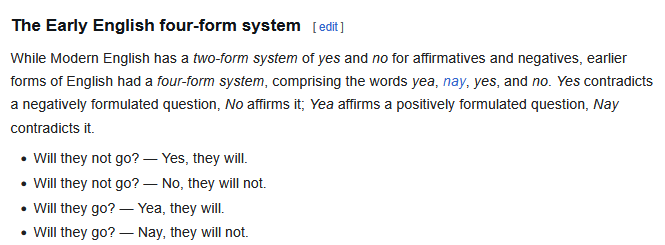
English used to have a 4 form system - Yes contradicts a negatively formulated question, No affirms it; Yea affirms a positively formulated question, Nay contradicts it.