Skip to content
  • Categories
  • Recent
  • Tags
  • Popular
  • World
  • Users
  • Groups
Skins
  • Light
  • Brite
  • Cerulean
  • Cosmo
  • Flatly
  • Journal
  • Litera
  • Lumen
  • Lux
  • Materia
  • Minty
  • Morph
  • Pulse
  • Sandstone
  • Simplex
  • Sketchy
  • Spacelab
  • United
  • Yeti
  • Zephyr
  • Dark
  • Cyborg
  • Darkly
  • Quartz
  • Slate
  • Solar
  • Superhero
  • Vapor

  • Default (Cyborg)
  • No Skin
Collapse
Brand Logo

CIRCLE WITH A DOT

  1. Home
  2. Uncategorized
  3. The teacher said "In English a double negative forms a positive.

The teacher said "In English a double negative forms a positive.

Scheduled Pinned Locked Moved Uncategorized
90 Posts 47 Posters 0 Views
  • Oldest to Newest
  • Newest to Oldest
  • Most Votes
Reply
  • Reply as topic
Log in to reply
This topic has been deleted. Only users with topic management privileges can see it.
  • E ef@mastodon.bsd.cafe

    @HighlandLawyer @rzeta0 @kibcol1049 absolutely but in common speech, being understood and questioning where it is not clear, is easier. Am not a linguist so grammatical nuances are not my finest hour. I ask a lot of questions.

    highlandlawyer@mastodon.socialH This user is from outside of this forum
    highlandlawyer@mastodon.socialH This user is from outside of this forum
    highlandlawyer@mastodon.social
    wrote last edited by
    #32

    @EF @rzeta0 @kibcol1049
    Questions are good. Frustratingly, languages are illogical so even when you learn "the rule", you then come up against particular dialects or idioms which contradict that rule. Happy happy joy joy. (Another idiom where emphatic positive means a negative)

    1 Reply Last reply
    0
    • lily_and_frog@mastodon.artL lily_and_frog@mastodon.art

      @eleder @jack @Wolf_Baginski @kibcol1049

      That's opening a totally different can of worm about how to respond to a negative question!!!

      "Are you not finishing that?"

      Does "yes" means "I will finish it" or "your statement is correct, I will not finish it".

      I've learnt recently that French uses "si" (I will finish it) instead of "yes" (your statement is correct, i will not finish it) to answer a negative question. Native French speaker myself, I feel a bit ashamed about not knowing it before.

      kibcol1049@mstdn.socialK This user is from outside of this forum
      kibcol1049@mstdn.socialK This user is from outside of this forum
      kibcol1049@mstdn.social
      wrote last edited by
      #33

      @Lily_and_frog @eleder @jack @Wolf_Baginski The text book English language rules are different to the current spoken language trends. The meaning is usually clear when spoken even though grammatically incorrect. I feel sorry for non English speakers.

      lily_and_frog@mastodon.artL deltawye@tiggi.esD sylvie@chitter.xyzS 3 Replies Last reply
      0
      • lankohr@mastodon.socialL lankohr@mastodon.social

        @kibcol1049 Reminds me of an old programmer joke:

        A wife sends her programmer husband to the grocery store for a loaf of bread...

        On his way out she says "and if they have eggs, get a dozen". The programmer husband returns home with 12 loaves of bread and says: "They had eggs."

        kibcol1049@mstdn.socialK This user is from outside of this forum
        kibcol1049@mstdn.socialK This user is from outside of this forum
        kibcol1049@mstdn.social
        wrote last edited by
        #34

        @lankohr 🤭

        1 Reply Last reply
        0
        • lily_and_frog@mastodon.artL lily_and_frog@mastodon.art

          @eleder @jack @Wolf_Baginski @kibcol1049

          That's opening a totally different can of worm about how to respond to a negative question!!!

          "Are you not finishing that?"

          Does "yes" means "I will finish it" or "your statement is correct, I will not finish it".

          I've learnt recently that French uses "si" (I will finish it) instead of "yes" (your statement is correct, i will not finish it) to answer a negative question. Native French speaker myself, I feel a bit ashamed about not knowing it before.

          oneinterestingfact@mastodon.ieO This user is from outside of this forum
          oneinterestingfact@mastodon.ieO This user is from outside of this forum
          oneinterestingfact@mastodon.ie
          wrote last edited by
          #35

          @Lily_and_frog @eleder @jack @Wolf_Baginski @kibcol1049 the ambiguity is part of the fun!

          lily_and_frog@mastodon.artL 1 Reply Last reply
          0
          • R relay@relay.an.exchange shared this topic
          • lily_and_frog@mastodon.artL lily_and_frog@mastodon.art

            @eleder @jack @Wolf_Baginski @kibcol1049

            That's opening a totally different can of worm about how to respond to a negative question!!!

            "Are you not finishing that?"

            Does "yes" means "I will finish it" or "your statement is correct, I will not finish it".

            I've learnt recently that French uses "si" (I will finish it) instead of "yes" (your statement is correct, i will not finish it) to answer a negative question. Native French speaker myself, I feel a bit ashamed about not knowing it before.

            highlandlawyer@mastodon.socialH This user is from outside of this forum
            highlandlawyer@mastodon.socialH This user is from outside of this forum
            highlandlawyer@mastodon.social
            wrote last edited by
            #36

            @Lily_and_frog @eleder @jack @Wolf_Baginski @kibcol1049
            How about the usage in Scottish or Irish English of "Is that you then?", which is asking a completely different question to the literal English words used.

            1 Reply Last reply
            0
            • jack@mastodon.sdf.orgJ jack@mastodon.sdf.org

              @eleder @Wolf_Baginski @kibcol1049 In German, you can express something analogous with "Ja, nee, klar" ("Yes, naa, sure"), i.e. yes-no-yes.

              What do you make of that?

              truenorthspice@mastodon.worldT This user is from outside of this forum
              truenorthspice@mastodon.worldT This user is from outside of this forum
              truenorthspice@mastodon.world
              wrote last edited by
              #37

              @jack @eleder @Wolf_Baginski @kibcol1049

              In Canada we sometimes say "Yeah, No, yeah. "

              maggiejk@zeroes.caM 1 Reply Last reply
              0
              • lankohr@mastodon.socialL lankohr@mastodon.social

                @kibcol1049 Reminds me of an old programmer joke:

                A wife sends her programmer husband to the grocery store for a loaf of bread...

                On his way out she says "and if they have eggs, get a dozen". The programmer husband returns home with 12 loaves of bread and says: "They had eggs."

                sibrosan@mastodon.socialS This user is from outside of this forum
                sibrosan@mastodon.socialS This user is from outside of this forum
                sibrosan@mastodon.social
                wrote last edited by
                #38

                @lankohr @kibcol1049

                Is it purely a programmer joke or also a sexist one?

                What about:

                A man sends his programmer wife to the grocery store for a loaf of bread...

                On her way out he says "and if they have eggs, get a dozen". The programmer wife returns home with 12 loaves of bread and says: "They had eggs."

                lankohr@mastodon.socialL 1 Reply Last reply
                0
                • sibrosan@mastodon.socialS sibrosan@mastodon.social

                  @lankohr @kibcol1049

                  Is it purely a programmer joke or also a sexist one?

                  What about:

                  A man sends his programmer wife to the grocery store for a loaf of bread...

                  On her way out he says "and if they have eggs, get a dozen". The programmer wife returns home with 12 loaves of bread and says: "They had eggs."

                  lankohr@mastodon.socialL This user is from outside of this forum
                  lankohr@mastodon.socialL This user is from outside of this forum
                  lankohr@mastodon.social
                  wrote last edited by
                  #39

                  @sibrosan @kibcol1049 Of course it could be. Also husband and husband, wife and wife, spy and spy...

                  lankohr@mastodon.socialL sibrosan@mastodon.socialS 2 Replies Last reply
                  0
                  • lankohr@mastodon.socialL lankohr@mastodon.social

                    @sibrosan @kibcol1049 Of course it could be. Also husband and husband, wife and wife, spy and spy...

                    lankohr@mastodon.socialL This user is from outside of this forum
                    lankohr@mastodon.socialL This user is from outside of this forum
                    lankohr@mastodon.social
                    wrote last edited by
                    #40

                    @sibrosan @kibcol1049 Insert your poly and non-binary versions.

                    asprinkleofsage@mastodon.socialA 1 Reply Last reply
                    0
                    • rzeta0@mastodon.ieR rzeta0@mastodon.ie

                      @kibcol1049

                      English is my second language and phrases like

                      "we don't want no education"

                      always bother me.

                      cppguy@infosec.spaceC This user is from outside of this forum
                      cppguy@infosec.spaceC This user is from outside of this forum
                      cppguy@infosec.space
                      wrote last edited by
                      #41

                      @rzeta0

                      I believe that example is quite intentional. It's meant to be wrong.

                      @kibcol1049

                      rzeta0@mastodon.ieR kibcol1049@mstdn.socialK 2 Replies Last reply
                      0
                      • oneinterestingfact@mastodon.ieO oneinterestingfact@mastodon.ie

                        @Lily_and_frog @eleder @jack @Wolf_Baginski @kibcol1049 the ambiguity is part of the fun!

                        lily_and_frog@mastodon.artL This user is from outside of this forum
                        lily_and_frog@mastodon.artL This user is from outside of this forum
                        lily_and_frog@mastodon.art
                        wrote last edited by
                        #42

                        @OneInterestingFact @eleder @jack @Wolf_Baginski @kibcol1049

                        Yeah, right... 😉

                        1 Reply Last reply
                        0
                        • kibcol1049@mstdn.socialK kibcol1049@mstdn.social

                          The teacher said "In English a double negative forms a positive. In some languages, though, such as Russian, a double negative is still a negative. However, there is no language wherein a double positive can form a negative."
                          A voice from the back of the room piped up, "Yeah, right."

                          ard_the_rich@mastodon.artA This user is from outside of this forum
                          ard_the_rich@mastodon.artA This user is from outside of this forum
                          ard_the_rich@mastodon.art
                          wrote last edited by
                          #43

                          @kibcol1049
                          Be careful in Germany:
                          "yes, yes" means "kiss my ass".

                          ("Ja, ja" heißt "leck mich am Arsch".)

                          lankohr@mastodon.socialL oddel@social.cologneO 2 Replies Last reply
                          0
                          • kibcol1049@mstdn.socialK kibcol1049@mstdn.social

                            @Lily_and_frog @eleder @jack @Wolf_Baginski The text book English language rules are different to the current spoken language trends. The meaning is usually clear when spoken even though grammatically incorrect. I feel sorry for non English speakers.

                            lily_and_frog@mastodon.artL This user is from outside of this forum
                            lily_and_frog@mastodon.artL This user is from outside of this forum
                            lily_and_frog@mastodon.art
                            wrote last edited by
                            #44

                            @kibcol1049 @eleder @jack @Wolf_Baginski

                            The difficulty with both double negatives and negative questions is definitely not limited to English!

                            Your joke definitely translates well in french (especially in québécois french)!

                            1 Reply Last reply
                            0
                            • cppguy@infosec.spaceC cppguy@infosec.space

                              @rzeta0

                              I believe that example is quite intentional. It's meant to be wrong.

                              @kibcol1049

                              rzeta0@mastodon.ieR This user is from outside of this forum
                              rzeta0@mastodon.ieR This user is from outside of this forum
                              rzeta0@mastodon.ie
                              wrote last edited by
                              #45

                              @CppGuy @kibcol1049

                              "I don't know nuffin"

                              1 Reply Last reply
                              0
                              • kibcol1049@mstdn.socialK kibcol1049@mstdn.social

                                The teacher said "In English a double negative forms a positive. In some languages, though, such as Russian, a double negative is still a negative. However, there is no language wherein a double positive can form a negative."
                                A voice from the back of the room piped up, "Yeah, right."

                                t60n3@mastodon.socialT This user is from outside of this forum
                                t60n3@mastodon.socialT This user is from outside of this forum
                                t60n3@mastodon.social
                                wrote last edited by
                                #46

                                @kibcol1049 In American Ebonics double negatives denoting positive is a real rule (one of the rules that differentiates it from common american english). I really appreciate how language is living and is able to adjust to time, place, and context.

                                1 Reply Last reply
                                0
                                • lily_and_frog@mastodon.artL lily_and_frog@mastodon.art

                                  @eleder @jack @Wolf_Baginski @kibcol1049

                                  That's opening a totally different can of worm about how to respond to a negative question!!!

                                  "Are you not finishing that?"

                                  Does "yes" means "I will finish it" or "your statement is correct, I will not finish it".

                                  I've learnt recently that French uses "si" (I will finish it) instead of "yes" (your statement is correct, i will not finish it) to answer a negative question. Native French speaker myself, I feel a bit ashamed about not knowing it before.

                                  bencurthoys@mastodon.socialB This user is from outside of this forum
                                  bencurthoys@mastodon.socialB This user is from outside of this forum
                                  bencurthoys@mastodon.social
                                  wrote last edited by
                                  #47

                                  @Lily_and_frog @eleder @jack @Wolf_Baginski @kibcol1049

                                  English used to have a 4 form system - Yes contradicts a negatively formulated question, No affirms it; Yea affirms a positively formulated question, Nay contradicts it.
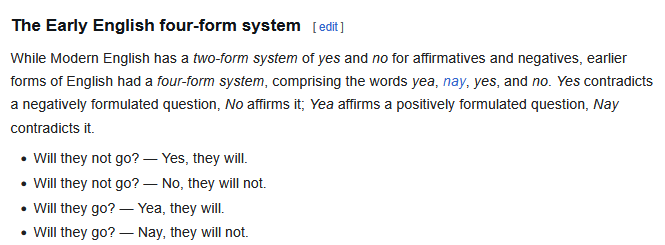
                                  Link Preview Image
                                  1 Reply Last reply
                                  0
                                  • rzeta0@mastodon.ieR rzeta0@mastodon.ie

                                    @kibcol1049

                                    English is my second language and phrases like

                                    "we don't want no education"

                                    always bother me.

                                    the_wub@mastodon.socialT This user is from outside of this forum
                                    the_wub@mastodon.socialT This user is from outside of this forum
                                    the_wub@mastodon.social
                                    wrote last edited by
                                    #48

                                    @rzeta0 @kibcol1049 It is a dialect form in the bits of the North of England that I grew up in. Maybe other parts of the UK too.

                                    As in:

                                    "We don't need nothing from you."

                                    Which in more standard English would have been:

                                    "We don't need anything from you.".

                                    It has always seemed to me to be the interchangebility of anything/nothing and any/no as a reinforcement of the negative rather than necessarily a use of double negatives as is normally practiced in UK English.

                                    kibcol1049@mstdn.socialK 1 Reply Last reply
                                    0
                                    • kibcol1049@mstdn.socialK kibcol1049@mstdn.social

                                      The teacher said "In English a double negative forms a positive. In some languages, though, such as Russian, a double negative is still a negative. However, there is no language wherein a double positive can form a negative."
                                      A voice from the back of the room piped up, "Yeah, right."

                                      hans_zelf@mas.toH This user is from outside of this forum
                                      hans_zelf@mas.toH This user is from outside of this forum
                                      hans_zelf@mas.to
                                      wrote last edited by
                                      #49

                                      @kibcol1049 😂

                                      1 Reply Last reply
                                      0
                                      • lankohr@mastodon.socialL lankohr@mastodon.social

                                        @sibrosan @kibcol1049 Of course it could be. Also husband and husband, wife and wife, spy and spy...

                                        sibrosan@mastodon.socialS This user is from outside of this forum
                                        sibrosan@mastodon.socialS This user is from outside of this forum
                                        sibrosan@mastodon.social
                                        wrote last edited by
                                        #50

                                        @lankohr @kibcol1049

                                        I think it is, in general, not that simple.

                                        A joke like this starts out with setting a scene that sounds familiar enough for people to easily picture in their mind.

                                        The humorous element is in the unexpected turn of events in the punch line.

                                        For most people, the gender role reversal in my version will be already somewhat unexpected, which interferes with the punch line effect.

                                        1 Reply Last reply
                                        0
                                        • the_wub@mastodon.socialT the_wub@mastodon.social

                                          @rzeta0 @kibcol1049 It is a dialect form in the bits of the North of England that I grew up in. Maybe other parts of the UK too.

                                          As in:

                                          "We don't need nothing from you."

                                          Which in more standard English would have been:

                                          "We don't need anything from you.".

                                          It has always seemed to me to be the interchangebility of anything/nothing and any/no as a reinforcement of the negative rather than necessarily a use of double negatives as is normally practiced in UK English.

                                          kibcol1049@mstdn.socialK This user is from outside of this forum
                                          kibcol1049@mstdn.socialK This user is from outside of this forum
                                          kibcol1049@mstdn.social
                                          wrote last edited by
                                          #51

                                          @the_wub @rzeta0 🤔👍

                                          1 Reply Last reply
                                          0
                                          Reply
                                          • Reply as topic
                                          Log in to reply
                                          • Oldest to Newest
                                          • Newest to Oldest
                                          • Most Votes


                                          • Login

                                          • Login or register to search.
                                          • First post
                                            Last post
                                          0
                                          • Categories
                                          • Recent
                                          • Tags
                                          • Popular
                                          • World
                                          • Users
                                          • Groups