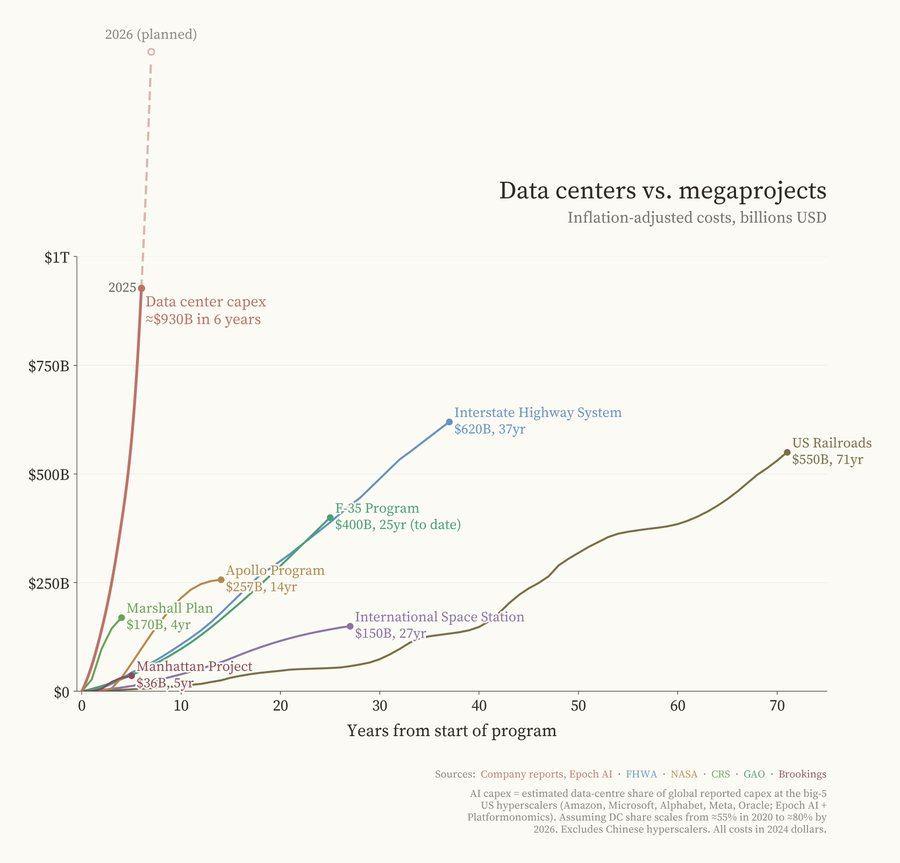
> The hyperscalers have already outspent the most famous US megaprojects
-
@cwebber wish we had LHC on that graph
@darkuncle @cwebber the LHC was not a US project, and cost only between 4.7 and 6.5 B. That’s a most a third of what Facebook paid for WhatsApp. Probably less than a week of Iran war.
-
Government spending goes into debt, not profits. Governments usually go into deficit on purpose. The investment is not visible, in the same way, in the same timeframe.
Do you think that the private sector does not finance its capital spending with debt, or doesn't do it on purpose, or something? We were at one point comparing the scale of capital flows into infrastructure projects, the structure of the financing is irrelevant.
-
> The hyperscalers have already outspent the most famous US megaprojects
this looks sustainable, datacenters are a one-time cost... right?!?
The counter argument is that computational intelligence grows our ability to do things (grows the economy) to keep paying for it.
The first railroads, power lines, and cell phones seemed like excessively expensive boondoggles in the beginning.
-
Do you think that the private sector does not finance its capital spending with debt, or doesn't do it on purpose, or something? We were at one point comparing the scale of capital flows into infrastructure projects, the structure of the financing is irrelevant.
If there's no difference, why do we even use the debt-to-GDP ratio for measuring governments at all, then?
-
> The hyperscalers have already outspent the most famous US megaprojects
this looks sustainable, datacenters are a one-time cost... right?!?
@cwebber
I found a handy website (https://pcpartpicker.com/trends/price/memory/#ram.ddr5.4800.2x16384) to track the price of various types of RAM. I use DDR5-4800 2x16GB in my recently-purchased used laptop. The chart suggests this pair of DIMMs increased in cost by four-fold over a period of about six months!
#bioinformatics #DenyAI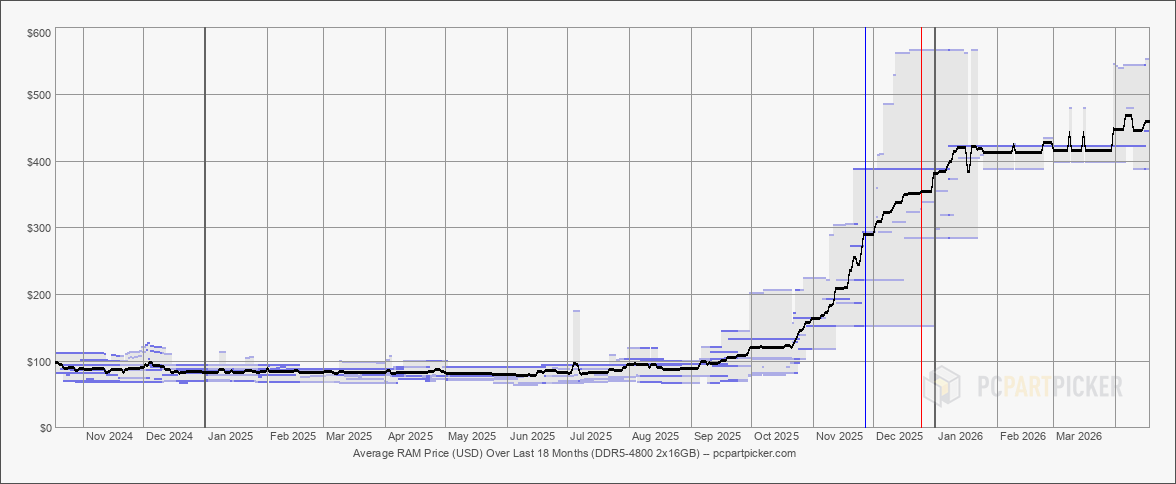
-
@cwebber imagine all the things that could have been done with that money if it was spent on stuff that benefited the general public instead
@aeva I have no idea if you can usefully search the term, but "capital strike".
This is the idea that holders of capital/capital as a social entity asserts power not by not spending (it's capital, it can't not be spent, that's not how it works) but by spending on harmful things.
And once you're fueling the whole thing off habitability loss/certain genocide/upping the risk of human extinction, a little social collapse hardly seems notable.
-
> The hyperscalers have already outspent the most famous US megaprojects
this looks sustainable, datacenters are a one-time cost... right?!?
@cwebber and all we have to show for this insane waste of money is slop, lies and technical debt. Yet somehow the decision makers keep thinking the problem is that we're not spending enough money.
-
If there's no difference, why do we even use the debt-to-GDP ratio for measuring governments at all, then?
Debt ratios indicate the sustainability of a budget under different interest rate scenarios, whether a household or a corporate conglomerate or national government, whether the denominator is income or assets or an aggregate estimate of total production. E.g. to get a read on the sustainability of the present federal budget under existing interest rate conditions you would look up net interest payments as a share of GDP:

Federal Outlays: Interest as Percent of Gross Domestic Product
Graph and download economic data for Federal Outlays: Interest as Percent of Gross Domestic Product (FYOIGDA188S) from 1940 to 2025 about outlays, federal, percent, interest, GDP, and USA.
(fred.stlouisfed.org)
-
> The hyperscalers have already outspent the most famous US megaprojects
this looks sustainable, datacenters are a one-time cost... right?!?
@cwebber @photovince even if you correct for inflation it still does not make any sense
-
R relay@relay.mycrowd.ca shared this topic