Skip to content
  • Categories
  • Recent
  • Tags
  • Popular
  • World
  • Users
  • Groups
Skins
  • Light
  • Brite
  • Cerulean
  • Cosmo
  • Flatly
  • Journal
  • Litera
  • Lumen
  • Lux
  • Materia
  • Minty
  • Morph
  • Pulse
  • Sandstone
  • Simplex
  • Sketchy
  • Spacelab
  • United
  • Yeti
  • Zephyr
  • Dark
  • Cyborg
  • Darkly
  • Quartz
  • Slate
  • Solar
  • Superhero
  • Vapor

  • Default (Cyborg)
  • No Skin
Collapse
Brand Logo

CIRCLE WITH A DOT

  1. Home
  2. Uncategorized
  3. What's the most surprising fact you've learned in the last couple of weeks?

What's the most surprising fact you've learned in the last couple of weeks?

Scheduled Pinned Locked Moved Uncategorized
93 Posts 44 Posters 58 Views
  • Oldest to Newest
  • Newest to Oldest
  • Most Votes
Reply
  • Reply as topic
Log in to reply
This topic has been deleted. Only users with topic management privileges can see it.
  • bornach@vis.socialB bornach@vis.social

    @pozorvlak @johncarlosbaez
    Learned this from https://youtu.be/GREaEG_0Xcw

    pozorvlak@mathstodon.xyzP This user is from outside of this forum
    pozorvlak@mathstodon.xyzP This user is from outside of this forum
    pozorvlak@mathstodon.xyz
    wrote last edited by
    #7

    @bornach @johncarlosbaez me too!

    pozorvlak@mathstodon.xyzP 1 Reply Last reply
    0
    • johncarlosbaez@mathstodon.xyzJ johncarlosbaez@mathstodon.xyz

      What's the most surprising fact you've learned in the last couple of weeks? I don't mind if it's quite technical. I just want to hear what you folks are being surprised by!

      chemicaleyeguy@mstdn.scienceC This user is from outside of this forum
      chemicaleyeguy@mstdn.scienceC This user is from outside of this forum
      chemicaleyeguy@mstdn.science
      wrote last edited by
      #8

      @johncarlosbaez Surprised to learn on #MayThe4th that *both* #GeorgeLucas and #StanleyKubrick were inspired by Canadian avant-garde collage filmmaker Arthur Lipsett, who was mentored and recommended to the National Film Board of #Canada by Group of Seven co-founder Arthur Lismer. https://en.wikipedia.org/wiki/Arthur_Lipsett

      1 Reply Last reply
      0
      • johncarlosbaez@mathstodon.xyzJ johncarlosbaez@mathstodon.xyz

        What's the most surprising fact you've learned in the last couple of weeks? I don't mind if it's quite technical. I just want to hear what you folks are being surprised by!

        maxpool@mathstodon.xyzM This user is from outside of this forum
        maxpool@mathstodon.xyzM This user is from outside of this forum
        maxpool@mathstodon.xyz
        wrote last edited by
        #9

        @johncarlosbaez

        Ancient Rome consumed lots of oil and they didn't reuse the large Dressel 20 amphora barrels. Monte Testaccio in Rome is a 'trash mountain' made of 53 million broken olive oil amphorae.

        Link Preview Image
        Monte Testaccio - Wikipedia

        favicon

        (en.wikipedia.org)

        johncarlosbaez@mathstodon.xyzJ 1 Reply Last reply
        0
        • johncarlosbaez@mathstodon.xyzJ johncarlosbaez@mathstodon.xyz

          What's the most surprising fact you've learned in the last couple of weeks? I don't mind if it's quite technical. I just want to hear what you folks are being surprised by!

          pigworker@types.plP This user is from outside of this forum
          pigworker@types.plP This user is from outside of this forum
          pigworker@types.pl
          wrote last edited by
          #10

          I learned that the free monad construction, which iterates any container to give you a term monad, is itself a monad on containers, and that its Kleisli arrows determine a class of recursive functions over tree-like data. Moreover, if someone offers to let you test such a function but withholds the Kleisli arrow which generated it, you can recover their secret by a pleasingly small amount of perturbation testing.

          julesh@mathstodon.xyzJ pozorvlak@mathstodon.xyzP 2 Replies Last reply
          0
          • johncarlosbaez@mathstodon.xyzJ johncarlosbaez@mathstodon.xyz

            What's the most surprising fact you've learned in the last couple of weeks? I don't mind if it's quite technical. I just want to hear what you folks are being surprised by!

            glocq@mathstodon.xyzG This user is from outside of this forum
            glocq@mathstodon.xyzG This user is from outside of this forum
            glocq@mathstodon.xyz
            wrote last edited by
            #11

            @johncarlosbaez There is no recorded case of schizophrenia in anyone congenitally blind. No one knows why.

            tal@mastodon.socialT 1 Reply Last reply
            0
            • pozorvlak@mathstodon.xyzP pozorvlak@mathstodon.xyz

              @bornach @johncarlosbaez me too!

              pozorvlak@mathstodon.xyzP This user is from outside of this forum
              pozorvlak@mathstodon.xyzP This user is from outside of this forum
              pozorvlak@mathstodon.xyz
              wrote last edited by
              #12

              @bornach @johncarlosbaez two literary ones:

              - there's a Spanish equivalent of Shakespeare and I've never heard of him before today: https://mathstodon.xyz/@mjd/116532678297823850
              - Ann Radcliffe's "The Mysteries of Udolpho", the book parodied by Jane Austen's "Northanger Abbey", has been continuously in print since 1794 and made Radcliffe £500. That's almost as much as Austen's total lifetime earnings of £684.

              mjd@mathstodon.xyzM 1 Reply Last reply
              0
              • johncarlosbaez@mathstodon.xyzJ johncarlosbaez@mathstodon.xyz

                What's the most surprising fact you've learned in the last couple of weeks? I don't mind if it's quite technical. I just want to hear what you folks are being surprised by!

                maxpool@mathstodon.xyzM This user is from outside of this forum
                maxpool@mathstodon.xyzM This user is from outside of this forum
                maxpool@mathstodon.xyz
                wrote last edited by
                #13

                @johncarlosbaez

                Maybe the most surprising fact I learned just few hours ago and wrote down is that hybrid car engines don't use Otto cycle. I never thought of that.

                ma𝕏pool (@maxpool@mathstodon.xyz)

                I just learned something new about hybrid cars: traditional gasoline cars with internal combustion engines using the Otto cycle are only about 25% efficient. Hybrids use a modified engine using the Atkinson cycle, which achieves roughly 40% efficiency, the Toyota Sienna in the video 41%. This increased thermal efficiency is the primary reason for their superior fuel economy. https://www.youtube.com/watch?v=KnUFH5GX_fI #cars #hybrids

                favicon

                Mathstodon (mathstodon.xyz)

                1 Reply Last reply
                0
                • johncarlosbaez@mathstodon.xyzJ johncarlosbaez@mathstodon.xyz

                  What's the most surprising fact you've learned in the last couple of weeks? I don't mind if it's quite technical. I just want to hear what you folks are being surprised by!

                  rioda@mastodon.bida.imR This user is from outside of this forum
                  rioda@mastodon.bida.imR This user is from outside of this forum
                  rioda@mastodon.bida.im
                  wrote last edited by
                  #14

                  @johncarlosbaez a historical bit, for a change: I was very shocked to learn that the few italian places that have "Romano" in their name, derive that not from "Roma" and "romano" as one might expect, but from quite the opposite: during the long war between the (Roman) Empire and the Langobards, those places took name from the upper class of the Langobards, i.e. the arimanni; "Romano", in the names of these places, comes from arimanni, not from "Roma" and "Romano".

                  johncarlosbaez@mathstodon.xyzJ 1 Reply Last reply
                  0
                  • johncarlosbaez@mathstodon.xyzJ johncarlosbaez@mathstodon.xyz

                    What's the most surprising fact you've learned in the last couple of weeks? I don't mind if it's quite technical. I just want to hear what you folks are being surprised by!

                    bartoszmilewski@mathstodon.xyzB This user is from outside of this forum
                    bartoszmilewski@mathstodon.xyzB This user is from outside of this forum
                    bartoszmilewski@mathstodon.xyz
                    wrote last edited by
                    #15

                    @johncarlosbaez
                    Our worm-like ancestors were cyclops. When they decided to start swimming, the central eye squeezed out two side eyes and was itself reduced to the pineal gland that to this day regulates our circadian cycle.

                    Link Preview Image
                    Our modern vision evolved from an ancient one-eyed worm creature

                    The now extinct worm-like animal first lost paired eyes, then re-evolved them.

                    favicon

                    The Conversation (theconversation.com)

                    johncarlosbaez@mathstodon.xyzJ 1 Reply Last reply
                    0
                    • pigworker@types.plP pigworker@types.pl

                      I learned that the free monad construction, which iterates any container to give you a term monad, is itself a monad on containers, and that its Kleisli arrows determine a class of recursive functions over tree-like data. Moreover, if someone offers to let you test such a function but withholds the Kleisli arrow which generated it, you can recover their secret by a pleasingly small amount of perturbation testing.

                      julesh@mathstodon.xyzJ This user is from outside of this forum
                      julesh@mathstodon.xyzJ This user is from outside of this forum
                      julesh@mathstodon.xyz
                      wrote last edited by
                      #16

                      @johncarlosbaez @pigworker I learned the same thing but the other way round (this is not a coincidence, we were in the same place when it happened). I knew this operation was a monad but didn't know it was the free monad monad

                      Said in terms of just polynomial functors, the operation p* defined as the least fixpoint of p*(y) = y + p(p*(y)) (that's the least fixpoint of an endofunctor on Poly) is both a monad -* on Poly, and also has the property that p* is a monad on Set for every p

                      johncarlosbaez@mathstodon.xyzJ 1 Reply Last reply
                      0
                      • pigworker@types.plP pigworker@types.pl

                        I learned that the free monad construction, which iterates any container to give you a term monad, is itself a monad on containers, and that its Kleisli arrows determine a class of recursive functions over tree-like data. Moreover, if someone offers to let you test such a function but withholds the Kleisli arrow which generated it, you can recover their secret by a pleasingly small amount of perturbation testing.

                        pozorvlak@mathstodon.xyzP This user is from outside of this forum
                        pozorvlak@mathstodon.xyzP This user is from outside of this forum
                        pozorvlak@mathstodon.xyz
                        wrote last edited by
                        #17

                        @pigworker @johncarlosbaez

                        > I learned that the free monad construction, which iterates any container to give you a term monad, is itself a monad on containers,

                        Makes sense - "free" things are usually left adjoint functors, and "forgetful . free" gives a monad.

                        > and that its Kleisli arrows determine a class of recursive functions over tree-like data.

                        Wait, what? A Kleisli arrow would be a natural transformation f -> Free g where f and g are endofunctors; how does that give you a recursive function? Co-Kleisli arrows, sure...

                        > Moreover, if someone offers to let you test such a function but withholds the Kleisli arrow which generated it, you can recover their secret by a pleasingly small amount of perturbation testing.

                        SORCERY

                        pigworker@types.plP 1 Reply Last reply
                        0
                        • johncarlosbaez@mathstodon.xyzJ johncarlosbaez@mathstodon.xyz

                          What's the most surprising fact you've learned in the last couple of weeks? I don't mind if it's quite technical. I just want to hear what you folks are being surprised by!

                          magnus@mastodon.worldM This user is from outside of this forum
                          magnus@mastodon.worldM This user is from outside of this forum
                          magnus@mastodon.world
                          wrote last edited by
                          #18

                          @johncarlosbaez

                          I was surprised to learn that there are small cleaner ants that clean bigger ants of a different species.

                          If one insect wants help with cleaning, why choose another smaller insect of the same family? One could imagine so many other willing arthropods.
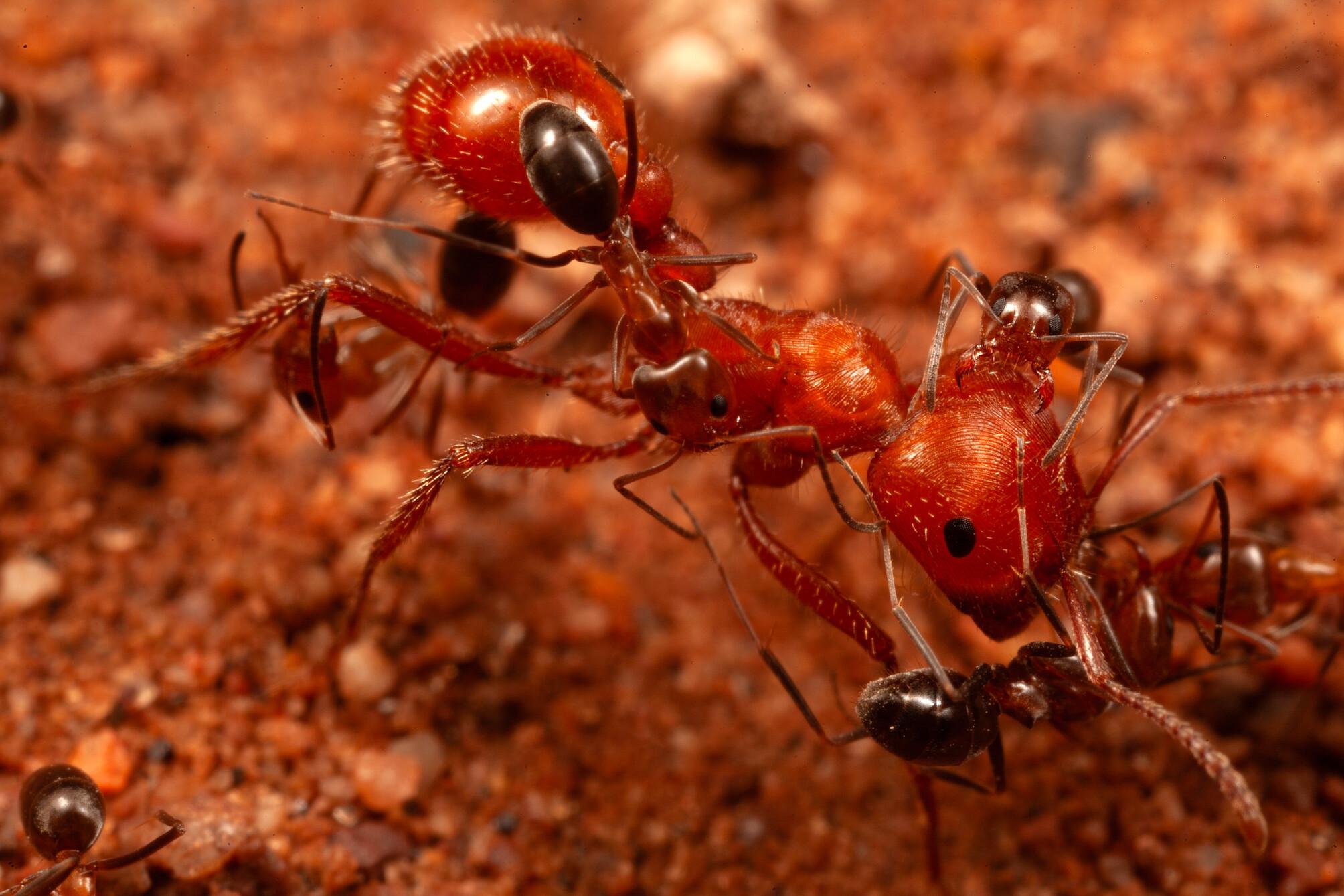
                          Link Preview Image
                          Magnus (@magnus@mastodon.world)

                          Attached: 1 image Did ants learn this from cleaner fish? There are small ants that clean big ants without meeting any agression, just like small cleaner fish can clean sharks. https://onlinelibrary.wiley.com/doi/10.1002/ece3.73308

                          favicon

                          Mastodon (mastodon.world)

                          johncarlosbaez@mathstodon.xyzJ saltywizard@beige.partyS 2 Replies Last reply
                          0
                          • johncarlosbaez@mathstodon.xyzJ johncarlosbaez@mathstodon.xyz

                            What's the most surprising fact you've learned in the last couple of weeks? I don't mind if it's quite technical. I just want to hear what you folks are being surprised by!

                            arsatiki@wandering.shopA This user is from outside of this forum
                            arsatiki@wandering.shopA This user is from outside of this forum
                            arsatiki@wandering.shop
                            wrote last edited by
                            #19

                            @johncarlosbaez India now has a larger share of new battery electric cars (out of all new cars sold) than USA

                            1 Reply Last reply
                            0
                            • johncarlosbaez@mathstodon.xyzJ johncarlosbaez@mathstodon.xyz

                              What's the most surprising fact you've learned in the last couple of weeks? I don't mind if it's quite technical. I just want to hear what you folks are being surprised by!

                              lambo@openbiblio.socialL This user is from outside of this forum
                              lambo@openbiblio.socialL This user is from outside of this forum
                              lambo@openbiblio.social
                              wrote last edited by
                              #20

                              @johncarlosbaez That a certain crystal structure of some material can suddenly not be produced anymore, a so called "disappearing polymorphism". I learned this from a recent episode of the "Veritasium" YouTube series. I was stunned, I still am. It seems we still do not really know how this happens. It is being hypothesized that a very tiny crystal is enough to "infect" the material to the effect of losing its polymorphism. There's also a very nice Wikipedia article about this.

                              lambo@openbiblio.socialL johncarlosbaez@mathstodon.xyzJ 2 Replies Last reply
                              0
                              • johncarlosbaez@mathstodon.xyzJ johncarlosbaez@mathstodon.xyz

                                What's the most surprising fact you've learned in the last couple of weeks? I don't mind if it's quite technical. I just want to hear what you folks are being surprised by!

                                pait@mastodon.socialP This user is from outside of this forum
                                pait@mastodon.socialP This user is from outside of this forum
                                pait@mastodon.social
                                wrote last edited by
                                #21

                                @johncarlosbaez That of the heat the human body loses, 50% is by radiation.

                                Then 30% by convection, and 20% by evaporation of sweat, the latter being highly variable. Very little by conduction, unless the person is immersed in water.

                                I did not think radiation would amount to that much.

                                johncarlosbaez@mathstodon.xyzJ 1 Reply Last reply
                                0
                                • R relay@relay.mycrowd.ca shared this topic
                                • glocq@mathstodon.xyzG glocq@mathstodon.xyz

                                  @johncarlosbaez There is no recorded case of schizophrenia in anyone congenitally blind. No one knows why.

                                  tal@mastodon.socialT This user is from outside of this forum
                                  tal@mastodon.socialT This user is from outside of this forum
                                  tal@mastodon.social
                                  wrote last edited by
                                  #22

                                  @glocq There was research a few years ago, into the idea that psychiatric disorders could be diagnosed by eye saccade patterns. And the optic nerves are often included in the CNS. There's something really interesting going on here.

                                  1 Reply Last reply
                                  0
                                  • johncarlosbaez@mathstodon.xyzJ johncarlosbaez@mathstodon.xyz

                                    What's the most surprising fact you've learned in the last couple of weeks? I don't mind if it's quite technical. I just want to hear what you folks are being surprised by!

                                    wdenton@cosocial.caW This user is from outside of this forum
                                    wdenton@cosocial.caW This user is from outside of this forum
                                    wdenton@cosocial.ca
                                    wrote last edited by
                                    #23

                                    @johncarlosbaez Denny Dias, guitarist for Steely Dan, was also a software engineer and worked on the database programming language Clipper.

                                    1 Reply Last reply
                                    0
                                    • pozorvlak@mathstodon.xyzP pozorvlak@mathstodon.xyz

                                      @pigworker @johncarlosbaez

                                      > I learned that the free monad construction, which iterates any container to give you a term monad, is itself a monad on containers,

                                      Makes sense - "free" things are usually left adjoint functors, and "forgetful . free" gives a monad.

                                      > and that its Kleisli arrows determine a class of recursive functions over tree-like data.

                                      Wait, what? A Kleisli arrow would be a natural transformation f -> Free g where f and g are endofunctors; how does that give you a recursive function? Co-Kleisli arrows, sure...

                                      > Moreover, if someone offers to let you test such a function but withholds the Kleisli arrow which generated it, you can recover their secret by a pleasingly small amount of perturbation testing.

                                      SORCERY

                                      pigworker@types.plP This user is from outside of this forum
                                      pigworker@types.plP This user is from outside of this forum
                                      pigworker@types.pl
                                      wrote last edited by
                                      #24

                                      @pozorvlak A container is a strictly positive functor, generalising the notion of "algebraic signature". For any such F, its free monad F* gives you the F-terms, seen as containers over sets of variables, where Kleisli arrows X -> F* Y are simultaneous substitutions from variables in X to F-terms over Y. Klesli extension then gives you the action of such a thing on terms in F* X.

                                      Now, indeed, morphisms F -> G in the category of containers correspond exactly to natural transformations from F to G, i.e. parametrically polymorphic functions in forall X. F X -> G X. (There is a representation theorem which gives a more concrete definition of container morphism.) Anyhow, joyously, -* is a monad on containers. A Kleisli arrow is some F -> G*, "compiling" F-operations to G-terms. Kleisli extension then gives you a compositonal F* -> G* compiler for whole F-terms. Instead of "variables and substitution", you get "operations and compilation".

                                      So you can take some F -> G*, Kleisli extend to get an F* -> G*, then instantiate at 0 to get a recursive function in F* 0 -> G* 0 operating only on closed F-terms. If you let me test this function, I can reverse-engineer the Kleisli arrow you got it from.

                                      If, e.g., you take F = G = (X -> 1 + X2), making F* 0 and G* 0 the type of unlabelled binary trees, I will need at most 4 tests to recover your F -> G* (or in degenerate cases, another which gives the same function), and they are the simplest 4 trees you can think of!

                                      @johncarlosbaez

                                      pozorvlak@mathstodon.xyzP 1 Reply Last reply
                                      0
                                      • johncarlosbaez@mathstodon.xyzJ johncarlosbaez@mathstodon.xyz

                                        What's the most surprising fact you've learned in the last couple of weeks? I don't mind if it's quite technical. I just want to hear what you folks are being surprised by!

                                        oscarcunningham@mathstodon.xyzO This user is from outside of this forum
                                        oscarcunningham@mathstodon.xyzO This user is from outside of this forum
                                        oscarcunningham@mathstodon.xyz
                                        wrote last edited by
                                        #25

                                        @johncarlosbaez In the pilot wave interpretation of quantum mechanics the evolution of the configuration depends only on the rate of change of the phase of the wavefunction. So because the ground state of the wavefunction always has constant phase, the configuration will be "frozen". So in particular the QFT vacuum isn't a boiling sea, it's more like a frozen landscape!

                                        1 Reply Last reply
                                        0
                                        • johncarlosbaez@mathstodon.xyzJ johncarlosbaez@mathstodon.xyz

                                          What's the most surprising fact you've learned in the last couple of weeks? I don't mind if it's quite technical. I just want to hear what you folks are being surprised by!

                                          dyoung@mathstodon.xyzD This user is from outside of this forum
                                          dyoung@mathstodon.xyzD This user is from outside of this forum
                                          dyoung@mathstodon.xyz
                                          wrote last edited by
                                          #26

                                          @johncarlosbaez that sample variance and sample mean being statistically independent can be taken to be a defining feature of the normal distribution.

                                          johncarlosbaez@mathstodon.xyzJ 1 Reply Last reply
                                          0
                                          Reply
                                          • Reply as topic
                                          Log in to reply
                                          • Oldest to Newest
                                          • Newest to Oldest
                                          • Most Votes


                                          • Login

                                          • Login or register to search.
                                          • First post
                                            Last post
                                          0
                                          • Categories
                                          • Recent
                                          • Tags
                                          • Popular
                                          • World
                                          • Users
                                          • Groups