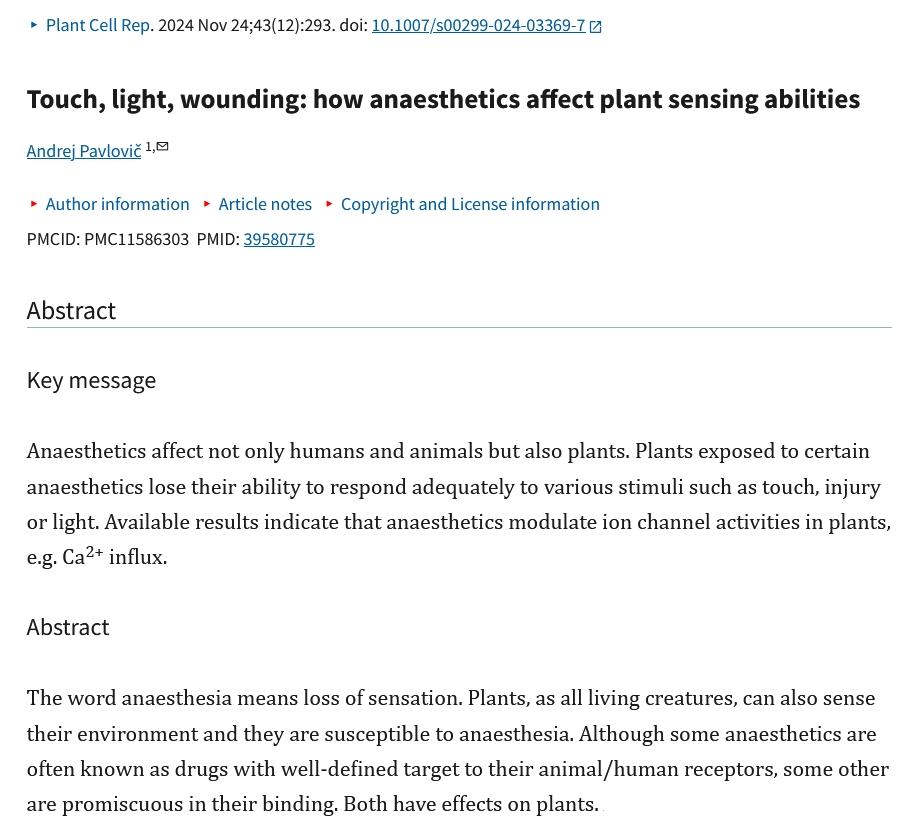
Wow: you can knock out a plant with anesthetics - the same anesthetics that work on people!
-
@johncarlosbaez Michael Pollan discusses this in his recent book on consciousness, A World Appears. Floored me. Are plants conscious?
@IzzyChambers @johncarlosbaez consciousness is still a very different matter and not something we even would know how to measure. we can only go off what seems to produce it in humans and how other living things might act similarly. plants don't just lack nerve cells, they also lack something analogous to a central nervous system to integrate information. far as I understand it if plants possess consciousness we're either very very wrong about the prerequisites and purpose of consciousness or very very wrong about how plants function. and we wouldn't really be able to test it either way.
-
@johncarlosbaez @djm62 I got the joke ;), but possibly contaminating the water table with chloroform can be problematic, and people actually are concerned about chloroform contamination in drinking water. This is because chloroform is often a product of the chlorine used to disinfect water reacting with organic material that has not been carefully removed by filtration or other means (cf. https://doi.org/10.1080/15287390252807957 and https://www.who.int/docs/default-source/wash-documents/wash-chemicals/trihalomethanes.pdf)
-
*takes off surgical gown, sadly puts away scythe*
-
Wow: you can knock out a plant with anesthetics - the same anesthetics that work on people!
It's easist to see for plants that move, like a Venus fly trap. But experiments have shown it's true for others too.
We're still struggling to figure out what this means. We don't really know how anesthetics work, but here's a clue: you don't need to have neurons to get anesthetized!
@johncarlosbaez As someone who has been aneasthetised recently, it is somewhat humbling/disturbing to be reminded that we basically don't understand why or how it works and that as far as the aneasthetist is concerned - we might as well be plants.
-
@IzzyChambers @johncarlosbaez consciousness is still a very different matter and not something we even would know how to measure. we can only go off what seems to produce it in humans and how other living things might act similarly. plants don't just lack nerve cells, they also lack something analogous to a central nervous system to integrate information. far as I understand it if plants possess consciousness we're either very very wrong about the prerequisites and purpose of consciousness or very very wrong about how plants function. and we wouldn't really be able to test it either way.
@elexia @johncarlosbaez Maybe, but given that we don't have a clear understanding of what consciousness is or how plants process information, I don't think we can rule it out.
-
Wow: you can knock out a plant with anesthetics - the same anesthetics that work on people!
It's easist to see for plants that move, like a Venus fly trap. But experiments have shown it's true for others too.
We're still struggling to figure out what this means. We don't really know how anesthetics work, but here's a clue: you don't need to have neurons to get anesthetized!
@johncarlosbaez wait a sec.
it plants and animals diverged from each other before the whole "multiple cells" thing, (my admittedly noncomprehensive education implies they do) and anaesthetics work on both, then can you anaesthetise an amoeba?
Because that feels like it'd be the logical next step. -
@elexia @johncarlosbaez Maybe, but given that we don't have a clear understanding of what consciousness is or how plants process information, I don't think we can rule it out.
@IzzyChambers @johncarlosbaez I wouldn't rule it out, just think it's very improbable given what we currently know about these things.
-
The weird thing is that plant cells have discrete action potentials, but C. elegans (the roundworm) does not[1].
C. elegans has a nervous system made of 302 neurons with graded potentials (no spikes, meaning they are 'analog') and no myelin to work as wire insulation. Its signaling is slow. C. Elegans cognition is mix of of mechanical, chemical and electrical signals.
Mechanical stetching opens ion channels in the neurons, generating signals. Neurons can react external touching or internal movement. Internal mechanical feedback is part of its thinking and movement.
[1]: as far as I know.
@maxpool I noted this in a different response to this thread, but for what little we know about how inhalational anesthetics work, we at least know that the more lipophilic (that is, how well they dissolve in fats) they are, the more potent their effect is; for the noble gases, this is then also correlated with their atomic polarizability (https://en.wikipedia.org/wiki/Polarizability). So, helium, neon, and argon display almost no anesthetic activity, but krypton and xenon do. In fact, argon will only display anesthetic activity at hyperbaric (pressure greater than atmospheric pressure) conditions, where its solubility in fats is enhanced. See the survey of Winkler and others, e.g. https://doi.org/10.1016/j.pharmthera.2016.02.002 and https://doi.org/10.3390/oxygen4040026 . (cc. @johncarlosbaez @heptapodEnthusiast)
-
@jmcclure @ClimateJenny - thanks, Jenny and Jesse! The research on anesthetics has caused a controversy on whether plants are "conscious". I didn't want to mention that in my main post because I find most discussions of consciousness very irritating: people don't define their terms and some treat consciousness, sentience and awareness as the same while others don't, etc., and it become just as bad as "interpretations of quantum mechanics". But I enjoy learning actual facts about how animals and plants behave!
Indeed - I've been a fly on the wall of such debates. Plant capabilities themselves are stunning and worthy of note.
But discussions of "consciousness" / "sentience" always devolve into semantic nonsense. Often a pseudo-resolution comes with something like "For any *reasonable* definition of (consciousness / sentience) plants ..."
But as a behavioral neuroscientist, I can tell you I've yet to encounter a reasonable definition of either of these terms.
-
@johncarlosbaez very interesting, thanks for pulling that one up! It's wild that lidocaine actually works on plants that move. Indeed, the inhalational anesthetics are poorly understood with respect to their mechanism of action, but we at least know that their being lipophilic (i.e., how well they dissolve in fats and other non-aqueous media) correlates well with their potency.
@tpfto @johncarlosbaez My personal amateur guess is that the gaseous anaesthetics are disrupting the formation or dissolution of lipid rafts, which regulate a lot of the traffic through the cell membrane. AIUI, lipid rafts more or less work by locally changing the stiffness and hydrophobicity of the patch of membrane they form on. If the gas dissolves into the lipid bilayer and changes either property, it could alter ion channels, endo/exocytosis, and more. Any eukaryotic cell would be vulnerable to an effect like that. (And perhaps bacteria and archaea too, but I don't remember enough of their membrane chemistry to say anything reliable.)
And regardless of how such anaesthetics affect the cell membrane, I suspect their narrow therapeutic index comes from disrupting the function of the mitochondrial membrane. Depolarizing the mitochondria (by making them leaky or by blocking their proton pumps) is lethal for most eukaryotic cells, since the H+ gradient across the inner membrane is what powers aerobic ATP synthesis.
-
@IzzyChambers @johncarlosbaez consciousness is still a very different matter and not something we even would know how to measure. we can only go off what seems to produce it in humans and how other living things might act similarly. plants don't just lack nerve cells, they also lack something analogous to a central nervous system to integrate information. far as I understand it if plants possess consciousness we're either very very wrong about the prerequisites and purpose of consciousness or very very wrong about how plants function. and we wouldn't really be able to test it either way.
@elexia @IzzyChambers @johncarlosbaez My personal bet is that, when we say "consciousness" without mysticism, what we really mean is "awake" aka "able to perceive and react to external stimuli". In which case, single cells are absolutely capable of being conscious, and the difference from our own experience is one of size scale and complexity.
Even for animal life, animals of different body sizes have radically different types of situational awareness, so it's not surprising we struggle to imagine what a single-celled organism like *Stentor coeruleus* "thinks" of its experiences.
It's a little humbling to think of your individual cells having their own opinions about how "the weather" (your metabolic inner life) has been lately.
-
@tpfto @johncarlosbaez My personal amateur guess is that the gaseous anaesthetics are disrupting the formation or dissolution of lipid rafts, which regulate a lot of the traffic through the cell membrane. AIUI, lipid rafts more or less work by locally changing the stiffness and hydrophobicity of the patch of membrane they form on. If the gas dissolves into the lipid bilayer and changes either property, it could alter ion channels, endo/exocytosis, and more. Any eukaryotic cell would be vulnerable to an effect like that. (And perhaps bacteria and archaea too, but I don't remember enough of their membrane chemistry to say anything reliable.)
And regardless of how such anaesthetics affect the cell membrane, I suspect their narrow therapeutic index comes from disrupting the function of the mitochondrial membrane. Depolarizing the mitochondria (by making them leaky or by blocking their proton pumps) is lethal for most eukaryotic cells, since the H+ gradient across the inner membrane is what powers aerobic ATP synthesis.
@heptapodEnthusiast regarding the lipid rafts, there is in fact a (relatively recent) paper that posits this theory: https://doi.org/10.1073/pnas.2004259117 . Perhaps you've seen it already? (cc. @johncarlosbaez)
-
@heptapodEnthusiast regarding the lipid rafts, there is in fact a (relatively recent) paper that posits this theory: https://doi.org/10.1073/pnas.2004259117 . Perhaps you've seen it already? (cc. @johncarlosbaez)
@tpfto I don't recall reading it directly, but I have certainly read material that was influenced by it. Thank you for sharing!
-
Wow: you can knock out a plant with anesthetics - the same anesthetics that work on people!
It's easist to see for plants that move, like a Venus fly trap. But experiments have shown it's true for others too.
We're still struggling to figure out what this means. We don't really know how anesthetics work, but here's a clue: you don't need to have neurons to get anesthetized!
@johncarlosbaez This is wild!
-
Wow: you can knock out a plant with anesthetics - the same anesthetics that work on people!
It's easist to see for plants that move, like a Venus fly trap. But experiments have shown it's true for others too.
We're still struggling to figure out what this means. We don't really know how anesthetics work, but here's a clue: you don't need to have neurons to get anesthetized!
@johncarlosbaez On the downside we may have hurt a lot of life before.
-
Wow: you can knock out a plant with anesthetics - the same anesthetics that work on people!
It's easist to see for plants that move, like a Venus fly trap. But experiments have shown it's true for others too.
We're still struggling to figure out what this means. We don't really know how anesthetics work, but here's a clue: you don't need to have neurons to get anesthetized!
@johncarlosbaez
I remember the Yellow Shell No-Pest strips and other insecticides. Your could feel them as soon as you walked into a place that had one or been sprayed with Raid.
-
R relay@relay.mycrowd.ca shared this topic