One of my bedrock beliefs is that capitalists *really* hate capitalism.
-
But, of course, the businesses that want binding arbitration and tort reform (so they can't be sued) *also* want to "dismantle the administrative state" (so they can't be regulated). They're the impunity movement, the "when the president does it, that means it is not illegal" movement, the "heads I win, tails you lose" movement. They're the caveat emptor movement, the "that makes me smart" movement:
28/
They don't want efficient markets, with the ever-present threat of a better competitor putting them out of business. They want feudalism. They want to go meta. They want to have the kind of self-determination you can only achieve by taking away everyone else's self-determination.
I was very struck by Keller's claim to be engaged in an exercise that Milton Friedman identified as the best one for making markets work.
29/
-
They don't want efficient markets, with the ever-present threat of a better competitor putting them out of business. They want feudalism. They want to go meta. They want to have the kind of self-determination you can only achieve by taking away everyone else's self-determination.
I was very struck by Keller's claim to be engaged in an exercise that Milton Friedman identified as the best one for making markets work.
29/
One of Keller's most forceful points is that class action suits are especially important for reining in petty, recurrent grifts, the junk fees that are the hallmark of enshittification.
He quotes his old boss, the archconservative judge Richard Posner, who said "Only a lunatic or a fanatic sues for $20." But if you multiply a $20 junk fee by ten million purchases, a company can use that fact to make *hundreds of millions* of dollars.
30/
-
One of Keller's most forceful points is that class action suits are especially important for reining in petty, recurrent grifts, the junk fees that are the hallmark of enshittification.
He quotes his old boss, the archconservative judge Richard Posner, who said "Only a lunatic or a fanatic sues for $20." But if you multiply a $20 junk fee by ten million purchases, a company can use that fact to make *hundreds of millions* of dollars.
30/
That's real money, which is why every company has figured out a way to whack you for $20,.
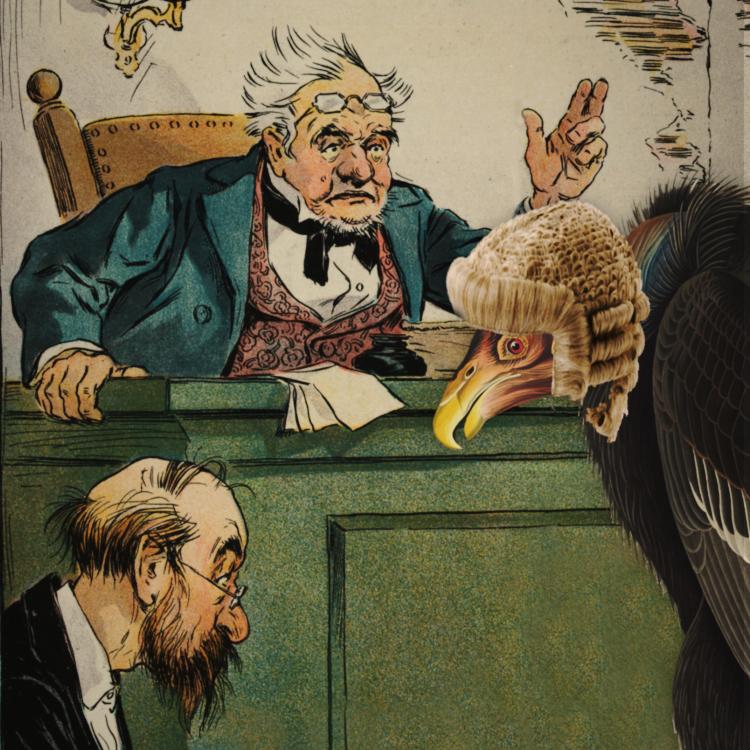
There's two ways to end this: one is litigation, the other is regulation, and the capitalism-hating-capitalists who run the world want to kill both. That's why the business lobby smears lawyers like Keller as being "vultures." But as Matt Stoller says, "vultures look aggressive and whatnot, but when you actually get rid of vultures out of an ecosystem, all sorts of things go haywire."
32/
-
That's real money, which is why every company has figured out a way to whack you for $20,.
There's two ways to end this: one is litigation, the other is regulation, and the capitalism-hating-capitalists who run the world want to kill both. That's why the business lobby smears lawyers like Keller as being "vultures." But as Matt Stoller says, "vultures look aggressive and whatnot, but when you actually get rid of vultures out of an ecosystem, all sorts of things go haywire."
32/
I love this. Vultures live off the disgusting, rotting crap that piles up around us, breeding disease and emitting an unbearable stench. If plaintiff-side, no-win/no-fee lawyers are vultures, then junk fees, wage theft, and the million frauds they fight are the disgusting, rotting crap that vultures feed off of - and the harder we make it for our noble vulture lawyers, the more disgusting, rotting crap we have to live with, hence the unbearable stench that is all around us.
32/
-
I love this. Vultures live off the disgusting, rotting crap that piles up around us, breeding disease and emitting an unbearable stench. If plaintiff-side, no-win/no-fee lawyers are vultures, then junk fees, wage theft, and the million frauds they fight are the disgusting, rotting crap that vultures feed off of - and the harder we make it for our noble vulture lawyers, the more disgusting, rotting crap we have to live with, hence the unbearable stench that is all around us.
32/
Listening to Keller was a fascinating exercise. I thoroughly disagree with him about many things - the way he characterized Section 230 of the Communications Decency Act couldn't have been more wrong - but it's quite bracing to hear a capitalist who *doesn't* hate capitalism defend it against the vast majority of capitalists, who hate capitalism more than any socialist ever did.
33/
-
Listening to Keller was a fascinating exercise. I thoroughly disagree with him about many things - the way he characterized Section 230 of the Communications Decency Act couldn't have been more wrong - but it's quite bracing to hear a capitalist who *doesn't* hate capitalism defend it against the vast majority of capitalists, who hate capitalism more than any socialist ever did.
33/
I'm coming to #Guelph, Ontario this Friday (May
 to deliver the Musagetes Lecture:
Guelph Lecture—On Being
Presented by ArtsEverywhere Festival The 2026 Guelph Lecture—On Being will be presented by Cory Doctorow on the “enshittification” of the internet.

River Run Centre (riverrun.ca)
eof/
-
One of my bedrock beliefs is that capitalists *really* hate capitalism. They may name their beloved institutes after the likes of Adam Smith, but they ignore everything Smith had to say about the necessity of competition to keep markets from turning into monopolies:
--
If you'd like an essay-formatted version of this thread to read or share, here's a link to it on pluralistic.net, my surveillance-free, ad-free, tracker-free blog:
1/
@pluralistic You mentioned the other day you don't see eye to eye with Mark Carney on much, but there is a tremendous bit by Tomaso Padoa-Schioppa quoted in his book "Values":
-
@pluralistic You mentioned the other day you don't see eye to eye with Mark Carney on much, but there is a tremendous bit by Tomaso Padoa-Schioppa quoted in his book "Values":
@pluralistic "When the two contaminate each other, both deprave".
-
I love this. Vultures live off the disgusting, rotting crap that piles up around us, breeding disease and emitting an unbearable stench. If plaintiff-side, no-win/no-fee lawyers are vultures, then junk fees, wage theft, and the million frauds they fight are the disgusting, rotting crap that vultures feed off of - and the harder we make it for our noble vulture lawyers, the more disgusting, rotting crap we have to live with, hence the unbearable stench that is all around us.
32/
No one loves vultures or lawyers...
-
@pluralistic "When the two contaminate each other, both deprave".
@pluralistic Which is to say, I thoroughly agree with you that capitalists hate capitalism - or they hate competition. And it's the state's job to set the rules by which the capitalists are permitted to play, to force them to compete and to break up monopolies.
But the capitalists have been using their wealth to corrupt power and so need taking down a peg or two by a government prepared to do whatever it takes - including using the state's most treasured monopoly, the monopoly on violence.
-
@pluralistic Which is to say, I thoroughly agree with you that capitalists hate capitalism - or they hate competition. And it's the state's job to set the rules by which the capitalists are permitted to play, to force them to compete and to break up monopolies.
But the capitalists have been using their wealth to corrupt power and so need taking down a peg or two by a government prepared to do whatever it takes - including using the state's most treasured monopoly, the monopoly on violence.
-
One of my bedrock beliefs is that capitalists *really* hate capitalism. They may name their beloved institutes after the likes of Adam Smith, but they ignore everything Smith had to say about the necessity of competition to keep markets from turning into monopolies:
--
If you'd like an essay-formatted version of this thread to read or share, here's a link to it on pluralistic.net, my surveillance-free, ad-free, tracker-free blog:
1/
@pluralistic
Unless Adam's invisible hand is controlled by an invisible arm called regulations, then the invisible hand has an invisible impact on monopolization. -
@pluralistic
Unless Adam's invisible hand is controlled by an invisible arm called regulations, then the invisible hand has an invisible impact on monopolization.@NMBA @pluralistic It is easiest to hold things using a single bag.
-
If you switch to an artisanal brand of cookies made by a local family business, Unilever or P&G will buy that company and issue a press release declaring that they made the acquisition because they know "their customers value choice":
Gerrymandering strips your vote of any impact on political outcomes. Monopoly strips your purchases of any ability to influence economic outcomes.
11/
@pluralistic for some reason we don't punish "small business owners" who sell out to big multinationals (or to smol, local conglomerates)
-
@bencurthoys @pluralistic Market capitalism is a metastable system whose governance structure (capitalism) creates affordances that allow market actors to avoid competition. Some are intentional (patents) others emerge from gaming the rules. https://zirk.us/@MidniteMikeWrites/114808262786519399
-
R relay@relay.mycrowd.ca shared this topic
-
One of my bedrock beliefs is that capitalists *really* hate capitalism. They may name their beloved institutes after the likes of Adam Smith, but they ignore everything Smith had to say about the necessity of competition to keep markets from turning into monopolies:
--
If you'd like an essay-formatted version of this thread to read or share, here's a link to it on pluralistic.net, my surveillance-free, ad-free, tracker-free blog:
1/
@pluralistic It's always "free
 markets for thee but not for me", whether on a level between corporations or between states.
 -
@pluralistic
Unless Adam's invisible hand is controlled by an invisible arm called regulations, then the invisible hand has an invisible impact on monopolization.@NMBA @pluralistic Markets work when all decisions are made through markets alone. Regulations is how you ensure that.
-
The theory of capitalism holds that markets are a kind of distributed computer that aggregates trillions of decisions from billions of market participants in order to optimize production and distribution of goods and services, creating a "Pareto-optimal" world where no one can be made better off without making someone else worse off.
2/
@pluralistic But markets can exist without allowing the unlimited accumulation, concentration and centralisation of capital. To allow the latter is an explicit choice by lawmakers.
-
One of my bedrock beliefs is that capitalists *really* hate capitalism. They may name their beloved institutes after the likes of Adam Smith, but they ignore everything Smith had to say about the necessity of competition to keep markets from turning into monopolies:
--
If you'd like an essay-formatted version of this thread to read or share, here's a link to it on pluralistic.net, my surveillance-free, ad-free, tracker-free blog:
1/
@pluralistic ditto religion. Turn the other cheek'? 'Do Unto Others?
Systems of thought are merely convenient rationale for whatever a robber baron wants to get away with.
-
One of my bedrock beliefs is that capitalists *really* hate capitalism. They may name their beloved institutes after the likes of Adam Smith, but they ignore everything Smith had to say about the necessity of competition to keep markets from turning into monopolies:
--
If you'd like an essay-formatted version of this thread to read or share, here's a link to it on pluralistic.net, my surveillance-free, ad-free, tracker-free blog:
1/
@pluralistic I think this is something that, even though it has always been denied by capitalists, has been described by its opponents for a long time, especially Marx:
"Monopoly produces competition, competition
produces monopoly. Monopolists compete among themselves; competi-
tors become monopolists." Marx, poverty of philosophy