!!!!!
-
@mhoye this is incredible
-
@mhoye yes, I *did* check the date at the top of this one.
-
@mhoye OMG, that's so cool.
-
@mhoye
Very comparable to SUBLEQ and similar single operation Instruction Sets.But in these days of machine learning hallucinations, I am a bit critical until an actual mathematician tells me it's correct...
Sorry...

-
@mhoye two-button RPN calculator when
-
@mhoye what the??!
-
@mhoye But what does it mean for me, someone who still has to wrestle people away from using floats for money calculations?
-
@mhoye I skim read it. I'm not totally sure if the solutions are proven exact from algebraic identitied or what. The prose parts feel like slop-- the author admits to this but... For instance I didn't see any derivation for sin(x).
-
@mhoye
Very comparable to SUBLEQ and similar single operation Instruction Sets.But in these days of machine learning hallucinations, I am a bit critical until an actual mathematician tells me it's correct...
Sorry...
-
@mhoye as someone who has not seen a mathematical calculator in over two decades: what can this do? Simplify CPU to only to one logic gate? I see that Andrzej (hey! Cracow!) talks about neural networks, but this gives even less understanding.
-
@holdenweb @mhoye True, true. But what about those minecraft people who build calculators and such - will it vastly simplify their lives?
-
@mhoye I expected this to say 1975 or some shit but no it says 2026. Fucking WILD.
-
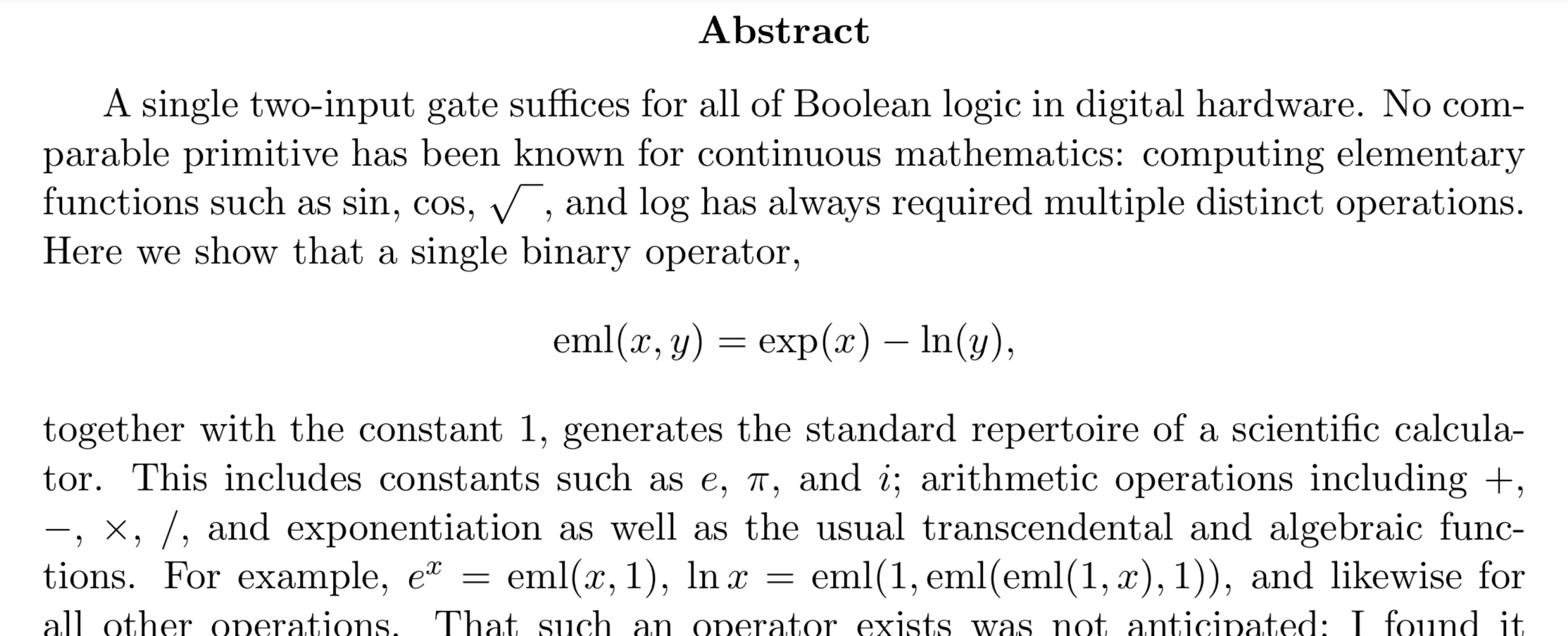
@mhoye alt-text:
"""
A single two-input gate suffices for all of Boolean logic in digital hardware. No comparable primitive has been known for continuous mathematics: computing elementary functions such as sin, cos, , and log has always required multiple distinct operations. Here we show that a single binary operator,eml(x,y)=exp(x)−ln(y),together with the constant 1, generates the standard repertoire of a scientific calculator. This includes constants such as e, π, and i; arithmetic operations including +, −, ×, /, and exponentiation as well as the usual transcendental and algebraic functions. For example,
ex=eml(x,1), lnx=eml(1,eml(eml(1,x),1)), and likewise for all other operations. That such an operator exists was not anticipated; I found it [...]
""" -
@mhoye oh shit
-
@mhoye this paper is a shitpost, right?
-
@mhoye I skim read it. I'm not totally sure if the solutions are proven exact from algebraic identitied or what. The prose parts feel like slop-- the author admits to this but... For instance I didn't see any derivation for sin(x).
-
@mhoye can you please add an alt so we can retoot this mindblowing article? thank you! you can almost copy paste the abstract as the alt.
-
@mhoye
Very comparable to SUBLEQ and similar single operation Instruction Sets.But in these days of machine learning hallucinations, I am a bit critical until an actual mathematician tells me it's correct...
Sorry...
-
@jorendorff @mhoye ah! I was wondering how you got a cyclic function out of ln and exp. I am not superstrong at math-- I just like it

The core idea does seem pretty cool. The paper is annoyingly wordy in a slop-machine-wrote-this way-- the author discloses as much. Lately I have been thinking about how functions (e.g. sin()) are actually implemented (did some baby level numerical integration stuff lately which made me curius.)
Also wonder: is this idea similar to Taylor polynomials?
-
@mhoye This is way over my head but there was this in my feed related to the link: https://www.stylewarning.com/posts/not-all-elementary/
-
R relay@relay.mycrowd.ca shared this topic