Skip to content
  • Categories
  • Recent
  • Tags
  • Popular
  • World
  • Users
  • Groups
Skins
  • Light
  • Brite
  • Cerulean
  • Cosmo
  • Flatly
  • Journal
  • Litera
  • Lumen
  • Lux
  • Materia
  • Minty
  • Morph
  • Pulse
  • Sandstone
  • Simplex
  • Sketchy
  • Spacelab
  • United
  • Yeti
  • Zephyr
  • Dark
  • Cyborg
  • Darkly
  • Quartz
  • Slate
  • Solar
  • Superhero
  • Vapor

  • Default (Cyborg)
  • No Skin
Collapse
Brand Logo

CIRCLE WITH A DOT

  1. Home
  2. Uncategorized
  3. !!!!!

!!!!!

Scheduled Pinned Locked Moved Uncategorized
23 Posts 19 Posters 5 Views
  • Oldest to Newest
  • Newest to Oldest
  • Most Votes
Reply
  • Reply as topic
Log in to reply
This topic has been deleted. Only users with topic management privileges can see it.
  • meilin@tech.lgbtM meilin@tech.lgbt

    @mhoye
    Very comparable to SUBLEQ and similar single operation Instruction Sets.

    But in these days of machine learning hallucinations, I am a bit critical until an actual mathematician tells me it's correct...

    Sorry... 😐

    tml@mementomori.socialT This user is from outside of this forum
    tml@mementomori.socialT This user is from outside of this forum
    tml@mementomori.social
    wrote last edited by
    #12

    @MeiLin @mhoye Haha, exactly my reaction. I can't fully believe this until I see a Numberphile (or similar) video about it;)

    1 Reply Last reply
    0
    • mhoye@cosocial.caM mhoye@cosocial.ca

      !!!!!

      Link Preview Image
      All elementary functions from a single operator

      favicon

      (arxiv.org)

      Link Preview Image
      mms@mastodon.bsd.cafeM This user is from outside of this forum
      mms@mastodon.bsd.cafeM This user is from outside of this forum
      mms@mastodon.bsd.cafe
      wrote last edited by
      #13

      @mhoye as someone who has not seen a mathematical calculator in over two decades: what can this do? Simplify CPU to only to one logic gate? I see that Andrzej (hey! Cracow!) talks about neural networks, but this gives even less understanding.

      1 Reply Last reply
      0
      • holdenweb@freeradical.zoneH holdenweb@freeradical.zone

        @kboyd @mhoye More trouble, most likely.

        kboyd@phpc.socialK This user is from outside of this forum
        kboyd@phpc.socialK This user is from outside of this forum
        kboyd@phpc.social
        wrote last edited by
        #14

        @holdenweb @mhoye True, true. But what about those minecraft people who build calculators and such - will it vastly simplify their lives?

        1 Reply Last reply
        0
        • mhoye@cosocial.caM mhoye@cosocial.ca

          !!!!!

          Link Preview Image
          All elementary functions from a single operator

          favicon

          (arxiv.org)

          Link Preview Image
          elizafox@social.treehouse.systemsE This user is from outside of this forum
          elizafox@social.treehouse.systemsE This user is from outside of this forum
          elizafox@social.treehouse.systems
          wrote last edited by
          #15

          @mhoye I expected this to say 1975 or some shit but no it says 2026. Fucking WILD.

          1 Reply Last reply
          0
          • mhoye@cosocial.caM mhoye@cosocial.ca

            !!!!!

            Link Preview Image
            All elementary functions from a single operator

            favicon

            (arxiv.org)

            Link Preview Image
            soblow@eldritch.cafeS This user is from outside of this forum
            soblow@eldritch.cafeS This user is from outside of this forum
            soblow@eldritch.cafe
            wrote last edited by
            #16

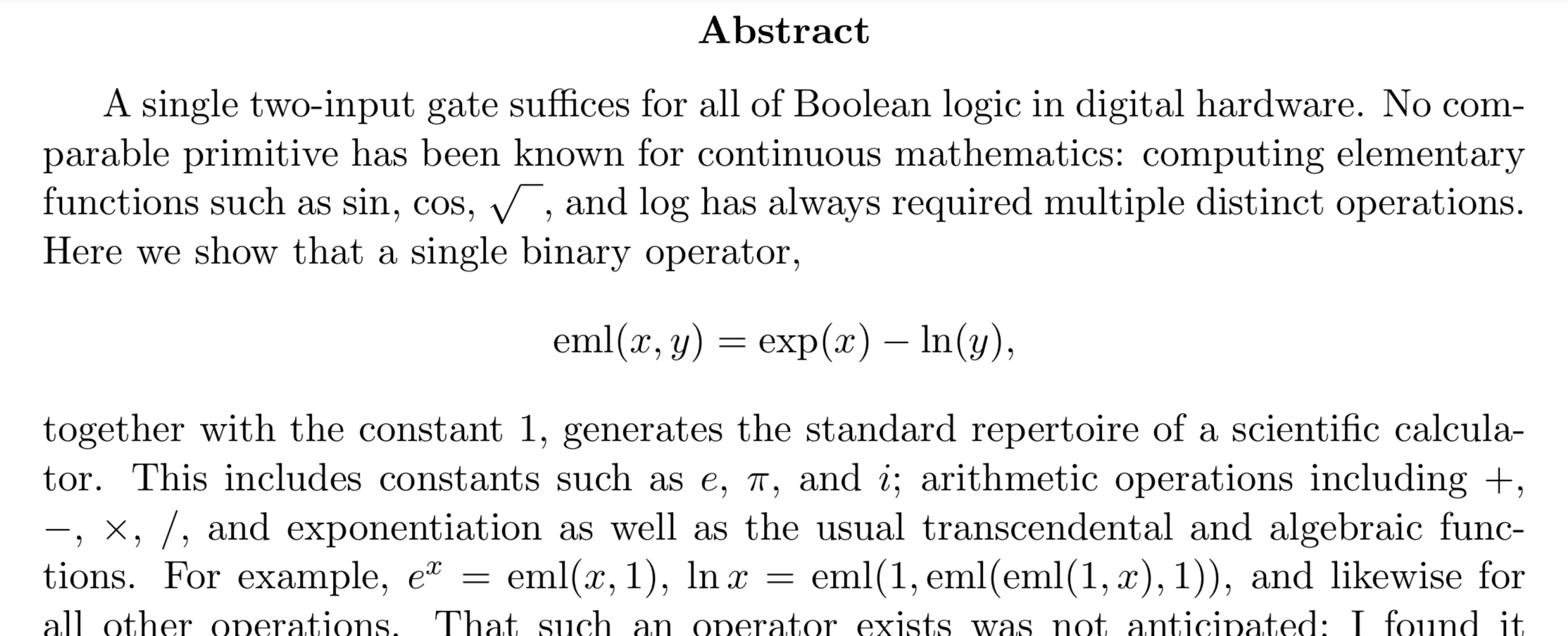
            @mhoye alt-text:

            """
            A single two-input gate suffices for all of Boolean logic in digital hardware. No comparable primitive has been known for continuous mathematics: computing elementary functions such as sin, cos, , and log has always required multiple distinct operations. Here we show that a single binary operator,

            eml⁡(x,y)=exp⁡(x)−ln⁡(y),

            together with the constant 1, generates the standard repertoire of a scientific calculator. This includes constants such as e, π, and i; arithmetic operations including +, −, ×, /, and exponentiation as well as the usual transcendental and algebraic functions. For example, ex=eml⁡(x,1), ln⁡x=eml⁡(1,eml⁡(eml⁡(1,x),1)), and likewise for all other operations. That such an operator exists was not anticipated; I found it [...]
            """

            1 Reply Last reply
            0
            • mhoye@cosocial.caM mhoye@cosocial.ca

              !!!!!

              Link Preview Image
              All elementary functions from a single operator

              favicon

              (arxiv.org)

              Link Preview Image
              lykrast@eldritch.cafeL This user is from outside of this forum
              lykrast@eldritch.cafeL This user is from outside of this forum
              lykrast@eldritch.cafe
              wrote last edited by
              #17

              @mhoye oh shit

              1 Reply Last reply
              0
              • mhoye@cosocial.caM mhoye@cosocial.ca

                !!!!!

                Link Preview Image
                All elementary functions from a single operator

                favicon

                (arxiv.org)

                Link Preview Image
                ellie@ellieayla.netE This user is from outside of this forum
                ellie@ellieayla.netE This user is from outside of this forum
                ellie@ellieayla.net
                wrote last edited by
                #18

                @mhoye this paper is a shitpost, right?

                1 Reply Last reply
                0
                • psysal@mastodon.socialP psysal@mastodon.social

                  @mhoye I skim read it. I'm not totally sure if the solutions are proven exact from algebraic identitied or what. The prose parts feel like slop-- the author admits to this but... For instance I didn't see any derivation for sin(x).

                  jorendorff@federate.socialJ This user is from outside of this forum
                  jorendorff@federate.socialJ This user is from outside of this forum
                  jorendorff@federate.social
                  wrote last edited by
                  #19

                  @PsySal @mhoye From Euler's formula, sin(x) = (exp(ix) - exp(-ix))/2i.

                  So you first find formulas for subtraction, negation, multiplication, division, i, and 2, and then it's easy...

                  I dunno. The paper strikes me as crank. But what do I know.

                  psysal@mastodon.socialP 1 Reply Last reply
                  0
                  • mhoye@cosocial.caM mhoye@cosocial.ca

                    !!!!!

                    Link Preview Image
                    All elementary functions from a single operator

                    favicon

                    (arxiv.org)

                    Link Preview Image
                    f4grx@chaos.socialF This user is from outside of this forum
                    f4grx@chaos.socialF This user is from outside of this forum
                    f4grx@chaos.social
                    wrote last edited by
                    #20

                    @mhoye can you please add an alt so we can retoot this mindblowing article? thank you! you can almost copy paste the abstract as the alt.

                    1 Reply Last reply
                    0
                    • meilin@tech.lgbtM meilin@tech.lgbt

                      @mhoye
                      Very comparable to SUBLEQ and similar single operation Instruction Sets.

                      But in these days of machine learning hallucinations, I am a bit critical until an actual mathematician tells me it's correct...

                      Sorry... 😐

                      f4grx@chaos.socialF This user is from outside of this forum
                      f4grx@chaos.socialF This user is from outside of this forum
                      f4grx@chaos.social
                      wrote last edited by
                      #21

                      @MeiLin @mhoye some of the formulas could be recalculated by hand.

                      eg it's obvious that eml(x,1) is exp(x)

                      1 Reply Last reply
                      0
                      • jorendorff@federate.socialJ jorendorff@federate.social

                        @PsySal @mhoye From Euler's formula, sin(x) = (exp(ix) - exp(-ix))/2i.

                        So you first find formulas for subtraction, negation, multiplication, division, i, and 2, and then it's easy...

                        I dunno. The paper strikes me as crank. But what do I know.

                        psysal@mastodon.socialP This user is from outside of this forum
                        psysal@mastodon.socialP This user is from outside of this forum
                        psysal@mastodon.social
                        wrote last edited by
                        #22

                        @jorendorff @mhoye ah! I was wondering how you got a cyclic function out of ln and exp. I am not superstrong at math-- I just like it 🙂

                        The core idea does seem pretty cool. The paper is annoyingly wordy in a slop-machine-wrote-this way-- the author discloses as much. Lately I have been thinking about how functions (e.g. sin()) are actually implemented (did some baby level numerical integration stuff lately which made me curius.)

                        Also wonder: is this idea similar to Taylor polynomials?

                        1 Reply Last reply
                        0
                        • mhoye@cosocial.caM mhoye@cosocial.ca

                          !!!!!

                          Link Preview Image
                          All elementary functions from a single operator

                          favicon

                          (arxiv.org)

                          Link Preview Image
                          pointlessone@status.pointless.oneP This user is from outside of this forum
                          pointlessone@status.pointless.oneP This user is from outside of this forum
                          pointlessone@status.pointless.one
                          wrote last edited by
                          #23

                          @mhoye This is way over my head but there was this in my feed related to the link: https://www.stylewarning.com/posts/not-all-elementary/

                          1 Reply Last reply
                          1
                          0
                          • R relay@relay.mycrowd.ca shared this topic
                          Reply
                          • Reply as topic
                          Log in to reply
                          • Oldest to Newest
                          • Newest to Oldest
                          • Most Votes


                          • Login

                          • Login or register to search.
                          • First post
                            Last post
                          0
                          • Categories
                          • Recent
                          • Tags
                          • Popular
                          • World
                          • Users
                          • Groups