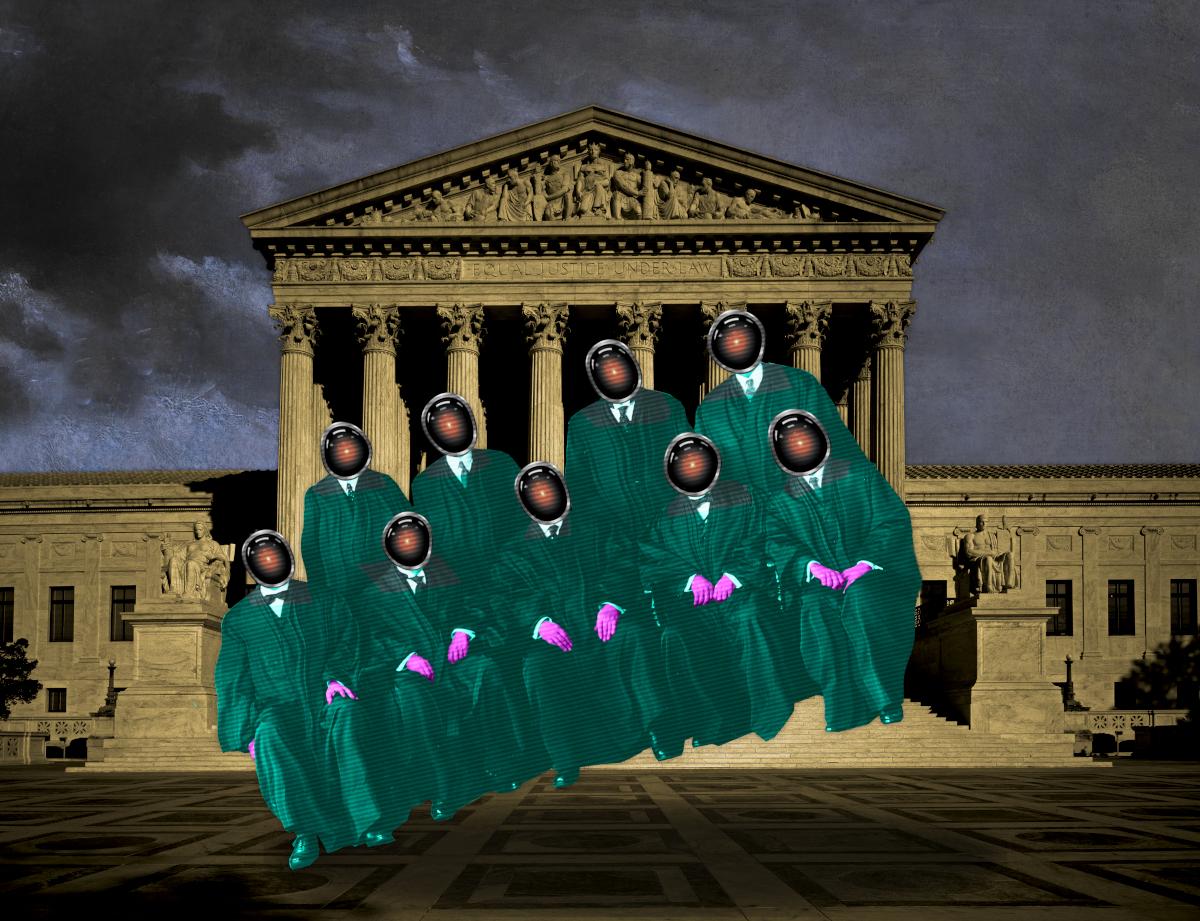
The Supreme Court has just turned down a petition to hear an appeal in a case that held that AI works can't be copyrighted.
-
In a nutshell: in a world of five publishers, four studios, three labels, two app companies and one company that controls all ebooks and audiobooks, giving a creative worker more copyright is like giving your bullied kid extra lunch money. It doesn't matter how much lunch money you give that kid - the bullies will take it all, and the kid will go hungry:
https://pluralistic.net/2022/08/21/what-is-chokepoint-capitalism/
30/
Indeed, if you keep giving that kid more lunch money, the bullies will eventually have enough dough that they'll hire a fancy ad-agency to blitz the world with a campaign insisting that our schoolkids are all going hungry and need *even more* lunch money (they'll take that money, too).
31/
-
Indeed, if you keep giving that kid more lunch money, the bullies will eventually have enough dough that they'll hire a fancy ad-agency to blitz the world with a campaign insisting that our schoolkids are all going hungry and need *even more* lunch money (they'll take that money, too).
31/
When Mitch Glazier - who got a $1m+/year job for the labels after attempting to pauperize musicans - writes on behalf of Disney in support of a copyright suit to establish that copyright prevents training a model without a license, he's not defending creative workers.
32/
-
When Mitch Glazier - who got a $1m+/year job for the labels after attempting to pauperize musicans - writes on behalf of Disney in support of a copyright suit to establish that copyright prevents training a model without a license, he's not defending creative workers.
32/
Disney is the company that takes the position that if it buys a company like Lucasfilm or Fox, it only acquires the *right* to use the works we made for those companies, but not the *obligation* to pay us when they do:
https://pluralistic.net/2021/04/29/writers-must-be-paid/#pay-the-writer
If a new, unambiguous copyright over model training comes into existence - whether through a court precedent or a new law - then all our contracts will be amended to non-negotiably require us to assign that right to our bosses.
33/
-
Disney is the company that takes the position that if it buys a company like Lucasfilm or Fox, it only acquires the *right* to use the works we made for those companies, but not the *obligation* to pay us when they do:
https://pluralistic.net/2021/04/29/writers-must-be-paid/#pay-the-writer
If a new, unambiguous copyright over model training comes into existence - whether through a court precedent or a new law - then all our contracts will be amended to non-negotiably require us to assign that right to our bosses.
33/
And our bosses will enter into "partnerships" to train models on our works. And those models will exist for one purpose: to let them create works without paying us.
The market concentration that lets our bosses dictate terms to us is getting *much* worse, and it's only speeding up. Getty Images - who sued Stability AI over image generation - is merging with Shutterstock:
https://globalcompetitionreview.com/gcr-usa/article/photographers-alarmed-gettyshutterstock-merger
And Paramount is merging with Warners:
https://pluralistic.net/2026/02/28/golden-mean/#reality-based-community
34/
-
And our bosses will enter into "partnerships" to train models on our works. And those models will exist for one purpose: to let them create works without paying us.
The market concentration that lets our bosses dictate terms to us is getting *much* worse, and it's only speeding up. Getty Images - who sued Stability AI over image generation - is merging with Shutterstock:
https://globalcompetitionreview.com/gcr-usa/article/photographers-alarmed-gettyshutterstock-merger
And Paramount is merging with Warners:
https://pluralistic.net/2026/02/28/golden-mean/#reality-based-community
34/
This is where this new SCOTUS action comes in. A new copyright that covers training is just one more thing these increasingly powerful members of this increasingly incestuous cartel can force us to sign away. That new copyright isn't something for us to bargain *with*, it's something we'll bargain *away*.
But the fact that the works that a model produces are automatically in the public domain is something we *can't* bargain away. It's a legal *fact*, not a legal *right*.
35/
-
This is where this new SCOTUS action comes in. A new copyright that covers training is just one more thing these increasingly powerful members of this increasingly incestuous cartel can force us to sign away. That new copyright isn't something for us to bargain *with*, it's something we'll bargain *away*.
But the fact that the works that a model produces are automatically in the public domain is something we *can't* bargain away. It's a legal *fact*, not a legal *right*.
35/
It means the more humans there are involved in the creation of a work, the more copyrightable the work is.
Media bosses love AI because it dangles a tantalizing possibility of running a firm without ego-shattering confrontations with creative workers who know how to do things. It's the solipsistic fantasy of a world without workers, in which a media boss conceives of a "product," prompts a sycophantic AI, and receives an item that's ready for sale:
36/
-
It means the more humans there are involved in the creation of a work, the more copyrightable the work is.
Media bosses love AI because it dangles a tantalizing possibility of running a firm without ego-shattering confrontations with creative workers who know how to do things. It's the solipsistic fantasy of a world without workers, in which a media boss conceives of a "product," prompts a sycophantic AI, and receives an item that's ready for sale:
36/
Many bosses know this isn't within reach. They imagine that they'll get the AI to shit out a script and then pay a writer on the cheap to "polish" it. They think they'll get an AI to shit out a motion sequence, a still, or a 3D model and then pay a human artist pennies to put the "final touches" on it.
37/
-
Many bosses know this isn't within reach. They imagine that they'll get the AI to shit out a script and then pay a writer on the cheap to "polish" it. They think they'll get an AI to shit out a motion sequence, a still, or a 3D model and then pay a human artist pennies to put the "final touches" on it.
37/
But the Copyright Office's position is that *only* those human contributions are eligible for a copyright: a few editorial changes, a few pixels or vectors rearranged. Everything else is in the public domain.
Here's the cool part: the only thing our bosses hate more than paying us is when other people take their stuff without paying for it. To achieve the kind of control they demand, they will have to pay *us* to make creative works.
38/
-
But the Copyright Office's position is that *only* those human contributions are eligible for a copyright: a few editorial changes, a few pixels or vectors rearranged. Everything else is in the public domain.
Here's the cool part: the only thing our bosses hate more than paying us is when other people take their stuff without paying for it. To achieve the kind of control they demand, they will have to pay *us* to make creative works.
38/
What's more, the fact that AI-generated works are in the public domain leaves a lot of uses that *don't* harm creative workers intact. You can amuse yourself and your friends with all the AI slop you can generate; the fact that it's not copyrightable doesn't matter to that use. I happen to think AI "art" is shit, but you do you:
https://pluralistic.net/2024/05/13/spooky-action-at-a-close-up/#invisible-hand
39/
-
What's more, the fact that AI-generated works are in the public domain leaves a lot of uses that *don't* harm creative workers intact. You can amuse yourself and your friends with all the AI slop you can generate; the fact that it's not copyrightable doesn't matter to that use. I happen to think AI "art" is shit, but you do you:
https://pluralistic.net/2024/05/13/spooky-action-at-a-close-up/#invisible-hand
39/
This also means that if you're a writer who likes to brainstorm with a chatbot as you develop an idea, that's fine, so long as the AI's words don't end up in the final product. Creative workers already assemble "mood boards" and clippings for inspiration - so long as these aren't incorporated into the final work, that's fine.
That's just what the Hollywood writers bargained for in their historic strike over AI.
40/
-
This also means that if you're a writer who likes to brainstorm with a chatbot as you develop an idea, that's fine, so long as the AI's words don't end up in the final product. Creative workers already assemble "mood boards" and clippings for inspiration - so long as these aren't incorporated into the final work, that's fine.
That's just what the Hollywood writers bargained for in their historic strike over AI.
40/
They retained the right to use AI *if they wanted to*, but their bosses couldn't *force* them to:
The Writers Guild were able to bargain with the heavily concentrated studios because they are organized in a union. Not just any union, either: the Writers Guild (along with the other Hollywood unions) are able to undertake "sectoral bargaining" - that's when a union can negotiate a contract with *all* the employers in a sector at once.
41/
-
They retained the right to use AI *if they wanted to*, but their bosses couldn't *force* them to:
The Writers Guild were able to bargain with the heavily concentrated studios because they are organized in a union. Not just any union, either: the Writers Guild (along with the other Hollywood unions) are able to undertake "sectoral bargaining" - that's when a union can negotiate a contract with *all* the employers in a sector at once.
41/
Sectoral bargaining was once the standard for labor relations, but it was outlawed in the 1947 Taft-Hartley Act, which clawed back many of the important labor rights established with the New Deal's National Labor Relations Act. To get Taft-Hartley through Congress, its authors had to compromise by grandfathering in the powerful Hollywood unions, who retained their right to sectoral bargaining. More 75 years later, the sectoral bargaining right *still* protects those workers.
42/
-
Sectoral bargaining was once the standard for labor relations, but it was outlawed in the 1947 Taft-Hartley Act, which clawed back many of the important labor rights established with the New Deal's National Labor Relations Act. To get Taft-Hartley through Congress, its authors had to compromise by grandfathering in the powerful Hollywood unions, who retained their right to sectoral bargaining. More 75 years later, the sectoral bargaining right *still* protects those workers.
42/
Our bosses tell us that we should side with them in demanding a new law: a copyright law that covers training an AI model. The mere fact that our bosses want this should set off alarm bells. Just because we're on their side, it doesn't mean they're on our side. They are *not*.
If we're going to use our muscle to fight for a new law, let it be a sectoral bargaining law - one that covers *all* workers. Y
43/
-
Our bosses tell us that we should side with them in demanding a new law: a copyright law that covers training an AI model. The mere fact that our bosses want this should set off alarm bells. Just because we're on their side, it doesn't mean they're on our side. They are *not*.
If we're going to use our muscle to fight for a new law, let it be a sectoral bargaining law - one that covers *all* workers. Y
43/
ou can tell that this would be good for us because our bosses would *hate* it, and every other worker in America would *love* it. The Writers Guild used sectoral bargaining to achieve something that 40 years of copyright expansion failed at: it made creative workers *richer*, rather than giving us another way to be angry about how our work is being used.
44/
-
ou can tell that this would be good for us because our bosses would *hate* it, and every other worker in America would *love* it. The Writers Guild used sectoral bargaining to achieve something that 40 years of copyright expansion failed at: it made creative workers *richer*, rather than giving us another way to be angry about how our work is being used.
44/
Image:
Cryteria (modified)
https://commons.wikimedia.org/wiki/File:HAL9000.svgCC BY 3.0
https://creativecommons.org/licenses/by/3.0/deed.eneof/
-
R relay@relay.infosec.exchange shared this topicR relay@relay.an.exchange shared this topic
-
At the core of the dispute is a bedrock of copyright law: that copyright is for humans, and humans alone. In legal/technical terms, "copyright inheres at the moment of fixation of a work of human creativity." Most people - even people who work with copyright every day - have not heard it put in those terms. Nevertheless, it is the foundation of international copyright law, and copyright in the USA.
2/
@pluralistic I had a thought, which is kind-of tangential to this thread, that it is *very* weird that we all automatically assume the rights granted by free software licenses should be granted to non-humans: https://mastodon.xyz/@brunopostle/115552718550139735
-
This is one of the rare instances in which a bad case made *good* law. Thaler's case wasn't even close - it was an absolute loser from the jump. Normally, plaintiffs give up after being shot down by an agency like the Copyright Office or by a lower court. But not Thaler - he stuck with it all the way to the highest court in the land, bringing clarity to an issue that might have otherwise remained blurry and ill-defined for years.
12/
That's because bad cases don't necessarily make bad law; as you said before, it's *hard* cases that make bad law. And this case was easy!
-
@pluralistic I had a thought, which is kind-of tangential to this thread, that it is *very* weird that we all automatically assume the rights granted by free software licenses should be granted to non-humans: https://mastodon.xyz/@brunopostle/115552718550139735
@brunopostle @pluralistic show me a person who is neither a corporation nor a human. In my worthless opinion, the laws should say person in many places. Then we can get corporations recognized as not people.
-
@brunopostle @pluralistic show me a person who is neither a corporation nor a human. In my worthless opinion, the laws should say person in many places. Then we can get corporations recognized as not people.
@jamesb192 @pluralistic A 'people-only' free software license, that didn't extend rights to corporations or bots, would meet the Open Source definition
-
Finally, there's c): copyright is for *tangible* things, not intangibles. Part of the reason choreographers created a notation system for dance moves is that the moves themselves aren't copyrightable:
The non-copyrightability of movement is (partly) why the noted sex-pest and millionaire grifter Bikram Choudhury was blocked from claiming copyright on ancient yoga poses (the other reason is that they are ancient!):
7/
@pluralistic
So now I'm interested to know whether different people own the copyrights to the ballet Swan Lake when notated in Labano and in Benesh.