Skip to content
  • Categories
  • Recent
  • Tags
  • Popular
  • World
  • Users
  • Groups
Skins
  • Light
  • Brite
  • Cerulean
  • Cosmo
  • Flatly
  • Journal
  • Litera
  • Lumen
  • Lux
  • Materia
  • Minty
  • Morph
  • Pulse
  • Sandstone
  • Simplex
  • Sketchy
  • Spacelab
  • United
  • Yeti
  • Zephyr
  • Dark
  • Cyborg
  • Darkly
  • Quartz
  • Slate
  • Solar
  • Superhero
  • Vapor

  • Default (Cyborg)
  • No Skin
Collapse
Brand Logo

CIRCLE WITH A DOT

  1. Home
  2. Uncategorized
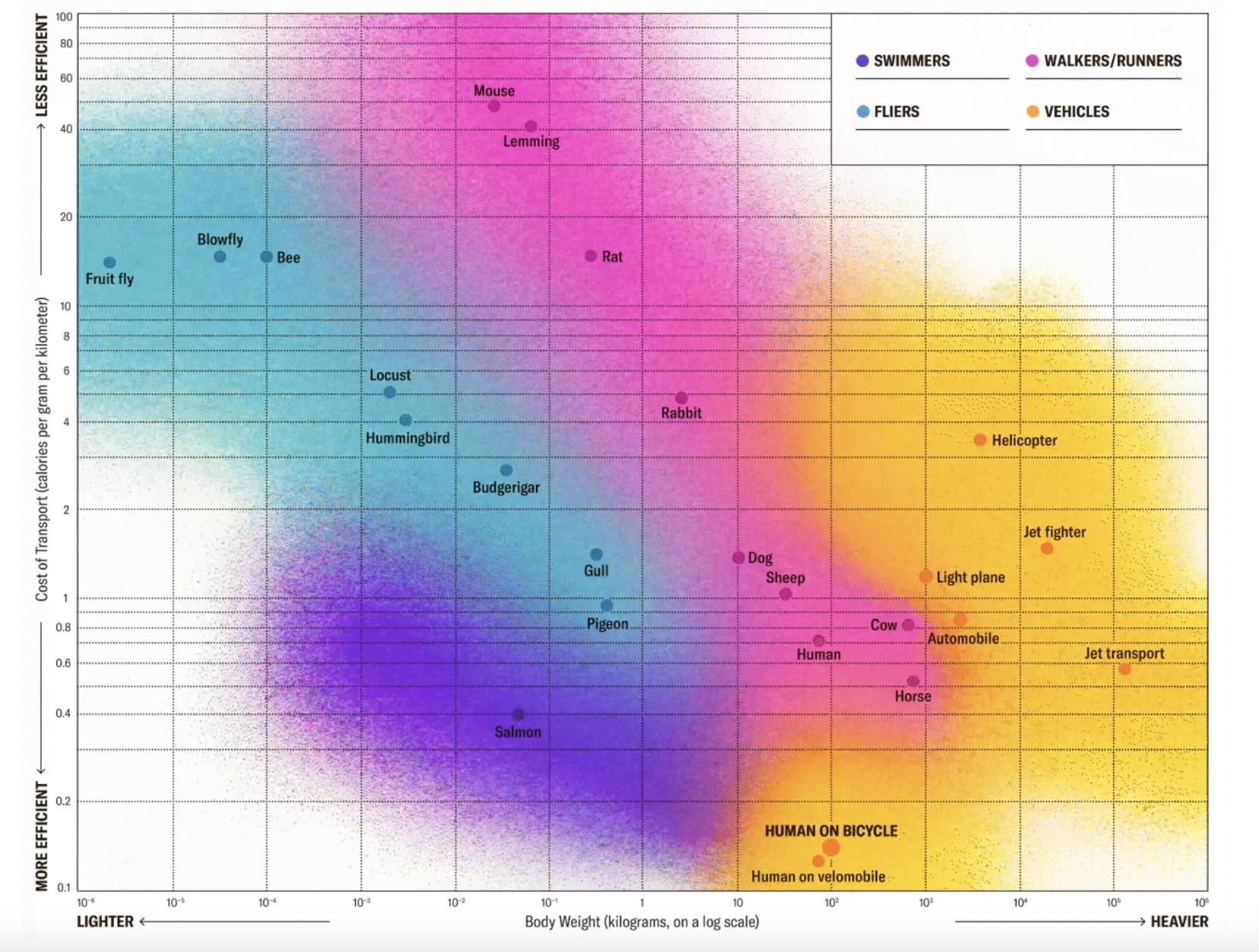
  3. It's #WorldBicycleDay and a good time to mention this graph from Scientific American, first published in 1973, and updated 2025.
It's #WorldBicycleDay and a good time to mention this graph from Scientific American, first published in 1973, and updated 2025.

Scheduled Pinned Locked Moved Uncategorized
worldbicycledaybiketooterclimate
43 Posts 22 Posters 0 Views
  • Oldest to Newest
  • Newest to Oldest
  • Most Votes
Reply
  • Reply as topic
Log in to reply
This topic has been deleted. Only users with topic management privileges can see it.
  • two9a@hachyderm.ioT two9a@hachyderm.io

    @markhburton @KingmaYpe Mm, it may feel like it's three times more efficient for the human pedalling, but that load's been transferred to the motor I guess.

    Definitely on a par for efficiency though.

    markhburton@mstdn.socialM This user is from outside of this forum
    markhburton@mstdn.socialM This user is from outside of this forum
    markhburton@mstdn.social
    wrote last edited by
    #19

    @Two9A @KingmaYpe
    You'd have to include at least the energy used in generation, transmission and battery losses, and conversion losses motion to electricity at source, and vice versa at the motor.
    That's not taking account of the additional mining, processing, manufacture and distribution of the motor battery, and charger.

    1 Reply Last reply
    0
    • lovestha@floss.socialL lovestha@floss.social

      @Two9A @KingmaYpe but I don't think I trust freight train as only twice as energy efficient as a jet.

      two9a@hachyderm.ioT This user is from outside of this forum
      two9a@hachyderm.ioT This user is from outside of this forum
      two9a@hachyderm.io
      wrote last edited by
      #20

      @LovesTha @KingmaYpe I dunno, the widebodies with the gargantuan turbofans are astonishingly efficient. I found figures for the A330neo as operated by Cebu Pacific (with 459 seats crammed into economy) of 250 tons takeoff weight, 1.75L/100km of Jet-A used per seat; that translates to 0.6 cal/g/km if my sums work out.

      maccruiskeen@social.linux.pizzaM 1 Reply Last reply
      0
      • W woo@fosstodon.org

        @Two9A When you look at how close to zero it is, it's amazing how much people will spend for a tiny increase in efficiency.

        The first person I knew who bought an expensive bike realised that the lock he bought to protect it weighed more than the weight he'd saved by buying expensive tubing.

        W This user is from outside of this forum
        W This user is from outside of this forum
        woo@fosstodon.org
        wrote last edited by
        #21

        @Two9A I just remembered that he also dragged that lock over the roof of a black car he hadn't seen, because dropped handlebars aren't a great idea in built-up areas, smashed his head and faced a crazy insurance claim.

        1 Reply Last reply
        0
        • two9a@hachyderm.ioT two9a@hachyderm.io

          It's #WorldBicycleDay and a good time to mention this graph from Scientific American, first published in 1973, and updated 2025.

          A person on a bike is the world's most energy-efficient mode of transport, and it's not even close. Salmon use three times as many joules/g/km to get around, and then it's jet aircraft at 5x.

          #BikeTooter #Climate

          mr_harm@mastodon.socialM This user is from outside of this forum
          mr_harm@mastodon.socialM This user is from outside of this forum
          mr_harm@mastodon.social
          wrote last edited by
          #22

          @Two9A interesting that a fighter jet is quite efficient in comparison to most walking animals...

          1 Reply Last reply
          0
          • R relay@relay.an.exchange shared this topic
          • two9a@hachyderm.ioT two9a@hachyderm.io

            It's #WorldBicycleDay and a good time to mention this graph from Scientific American, first published in 1973, and updated 2025.

            A person on a bike is the world's most energy-efficient mode of transport, and it's not even close. Salmon use three times as many joules/g/km to get around, and then it's jet aircraft at 5x.

            #BikeTooter #Climate

            joncounts@mastodon.nzJ This user is from outside of this forum
            joncounts@mastodon.nzJ This user is from outside of this forum
            joncounts@mastodon.nz
            wrote last edited by
            #23

            @Two9A There are velomobiles and then there’s Australian Aidan Lampe in a velomobile, who just set a world record by biking 1,512 km (!!!) in 24 hours, averaging over 63 km/hr.

            Extraordinary.

            ligfietsers (@ligfietsers@mastodon.nl)

            Confirmed & Insane: The new 24-Hour Velomobile World Record is 1,512 km / 940 Miles #ligfietsers https://www.recumbent.news/2026/05/31/confirmed-insane-the-new-24-hour-velomobile-world-record-is-1512-km-940-miles/ #Velomobile #Races

            favicon

            Mastodon.nl door Stichting Activityclub (mastodon.nl)

            armb@infosec.exchangeA 1 Reply Last reply
            0
            • two9a@hachyderm.ioT two9a@hachyderm.io

              It's #WorldBicycleDay and a good time to mention this graph from Scientific American, first published in 1973, and updated 2025.

              A person on a bike is the world's most energy-efficient mode of transport, and it's not even close. Salmon use three times as many joules/g/km to get around, and then it's jet aircraft at 5x.

              #BikeTooter #Climate

              esorette@rivals.spaceE This user is from outside of this forum
              esorette@rivals.spaceE This user is from outside of this forum
              esorette@rivals.space
              wrote last edited by
              #24

              @Two9A where are the trains ? am I missing something ?

              two9a@hachyderm.ioT 1 Reply Last reply
              0
              • esorette@rivals.spaceE esorette@rivals.space

                @Two9A where are the trains ? am I missing something ?

                two9a@hachyderm.ioT This user is from outside of this forum
                two9a@hachyderm.ioT This user is from outside of this forum
                two9a@hachyderm.io
                wrote last edited by
                #25

                RE: https://floss.social/@LovesTha/116685207077107467

                @esorette A figure found by @LovesTha puts freight trains in the lower right, about twice as energy-efficient as aeroplanes: https://hachyderm.io/@LovesTha@floss.social/116685207112065538

                lovestha@floss.socialL 1 Reply Last reply
                0
                • two9a@hachyderm.ioT two9a@hachyderm.io

                  RE: https://floss.social/@LovesTha/116685207077107467

                  @esorette A figure found by @LovesTha puts freight trains in the lower right, about twice as energy-efficient as aeroplanes: https://hachyderm.io/@LovesTha@floss.social/116685207112065538

                  lovestha@floss.socialL This user is from outside of this forum
                  lovestha@floss.socialL This user is from outside of this forum
                  lovestha@floss.social
                  wrote last edited by
                  #26

                  @Two9A @esorette what i didn't say was that freight trains can be off the chart to the right 🙂

                  They be heavy.

                  1 Reply Last reply
                  0
                  • two9a@hachyderm.ioT two9a@hachyderm.io

                    It's #WorldBicycleDay and a good time to mention this graph from Scientific American, first published in 1973, and updated 2025.

                    A person on a bike is the world's most energy-efficient mode of transport, and it's not even close. Salmon use three times as many joules/g/km to get around, and then it's jet aircraft at 5x.

                    #BikeTooter #Climate

                    jochenlingelba1@h-net.socialJ This user is from outside of this forum
                    jochenlingelba1@h-net.socialJ This user is from outside of this forum
                    jochenlingelba1@h-net.social
                    wrote last edited by
                    #27

                    @Two9A And here is the original 1973 article: https://www.jstor.org/stable/24923004

                    1 Reply Last reply
                    0
                    • joncounts@mastodon.nzJ joncounts@mastodon.nz

                      @Two9A There are velomobiles and then there’s Australian Aidan Lampe in a velomobile, who just set a world record by biking 1,512 km (!!!) in 24 hours, averaging over 63 km/hr.

                      Extraordinary.

                      ligfietsers (@ligfietsers@mastodon.nl)

                      Confirmed & Insane: The new 24-Hour Velomobile World Record is 1,512 km / 940 Miles #ligfietsers https://www.recumbent.news/2026/05/31/confirmed-insane-the-new-24-hour-velomobile-world-record-is-1512-km-940-miles/ #Velomobile #Races

                      favicon

                      Mastodon.nl door Stichting Activityclub (mastodon.nl)

                      armb@infosec.exchangeA This user is from outside of this forum
                      armb@infosec.exchangeA This user is from outside of this forum
                      armb@infosec.exchange
                      wrote last edited by
                      #28

                      @joncounts @Two9A I don't believe the "velomobile weighs less than bicycle" as shown on the chart though.

                      two9a@hachyderm.ioT 1 Reply Last reply
                      0
                      • armb@infosec.exchangeA armb@infosec.exchange

                        @joncounts @Two9A I don't believe the "velomobile weighs less than bicycle" as shown on the chart though.

                        two9a@hachyderm.ioT This user is from outside of this forum
                        two9a@hachyderm.ioT This user is from outside of this forum
                        two9a@hachyderm.io
                        wrote last edited by
                        #29

                        @armb @joncounts Mm, I mentioned elsewhere that I think the "human on velomobile" is one data point, and the person they found to measure energy output was just particularly small and light. It was always going to be in the ballpark of "human on bike" though.

                        1 Reply Last reply
                        0
                        • two9a@hachyderm.ioT two9a@hachyderm.io

                          It's #WorldBicycleDay and a good time to mention this graph from Scientific American, first published in 1973, and updated 2025.

                          A person on a bike is the world's most energy-efficient mode of transport, and it's not even close. Salmon use three times as many joules/g/km to get around, and then it's jet aircraft at 5x.

                          #BikeTooter #Climate

                          alper@rls.socialA This user is from outside of this forum
                          alper@rls.socialA This user is from outside of this forum
                          alper@rls.social
                          wrote last edited by
                          #30

                          @Two9A Can somebody update this and add an e-bike?

                          1 Reply Last reply
                          0
                          • kingmaype@mastodon.greenK kingmaype@mastodon.green

                            @Two9A @markhburton

                            Muscles are about as efficient as combustion engines.

                            kingmaype@mastodon.greenK This user is from outside of this forum
                            kingmaype@mastodon.greenK This user is from outside of this forum
                            kingmaype@mastodon.green
                            wrote last edited by
                            #31

                            @Two9A @markhburton

                            Fatbikes in NL take about 20 Wh/km:

                            Link Preview Image
                            Hoeveel stroom verbruikt een elektrische fiets? | ANWB

                            Hoeveel kWh een elektrische fiets verbruikt hangt af van meerdere factoren. Lees hier alles over het (besparen van) stroomverbruik met een elektrische fiets.

                            favicon

                            ANWB (www.anwb.nl)

                            A Wh is about 0.86 calories.

                            two9a@hachyderm.ioT 1 Reply Last reply
                            0
                            • two9a@hachyderm.ioT two9a@hachyderm.io

                              @LovesTha @KingmaYpe I dunno, the widebodies with the gargantuan turbofans are astonishingly efficient. I found figures for the A330neo as operated by Cebu Pacific (with 459 seats crammed into economy) of 250 tons takeoff weight, 1.75L/100km of Jet-A used per seat; that translates to 0.6 cal/g/km if my sums work out.

                              maccruiskeen@social.linux.pizzaM This user is from outside of this forum
                              maccruiskeen@social.linux.pizzaM This user is from outside of this forum
                              maccruiskeen@social.linux.pizza
                              wrote last edited by
                              #32

                              @Two9A @LovesTha @KingmaYpe Sure, but I think for my commute to work (3mi) the bike still cmes out ahead. But I am not going to able to bike to Europe.

                              lovestha@floss.socialL 1 Reply Last reply
                              0
                              • kingmaype@mastodon.greenK kingmaype@mastodon.green

                                @Two9A @markhburton

                                Fatbikes in NL take about 20 Wh/km:

                                Link Preview Image
                                Hoeveel stroom verbruikt een elektrische fiets? | ANWB

                                Hoeveel kWh een elektrische fiets verbruikt hangt af van meerdere factoren. Lees hier alles over het (besparen van) stroomverbruik met een elektrische fiets.

                                favicon

                                ANWB (www.anwb.nl)

                                A Wh is about 0.86 calories.

                                two9a@hachyderm.ioT This user is from outside of this forum
                                two9a@hachyderm.ioT This user is from outside of this forum
                                two9a@hachyderm.io
                                wrote last edited by
                                #33

                                @KingmaYpe @markhburton Which would be 0.0086 calories per kg per km if you're a hundred kg's and jump on an ebike.

                                That's below the bottom of the Y-axis on this chart, by some distance.

                                kingmaype@mastodon.greenK 1 Reply Last reply
                                0
                                • two9a@hachyderm.ioT two9a@hachyderm.io

                                  It's #WorldBicycleDay and a good time to mention this graph from Scientific American, first published in 1973, and updated 2025.

                                  A person on a bike is the world's most energy-efficient mode of transport, and it's not even close. Salmon use three times as many joules/g/km to get around, and then it's jet aircraft at 5x.

                                  #BikeTooter #Climate

                                  L This user is from outside of this forum
                                  L This user is from outside of this forum
                                  luc0x61@mastodon.gamedev.place
                                  wrote last edited by
                                  #34

                                  @Two9A Curious that electric trains aren't mentioned, given the low friction and efficient transmission of power. Maybe because it was an abandoned transportation in the 1970s America, to support the combustion engines local industry.

                                  1 Reply Last reply
                                  0
                                  • two9a@hachyderm.ioT two9a@hachyderm.io

                                    @KingmaYpe @markhburton Which would be 0.0086 calories per kg per km if you're a hundred kg's and jump on an ebike.

                                    That's below the bottom of the Y-axis on this chart, by some distance.

                                    kingmaype@mastodon.greenK This user is from outside of this forum
                                    kingmaype@mastodon.greenK This user is from outside of this forum
                                    kingmaype@mastodon.green
                                    wrote last edited by
                                    #35

                                    @Two9A @markhburton

                                    Times 20, but still off scale.

                                    1 Reply Last reply
                                    0
                                    • two9a@hachyderm.ioT two9a@hachyderm.io

                                      It's #WorldBicycleDay and a good time to mention this graph from Scientific American, first published in 1973, and updated 2025.

                                      A person on a bike is the world's most energy-efficient mode of transport, and it's not even close. Salmon use three times as many joules/g/km to get around, and then it's jet aircraft at 5x.

                                      #BikeTooter #Climate

                                      lpryszcz@genomic.socialL This user is from outside of this forum
                                      lpryszcz@genomic.socialL This user is from outside of this forum
                                      lpryszcz@genomic.social
                                      wrote last edited by
                                      #36

                                      @Two9A where do train and bus fall?

                                      two9a@hachyderm.ioT 1 Reply Last reply
                                      0
                                      • lpryszcz@genomic.socialL lpryszcz@genomic.social

                                        @Two9A where do train and bus fall?

                                        two9a@hachyderm.ioT This user is from outside of this forum
                                        two9a@hachyderm.ioT This user is from outside of this forum
                                        two9a@hachyderm.io
                                        wrote last edited by
                                        #37

                                        @lpryszcz Elsewhere in this thread, calculations are floating around of 0.3 cal/g/km; that'd be on the scale of an aircraft (or above that) in weight, but more energy efficient.

                                        1 Reply Last reply
                                        0
                                        • two9a@hachyderm.ioT two9a@hachyderm.io

                                          It's #WorldBicycleDay and a good time to mention this graph from Scientific American, first published in 1973, and updated 2025.

                                          A person on a bike is the world's most energy-efficient mode of transport, and it's not even close. Salmon use three times as many joules/g/km to get around, and then it's jet aircraft at 5x.

                                          #BikeTooter #Climate

                                          laughingcoyote@social.vivaldi.netL This user is from outside of this forum
                                          laughingcoyote@social.vivaldi.netL This user is from outside of this forum
                                          laughingcoyote@social.vivaldi.net
                                          wrote last edited by
                                          #38

                                          @Two9A I recall Astronomer Carl Sagan in his promotion of the bicycle as the most efficient mode of transport said that if the surface of the earth were glass (meaning very flat and smooth), lizards would have evolved wheels rather than feet. An additional element is that the power source of the bicycle and the the passenger(s) are the same, self-contained, unit, so you don't have to move around a power source, much of the drive train, container, as well as large tires to support this load in addition to the passenger, which also minimizes friction in both the wheels and airflow. Probably a key element in energy efficiency then becomes the energy subsidies in the food source, but this holds for both bicycle and other other forms of transport as people must eat to sustain themselves whether or not they ride bicycle to get around. Furthermore non-bicyclists require exercise separate from their transport to burn off stored excess energy and sustain their health which adds additional energy costs including transport to and from the gym, and even more if they don't exercise and are forced to utilize the highly energy and resource intensive medical system to keep themselves functioning. I'll note my wife is going on 88 years, riding a bicycle between 10 and as much as a hundred miles a day, despite knee problems walking.

                                          1 Reply Last reply
                                          0
                                          Reply
                                          • Reply as topic
                                          Log in to reply
                                          • Oldest to Newest
                                          • Newest to Oldest
                                          • Most Votes


                                          • Login

                                          • Login or register to search.
                                          • First post
                                            Last post
                                          0
                                          • Categories
                                          • Recent
                                          • Tags
                                          • Popular
                                          • World
                                          • Users
                                          • Groups