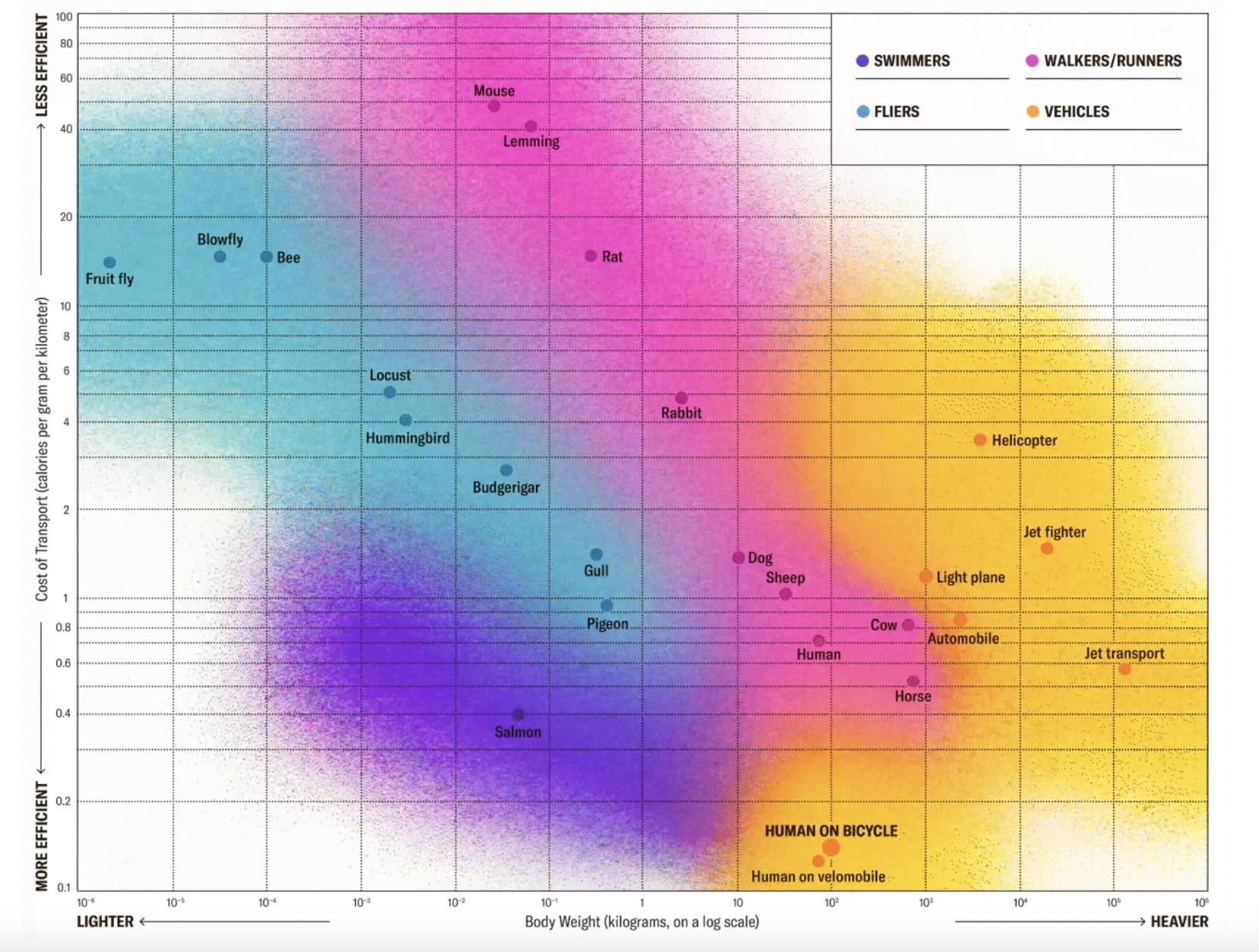
It's #WorldBicycleDay and a good time to mention this graph from Scientific American, first published in 1973, and updated 2025.
-
@LovesTha @KingmaYpe At least the ebike missing makes sense, if the data's from 1973; the energy efficiency of the average train or bus you'd need to ask SciAm for, as to where it sits on this plot.
I'd _guess_ they'd sit on the far lower right, at the bottom of that vehicular zone, which would still make "human on bike" lower on energy use.
@Two9A @KingmaYpe the cloud of machine points implies they used such data, they just didn't choose to highlight the bus and train.
-
@LovesTha @KingmaYpe At least the ebike missing makes sense, if the data's from 1973; the energy efficiency of the average train or bus you'd need to ask SciAm for, as to where it sits on this plot.
I'd _guess_ they'd sit on the far lower right, at the bottom of that vehicular zone, which would still make "human on bike" lower on energy use.
-
@KingmaYpe @Two9A Trains and buses missing is also interesting choices.
@LovesTha @KingmaYpe @Two9A
No trains either! -
@KingmaYpe @Two9A
How can that possibly be true?@markhburton @KingmaYpe Mm, it may feel like it's three times more efficient for the human pedalling, but that load's been transferred to the motor I guess.
Definitely on a par for efficiency though.
-
@Two9A @KingmaYpe the cloud of machine points implies they used such data, they just didn't choose to highlight the bus and train.
@Two9A @KingmaYpe the first piece of data I can find converts to 0.3 calories per gram per km for freight trains. So probably as efficient as human in velomobile.
Edit: sorry, reading chart badly. 0.3 is worse than the bikes. But still very good
-
@Two9A @KingmaYpe the first piece of data I can find converts to 0.3 calories per gram per km for freight trains. So probably as efficient as human in velomobile.
Edit: sorry, reading chart badly. 0.3 is worse than the bikes. But still very good
@Two9A @KingmaYpe but I don't think I trust freight train as only twice as energy efficient as a jet.
-
@markhburton @KingmaYpe Mm, it may feel like it's three times more efficient for the human pedalling, but that load's been transferred to the motor I guess.
Definitely on a par for efficiency though.
Muscles are about as efficient as combustion engines.
-
It's #WorldBicycleDay and a good time to mention this graph from Scientific American, first published in 1973, and updated 2025.
A person on a bike is the world's most energy-efficient mode of transport, and it's not even close. Salmon use three times as many joules/g/km to get around, and then it's jet aircraft at 5x.
@Two9A When you look at how close to zero it is, it's amazing how much people will spend for a tiny increase in efficiency.
The first person I knew who bought an expensive bike realised that the lock he bought to protect it weighed more than the weight he'd saved by buying expensive tubing.
-
@markhburton @KingmaYpe Mm, it may feel like it's three times more efficient for the human pedalling, but that load's been transferred to the motor I guess.
Definitely on a par for efficiency though.
@Two9A @KingmaYpe
You'd have to include at least the energy used in generation, transmission and battery losses, and conversion losses motion to electricity at source, and vice versa at the motor.
That's not taking account of the additional mining, processing, manufacture and distribution of the motor battery, and charger. -
@Two9A @KingmaYpe but I don't think I trust freight train as only twice as energy efficient as a jet.
@LovesTha @KingmaYpe I dunno, the widebodies with the gargantuan turbofans are astonishingly efficient. I found figures for the A330neo as operated by Cebu Pacific (with 459 seats crammed into economy) of 250 tons takeoff weight, 1.75L/100km of Jet-A used per seat; that translates to 0.6 cal/g/km if my sums work out.
-
@Two9A When you look at how close to zero it is, it's amazing how much people will spend for a tiny increase in efficiency.
The first person I knew who bought an expensive bike realised that the lock he bought to protect it weighed more than the weight he'd saved by buying expensive tubing.
@Two9A I just remembered that he also dragged that lock over the roof of a black car he hadn't seen, because dropped handlebars aren't a great idea in built-up areas, smashed his head and faced a crazy insurance claim.
-
It's #WorldBicycleDay and a good time to mention this graph from Scientific American, first published in 1973, and updated 2025.
A person on a bike is the world's most energy-efficient mode of transport, and it's not even close. Salmon use three times as many joules/g/km to get around, and then it's jet aircraft at 5x.
@Two9A interesting that a fighter jet is quite efficient in comparison to most walking animals...
-
R relay@relay.an.exchange shared this topic
-
It's #WorldBicycleDay and a good time to mention this graph from Scientific American, first published in 1973, and updated 2025.
A person on a bike is the world's most energy-efficient mode of transport, and it's not even close. Salmon use three times as many joules/g/km to get around, and then it's jet aircraft at 5x.
@Two9A There are velomobiles and then there’s Australian Aidan Lampe in a velomobile, who just set a world record by biking 1,512 km (!!!) in 24 hours, averaging over 63 km/hr.
Extraordinary.
-
It's #WorldBicycleDay and a good time to mention this graph from Scientific American, first published in 1973, and updated 2025.
A person on a bike is the world's most energy-efficient mode of transport, and it's not even close. Salmon use three times as many joules/g/km to get around, and then it's jet aircraft at 5x.
@Two9A where are the trains ? am I missing something ?
-
@Two9A where are the trains ? am I missing something ?
RE: https://floss.social/@LovesTha/116685207077107467
@esorette A figure found by @LovesTha puts freight trains in the lower right, about twice as energy-efficient as aeroplanes: https://hachyderm.io/@LovesTha@floss.social/116685207112065538
-
RE: https://floss.social/@LovesTha/116685207077107467
@esorette A figure found by @LovesTha puts freight trains in the lower right, about twice as energy-efficient as aeroplanes: https://hachyderm.io/@LovesTha@floss.social/116685207112065538
-
It's #WorldBicycleDay and a good time to mention this graph from Scientific American, first published in 1973, and updated 2025.
A person on a bike is the world's most energy-efficient mode of transport, and it's not even close. Salmon use three times as many joules/g/km to get around, and then it's jet aircraft at 5x.
@Two9A And here is the original 1973 article: https://www.jstor.org/stable/24923004
-
@Two9A There are velomobiles and then there’s Australian Aidan Lampe in a velomobile, who just set a world record by biking 1,512 km (!!!) in 24 hours, averaging over 63 km/hr.
Extraordinary.
@joncounts @Two9A I don't believe the "velomobile weighs less than bicycle" as shown on the chart though.
-
@joncounts @Two9A I don't believe the "velomobile weighs less than bicycle" as shown on the chart though.
@armb @joncounts Mm, I mentioned elsewhere that I think the "human on velomobile" is one data point, and the person they found to measure energy output was just particularly small and light. It was always going to be in the ballpark of "human on bike" though.
-
It's #WorldBicycleDay and a good time to mention this graph from Scientific American, first published in 1973, and updated 2025.
A person on a bike is the world's most energy-efficient mode of transport, and it's not even close. Salmon use three times as many joules/g/km to get around, and then it's jet aircraft at 5x.
@Two9A Can somebody update this and add an e-bike?