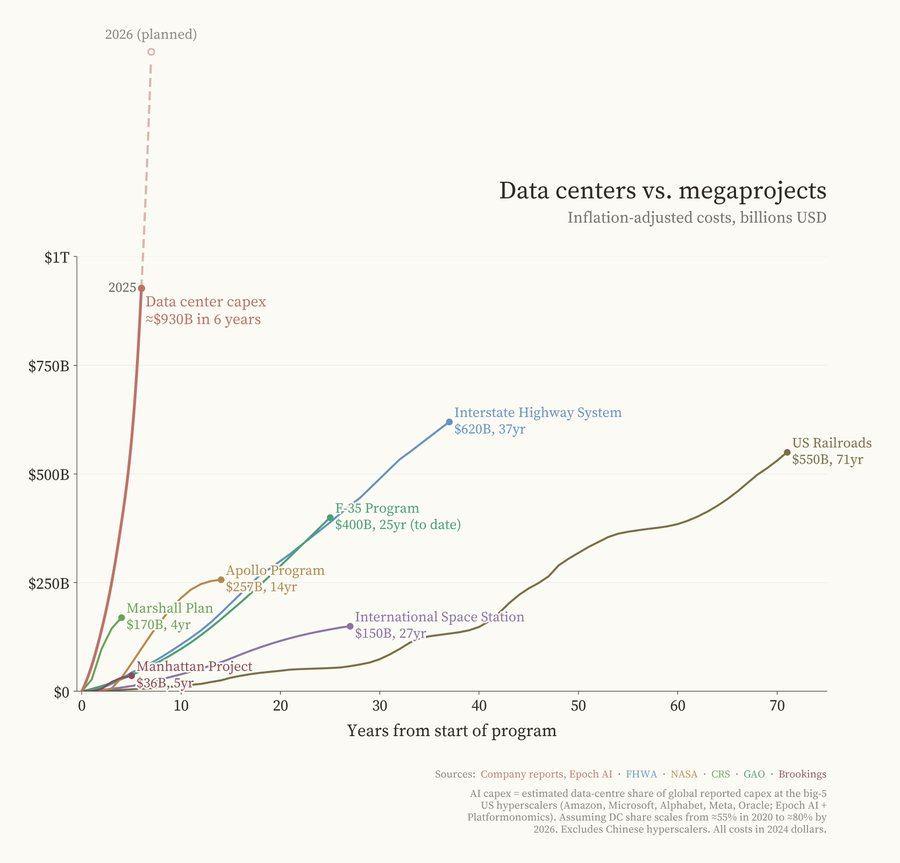
> The hyperscalers have already outspent the most famous US megaprojects
-
-
> The hyperscalers have already outspent the most famous US megaprojects
this looks sustainable, datacenters are a one-time cost... right?!?
What index did they use for the inflation adjustment?
-
> The hyperscalers have already outspent the most famous US megaprojects
this looks sustainable, datacenters are a one-time cost... right?!?
@cwebber now I'm looking at us railroads through the lens of a bubble investment and wondering if after all the loss of life and resettlement we could even call them a success from our standpoint in 2026
-
> The hyperscalers have already outspent the most famous US megaprojects
this looks sustainable, datacenters are a one-time cost... right?!?
@cwebber What are we even doing here?
-
What index did they use for the inflation adjustment?
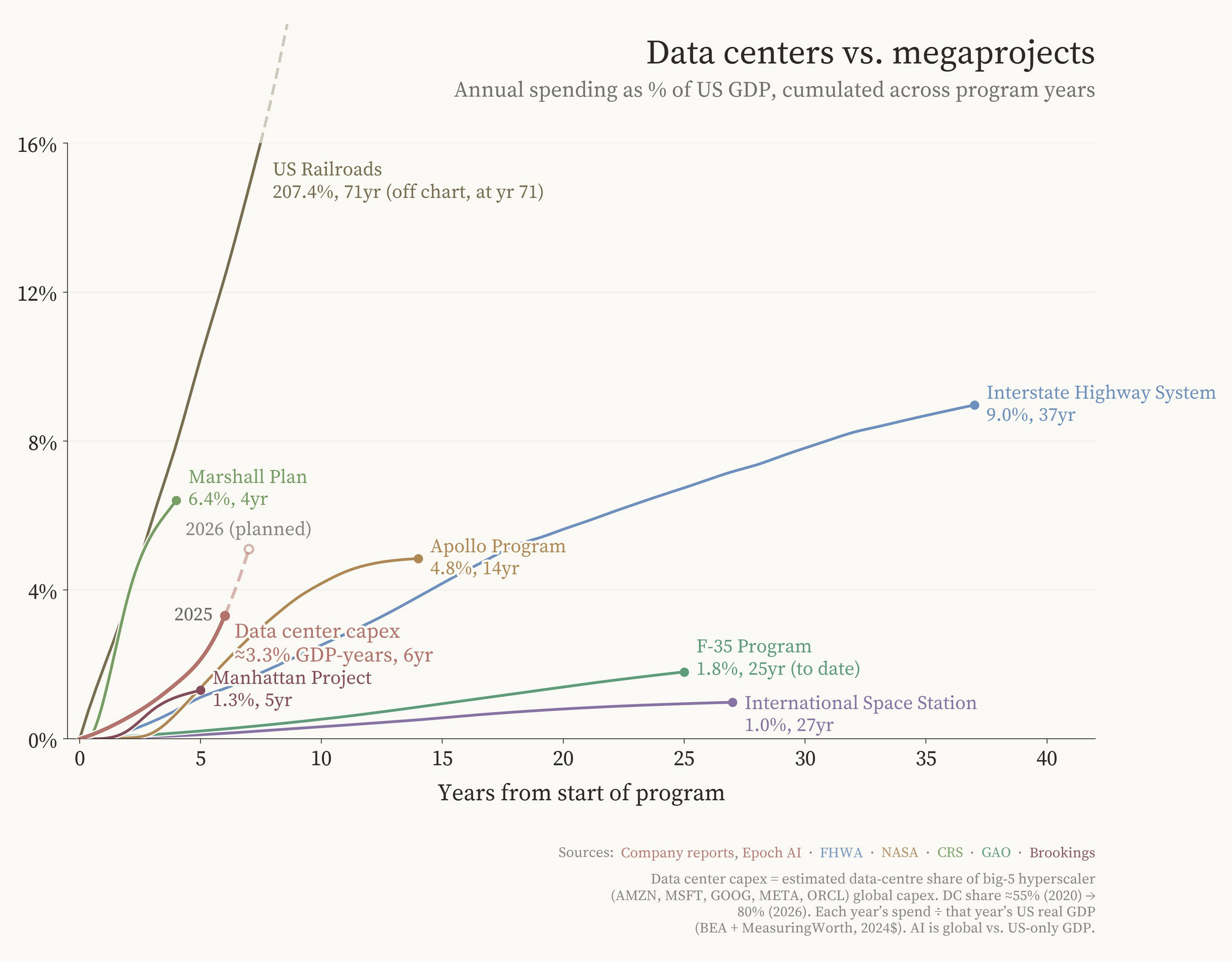
Weird to adjust historic spending on infrastructure projects by a consumer price index. This is better.
-
Weird to adjust historic spending on infrastructure projects by a consumer price index. This is better.
Percentage of GDP, for privately led projects doesn't seem a good index for me.
-
> The hyperscalers have already outspent the most famous US megaprojects
this looks sustainable, datacenters are a one-time cost... right?!?
@cwebber bubble
-
Percentage of GDP, for privately led projects doesn't seem a good index for me.
It's a better proxy for productive capacity than a price index based on wildly different baskets of consumer goods over the centuries.
And since when were apollo or the Manhattan project or the international space station or the interstate highway system private programs?
-
It's a better proxy for productive capacity than a price index based on wildly different baskets of consumer goods over the centuries.
And since when were apollo or the Manhattan project or the international space station or the interstate highway system private programs?
That's my point. None of those programs are private. However, the data centers _are_. It is unusual when the spending of private corporations outstrips that of their own government, on infrastructure.
Which is why GDP seems a bad fit, here. Because it uses the investments by private corps as part of its calculation, but doesn't fully cover government spending in the same period.
-
> The hyperscalers have already outspent the most famous US megaprojects
this looks sustainable, datacenters are a one-time cost... right?!?
@cwebber I suspect there is something important that is misleading about that graph, and I don't know quite what it is, but here are clues. A "data center" in practical / technical terms, is not defined by the computers inside it, but by a building (real estate), and the power & network connected to it. I walk through a floor of a data center in the Boston area every few weeks, for the past 5 years. I see maybe 200 racks, and room for 200 more. A large empty room, extremely little change. (1/2)
-
@cwebber I suspect there is something important that is misleading about that graph, and I don't know quite what it is, but here are clues. A "data center" in practical / technical terms, is not defined by the computers inside it, but by a building (real estate), and the power & network connected to it. I walk through a floor of a data center in the Boston area every few weeks, for the past 5 years. I see maybe 200 racks, and room for 200 more. A large empty room, extremely little change. (1/2)
@cwebber The company, https://en.wikipedia.org/wiki/American_Tower , has 27 data centers, 10 billion in revenue, it is not a small player, and its revenue and stock price have been flat over the past few years. So, I have to wonder how much of this kind of this stuff is at the same level of reporting as science reporting constantly telling us about the breakthrough that is about to cure cancer.
-
@cwebber wish we had LHC on that graph
@darkuncle @cwebber
It's a measly 4 or 5 billion USD (4.3*10⁹ CHF)
https://home.cern/resources/faqs/facts-and-figures-about-lhc -
> The hyperscalers have already outspent the most famous US megaprojects
this looks sustainable, datacenters are a one-time cost... right?!?
@cwebber OOPSIE!
-
> The hyperscalers have already outspent the most famous US megaprojects
this looks sustainable, datacenters are a one-time cost... right?!?
@cwebber Contrast this with current revenue generated by AI providers running on top of these and future necessary revenue these providers would need to generate during the lifetime of these data centers for a positive ROI.
-
That's my point. None of those programs are private. However, the data centers _are_. It is unusual when the spending of private corporations outstrips that of their own government, on infrastructure.
Which is why GDP seems a bad fit, here. Because it uses the investments by private corps as part of its calculation, but doesn't fully cover government spending in the same period.
Government spending is included in GDP. Public and private investment recruit from the same pool of capital.
-
> The hyperscalers have already outspent the most famous US megaprojects
this looks sustainable, datacenters are a one-time cost... right?!?
@cwebber
is this spending or announced future spendings? -
@cwebber
is this spending or announced future spendings? -
Government spending is included in GDP. Public and private investment recruit from the same pool of capital.
Government spending goes into debt, not profits. Governments usually go into deficit on purpose. The investment is not visible, in the same way, in the same timeframe.
-
@cwebber wish we had LHC on that graph
@darkuncle @cwebber the LHC was not a US project, and cost only between 4.7 and 6.5 B. That’s a most a third of what Facebook paid for WhatsApp. Probably less than a week of Iran war.
-
Government spending goes into debt, not profits. Governments usually go into deficit on purpose. The investment is not visible, in the same way, in the same timeframe.
Do you think that the private sector does not finance its capital spending with debt, or doesn't do it on purpose, or something? We were at one point comparing the scale of capital flows into infrastructure projects, the structure of the financing is irrelevant.