@bloor what if SQL is pronounced “squirrel”?
 R
R
robinhouston@mathstodon.xyz
@robinhouston@mathstodon.xyz
Posts
-
If SQL is pronounced "sequel" then surely DNS is pronounced "Dennis"? -
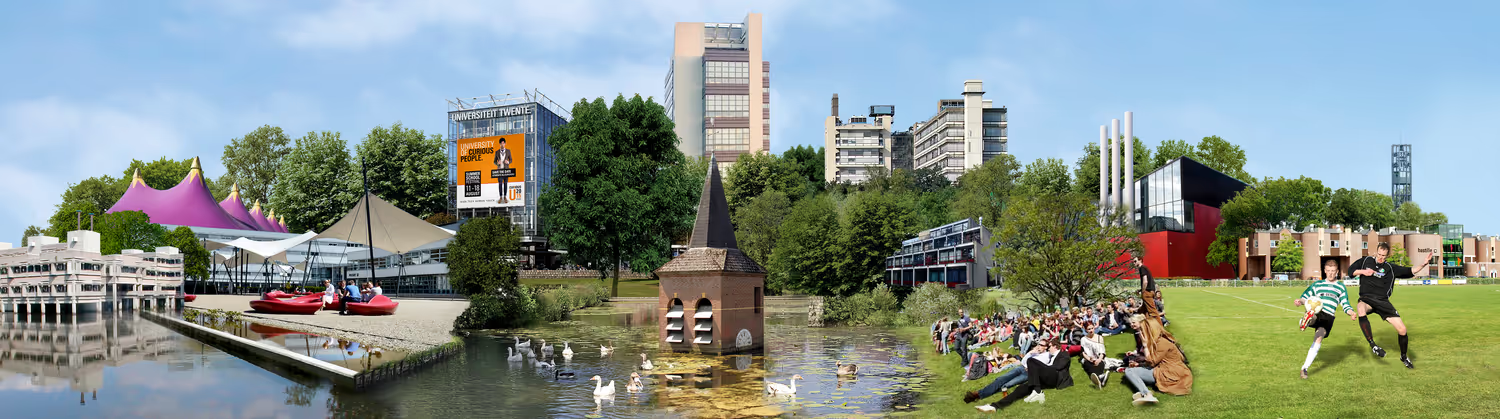
TIL. In April 1974, in the middle of the night, a small group of conspirators secretly installed a large tensegrity icosahedron made from discarded telephone poles on the campus of Twente University in the Netherlands.@simontatham Incidentally, if you read Jessen's paper he actually describes a multiparameter continuous family of orthogonal icosahedra, most of which *are* chiral – but everyone seems to have forgotten all of them apart from the simplest one.
-
TIL. In April 1974, in the middle of the night, a small group of conspirators secretly installed a large tensegrity icosahedron made from discarded telephone poles on the campus of Twente University in the Netherlands.@simontatham I think the tensegrity has the same geometry as Jessen's icosahedron, which is not the same as a regular icosahedron but not chiral either.
-
TIL. In April 1974, in the middle of the night, a small group of conspirators secretly installed a large tensegrity icosahedron made from discarded telephone poles on the campus of Twente University in the Netherlands.A funny detail, via @11011110:
In 2008, the university temporarily removed Het Ding for maintenance – and they accidentally put it back the other way up!
See before and after photos here, taken from https://www.utoday.nl/campus-life/74074/student-prank-and-artwork-het-ding-exists-50-years
-
TIL. In April 1974, in the middle of the night, a small group of conspirators secretly installed a large tensegrity icosahedron made from discarded telephone poles on the campus of Twente University in the Netherlands.@11011110 I wonder if we can find before and after photos to compare.
*Edit*: Yes, this article has comparison photos: https://www.utoday.nl/campus-life/74074/student-prank-and-artwork-het-ding-exists-50-years
I can see why he called it ‘mirrored’ – the transformation applied is equivalent to reflection in a horizontal plane – though it is also equivalent to a rotation.
-
TIL. In April 1974, in the middle of the night, a small group of conspirators secretly installed a large tensegrity icosahedron made from discarded telephone poles on the campus of Twente University in the Netherlands.@11011110 Not to be confused with
-
TIL. In April 1974, in the middle of the night, a small group of conspirators secretly installed a large tensegrity icosahedron made from discarded telephone poles on the campus of Twente University in the Netherlands.TIL. In April 1974, in the middle of the night, a small group of conspirators secretly installed a large tensegrity icosahedron made from discarded telephone poles on the campus of Twente University in the Netherlands.
It’s still there. People call it Het Ding (“the thing”).
-
An unusual polyhedron whose dihedral angles are all right angles.You can fill space with this shape, its mirror image, and some small cubes.
-
An unusual polyhedron whose dihedral angles are all right angles.Here’s another way to do it. This one would make a fine paperweight!
It would be fun to make a hinged model, so you can flip between all the different possible variations physically.
-
In my online undergraduate P5.js course, students are about to begin the module on motion and physics, including a bit of physics simulation using Matter.js.@csk Ha! I saw this on HN earlier, and didn’t realise it was you. Very nice.
-
An unusual polyhedron whose dihedral angles are all right angles.An unusual polyhedron whose dihedral angles are all right angles. https://sketchfab.com/3d-models/orthogonalized-tetrahedron-c26dd2789da3406bbb00e5df769ade6d
-
“In this paper we present work on enumerating all the incomplete open platonic solids, finding 6 tetrahedra, 122 cubes (just like LeWitt), 185 octahedra, 2,423,206 dodecahedra and 16,096,166 icosahedra.” -
“In this paper we present work on enumerating all the incomplete open platonic solids, finding 6 tetrahedra, 122 cubes (just like LeWitt), 185 octahedra, 2,423,206 dodecahedra and 16,096,166 icosahedra.”“In this paper we present work on enumerating all the incomplete open platonic solids, finding 6 tetrahedra, 122 cubes (just like LeWitt), 185 octahedra, 2,423,206 dodecahedra and 16,096,166 icosahedra.”