What is the name of the institution where ministers from each of the 27 Member States meet to debate policies and adopt EU legislation, mostly jointly with the European Parliament?
-
What is the name of the institution where ministers from each of the 27 Member States meet to debate policies and adopt EU legislation, mostly jointly with the European Parliament?
-
What is the name of the institution where ministers from each of the 27 Member States meet to debate policies and adopt EU legislation, mostly jointly with the European Parliament?
@hpod16 Lucky that I was reading about this just today… but as I’m still not 100% sure I’d say 4 is most definitely correct.
-
What is the name of the institution where ministers from each of the 27 Member States meet to debate policies and adopt EU legislation, mostly jointly with the European Parliament?
Leave it to the EU to name institutions in a way where you could easily look up the answer and still get it wrong.
-
-
@hpod16 Lucky that I was reading about this just today… but as I’m still not 100% sure I’d say 4 is most definitely correct.
@o_O I think 4 is indeed “the most correct option”


-
I once observed a former judge of the Court of Justice get it wrong when trying to explain the difference between the European Court of Justice, the General Court, and the Court of Justice of the European Union.
Even the @Curia handle is somewhat misleading if one is pedantic - it should be curiae...
@hpod16 -
What is the name of the institution where ministers from each of the 27 Member States meet to debate policies and adopt EU legislation, mostly jointly with the European Parliament?
@hpod16 Interesting result so far

-
@hpod16 Interesting result so far
@AndiPopp this one is just annoying and confusing. 🫠
Let’s hope I’m in a good enough mood to write a decent explainer tomorrow when the poll ends! -
What is the name of the institution where ministers from each of the 27 Member States meet to debate policies and adopt EU legislation, mostly jointly with the European Parliament?
@hpod16 me when #WTFistheCouncil :

-
@hpod16 Lucky that I was reading about this just today… but as I’m still not 100% sure I’d say 4 is most definitely correct.
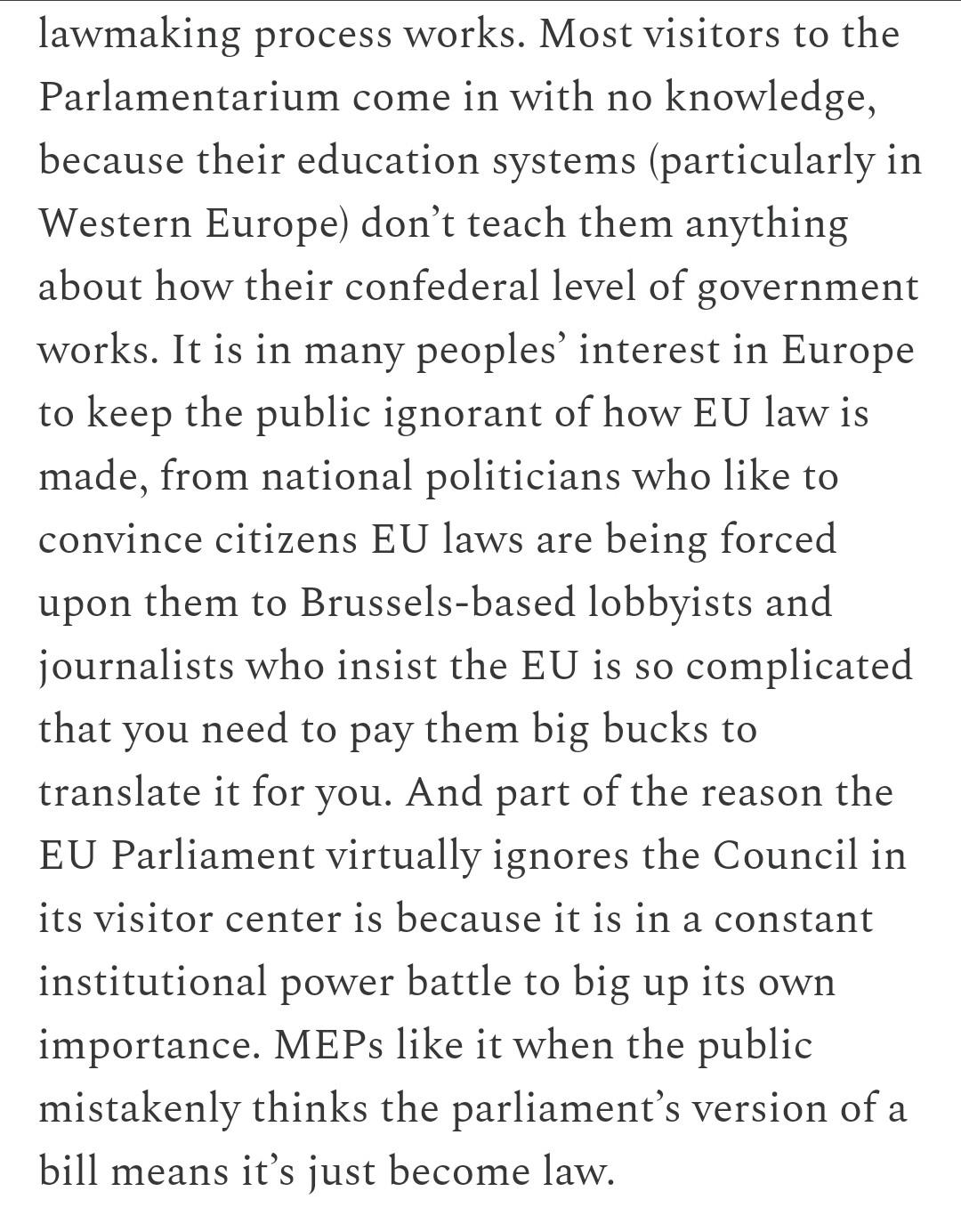
@o_O @hpod16 I think if your own national parliament is bicameral, it's really not that complicated, but nobody ever explains it to us as they would a national government and its executive/legislative divide... and I don't believe that omission is an oopsie. tldr: how are you supposed to #BlameBrussels if the peasants know YOU make EU law and ARE Brussels?
-
What is the name of the institution where ministers from each of the 27 Member States meet to debate policies and adopt EU legislation, mostly jointly with the European Parliament?
@hpod16 ..and the german-language media still calls it "Gipfel" lol
-
What is the name of the institution where ministers from each of the 27 Member States meet to debate policies and adopt EU legislation, mostly jointly with the European Parliament?
Ok, so the correct answer here was "the Council of the European Union." Meanwhile the "European Council" is where the EU's Heads of State or Government meet to define the EU's general political direction or priorities.
Also, the "Council of Europe" is not an EU body, and has non-EU countries like Georgia, Serbia, the UK party to it. -
Ok, so the correct answer here was "the Council of the European Union." Meanwhile the "European Council" is where the EU's Heads of State or Government meet to define the EU's general political direction or priorities.
Also, the "Council of Europe" is not an EU body, and has non-EU countries like Georgia, Serbia, the UK party to it.So why do #EU Member States meet in two different institutions with almost the same name?
Well, first the EU needs to identify the big issues that need EU solutions, and setting direction is the job of the *European Council*.
To achieve those objectives, the EU has to agree on law and policies, and adopt legislation, that's a job for *the Council of the European Union*
Source document: https://op.europa.eu/en/publication-detail/-/publication/a7f1adef-b93e-11f0-b37f-01aa75ed71a1/language-en?WT.mc_id=Selectedpublications&WT.ria_c=41957&WT.ria_f=9780&WT.ria_ev=search&WT.URL=https%3A%2F%2Fop.europa.eu%2Fen%2Fweb%2Fgeneral-publications%2Feucareersmaterial -
Ok, so the correct answer here was "the Council of the European Union." Meanwhile the "European Council" is where the EU's Heads of State or Government meet to define the EU's general political direction or priorities.
Also, the "Council of Europe" is not an EU body, and has non-EU countries like Georgia, Serbia, the UK party to it.@hpod16 So all of the three exist, but are different things? I hoped that there's only one answer and other were made up O_o
-
@hpod16 So all of the three exist, but are different things? I hoped that there's only one answer and other were made up O_o
@theZosia oh no, that would have been a lot less fun
you can't make this stuff up! -
@hpod16 So all of the three exist, but are different things? I hoped that there's only one answer and other were made up O_o
@theZosia @hpod16 tbh, that's not a bad way to think of it. The Council where Donald Tusk gets together to decide stuff with other heads of state and government is Real, it has *executive* power.
#WTFistheCouncil where Domański, Motyka et al make EU law (behind closed doors) as
 legislators is fake and should be called the Senate or whatever other name would make it immediately apparent to any EUropean that this institution makes EU law/legislates. Nobody's confused about Senate v. Sejm.
 -
@o_O @hpod16 I think if your own national parliament is bicameral, it's really not that complicated, but nobody ever explains it to us as they would a national government and its executive/legislative divide... and I don't believe that omission is an oopsie. tldr: how are you supposed to #BlameBrussels if the peasants know YOU make EU law and ARE Brussels?
@Veza85UE @hpod16 i think i know how it works (but didn’t until yesterday). But here difficulty mostly refers to having three things called very similar things. It’s telling that as I read on this in Swedish, there was an informal name (”minister council”) for the Council of the EU which sounded much more familiar.
(for the record, Sweden actually only has one chamber since 1971, fun fact)
-
So why do #EU Member States meet in two different institutions with almost the same name?
Well, first the EU needs to identify the big issues that need EU solutions, and setting direction is the job of the *European Council*.
To achieve those objectives, the EU has to agree on law and policies, and adopt legislation, that's a job for *the Council of the European Union*
Source document: https://op.europa.eu/en/publication-detail/-/publication/a7f1adef-b93e-11f0-b37f-01aa75ed71a1/language-en?WT.mc_id=Selectedpublications&WT.ria_c=41957&WT.ria_f=9780&WT.ria_ev=search&WT.URL=https%3A%2F%2Fop.europa.eu%2Fen%2Fweb%2Fgeneral-publications%2Feucareersmaterial@hpod16 And if your country has a bicameral Parliament, it's no big deal to get it:
also has a bicameral parliament. The lower chamber which we elect every 5 years together(ish) on the same weekend in elections, and a "Senate" they call Council which you elect every time you elect your national government. Because in the EU, your national ministers switch from Executive function, to Legislative. I explained this to a 5th grader and she got it. Our governments would rather we didn't know tho. -
Ok, so the correct answer here was "the Council of the European Union." Meanwhile the "European Council" is where the EU's Heads of State or Government meet to define the EU's general political direction or priorities.
Also, the "Council of Europe" is not an EU body, and has non-EU countries like Georgia, Serbia, the UK party to it.@hpod16 that’s a problem right there