"Maria and Peter are students and meet up for a late dinner.
-
@janjko yeah, I have the same problem. I would say Maria never lied. But for me, that doesn't mean what she said is true.
@vrandecic @janjko this. What she said was not true, and I don't understand* how that can be controversial because it was factually incorrect. That doesn't mean she was lying, it just means she was wrong
*I understand better after reading the article but it still boggles my mind
-
"Maria and Peter are students and meet up for a late dinner. Peter asks Maria whether Tom is at the party that they intend to go to after dinner. Maria answers that Tom is at the party. After all, Tom had told her that he would be at the party. When they arrive at the party, it turns out that Tom had changed his plans, and is not at the party. Was Maria's answer true or false?"
(please spread for visibility, I would like this to be as wide as possible)
1/2
@vrandecic if we can't answer this question, you think an AI can?
-
@vrandecic Seems like a false (true?) dichotomy: true, false, uninformed/incomplete
@rjblaskiewicz @vrandecic it is uninformed, but it's still false. He was objectively not there.
-
"Maria and Peter are students and meet up for a late dinner. Peter asks Maria whether Tom is at the party that they intend to go to after dinner. Maria answers that Tom is at the party. After all, Tom had told her that he would be at the party. When they arrive at the party, it turns out that Tom had changed his plans, and is not at the party. Was Maria's answer true or false?"
(please spread for visibility, I would like this to be as wide as possible)
1/2
@vrandecic presumably no-one was at the party at that point; it hadn't started yet.
-
@msbellows @vrandecic @poupou and then they went through a double slit and ended up scattered all over the place
@stk @msbellows @vrandecic @poupou at a party we just call that "mingling".
-
"Maria and Peter are students and meet up for a late dinner. Peter asks Maria whether Tom is at the party that they intend to go to after dinner. Maria answers that Tom is at the party. After all, Tom had told her that he would be at the party. When they arrive at the party, it turns out that Tom had changed his plans, and is not at the party. Was Maria's answer true or false?"
(please spread for visibility, I would like this to be as wide as possible)
1/2
@vrandecic it’s a false statement which she believes to be true.
-
"Maria and Peter are students and meet up for a late dinner. Peter asks Maria whether Tom is at the party that they intend to go to after dinner. Maria answers that Tom is at the party. After all, Tom had told her that he would be at the party. When they arrive at the party, it turns out that Tom had changed his plans, and is not at the party. Was Maria's answer true or false?"
(please spread for visibility, I would like this to be as wide as possible)
1/2
@vrandecic Maria's answer was false but even if Tom would have been at the party and Maria's answer would have been true, it would have only been accidentally true.
Not true in the sense that she knew he was there. Just true in the sense that he happened to be there.
-
@vrandecic Maria's answer was false but even if Tom would have been at the party and Maria's answer would have been true, it would have only been accidentally true.
Not true in the sense that she knew he was there. Just true in the sense that he happened to be there.
@vrandecic Was it a reasonable assumption for Maria to make in a casual conversion? 100% yes.
-
"Maria and Peter are students and meet up for a late dinner. Peter asks Maria whether Tom is at the party that they intend to go to after dinner. Maria answers that Tom is at the party. After all, Tom had told her that he would be at the party. When they arrive at the party, it turns out that Tom had changed his plans, and is not at the party. Was Maria's answer true or false?"
(please spread for visibility, I would like this to be as wide as possible)
1/2
@vrandecic False but not a lie because it was believed by Maria.
-
@rjblaskiewicz @vrandecic it is uninformed, but it's still false. He was objectively not there.
-
"Maria and Peter are students and meet up for a late dinner. Peter asks Maria whether Tom is at the party that they intend to go to after dinner. Maria answers that Tom is at the party. After all, Tom had told her that he would be at the party. When they arrive at the party, it turns out that Tom had changed his plans, and is not at the party. Was Maria's answer true or false?"
(please spread for visibility, I would like this to be as wide as possible)
1/2
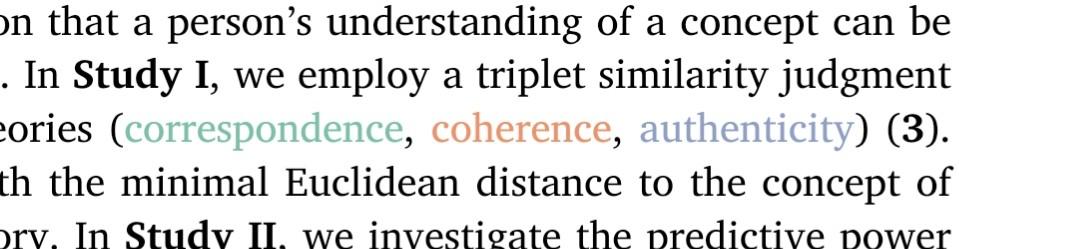
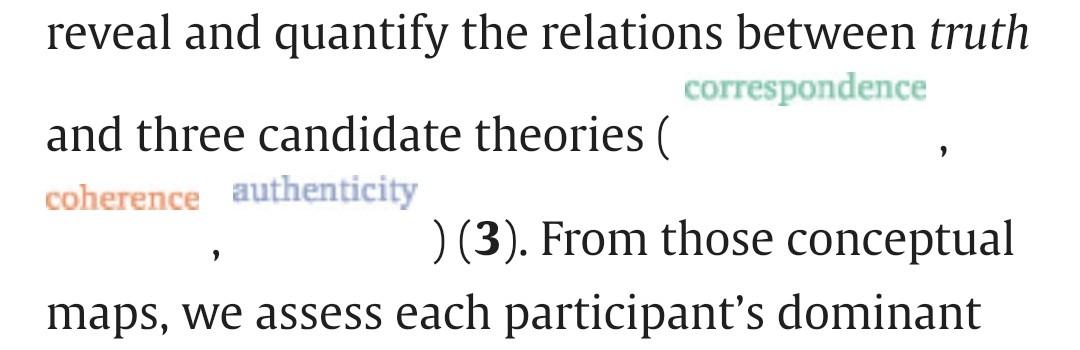
@vrandecic I wonder how much, if at all, this (type of) study can tell us about how people think about factual reality, rather than just how they feel about particular words.
Off topic: it never seizes to amaze me how lackluster web versions of scientific publications are made (see attached images of web version and PDF).
-
@rjblaskiewicz @vrandecic it is uninformed, but it's still false. He was objectively not there.
This last semester, my students and I were reading about the psychology behind "the dress" and one of the articles noted the dozens of processes that take place before you become aware of the color. The idea was that it's not even a decision. The brains of people who worked outside saw it one way and those whose brains compensated for artificial light saw it another way. Baseline understanding of concepts are similarly filtered, apparently....
-
This last semester, my students and I were reading about the psychology behind "the dress" and one of the articles noted the dozens of processes that take place before you become aware of the color. The idea was that it's not even a decision. The brains of people who worked outside saw it one way and those whose brains compensated for artificial light saw it another way. Baseline understanding of concepts are similarly filtered, apparently....
So, following from that, there are a lot of notions, ideas, and predispositions that filter what gets assigned the feeling of "obviously and inarguably true." That said, I am inclined to agree with you.

-
@janjko @vrandecic Her answer was false but she wasn't lying; she was simply wrong. It's only lying when you knowingly make a false statement.
If you claim something is true when you know that you don’t know if it is true or not, then that’s a lie, even if it turns out to be true. @vrandecic @irina @janjko
-
"Maria and Peter are students and meet up for a late dinner. Peter asks Maria whether Tom is at the party that they intend to go to after dinner. Maria answers that Tom is at the party. After all, Tom had told her that he would be at the party. When they arrive at the party, it turns out that Tom had changed his plans, and is not at the party. Was Maria's answer true or false?"
(please spread for visibility, I would like this to be as wide as possible)
1/2
@vrandecic I think there is a question to be asked about the relationship between Tom and Maria:
Is it a strong or weak relationship?If it is a strong, high-trust relationship:
=> Maria's answer was trueIf it is a weak, low-trust relationship:
=> Maria's answer was neither true nor false, because she doesn't really care about truthIt's the same with media: If an untrusted media site publishes bullshit and Maria cites that bullshit, is she telling the truth or does she simply not care?
1/2
-
@vrandecic I think there is a question to be asked about the relationship between Tom and Maria:
Is it a strong or weak relationship?If it is a strong, high-trust relationship:
=> Maria's answer was trueIf it is a weak, low-trust relationship:
=> Maria's answer was neither true nor false, because she doesn't really care about truthIt's the same with media: If an untrusted media site publishes bullshit and Maria cites that bullshit, is she telling the truth or does she simply not care?
1/2
@vrandecic Another view angle:
Passing of time and what we know at a certain point in time:
Sometimes we collectively say something is true until we've found evidence that it is not (because of better research etc.).
So in that case, I'd say Maria says the truth, because at that point in time this was her state of knowledge at that time.
Yeah, it's complicated!

2/2
-
@vrandecic I think there is a question to be asked about the relationship between Tom and Maria:
Is it a strong or weak relationship?If it is a strong, high-trust relationship:
=> Maria's answer was trueIf it is a weak, low-trust relationship:
=> Maria's answer was neither true nor false, because she doesn't really care about truthIt's the same with media: If an untrusted media site publishes bullshit and Maria cites that bullshit, is she telling the truth or does she simply not care?
1/2
-
"Maria and Peter are students and meet up for a late dinner. Peter asks Maria whether Tom is at the party that they intend to go to after dinner. Maria answers that Tom is at the party. After all, Tom had told her that he would be at the party. When they arrive at the party, it turns out that Tom had changed his plans, and is not at the party. Was Maria's answer true or false?"
(please spread for visibility, I would like this to be as wide as possible)
1/2
@vrandecic
Like many in the comments, I believe her answer was false not true. Her statement was factually false. I also believe that she told the truth as she knew it - she did not lie.
@Leefromphilly -
"Maria and Peter are students and meet up for a late dinner. Peter asks Maria whether Tom is at the party that they intend to go to after dinner. Maria answers that Tom is at the party. After all, Tom had told her that he would be at the party. When they arrive at the party, it turns out that Tom had changed his plans, and is not at the party. Was Maria's answer true or false?"
(please spread for visibility, I would like this to be as wide as possible)
1/2
@vrandecic You would do well to learn more about "Indian logic". There's true, false, neither true nor false, and both true and false.
In this case, the statement is inaccurate. It's neither true nor false. -
"Maria and Peter are students and meet up for a late dinner. Peter asks Maria whether Tom is at the party that they intend to go to after dinner. Maria answers that Tom is at the party. After all, Tom had told her that he would be at the party. When they arrive at the party, it turns out that Tom had changed his plans, and is not at the party. Was Maria's answer true or false?"
(please spread for visibility, I would like this to be as wide as possible)
1/2
@vrandecic The disagreement here is revealing something deep: conflating *fact-condition* (was Tom there) with *assertion-appropriateness* (should Maria have said it).
Maria failed on both. She wasn't positioned to assert fact, just relay intention. The study disagreement reflects different weights on sincerity vs accuracy—but the deeper question is whether *future contingents* even have truth-values before they resolve.