15 years ago, I co-authored my first paper in the field of #LightPollution studies: https://doi.org/10.1371/journal.pone.0017307

-
@skyglowberlin I teach large university science courses. Hundreds of fairly privileged students in the room. It has been my habit to ask them to raise their hands if they have ever seen the Milky Way.
The results have always been disappointing. Over the past 20 years it has gotten worse and worse. Recently many students don't even know what I mean by the question, and I have to explain what a dark sky looks like.
"Raise your hand if you have ever been awed by a clear dark sky full of countless, countless stars." Always less than 5%.
@jameshowell @GeoffWozniak @skyglowberlin My wife and kid and I have often tried, where practical, to catch meteor showers, sometimes planning road trips to countryside areas when they’re going to happen. None have ever been mind blowing, and yet those occasions are some of the most memorable moments I have, the bonding experiences and just taking all that in as a whole. I’m sure it’s a big part of the reason our (now) teen has been toying with the idea of getting into astrophysics.
Heartbreaking to realize how few even privileged people have ever taken the time to simply look up at night, or as you say, know what major celestial references even mean.
-
@skyglowberlin Almost certainly not.
It's an empirical question: you have to do the experiment. But all of developmental neurobiology shows us that disuse leads to loss, and disuse during critical developmental windows leads to permanent loss. Your hypothesis is almost certainly correct.
@jameshowell @skyglowberlin reading this on my glowing rectangle with aging eyes is super depressing!
I've seen things you people wouldn't believe. The milky way with my naked eyes. I navigated a trail by the moonlight. All those moments will be lost in time, like tears in rain. Time to die.
-
I first saw the Milky Way in July 2006. I was about 80 km north of Kandahar, Afghanistan. It was absolutely amazing. (I was sleeping in a hole in the ground, so I could just enjoy it until I fell asleep.)
@venya @jameshowell Glad you had a chance to enjoy that (despite the rest of the experience).
I remember @SaraBPritchard quoting from women's experience of seeing the stars while held in a Nazi concentration camps. I can't remember the exact details, but my recollection is that seeing the stars provided a similar sublime experience despite being caged in a place designed to destroy your humanity.
We all lose something by not regularly having that experience.
-
@venya @skyglowberlin I can't beat that story, but I got two stories.
In 2005 outside the refugio just below the summit of Champaqui about 60 km southwest of Córdoba Argentina. Clearest darkest sky I have experienced and golly, the southern hemisphere sky is disorienting. We were far from home.
In 1990 in rural Ohio with two young women who had grown up in Tokyo. They had never seen a non-urban night sky. Parked the car next to a cornfield, told them I had a treat for them. They flew into a blind panic. Screaming, crying, covering their eyes.
@jameshowell @venya What happened next? Did they calm down? And how did they describe the experience afterwards?
-
@jameshowell @GeoffWozniak @skyglowberlin My wife and kid and I have often tried, where practical, to catch meteor showers, sometimes planning road trips to countryside areas when they’re going to happen. None have ever been mind blowing, and yet those occasions are some of the most memorable moments I have, the bonding experiences and just taking all that in as a whole. I’m sure it’s a big part of the reason our (now) teen has been toying with the idea of getting into astrophysics.
Heartbreaking to realize how few even privileged people have ever taken the time to simply look up at night, or as you say, know what major celestial references even mean.
@reay @jameshowell @GeoffWozniak These days seeing the Milky Way in a natural setting is something that is experienced mainly by only the poorest of the poor and the richest of the rich.
-
@venya @jameshowell Glad you had a chance to enjoy that (despite the rest of the experience).
I remember @SaraBPritchard quoting from women's experience of seeing the stars while held in a Nazi concentration camps. I can't remember the exact details, but my recollection is that seeing the stars provided a similar sublime experience despite being caged in a place designed to destroy your humanity.
We all lose something by not regularly having that experience.
@skyglowberlin @venya @SaraBPritchard Wow. Now there is a little vignette that summarizes the human condition all right
-
@jameshowell @venya What happened next? Did they calm down? And how did they describe the experience afterwards?
@skyglowberlin They jumped back in the car and calmed down. We kept on to our destination. I was too young really even to understand what had happened, much less how to react constructively. I don't remember what I said. I was probably an asshole to them.
-
@reay @jameshowell @GeoffWozniak These days seeing the Milky Way in a natural setting is something that is experienced mainly by only the poorest of the poor and the richest of the rich.
@skyglowberlin @reay @GeoffWozniak More bizarre irony.
-
@reay @jameshowell @GeoffWozniak These days seeing the Milky Way in a natural setting is something that is experienced mainly by only the poorest of the poor and the richest of the rich.
@skyglowberlin @jameshowell @GeoffWozniak I get your point but respectfully disagree.
Anyone already in less populated areas can just look up at night and have a good shot at spotting the Milky Way.
People in more populated places but with a vehicle — not terribly uncommon — can head out of their city to get less light pollution and probably see the Milky Way. Here in Toronto, even if you head down to the lake (a walk for some, a cheap transit ride for most others), you can see way more in the night sky over the water than one may expect.
I suspect the larger reason people aren’t seeing it is just way more attention on produced entertainment (phones and streaming, etc.) than on interest in natural phenomena. No matter how accessible something may be, if you have no interest in it, it’s the same result.
-
@skyglowberlin They jumped back in the car and calmed down. We kept on to our destination. I was too young really even to understand what had happened, much less how to react constructively. I don't remember what I said. I was probably an asshole to them.
@jameshowell Oh no, sorry to hear that.
The Adler Teens program has taken Chicago teenagers to a park outside of the city and had the experience that some of the kids were terrified of getting off the bus, because "going out in the dark is dangerous" has been so deeply drilled into them by (well meaning) adults.
I think if I've remembered right they've generally had success getting everyone to see the stars, but it's a scary process for some people.
-
@skyglowberlin @jameshowell @GeoffWozniak I get your point but respectfully disagree.
Anyone already in less populated areas can just look up at night and have a good shot at spotting the Milky Way.
People in more populated places but with a vehicle — not terribly uncommon — can head out of their city to get less light pollution and probably see the Milky Way. Here in Toronto, even if you head down to the lake (a walk for some, a cheap transit ride for most others), you can see way more in the night sky over the water than one may expect.
I suspect the larger reason people aren’t seeing it is just way more attention on produced entertainment (phones and streaming, etc.) than on interest in natural phenomena. No matter how accessible something may be, if you have no interest in it, it’s the same result.
@reay @jameshowell @GeoffWozniak You are right that you often don't have to go so far to get a hint of the Milky Way. In fact, I've seen it (and photographed it) from the city center of Potsdam, Germany (population ~180,000).
But catching a fuzzy glimpse of the Milky Way and "seeing the Milky Way in a natural setting" (as I said above) are completely different experiences.
When you see the Milky Way in an area with some degree of light pollution, it's a nice experience and it looks kind of interesting. When you see it in a place with no or next to no light pollution you are CONFRONTED WITH THE COSMOS.
Algonquin National Park is 250 km from Toronto and still has a zenith sky brightness that's ~1% brighter than natural - and the horizon will be far brighter than that. You have to get 350 km from Toronto until the zenith is natural, and even then the horizon in most directions is going to be bright rather than dark.
That being said, getting to ANY place that's not lit by directly artificial lights, even an urban rooftop or park, will allow you to see far more than you would guess.

-
@reay @jameshowell @GeoffWozniak You are right that you often don't have to go so far to get a hint of the Milky Way. In fact, I've seen it (and photographed it) from the city center of Potsdam, Germany (population ~180,000).
But catching a fuzzy glimpse of the Milky Way and "seeing the Milky Way in a natural setting" (as I said above) are completely different experiences.
When you see the Milky Way in an area with some degree of light pollution, it's a nice experience and it looks kind of interesting. When you see it in a place with no or next to no light pollution you are CONFRONTED WITH THE COSMOS.
Algonquin National Park is 250 km from Toronto and still has a zenith sky brightness that's ~1% brighter than natural - and the horizon will be far brighter than that. You have to get 350 km from Toronto until the zenith is natural, and even then the horizon in most directions is going to be bright rather than dark.
That being said, getting to ANY place that's not lit by directly artificial lights, even an urban rooftop or park, will allow you to see far more than you would guess.
@skyglowberlin @reay @jameshowell Even the parks are becoming a problem. As someone who has been camping in parks for nearly 30 years, the last few years I've seen people put up floodlights on poles in their campsites that light up entire open areas, and they are projecting movies onto screens.
-
@jameshowell Oh no, sorry to hear that.
The Adler Teens program has taken Chicago teenagers to a park outside of the city and had the experience that some of the kids were terrified of getting off the bus, because "going out in the dark is dangerous" has been so deeply drilled into them by (well meaning) adults.
I think if I've remembered right they've generally had success getting everyone to see the stars, but it's a scary process for some people.
@skyglowberlin They were not afraid of the dark. They had a genuinely Lovecraftian moment when "CONFRONTED WITH THE COSMOS."
-
@skyglowberlin @reay @jameshowell Even the parks are becoming a problem. As someone who has been camping in parks for nearly 30 years, the last few years I've seen people put up floodlights on poles in their campsites that light up entire open areas, and they are projecting movies onto screens.
-
@skyglowberlin They were not afraid of the dark. They had a genuinely Lovecraftian moment when "CONFRONTED WITH THE COSMOS."
@jameshowell Got it. Man, what a scene, I can imagine why that stuck with you as a memory.
-
@jameshowell Got it. Man, what a scene, I can imagine why that stuck with you as a memory.
@jameshowell Very Issac Asimov "Nightfall"
-
@jameshowell Very Issac Asimov "Nightfall"
@skyglowberlin Just like that.
-
@skyglowberlin When I teach about retinal physiology, it breaks my heart. Often there isn't a single student who has ever experienced vision after true dark adaptation.
It turns out that—it takes time, but it's real—you can see by starlight. And the faintest stars you see? That's a single rod cell detecting A SINGLE PHOTON. Your retina is that sensitive.
Before 1879 this was an absolutely universal human experience. Now it's exotic, unimaginable.
@jameshowell @siracusa @skyglowberlin What I miss most about my hometown in rural eastern Washington State is the night sky.
It wasn't akin to being in Antarctica or anything, but I DID grow up being able to stare up to see the “band” of the Milky Way. One of my first major interests as a kid was astronomy. Even had my own telescope.
-
@skyglowberlin I teach large university science courses. Hundreds of fairly privileged students in the room. It has been my habit to ask them to raise their hands if they have ever seen the Milky Way.
The results have always been disappointing. Over the past 20 years it has gotten worse and worse. Recently many students don't even know what I mean by the question, and I have to explain what a dark sky looks like.
"Raise your hand if you have ever been awed by a clear dark sky full of countless, countless stars." Always less than 5%.
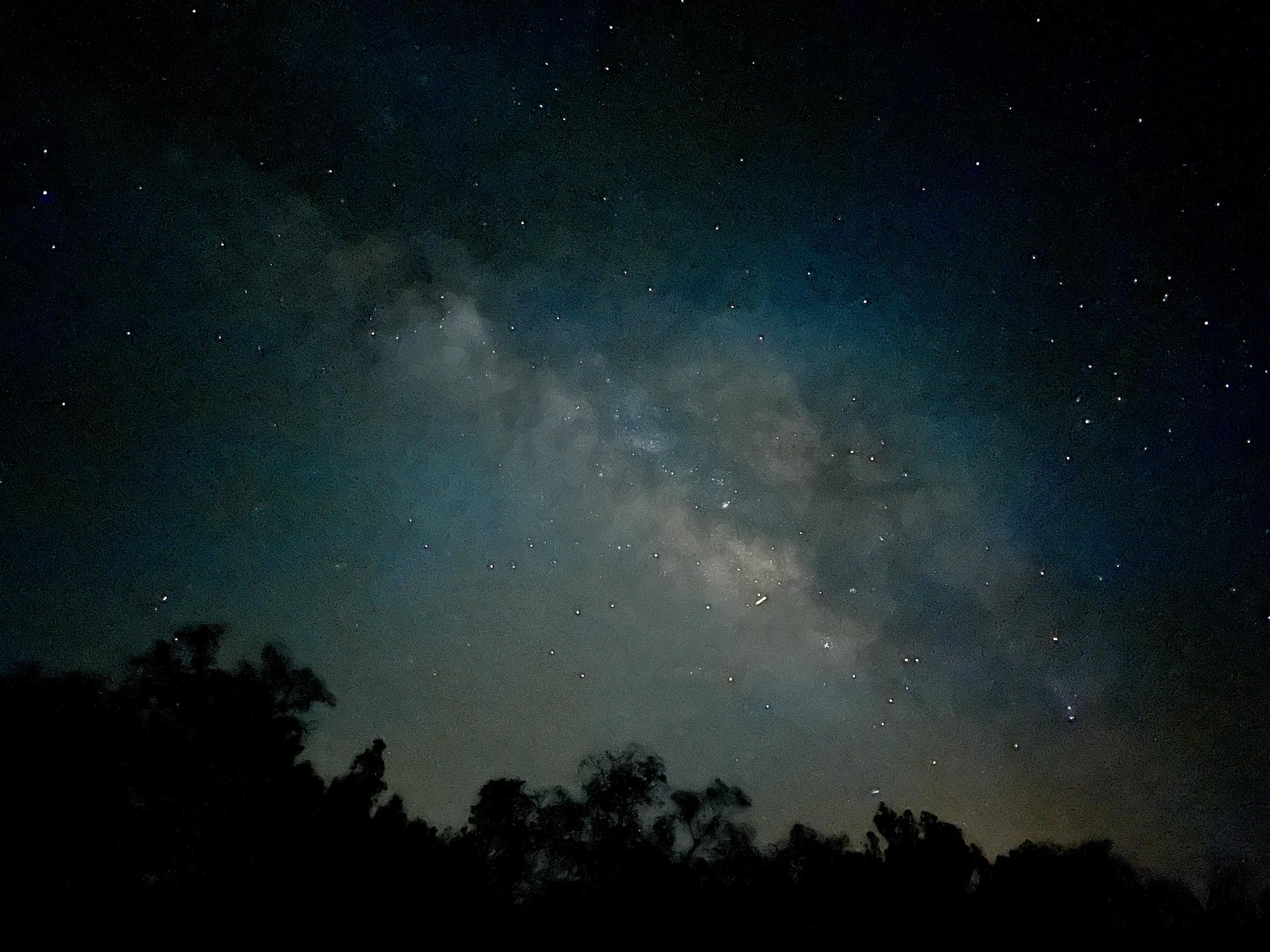
@jameshowell @skyglowberlin @siracusa It’s truly awe inspiring, isn’t it?
Copper Breaks State Park, TX — Bortle Class 2 dark sky designated.
Taken with my iPhone 14 Pro, merely leaning against a bench, in July 2024.
-
@jameshowell @siracusa @skyglowberlin What I miss most about my hometown in rural eastern Washington State is the night sky.
It wasn't akin to being in Antarctica or anything, but I DID grow up being able to stare up to see the “band” of the Milky Way. One of my first major interests as a kid was astronomy. Even had my own telescope.
@jameshowell @siracusa @skyglowberlin I now live just outside of Los Angeles.
LA has made great strides in reducing air pollution, but light pollution still basically precludes any real observation of the night sky. Stars are barely a thing here.
If I were a kid living here I very much doubt I'd have developed that interest in astronomy.



 ️
️