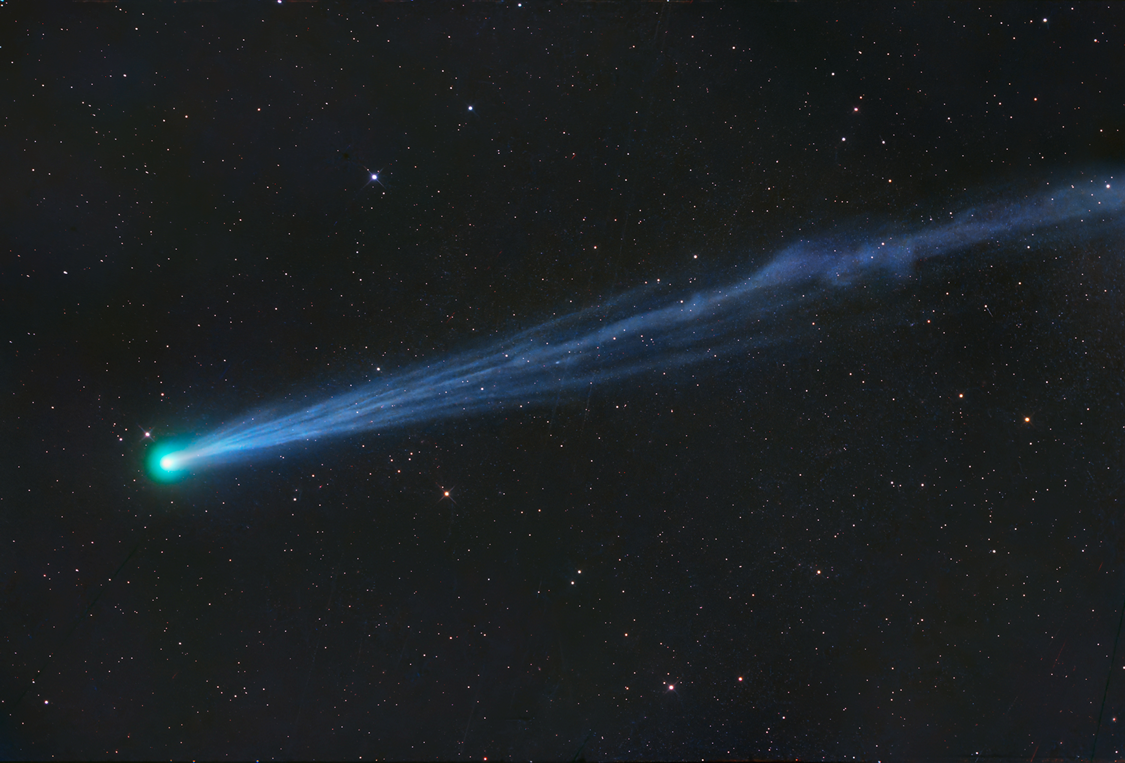
Comet C/2025 R3 (PanSTARRS) is now putting on a show, visible low in the predawn sky, with binoculars or telescope.
-
Post #10 got disconnected from the thread. This is one way to reconnect it and continue the thread.
Comet C/2025 R3 beautifully captured by astrophotographer Luc Perrot on April 16 from a volcanic peak overlooking France's Reunion Island, located in the Southern hemisphere, east of Madagascar.
Featured on NASA APOD on April 18.
https://apod.nasa.gov/apod/ap260418.html
Check out Luc's other works at https://www.lucperrot.fr/
11/n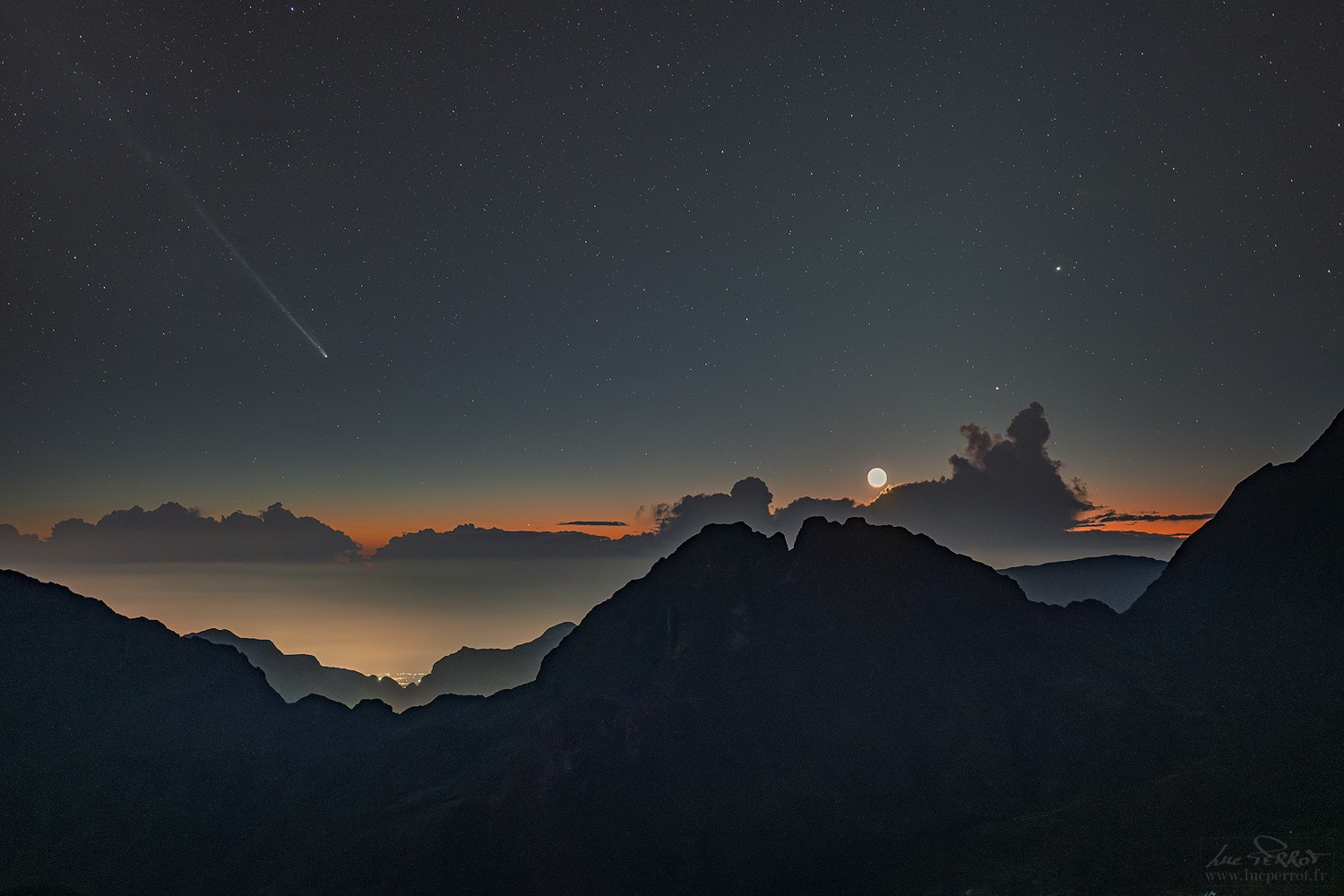
-
R relay@relay.infosec.exchange shared this topic
-
Comet C/2025 R3 beautifully captured by astrophotographer Luc Perrot on April 16 from a volcanic peak overlooking France's Reunion Island, located in the Southern hemisphere, east of Madagascar.
Featured on NASA APOD on April 18.
https://apod.nasa.gov/apod/ap260418.html
Check out Luc's other works at https://www.lucperrot.fr/
11/nLooks like Comet C/2025 R3 (PanSTARRS) survived its trip around the Sun and is now on its return trip out of the Solar System.
The comet makes its closest approach to Earth today.
These are images captured by the ESA/NASA Solar and Heliospheric Observatory (SOHO) LASCO C3 instrument.
LASCO = Large Angle and Spectrometric COronagraph.
Animation at https://soho.nascom.nasa.gov/data/realtime/mpeg/
12/n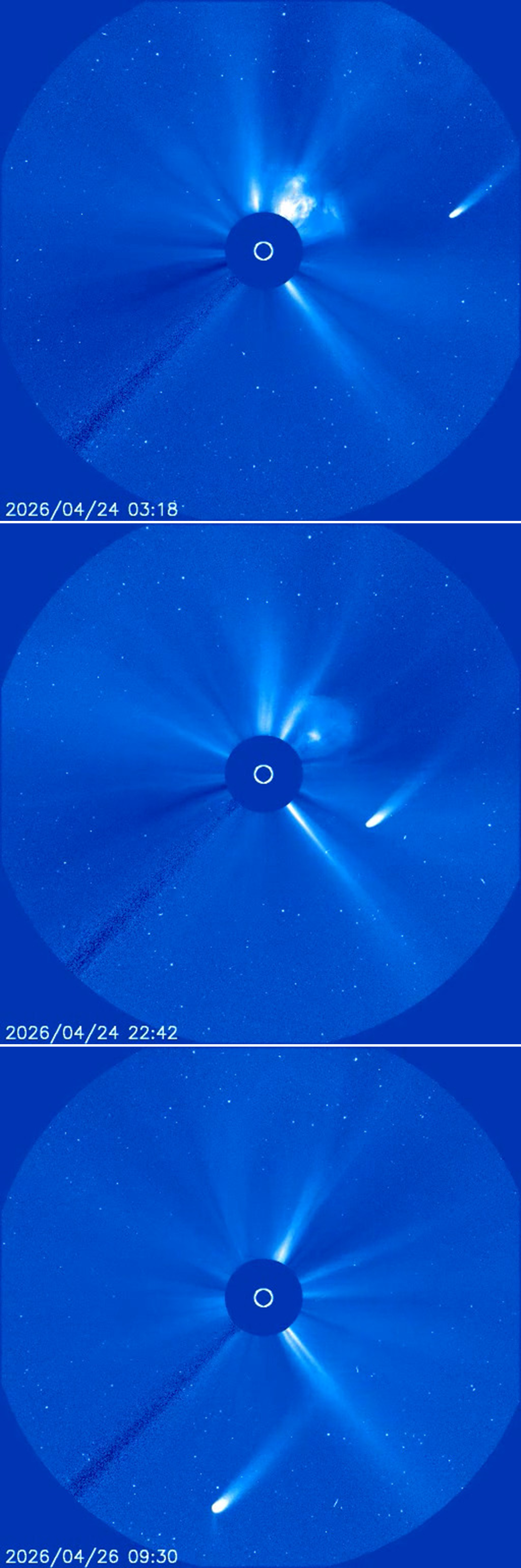
-
Looks like Comet C/2025 R3 (PanSTARRS) survived its trip around the Sun and is now on its return trip out of the Solar System.
The comet makes its closest approach to Earth today.
These are images captured by the ESA/NASA Solar and Heliospheric Observatory (SOHO) LASCO C3 instrument.
LASCO = Large Angle and Spectrometric COronagraph.
Animation at https://soho.nascom.nasa.gov/data/realtime/mpeg/
12/nVideo from ESA/NASA Solar and Heliospheric Observatory (SOHO) LASCO C3 with comet C/2025 R3 (PanSTARRS) in its field of view, uploaded to YouTube by Bum-Suk Yeom (염범석).
-
Looks like Comet C/2025 R3 (PanSTARRS) survived its trip around the Sun and is now on its return trip out of the Solar System.
The comet makes its closest approach to Earth today.
These are images captured by the ESA/NASA Solar and Heliospheric Observatory (SOHO) LASCO C3 instrument.
LASCO = Large Angle and Spectrometric COronagraph.
Animation at https://soho.nascom.nasa.gov/data/realtime/mpeg/
12/n -
Looks like Comet C/2025 R3 (PanSTARRS) survived its trip around the Sun and is now on its return trip out of the Solar System.
The comet makes its closest approach to Earth today.
These are images captured by the ESA/NASA Solar and Heliospheric Observatory (SOHO) LASCO C3 instrument.
LASCO = Large Angle and Spectrometric COronagraph.
Animation at https://soho.nascom.nasa.gov/data/realtime/mpeg/
12/nThe ESA/NASA Solar and Heliospheric Observatory (SOHO), launched on Dec. 2, 1995, has been studying the Sun for over 30 years, from its perch in a Halo orbit around the Sun-Earth Lagrange point L1.
With its 12 instruments, SOHO allows scientists to study the Sun’s internal structure and dynamics, the chromosphere, the corona, and solar particles. It has discovered over 5,000 comets.
https://science.nasa.gov/mission/soho/
https://en.wikipedia.org/wiki/Solar_and_Heliospheric_Observatory
13/n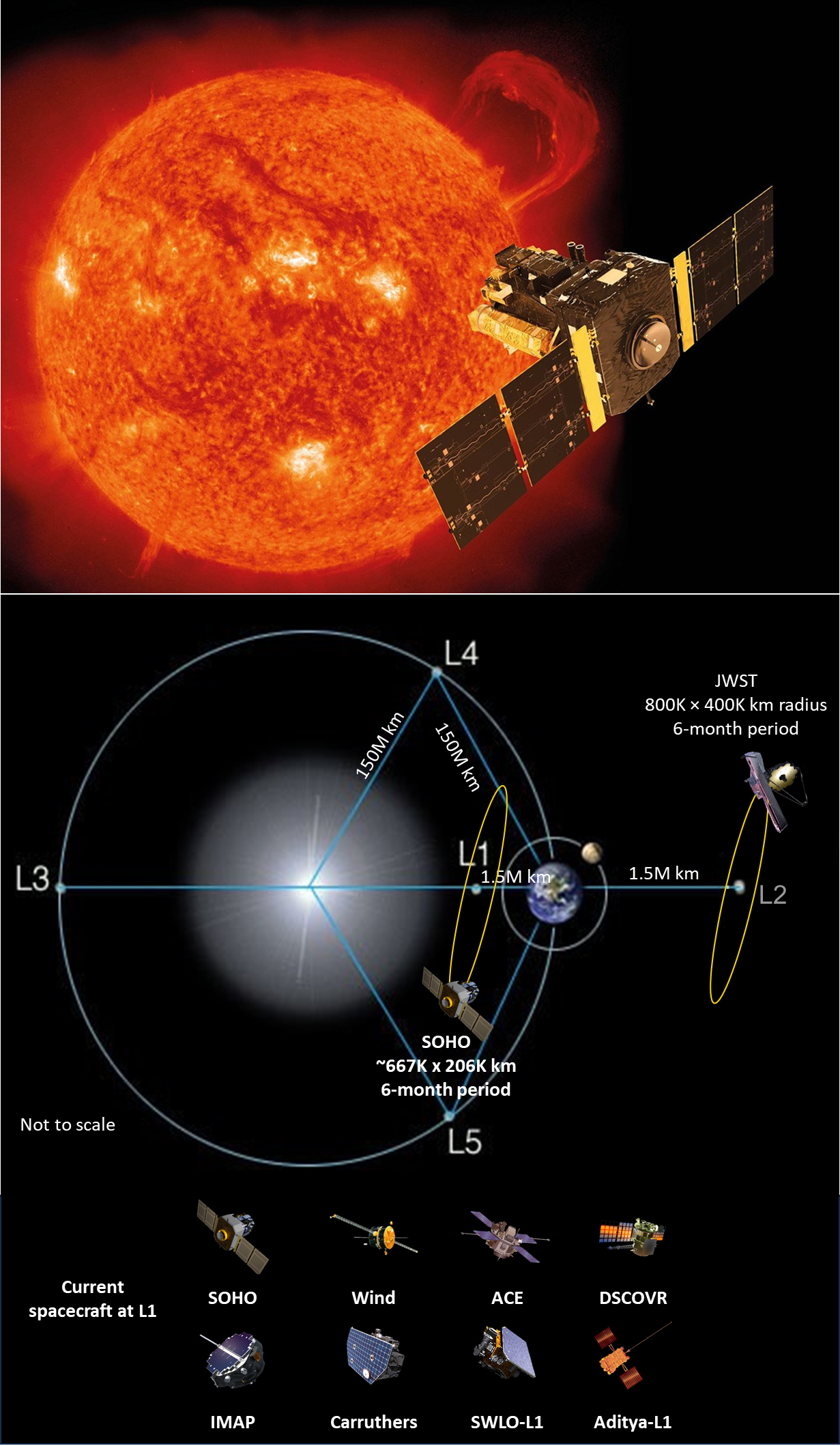
-
Looks like Comet C/2025 R3 (PanSTARRS) survived its trip around the Sun and is now on its return trip out of the Solar System.
The comet makes its closest approach to Earth today.
These are images captured by the ESA/NASA Solar and Heliospheric Observatory (SOHO) LASCO C3 instrument.
LASCO = Large Angle and Spectrometric COronagraph.
Animation at https://soho.nascom.nasa.gov/data/realtime/mpeg/
12/n@AkaSci I’ve been busy, hadn’t tracked it, but this looks like decent info on how to try to see it: https://starwalk.space/en/news/comet-c2025-r3-panstarrs
-
The ESA/NASA Solar and Heliospheric Observatory (SOHO), launched on Dec. 2, 1995, has been studying the Sun for over 30 years, from its perch in a Halo orbit around the Sun-Earth Lagrange point L1.
With its 12 instruments, SOHO allows scientists to study the Sun’s internal structure and dynamics, the chromosphere, the corona, and solar particles. It has discovered over 5,000 comets.
https://science.nasa.gov/mission/soho/
https://en.wikipedia.org/wiki/Solar_and_Heliospheric_Observatory
13/nThe horror! The horror!
How billionaires, one in particular, are destroying the night sky and astronomy.
This is a pic of Comet C/2025 R3 (PanSTARRS), trapped in a celestial cage of light streaks formed by LEO satellites racing across the sky in this 10-minute exposure image.
This is with ~10,000 orbiting satellites. Now, imagine a million of them, each with a solar array ~10x larger.

 ️
️
https://apod.nasa.gov/apod/ap260427.html
Image Credit & Copyright: Uli Fehr
14/n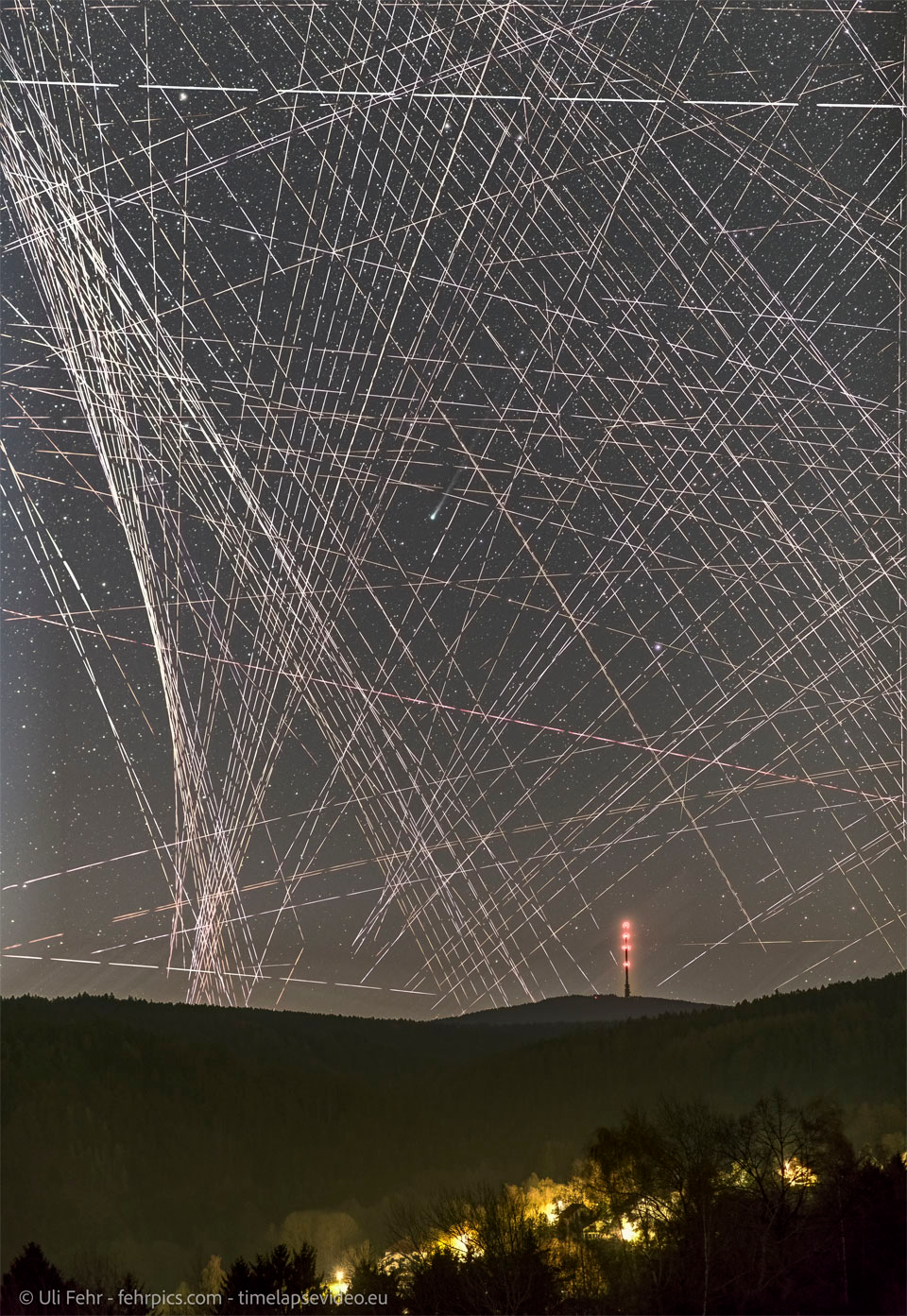
-
The horror! The horror!
How billionaires, one in particular, are destroying the night sky and astronomy.
This is a pic of Comet C/2025 R3 (PanSTARRS), trapped in a celestial cage of light streaks formed by LEO satellites racing across the sky in this 10-minute exposure image.
This is with ~10,000 orbiting satellites. Now, imagine a million of them, each with a solar array ~10x larger.
️
https://apod.nasa.gov/apod/ap260427.html
Image Credit & Copyright: Uli Fehr
14/nStop Prison Earth.
-
The horror! The horror!
How billionaires, one in particular, are destroying the night sky and astronomy.
This is a pic of Comet C/2025 R3 (PanSTARRS), trapped in a celestial cage of light streaks formed by LEO satellites racing across the sky in this 10-minute exposure image.
This is with ~10,000 orbiting satellites. Now, imagine a million of them, each with a solar array ~10x larger.
️
https://apod.nasa.gov/apod/ap260427.html
Image Credit & Copyright: Uli Fehr
14/nThe Tholian web. If only it were Elmo caught in interdimensional space, we'd all breathe easier.
-
The horror! The horror!
How billionaires, one in particular, are destroying the night sky and astronomy.
This is a pic of Comet C/2025 R3 (PanSTARRS), trapped in a celestial cage of light streaks formed by LEO satellites racing across the sky in this 10-minute exposure image.
This is with ~10,000 orbiting satellites. Now, imagine a million of them, each with a solar array ~10x larger.
️
https://apod.nasa.gov/apod/ap260427.html
Image Credit & Copyright: Uli Fehr
14/nRight now, starlink has the most, but Leo is catching up. Imagine the scene where Wally & Eve punching through the dead satellite field with their rocket? We're already there. 🤬

https://satellitemap.space/ -
The horror! The horror!
How billionaires, one in particular, are destroying the night sky and astronomy.
This is a pic of Comet C/2025 R3 (PanSTARRS), trapped in a celestial cage of light streaks formed by LEO satellites racing across the sky in this 10-minute exposure image.
This is with ~10,000 orbiting satellites. Now, imagine a million of them, each with a solar array ~10x larger.
️
https://apod.nasa.gov/apod/ap260427.html
Image Credit & Copyright: Uli Fehr
14/n@AkaSci Impressive, and unwelcome...
-
The horror! The horror!
How billionaires, one in particular, are destroying the night sky and astronomy.
This is a pic of Comet C/2025 R3 (PanSTARRS), trapped in a celestial cage of light streaks formed by LEO satellites racing across the sky in this 10-minute exposure image.
This is with ~10,000 orbiting satellites. Now, imagine a million of them, each with a solar array ~10x larger.
️
https://apod.nasa.gov/apod/ap260427.html
Image Credit & Copyright: Uli Fehr
14/n@AkaSci that is a great and saddening picture.
I love seeing people’s long exposure pictures of the night sky. Seems like those sort of images are going to become a thing of the past.
Although I am sure some AI company will offer a tool to strip the satellite tracks away. Thus annoying me a little bit more.
-
The horror! The horror!
How billionaires, one in particular, are destroying the night sky and astronomy.
This is a pic of Comet C/2025 R3 (PanSTARRS), trapped in a celestial cage of light streaks formed by LEO satellites racing across the sky in this 10-minute exposure image.
This is with ~10,000 orbiting satellites. Now, imagine a million of them, each with a solar array ~10x larger.
️
https://apod.nasa.gov/apod/ap260427.html
Image Credit & Copyright: Uli Fehr
14/n@AkaSci They could just turn off these lights!? 🤨
-
@AkaSci They could just turn off these lights!? 🤨
@kassander @AkaSci it's reflected sunlight.
-
The horror! The horror!
How billionaires, one in particular, are destroying the night sky and astronomy.
This is a pic of Comet C/2025 R3 (PanSTARRS), trapped in a celestial cage of light streaks formed by LEO satellites racing across the sky in this 10-minute exposure image.
This is with ~10,000 orbiting satellites. Now, imagine a million of them, each with a solar array ~10x larger.
️
https://apod.nasa.gov/apod/ap260427.html
Image Credit & Copyright: Uli Fehr
14/n@AkaSci I have recently moved to where I can see the night sky. The first thing I noticed was the frequency of satellites. It is disturbing.
Most people in the world cannot see the night sky.
-
R relay@relay.publicsquare.global shared this topic
-
The horror! The horror!
How billionaires, one in particular, are destroying the night sky and astronomy.
This is a pic of Comet C/2025 R3 (PanSTARRS), trapped in a celestial cage of light streaks formed by LEO satellites racing across the sky in this 10-minute exposure image.
This is with ~10,000 orbiting satellites. Now, imagine a million of them, each with a solar array ~10x larger.
️
https://apod.nasa.gov/apod/ap260427.html
Image Credit & Copyright: Uli Fehr
14/nAs Comet C/2025 R3 (PanSTARRS) heads out of the inner Solar System, it is putting on quite a show for enthusiasts and photographers.
This image was captured by astrophotographer Luc Perrot a few days ago from France's Reunion Island in the southern Indian Ocean, east of Madagascar.
The short whitish dust tail can be seen pointing up in the image while the long, wavy and bluish ion tail trails off toward the upper left.
The Orion nebula shines on the upper right.
https://apod.nasa.gov/apod/ap260510.html
15/n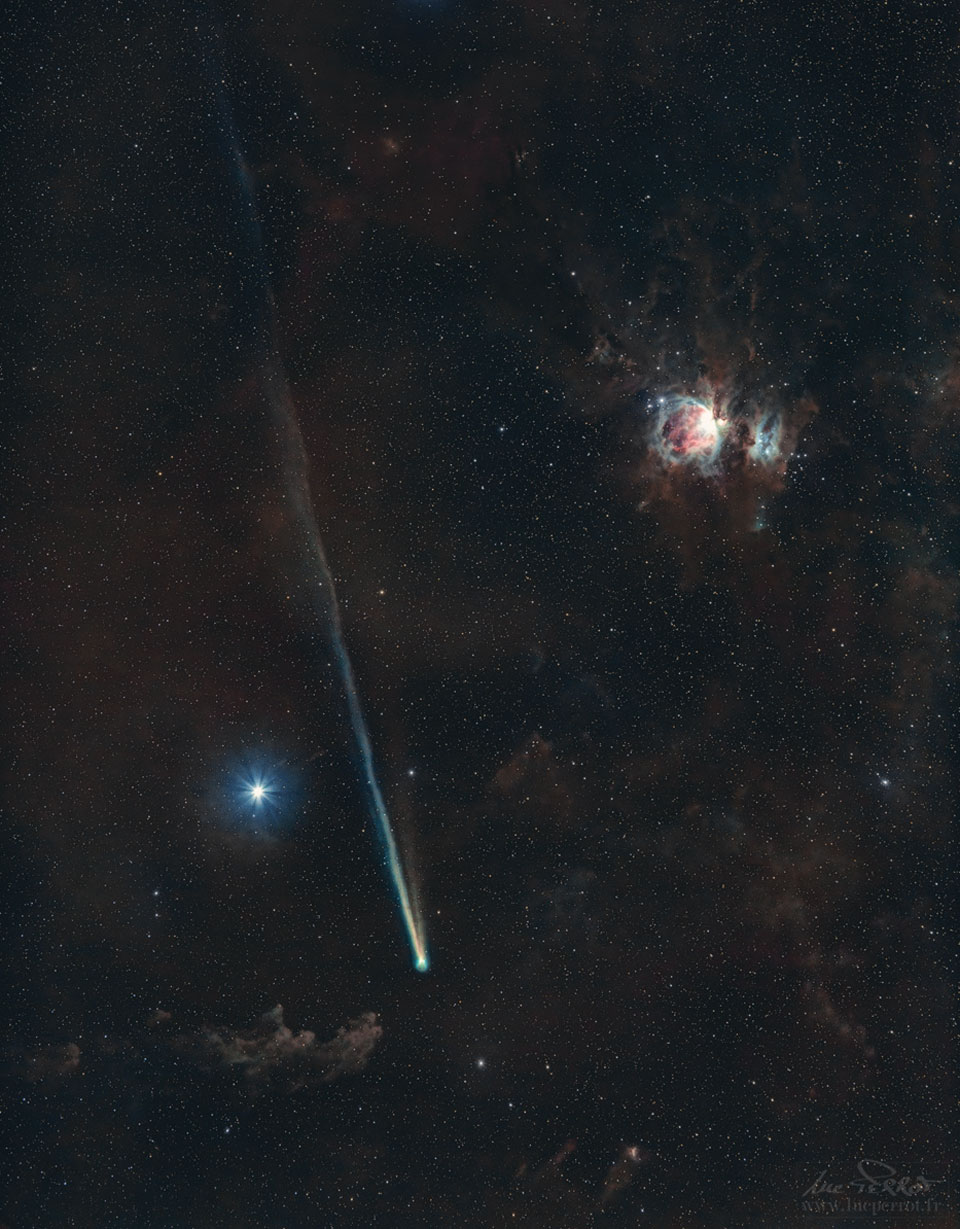
-
As Comet C/2025 R3 (PanSTARRS) heads out of the inner Solar System, it is putting on quite a show for enthusiasts and photographers.
This image was captured by astrophotographer Luc Perrot a few days ago from France's Reunion Island in the southern Indian Ocean, east of Madagascar.
The short whitish dust tail can be seen pointing up in the image while the long, wavy and bluish ion tail trails off toward the upper left.
The Orion nebula shines on the upper right.
https://apod.nasa.gov/apod/ap260510.html
15/nHere is another stunning image of Comet C/2025 R3 (PanSTARRS) taken by astrophotographer Luc Perrot at the same time as the previous one but with a wide-angle 50mm lens.
The image lies in and around the Orion constellation. The red Barnard's Loop arches above the comet and encloses two distinct Nebulae - the Orion Nebula on the left and the Flame Nebula on the right.
A tiny dark Horsehead Nebula can be seen in the red area to the left of the Flame Nebula.
https://www.instagram.com/p/DYHLsidjXtT/?img_index=1
16/n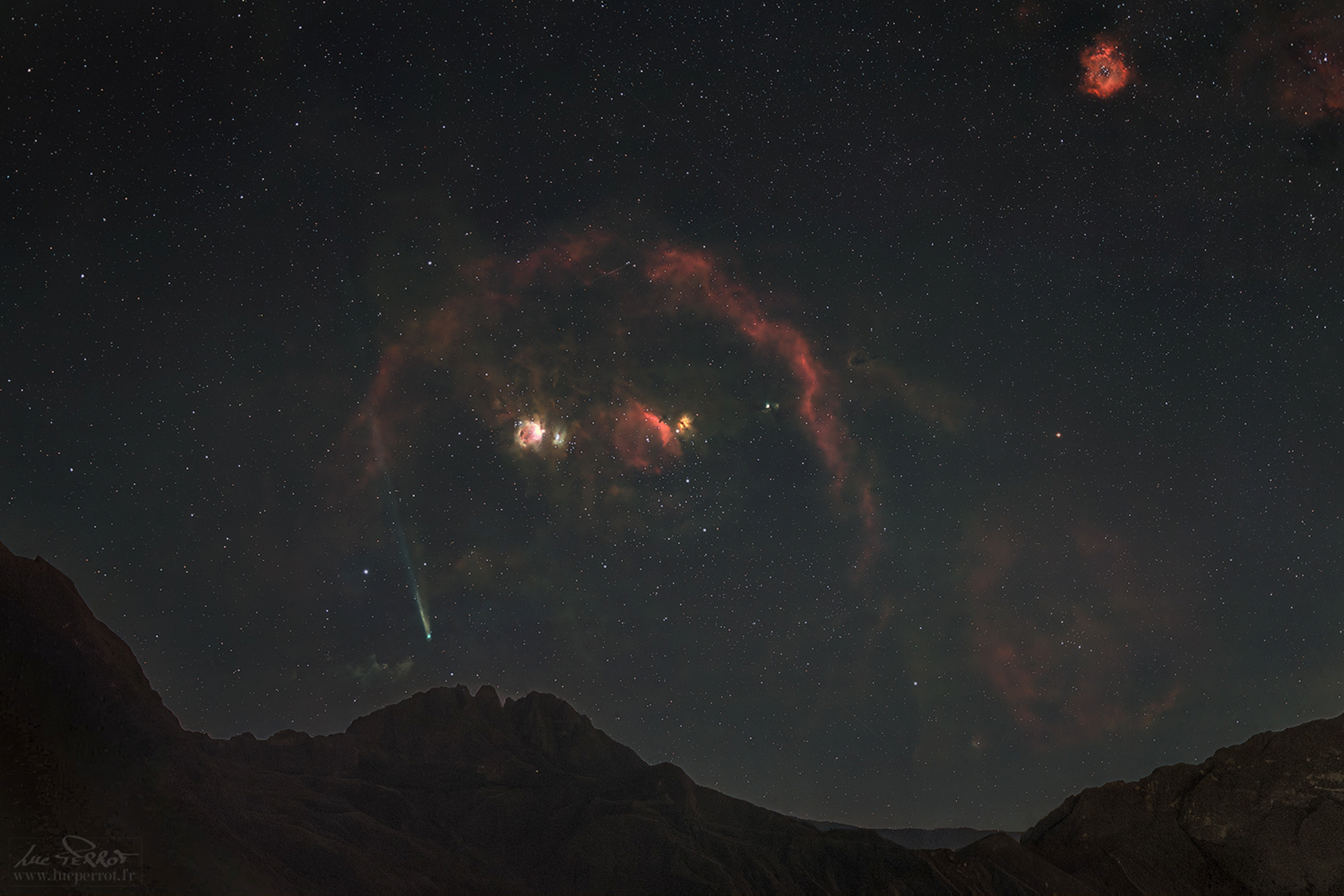
-
R relay@relay.infosec.exchange shared this topic
-
Here is another stunning image of Comet C/2025 R3 (PanSTARRS) taken by astrophotographer Luc Perrot at the same time as the previous one but with a wide-angle 50mm lens.
The image lies in and around the Orion constellation. The red Barnard's Loop arches above the comet and encloses two distinct Nebulae - the Orion Nebula on the left and the Flame Nebula on the right.
A tiny dark Horsehead Nebula can be seen in the red area to the left of the Flame Nebula.
https://www.instagram.com/p/DYHLsidjXtT/?img_index=1
16/nHere is an annotated version of the previous image of the evening sky by Luc Perrot.
Comet C/2025 R3 (PanSTARRS) is now best seen from the Southern hemisphere.
https://en.wikipedia.org/wiki/Orion_(constellation)
https://en.wikipedia.org/wiki/Orion_Nebula
https://en.wikipedia.org/wiki/Flame_Nebula
https://en.wikipedia.org/wiki/Horsehead_Nebula
https://en.wikipedia.org/wiki/Barnard%27s_Loop
https://en.wikipedia.org/wiki/C/2025_R3_(PanSTARRS)
17/n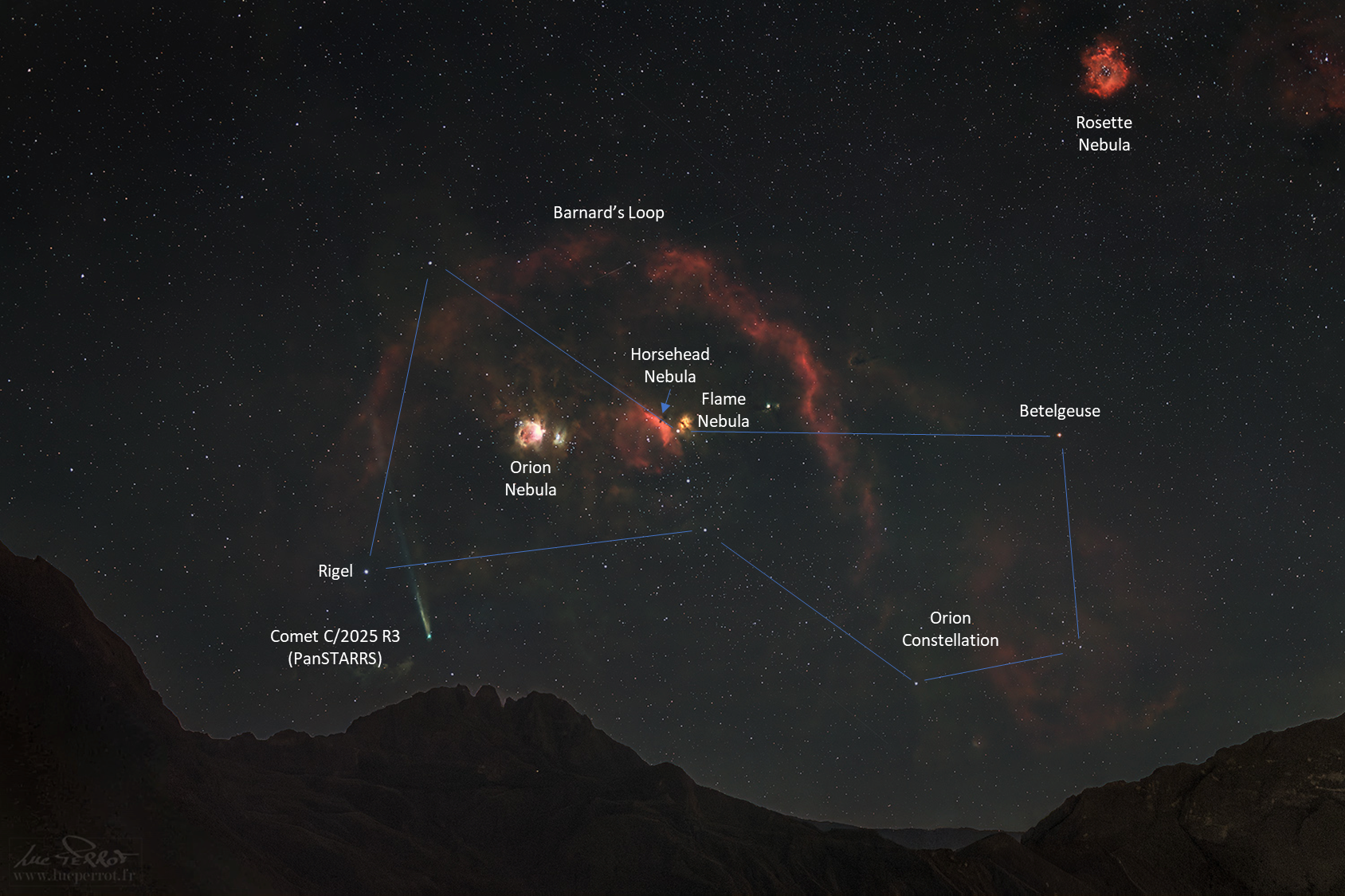
-
Here is another stunning image of Comet C/2025 R3 (PanSTARRS) taken by astrophotographer Luc Perrot at the same time as the previous one but with a wide-angle 50mm lens.
The image lies in and around the Orion constellation. The red Barnard's Loop arches above the comet and encloses two distinct Nebulae - the Orion Nebula on the left and the Flame Nebula on the right.
A tiny dark Horsehead Nebula can be seen in the red area to the left of the Flame Nebula.
https://www.instagram.com/p/DYHLsidjXtT/?img_index=1
16/n@AkaSci this is stunning.
-
As Comet C/2025 R3 (PanSTARRS) heads out of the inner Solar System, it is putting on quite a show for enthusiasts and photographers.
This image was captured by astrophotographer Luc Perrot a few days ago from France's Reunion Island in the southern Indian Ocean, east of Madagascar.
The short whitish dust tail can be seen pointing up in the image while the long, wavy and bluish ion tail trails off toward the upper left.
The Orion nebula shines on the upper right.
https://apod.nasa.gov/apod/ap260510.html
15/n@AkaSci I'm afraid this is yet another case of APOD-falling-for-an-extreme-image amongst a vast supply of conservatively processed pictures of the same object: not one of the latter shows a dust tail next to the long plasma tail, see e.g. https://x.com/Haru_koala/status/2053319363164619113 for a really deep example. It seems the color processing here went astray and a temporarily appearing streak of the plasma tail has been mis-painted as dusty. A dust tail *was* seen for a few days around solar conjunction such as in https://www.facebook.com/photo/?fbid=1262698482516089 thanks to a forward-scattering boost, but already on 29 April it had faded to near-oblivion: https://www.facebook.com/photo/?fbid=1423336013141204 - there were no optical detections in May AFAIK, and so it would be extremely unlikely and even unphysical to see a prominent dust tail now.
-
R relay@relay.mycrowd.ca shared this topic