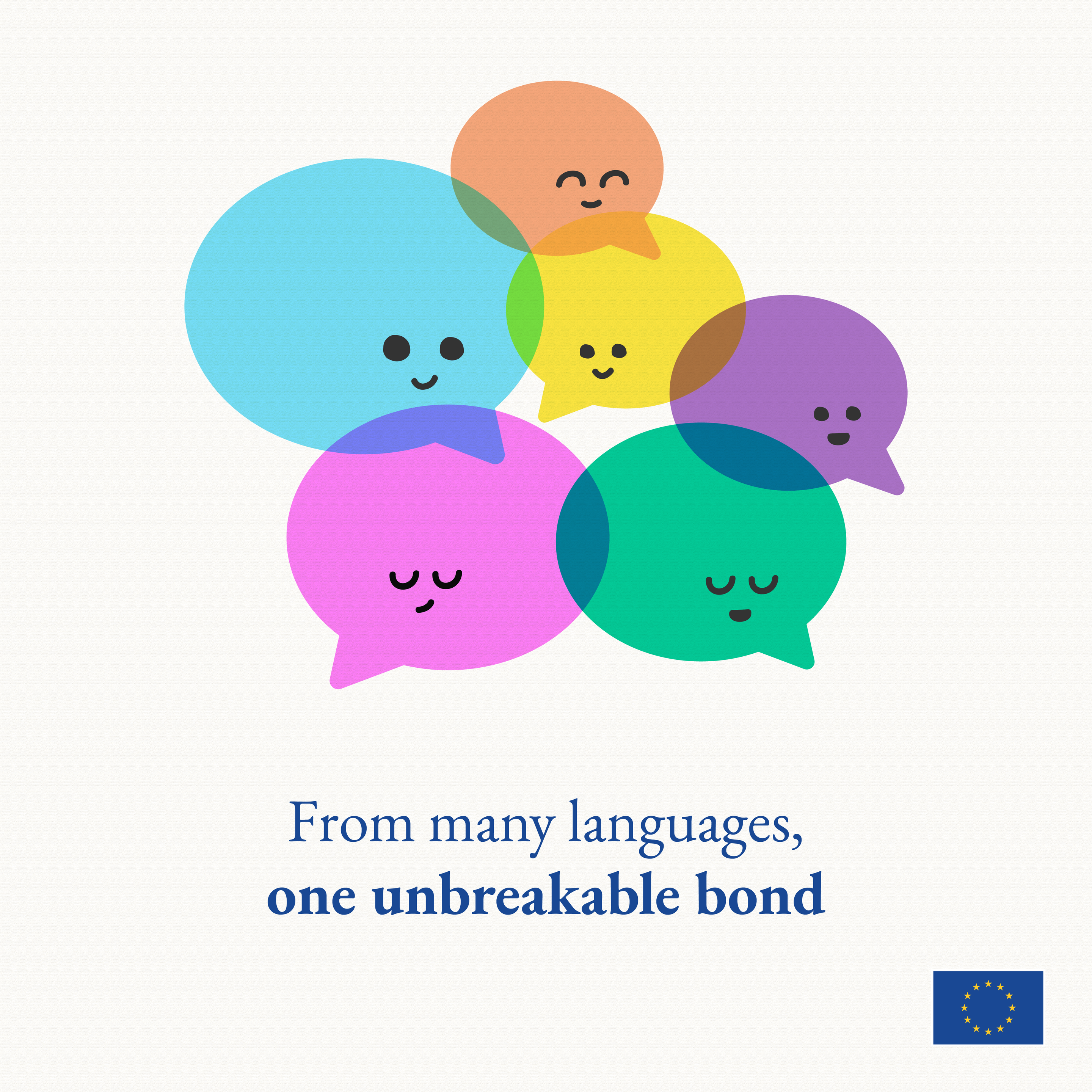
On International Mother Language Day, we celebrate the rich linguistic and cultural diversity that defines our Union, as well as the importance of protecting and promoting mother tongues across Europe.
-
@kubofhromoslav @proedie @kinkkong @Pare @valhalla @EUCommission you consider English harder than Esperanto?
@benny @kubofhromoslav @proedie @kinkkong @valhalla @EUCommission
I started studying English 40 years ago, with many years of lessons at school every week, let's say for 10 years. Then I kept on using it almost every day, attending also many conferences.I started studying Esperanto 10 years ago by myself, with just a tenth of lesson via e-mail by a professor, and I use it when I have the chance to.
My level for the two languages is almost the same!
Yes, English is MUCH harder than Esperanto!
-
@kubofhromoslav @proedie @kinkkong @Pare @valhalla @EUCommission you consider English harder than Esperanto?
@benny @proedie @kinkkong @Pare @valhalla @EUCommission, yes! For non-native speakers. By factor of 5-10, depending on the native language.
In about 2 years of mostly self-study of #Esperanto (2 months intensive study, 22 months of mostly using on internet) I get to same level as in English in 15 years of school learning.
Clear difference

-
@benny @proedie @kinkkong @Pare @valhalla @EUCommission, yes! For non-native speakers. By factor of 5-10, depending on the native language.
In about 2 years of mostly self-study of #Esperanto (2 months intensive study, 22 months of mostly using on internet) I get to same level as in English in 15 years of school learning.
Clear difference
@benny @proedie @kinkkong @Pare @valhalla @EUCommission, this is mostly because #Esperanto is pretty regular and designed for ease of use. Eg. you can learn couple of prefixes and suffixes (eg. "mal-" means opposite) to create a lot g other words just from 1 root.
Eg. bona = good, mal-bona = bad, bon-ulo = good person, bon-ega = great, etc.
I remember when I was new to Esperanto and tried to ask where is the canteen, using my own word created this way. And it was the official word!

-
@benny @proedie @kinkkong @Pare @valhalla @EUCommission, this is mostly because #Esperanto is pretty regular and designed for ease of use. Eg. you can learn couple of prefixes and suffixes (eg. "mal-" means opposite) to create a lot g other words just from 1 root.
Eg. bona = good, mal-bona = bad, bon-ulo = good person, bon-ega = great, etc.
I remember when I was new to Esperanto and tried to ask where is the canteen, using my own word created this way. And it was the official word!
@kubofhromoslav @benny @proedie @kinkkong @Pare @valhalla @EUCommission
Heck yeah. Esperanto was specifically created so that even if you've never seen a particular word before there is still some chance you can figure it out from roots, prefixes, and suffixes. And, as pointed out, it strives for regularity.
I've never studied it seriously, but when I see Esperanto it's kind of like a game for me to unravel what it means. And you can get surprisingly close a lot of the time.
-
@benny @proedie @kinkkong @Pare @valhalla @EUCommission, this is mostly because #Esperanto is pretty regular and designed for ease of use. Eg. you can learn couple of prefixes and suffixes (eg. "mal-" means opposite) to create a lot g other words just from 1 root.
Eg. bona = good, mal-bona = bad, bon-ulo = good person, bon-ega = great, etc.
I remember when I was new to Esperanto and tried to ask where is the canteen, using my own word created this way. And it was the official word!
@kubofhromoslav @proedie @kinkkong @Pare @valhalla @EUCommission maybe my problem is that I did not learn English so much through grammar than through constant repetition. I could hardly explain grammar rules, but most of the time I am close enough. But then again, my mother tongue is German which isn't too far off vocabilary wise.
I "learned" Esperanto about 25 years ago from a small booklet which really was enough, but there was very few vocabulary and the internet didn't have much either. -
@kubofhromoslav @proedie @kinkkong @Pare @valhalla @EUCommission maybe my problem is that I did not learn English so much through grammar than through constant repetition. I could hardly explain grammar rules, but most of the time I am close enough. But then again, my mother tongue is German which isn't too far off vocabilary wise.
I "learned" Esperanto about 25 years ago from a small booklet which really was enough, but there was very few vocabulary and the internet didn't have much either.@kubofhromoslav @proedie @kinkkong @Pare @valhalla @EUCommission so I quickly forhot everything I had learned. And the texts that I did find were also kinda... It looked like people were making up vocabulary as they went. I could understand quite a bit from other languages I knew, but sometimes I ran across the same word from different languages so I figured people just use their mother tongue and add Esperanto adfixes...
So while Esperanto is easy to learn it might not be easy to use. -
@kubofhromoslav @benny @proedie @kinkkong @Pare @valhalla @EUCommission
Heck yeah. Esperanto was specifically created so that even if you've never seen a particular word before there is still some chance you can figure it out from roots, prefixes, and suffixes. And, as pointed out, it strives for regularity.
I've never studied it seriously, but when I see Esperanto it's kind of like a game for me to unravel what it means. And you can get surprisingly close a lot of the time.
@kubofhromoslav @benny @proedie @kinkkong @Pare @valhalla @EUCommission
I just had a great example!
Ich kann nur ein bischen Deutsche, and I just came across the word 'einsehbar' - new to me, but I recognize 'sehen', and I know that '-bar' sagt dass etwas fähig ist. I'm not sure how adding 'ein-' affects the meaning, but I was able to keep reading, knowing that I was being told where I could go see the thing.
Esperanto says "what if that, but everywhere?".
-
@kubofhromoslav @proedie @kinkkong @Pare @valhalla @EUCommission you consider English harder than Esperanto?
@benny @kubofhromoslav @proedie @Pare @valhalla @EUCommission
Never tried #Esperanto, but I've been struggling with #English now for multiple decades. It's horribly irregular. Sure, everyone knows that
 is spelled "ghoti", but nobody knows how to pronounce Worcestershire.
That's why I'm in favour of #Spanish, which I learned many years after English. It's a piece of cake.
Also, #MAGA hates Spanish

-
@kubofhromoslav @benny @proedie @kinkkong @Pare @valhalla @EUCommission
I just had a great example!
Ich kann nur ein bischen Deutsche, and I just came across the word 'einsehbar' - new to me, but I recognize 'sehen', and I know that '-bar' sagt dass etwas fähig ist. I'm not sure how adding 'ein-' affects the meaning, but I was able to keep reading, knowing that I was being told where I could go see the thing.
Esperanto says "what if that, but everywhere?".
@jztusk @kubofhromoslav @proedie @kinkkong @Pare @valhalla @EUCommission ein means in or into in that case. Einsehbar could mean two things: possible to look into, like you can see into a yard, or "insightable", so you can intellectually see into a thing.
-
@jztusk @kubofhromoslav @proedie @kinkkong @Pare @valhalla @EUCommission ein means in or into in that case. Einsehbar could mean two things: possible to look into, like you can see into a yard, or "insightable", so you can intellectually see into a thing.
@benny @kubofhromoslav @proedie @kinkkong @Pare @valhalla @EUCommission
Ah, thanks! In this case it was a link to the journal paper that the article was about, so "you can look into" makes 100% sense.
And I'm pretty sure the Esperanto would be 'envidebla':
en- = 'ein-'
-vid-, from 'vidi' = to see
-ebl- = '-bar'/'able to' (Yeah, Esperanto's nicer to you if your native tongue is a Romance language than Germanic.)
-a = adjective ending.(I'm happy to be corrected by serious Esperanto speakers.
-
@benny @kubofhromoslav @proedie @kinkkong @Pare @valhalla @EUCommission
Ah, thanks! In this case it was a link to the journal paper that the article was about, so "you can look into" makes 100% sense.
And I'm pretty sure the Esperanto would be 'envidebla':
en- = 'ein-'
-vid-, from 'vidi' = to see
-ebl- = '-bar'/'able to' (Yeah, Esperanto's nicer to you if your native tongue is a Romance language than Germanic.)
-a = adjective ending.(I'm happy to be corrected by serious Esperanto speakers.
@jztusk @benny @proedie @kinkkong @Pare @valhalla @EUCommission, yes, "envidebla" or "enrigardebla" is correct #Esperanto

-
@kubofhromoslav @proedie @kinkkong @Pare @valhalla @EUCommission so I quickly forhot everything I had learned. And the texts that I did find were also kinda... It looked like people were making up vocabulary as they went. I could understand quite a bit from other languages I knew, but sometimes I ran across the same word from different languages so I figured people just use their mother tongue and add Esperanto adfixes...
So while Esperanto is easy to learn it might not be easy to use.@benny @proedie @kinkkong @Pare @valhalla @EUCommission, there definitely are some occasions when Esperanto speakers translate too directly from their native language and others are wondering what it means. That tends to disappear when speakers have contact from other Esperantists from different language families.
I still hear / read it sometimes, but rarely.
-
@benny @kubofhromoslav @proedie @Pare @valhalla @EUCommission
Never tried #Esperanto, but I've been struggling with #English now for multiple decades. It's horribly irregular. Sure, everyone knows that
is spelled "ghoti", but nobody knows how to pronounce Worcestershire.That's why I'm in favour of #Spanish, which I learned many years after English. It's a piece of cake.
Also, #MAGA hates Spanish
@kinkkong @kubofhromoslav @proedie @Pare @valhalla @EUCommission MAGA hates English, too. Ever heard them speak?
-
@jztusk @benny @proedie @kinkkong @Pare @valhalla @EUCommission, yes, "envidebla" or "enrigardebla" is correct #Esperanto
@kubofhromoslav @jztusk @proedie @kinkkong @Pare @valhalla @EUCommission what would be the difference between vide- and rigarde-? Because it looks like just being the same coming from two languages: vedere - Latin and regarder - French
-
@benny @proedie @kinkkong @Pare @valhalla @EUCommission, there definitely are some occasions when Esperanto speakers translate too directly from their native language and others are wondering what it means. That tends to disappear when speakers have contact from other Esperantists from different language families.
I still hear / read it sometimes, but rarely.
@kubofhromoslav @proedie @kinkkong @Pare @valhalla @EUCommission what I mean is not only from native languages but like having several word stems from several languages that mean the same, which looks to me like you learn all vocabulary from all languages and apply a unified grammar - I'm obviously exaggerating here.
-
@kinkkong @kubofhromoslav @proedie @Pare @valhalla @EUCommission MAGA hates English, too. Ever heard them speak?
@benny @kubofhromoslav @proedie @Pare @valhalla @EUCommission
Sure, but they claim that the #US were (or should be) an #English speaking country and everything should be #EnglishOnly.
Trump: "This is a country where we speak English, not #Spanish".
They closed the Spanish web page of the #CasaBlanca (#WhiteHouse).
Their hate of Spanish is irrational — and strong.
-
@benny @kubofhromoslav @proedie @Pare @valhalla @EUCommission
Sure, but they claim that the #US were (or should be) an #English speaking country and everything should be #EnglishOnly.
Trump: "This is a country where we speak English, not #Spanish".
They closed the Spanish web page of the #CasaBlanca (#WhiteHouse).
Their hate of Spanish is irrational — and strong.
@kinkkong @kubofhromoslav @proedie @Pare @valhalla @EUCommission I'm aware of all that. Still the USA has no official language, they just happen to have a lot of English speakers. Of course Trump is trying to make the lives of Spanish speakers as miserable as possible, after all it's Trump and he "has the best words" and those are English, porque no tiene educación.
-
@kubofhromoslav @jztusk @proedie @kinkkong @Pare @valhalla @EUCommission what would be the difference between vide- and rigarde-? Because it looks like just being the same coming from two languages: vedere - Latin and regarder - French
@benny @kubofhromoslav @proedie @kinkkong @Pare @valhalla @EUCommission
I was wondering that too. My guess is that it's similar to the difference in English between 'see' and 'look at' respectively. Heck, doesn't French have both 'voir' and 'regarder'?
And my understanding is that even though it's rather informal, German has 'kucken' in addition to 'sehen'?
-
@kinkkong @kubofhromoslav @proedie @Pare @valhalla @EUCommission I'm aware of all that. Still the USA has no official language, they just happen to have a lot of English speakers. Of course Trump is trying to make the lives of Spanish speakers as miserable as possible, after all it's Trump and he "has the best words" and those are English, porque no tiene educación.
-
@benny @proedie @kinkkong @Pare @valhalla @EUCommission, yes! For non-native speakers. By factor of 5-10, depending on the native language.
In about 2 years of mostly self-study of #Esperanto (2 months intensive study, 22 months of mostly using on internet) I get to same level as in English in 15 years of school learning.
Clear difference
@kubofhromoslav
@benny
I second that:
Esperanto is *by far* easier to learn than English.
You wrote of "a planned language equally hard for everyone to learn".
Or equally (relatively) easy to learn, like Esperanto.
Look up "Paderborner Methode" on Wikipedia:
It's been around 50 years now that in this scientific experiment with different school classes, was found out that pupils who learned Esperanto *first* were mostly able to learn additional (European) languages easier and significantly faster than those who *only* learned the European language, without learning Esperanto.
50 years - and there's still an active recommendation by the UN to offer Esperanto lessons in all schools in Europe - ignored ever since, despite its advantages!
@proedie @kinkkong @Pare @valhalla @EUCommission