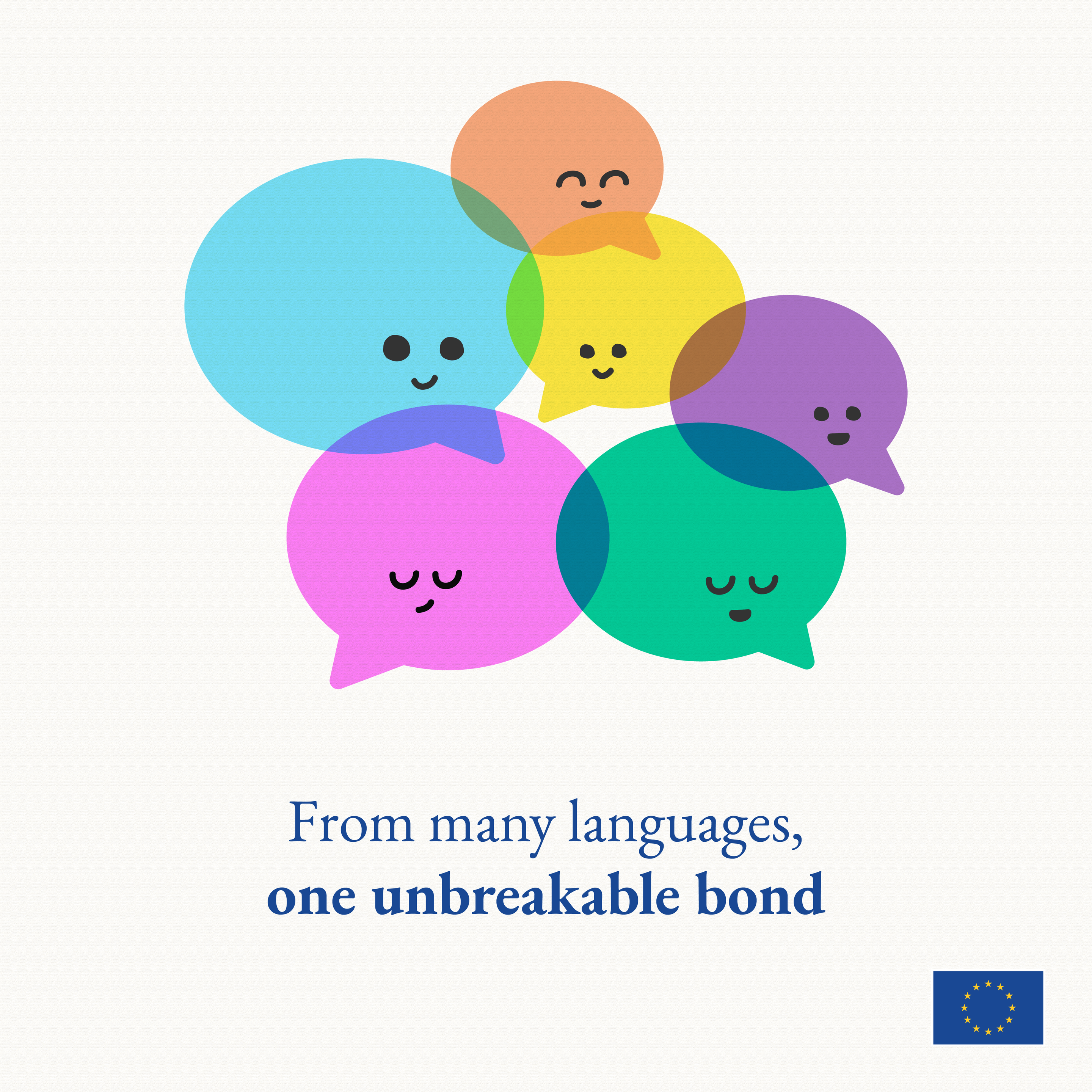
On International Mother Language Day, we celebrate the rich linguistic and cultural diversity that defines our Union, as well as the importance of protecting and promoting mother tongues across Europe.
-
@kinkkong @EUCommission honestly, using a language that is not the official language of one of the big countries of the EU (but is widely known as a second language) sounds better than giving undue advantage to the people in a country that already has a big population.
And besides, if that single language had to be chosen by number of EU speakers, I believe that German or French would come first, then Italian¹, and only then Spanish
¹ please don't! too many Italians are already self-centered assholes, they don't need to be helped gain confidence in their cultural importance this way.
PS: I'm sure that you, @valhalla, are aware of as many "self-centered assholes" whose mother language is the one we are using to write right now...

Are we sure that they deserve the confidence in their... how to say this... power?!?... given by the fact that their language is used as the only one important for intercommunication?
@EUCommission @kinkkong -
Algú podria creure que és una fantasia europea, una visió il·lusòria, però no, és exactament HIPOCRESIA EUROPEA!
@EUCommission, el que de debò celebreu és el dia de les llengües "maternes" estatals d'estats lingüicides que per a molts parlants són llengües imposades talment com madrastes de la ventafocs.
Podeu mentir tot el què vulgueu, ja que d'això en sabeu molt, però no enganyeu. I ara a seguir malgastant el futur en bombes i crims.
@vmateusimeon
Sí, després els projectes de recerca que financen tenen prohibit gastar diners en traducció o interpretació. Resultat: tot ha de ser en anglès...
@spla @tmallafre @EUCommission -
@vmateusimeon
Sí, després els projectes de recerca que financen tenen prohibit gastar diners en traducció o interpretació. Resultat: tot ha de ser en anglès...
@spla @tmallafre @EUCommission@jpujolar @spla @tmallafre @EUCommission la llengua materna més parlada amb diferència a la UE suposo.
-
@kubofhromoslav @Pare @valhalla @EUCommission @kinkkong Why not #Latin? It has several advantages:
1. It is the base for may European languages and left impressions on all the others.
2. It has been proven to work as an auxiliary language historically as well as contemporarily (Vatican).
3. Many pupils already have to learn it all around Europe for no good reason. It would give a meaning to common practice.
4. Its complicated grammar would make Esperanto look even more desirable.

@proedie I prefer Celtic.

-
@kinkkong @kubofhromoslav @Pare @valhalla @EUCommission Interesting, I never heard about this one before.
@proedie @kinkkong @kubofhromoslav @Pare @valhalla @EUCommission why not stay with English? We already speak it, it helps us connect with our friends on the Island and across the sea, even those further south who are not that blessed with embracing multilingualism, and no one's stopping us using other languages given the occasion, d'accord.
-
@EUCommission @kinkkong i aquest és el truc. Ens ha de representar Espanya, que minoritza el nostre idioma (que no és minoritari, però està miniritzat) i nosaltres que el giram en nom del negoci i el turisme.
És que no és pràctic, millor ho feim tot en anglès, un idioma sense cap país que el reprrsenti dins l'EU. Perfecte. Meravellós.
Bon dia dels idiomes materns (segons quind, i segons on)@cibersheep @EUCommission @kinkkong @spla Galician?
-
@kubofhromoslav @Pare @valhalla @EUCommission @kinkkong Why not #Latin? It has several advantages:
1. It is the base for may European languages and left impressions on all the others.
2. It has been proven to work as an auxiliary language historically as well as contemporarily (Vatican).
3. Many pupils already have to learn it all around Europe for no good reason. It would give a meaning to common practice.
4. Its complicated grammar would make Esperanto look even more desirable.
@proedie @Pare @valhalla @EUCommission @kinkkong, I learnt both #Esperanto and #Latin and I confirm that Latin's complicated grammar makes Esperanto even more desirable

In short, despite its many cool features, especially historic significance, Latin is just too hard for masses. We definitely can have an inteligencia layer fluent in Latin, but it would do little to unite Europe.
-
@proedie @kinkkong @kubofhromoslav @Pare @valhalla @EUCommission why not stay with English? We already speak it, it helps us connect with our friends on the Island and across the sea, even those further south who are not that blessed with embracing multilingualism, and no one's stopping us using other languages given the occasion, d'accord.
@benny @proedie @kinkkong @Pare @valhalla @EUCommission, couple of reasons.
English is not super neutral. Indeed, a bit in EU (only in 2 quite small countries), but definitely not on the world stage.
English's role is *national* communication. International use blends it.
English is unnecessary hard to use. Good for national communication, but for international one, and unification of Europe, we need a language that masses can use comfortably.
-
@benny @proedie @kinkkong @Pare @valhalla @EUCommission, couple of reasons.
English is not super neutral. Indeed, a bit in EU (only in 2 quite small countries), but definitely not on the world stage.
English's role is *national* communication. International use blends it.
English is unnecessary hard to use. Good for national communication, but for international one, and unification of Europe, we need a language that masses can use comfortably.
@kubofhromoslav @proedie @kinkkong @Pare @valhalla @EUCommission a truly neutral language would be one that is equally hard for all, which would be some planned language, which would not be used comfortably by the masses, because not many people speak Volapük or Klingon.
English's use is not nationsl communication just like French wasn't national in olden times or Sumerian in even older times. -
@kubofhromoslav @proedie @kinkkong @Pare @valhalla @EUCommission a truly neutral language would be one that is equally hard for all, which would be some planned language, which would not be used comfortably by the masses, because not many people speak Volapük or Klingon.
English's use is not nationsl communication just like French wasn't national in olden times or Sumerian in even older times.@benny @proedie @kinkkong @Pare @valhalla @EUCommission, it doesn't make sense to use language that is hard, or even harder than it could be. For masses we need a language that is *easy* to learn and use, while being fully capable. So, equally easy for everyone.
Such language is a nice hypothetical exercise, but doesn't exist. Esperanto is closer to that from what I know.
-
@benny @proedie @kinkkong @Pare @valhalla @EUCommission, it doesn't make sense to use language that is hard, or even harder than it could be. For masses we need a language that is *easy* to learn and use, while being fully capable. So, equally easy for everyone.
Such language is a nice hypothetical exercise, but doesn't exist. Esperanto is closer to that from what I know.
@kubofhromoslav @proedie @kinkkong @Pare @valhalla @EUCommission you consider English harder than Esperanto?
-
@kubofhromoslav @proedie @kinkkong @Pare @valhalla @EUCommission you consider English harder than Esperanto?
@benny @kubofhromoslav @proedie @kinkkong @valhalla @EUCommission
I started studying English 40 years ago, with many years of lessons at school every week, let's say for 10 years. Then I kept on using it almost every day, attending also many conferences.I started studying Esperanto 10 years ago by myself, with just a tenth of lesson via e-mail by a professor, and I use it when I have the chance to.
My level for the two languages is almost the same!
Yes, English is MUCH harder than Esperanto!
-
@kubofhromoslav @proedie @kinkkong @Pare @valhalla @EUCommission you consider English harder than Esperanto?
@benny @proedie @kinkkong @Pare @valhalla @EUCommission, yes! For non-native speakers. By factor of 5-10, depending on the native language.
In about 2 years of mostly self-study of #Esperanto (2 months intensive study, 22 months of mostly using on internet) I get to same level as in English in 15 years of school learning.
Clear difference
-
@benny @proedie @kinkkong @Pare @valhalla @EUCommission, yes! For non-native speakers. By factor of 5-10, depending on the native language.
In about 2 years of mostly self-study of #Esperanto (2 months intensive study, 22 months of mostly using on internet) I get to same level as in English in 15 years of school learning.
Clear difference
@benny @proedie @kinkkong @Pare @valhalla @EUCommission, this is mostly because #Esperanto is pretty regular and designed for ease of use. Eg. you can learn couple of prefixes and suffixes (eg. "mal-" means opposite) to create a lot g other words just from 1 root.
Eg. bona = good, mal-bona = bad, bon-ulo = good person, bon-ega = great, etc.
I remember when I was new to Esperanto and tried to ask where is the canteen, using my own word created this way. And it was the official word!

-
@benny @proedie @kinkkong @Pare @valhalla @EUCommission, this is mostly because #Esperanto is pretty regular and designed for ease of use. Eg. you can learn couple of prefixes and suffixes (eg. "mal-" means opposite) to create a lot g other words just from 1 root.
Eg. bona = good, mal-bona = bad, bon-ulo = good person, bon-ega = great, etc.
I remember when I was new to Esperanto and tried to ask where is the canteen, using my own word created this way. And it was the official word!
@kubofhromoslav @benny @proedie @kinkkong @Pare @valhalla @EUCommission
Heck yeah. Esperanto was specifically created so that even if you've never seen a particular word before there is still some chance you can figure it out from roots, prefixes, and suffixes. And, as pointed out, it strives for regularity.
I've never studied it seriously, but when I see Esperanto it's kind of like a game for me to unravel what it means. And you can get surprisingly close a lot of the time.
-
@benny @proedie @kinkkong @Pare @valhalla @EUCommission, this is mostly because #Esperanto is pretty regular and designed for ease of use. Eg. you can learn couple of prefixes and suffixes (eg. "mal-" means opposite) to create a lot g other words just from 1 root.
Eg. bona = good, mal-bona = bad, bon-ulo = good person, bon-ega = great, etc.
I remember when I was new to Esperanto and tried to ask where is the canteen, using my own word created this way. And it was the official word!
@kubofhromoslav @proedie @kinkkong @Pare @valhalla @EUCommission maybe my problem is that I did not learn English so much through grammar than through constant repetition. I could hardly explain grammar rules, but most of the time I am close enough. But then again, my mother tongue is German which isn't too far off vocabilary wise.
I "learned" Esperanto about 25 years ago from a small booklet which really was enough, but there was very few vocabulary and the internet didn't have much either. -
@kubofhromoslav @proedie @kinkkong @Pare @valhalla @EUCommission maybe my problem is that I did not learn English so much through grammar than through constant repetition. I could hardly explain grammar rules, but most of the time I am close enough. But then again, my mother tongue is German which isn't too far off vocabilary wise.
I "learned" Esperanto about 25 years ago from a small booklet which really was enough, but there was very few vocabulary and the internet didn't have much either.@kubofhromoslav @proedie @kinkkong @Pare @valhalla @EUCommission so I quickly forhot everything I had learned. And the texts that I did find were also kinda... It looked like people were making up vocabulary as they went. I could understand quite a bit from other languages I knew, but sometimes I ran across the same word from different languages so I figured people just use their mother tongue and add Esperanto adfixes...
So while Esperanto is easy to learn it might not be easy to use. -
@kubofhromoslav @benny @proedie @kinkkong @Pare @valhalla @EUCommission
Heck yeah. Esperanto was specifically created so that even if you've never seen a particular word before there is still some chance you can figure it out from roots, prefixes, and suffixes. And, as pointed out, it strives for regularity.
I've never studied it seriously, but when I see Esperanto it's kind of like a game for me to unravel what it means. And you can get surprisingly close a lot of the time.
@kubofhromoslav @benny @proedie @kinkkong @Pare @valhalla @EUCommission
I just had a great example!
Ich kann nur ein bischen Deutsche, and I just came across the word 'einsehbar' - new to me, but I recognize 'sehen', and I know that '-bar' sagt dass etwas fähig ist. I'm not sure how adding 'ein-' affects the meaning, but I was able to keep reading, knowing that I was being told where I could go see the thing.
Esperanto says "what if that, but everywhere?".
-
@kubofhromoslav @proedie @kinkkong @Pare @valhalla @EUCommission you consider English harder than Esperanto?
@benny @kubofhromoslav @proedie @Pare @valhalla @EUCommission
Never tried #Esperanto, but I've been struggling with #English now for multiple decades. It's horribly irregular. Sure, everyone knows that
 is spelled "ghoti", but nobody knows how to pronounce Worcestershire.
That's why I'm in favour of #Spanish, which I learned many years after English. It's a piece of cake.
Also, #MAGA hates Spanish

-
@kubofhromoslav @benny @proedie @kinkkong @Pare @valhalla @EUCommission
I just had a great example!
Ich kann nur ein bischen Deutsche, and I just came across the word 'einsehbar' - new to me, but I recognize 'sehen', and I know that '-bar' sagt dass etwas fähig ist. I'm not sure how adding 'ein-' affects the meaning, but I was able to keep reading, knowing that I was being told where I could go see the thing.
Esperanto says "what if that, but everywhere?".
@jztusk @kubofhromoslav @proedie @kinkkong @Pare @valhalla @EUCommission ein means in or into in that case. Einsehbar could mean two things: possible to look into, like you can see into a yard, or "insightable", so you can intellectually see into a thing.