If you use AI-generated code, you currently cannot claim copyright on it in the US.
-
@jamie I *am* an IP lawyer and I (along with many others) have been saying it for a while, that if the position the “AI” co’s are taking with respect to the legality of scraping “publicly available” materials were true (that all “publicly available” materials are “public domain” free to be used as raw materials without consent required), then copyright ceases to exist and all their own materials will be free for everyone else to use the very first time they’re leaked. That’ll be fun for the co.
@fsinn @jamie Thanks! Obtaining copyright for LLM-generated text is one thing, but I've read an assessment from a German state ministry yesterday that according to national laws copyright infringement by LLMs are passed on to users and text they generate in Germany, in their interpretation. If that holds, consequences might be rather big.
-
FWIW I'm not a lawyer and I'm not recommending that you do this.
 Even if companies have no legal standing on copyright, their legal team will try it. It *will* cost you money.
But man, oh man, I'm gonna have popcorn ready for when someone inevitably pulls this move.
@jamie Hopefully they won't. If you right now published your company's non-AI code, you can be sure copyright infringement won't the thing that kills you, that's just a cherry on top.
So if you do it with a codebase that has undisclosed AI code, you're still ruining your life except they won't have their cherry on top. Not sure it's worth it but YMMV.
-
@jamie so windows 11 source code is public domain now?
What about AWS? -
@kkarhan Yeah, this is very US-focused. I haven't worked with any lawyers outside the US and I'm not familiar with how copyright works outside the US at all.
However, if the company is in the US and they don't have a huge international presence, they probably aren't able to take legal action anyway.
@jamie @kkarhan
European/German law is similar:German UrhG Par2(2)
„[protected] works […] are only personal, inspired creations“ (quick, dirty translation)There is the special catch with the „inspired“ part. If it is not creative enough, it is not protected. This especially true for paintings („Gebrauchsgrafiken“), e.g. quickly drawn direction-pointing-arrows, texts like „this side up“ are not protected (unless very creatively designed).
IANAL though
-
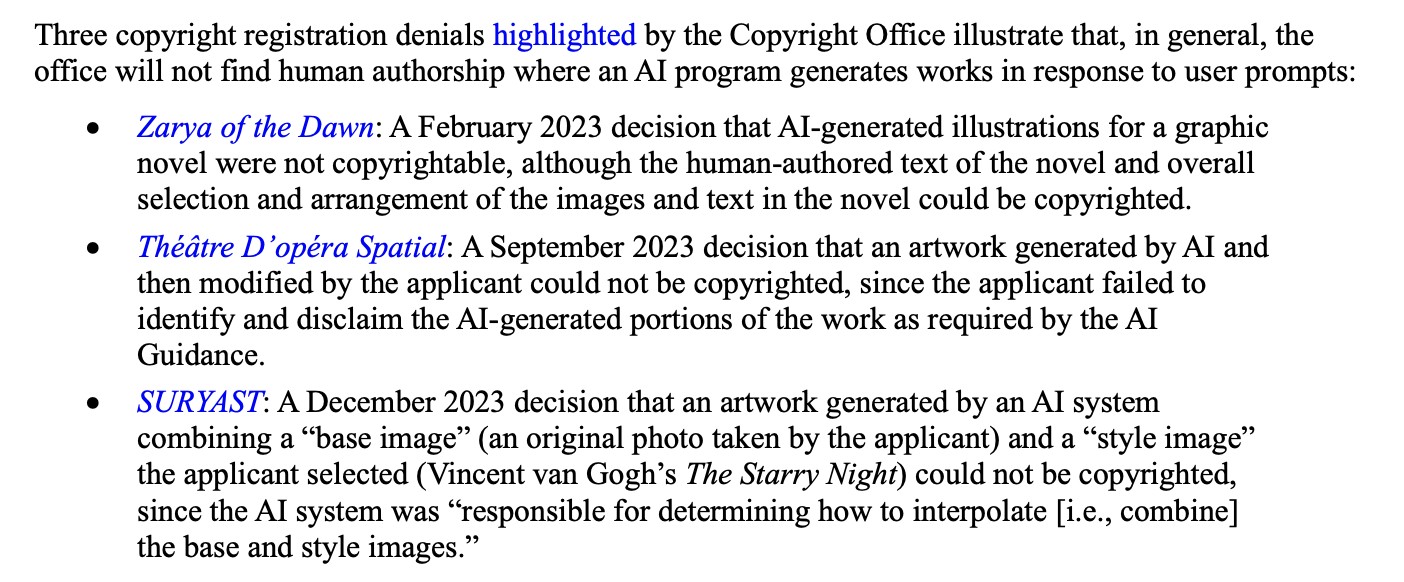
If you use AI-generated code, you currently cannot claim copyright on it in the US. If you fail to disclose/disclaim exactly which parts were not written by a human, you forfeit your copyright claim on *the entire codebase*.
This means copyright notices and even licenses folks are putting on their vibe-coded GitHub repos are unenforceable. The AI-generated code, and possibly the whole project, becomes public domain.
Source: https://www.congress.gov/crs_external_products/LSB/PDF/LSB10922/LSB10922.8.pdf
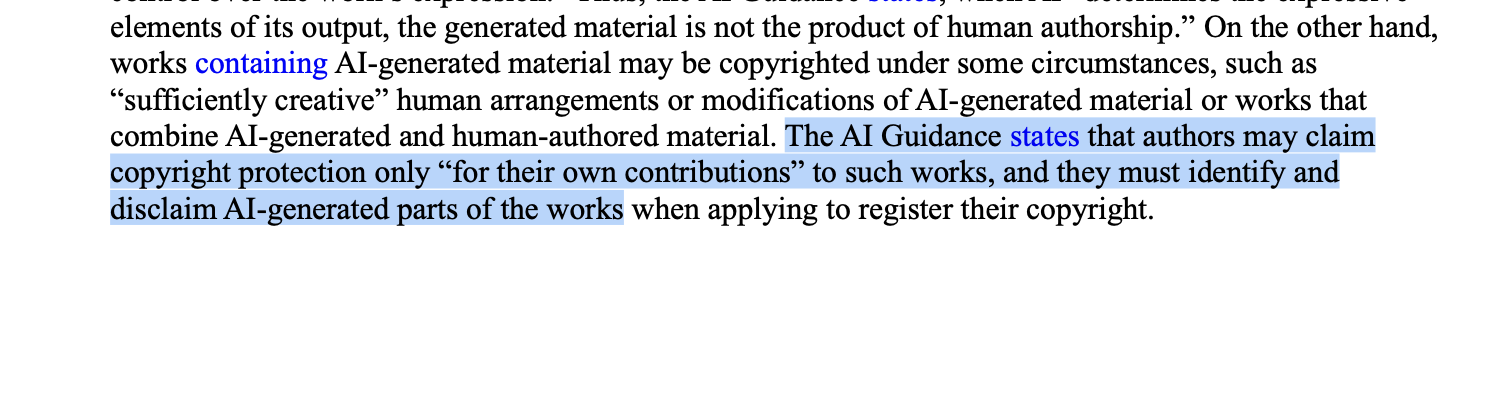
@jamie This is just The Merchant of Venice, but with code instead of flesh.
-
@jamie @kkarhan
European/German law is similar:German UrhG Par2(2)
„[protected] works […] are only personal, inspired creations“ (quick, dirty translation)There is the special catch with the „inspired“ part. If it is not creative enough, it is not protected. This especially true for paintings („Gebrauchsgrafiken“), e.g. quickly drawn direction-pointing-arrows, texts like „this side up“ are not protected (unless very creatively designed).
IANAL though
@vampirdaddy @jamie yeah, cuz in practice, you have "collecting societies" like #GEMA that literally will demand one to evidence there's no content being played that they represent or face huge [retroactive] fines and license payments.
OFC this is #NotLegalAdvice and @wbs_legal, a law firm spechalized in media, did a good writeup on this issue.
It's also the reason why one can buy 8-12hr #samplers with #BackgroundMusic that is "GEMA-free" for €120+ because even a small location will face €300+ in monthy (!) licensing fees if they choose to just play the local radio station (on top of TV/Radio licensing fees!)
- This is also why you get "digital signage screens" which are basically TVs without any tuner in them, because commercial users have to license per device instead of a flat per-household fee and the only way to not be affected by this is by being technically unable to recieve said programming...
- Similarly, this is why many commercial vehicles have no radio in them and why Rivian's amazon delivery vans only have an amplifier with bluetooth in them (so delivery drivers can listen to the navigation instructions on their issued handheld)...
-
@Suiseiseki@freesoftwareextremist.com @jamie@zomglol.wtf I was just saying what was on my last 2 contracts and i never report anything i wrote on company hardware because i think those rules are bs just as much as you do
-
@max @fsinn @jamie That's not true. Media organisations and individual journalist make a share of their income from granting licenses for secondary use of their digital works, for copying them or for offering them in libraries. Copyright is one of the few bedrocks of income. It doesn‘t vanish through wishful thinking or ignoring it.
@christianschwaegerl @fsinn @jamie That's the classical model, yes, and it's unfortunate that they have to rely on such an external influence on their integrity and this needs to change.
And it slowly is, both legally (e.g. publicly financed journalism can be one solution to avoid this conflict of interest) as well as illegally (content is reused without permission for "AI" training, or simply shared online for free so that every human has access to the information)
-
If you use AI-generated code, you currently cannot claim copyright on it in the US. If you fail to disclose/disclaim exactly which parts were not written by a human, you forfeit your copyright claim on *the entire codebase*.
This means copyright notices and even licenses folks are putting on their vibe-coded GitHub repos are unenforceable. The AI-generated code, and possibly the whole project, becomes public domain.
Source: https://www.congress.gov/crs_external_products/LSB/PDF/LSB10922/LSB10922.8.pdf
@jamie@zomglol.wtf Fantastic read – thanks for sharing!
-
If you use AI-generated code, you currently cannot claim copyright on it in the US. If you fail to disclose/disclaim exactly which parts were not written by a human, you forfeit your copyright claim on *the entire codebase*.
This means copyright notices and even licenses folks are putting on their vibe-coded GitHub repos are unenforceable. The AI-generated code, and possibly the whole project, becomes public domain.
Source: https://www.congress.gov/crs_external_products/LSB/PDF/LSB10922/LSB10922.8.pdf
Additionally, AI generated code can be a copyright infringement if the AI basically generated a copy of some copyrighted code. And if we consider that AI is trained on lots of GPLed code there is a high probability it will generate code that would need to be licensed accordingly.
There is no clean room implementation of anything with AI. The code is immediately tainted.
-
If you use AI-generated code, you currently cannot claim copyright on it in the US. If you fail to disclose/disclaim exactly which parts were not written by a human, you forfeit your copyright claim on *the entire codebase*.
This means copyright notices and even licenses folks are putting on their vibe-coded GitHub repos are unenforceable. The AI-generated code, and possibly the whole project, becomes public domain.
Source: https://www.congress.gov/crs_external_products/LSB/PDF/LSB10922/LSB10922.8.pdf
@jamie@zomglol.wtf brb forking Windows
-
If you use AI-generated code, you currently cannot claim copyright on it in the US. If you fail to disclose/disclaim exactly which parts were not written by a human, you forfeit your copyright claim on *the entire codebase*.
This means copyright notices and even licenses folks are putting on their vibe-coded GitHub repos are unenforceable. The AI-generated code, and possibly the whole project, becomes public domain.
Source: https://www.congress.gov/crs_external_products/LSB/PDF/LSB10922/LSB10922.8.pdf
@jamie So, AI agents will need to hire humans to clean-room reimplement vibecoded projects?
What a time to be alive! #ReverseCentaur -
@tuban_muzuru You conduct yourself like a real asshole.
Tell me it ain't so, all this hoop-de-doo about how AI gonna take yer jerbs.
Worry not and take ol' TM's evergreen advice: the machines will always handle the rules and the humans will handle the exceptions.
-
If you use AI-generated code, you currently cannot claim copyright on it in the US. If you fail to disclose/disclaim exactly which parts were not written by a human, you forfeit your copyright claim on *the entire codebase*.
This means copyright notices and even licenses folks are putting on their vibe-coded GitHub repos are unenforceable. The AI-generated code, and possibly the whole project, becomes public domain.
Source: https://www.congress.gov/crs_external_products/LSB/PDF/LSB10922/LSB10922.8.pdf
@jamie Maybe this would also be a problem for somebody that is publishing code with an Open Source license. If you don't have copyright on your vibe code, you can't license it, right?
Feels like it could lead to conflicts like the Google vs Oracle Java debacle. Nobody wants that. -
@katrinatransfem @fsinn @jamie If the material is acquired legally, they don't need a specific "license" to use it as training material. Copyright holders don't get to determine how their work is used after it's acquired, except to prevent its distribution.
Now, for the even larger than normal scumbags like Anthropic and Meta that torrented millions of books, that's certainly a problem. But Google, for instance, actually bought all the books they scanned.
-
@jamie The funny thing about this whole thread is apparently I'd already blocked that guy some time ago, so I'm only seeing your side of the conversation. And…that's all I need to know anyway.

@jaredwhite @jamie Thanks for the tip for another hateful person to block.
-
If you use AI-generated code, you currently cannot claim copyright on it in the US. If you fail to disclose/disclaim exactly which parts were not written by a human, you forfeit your copyright claim on *the entire codebase*.
This means copyright notices and even licenses folks are putting on their vibe-coded GitHub repos are unenforceable. The AI-generated code, and possibly the whole project, becomes public domain.
Source: https://www.congress.gov/crs_external_products/LSB/PDF/LSB10922/LSB10922.8.pdf
@stroughtonsmith Is this relevant? I honestly don’t know a ton about this but I’m curious if you have thoughts on it…
-
-
@stroughtonsmith Is this relevant? I honestly don’t know a ton about this but I’m curious if you have thoughts on it…
@Verxion I think this is probably right:
Nick Lockwood (@nicklockwood@mastodon.social)
People pontificating about whether codebases containing LLM-generated code are subject to IP protection all seem to be forgetting the key point that the law always sides with capital When big media decided that pirating an mp3 file should be a criminal (not civil) offence, the law sided with them When big tech decided that pirating every piece of media on the internet for AI training was fair use, the law sided with them

Mastodon (mastodon.social)
-
@Verxion I think this is probably right:
Nick Lockwood (@nicklockwood@mastodon.social)
People pontificating about whether codebases containing LLM-generated code are subject to IP protection all seem to be forgetting the key point that the law always sides with capital When big media decided that pirating an mp3 file should be a criminal (not civil) offence, the law sided with them When big tech decided that pirating every piece of media on the internet for AI training was fair use, the law sided with them
Mastodon (mastodon.social)
@stroughtonsmith I think that’s fair. I seriously do and so I’m not disagreeing with you.
…the sad thing though (to me anyway) is that this means an indie dev is unlikely to be able to afford to retain ownership like a large corporation can.