If you use AI-generated code, you currently cannot claim copyright on it in the US.
-
-
R relay@relay.publicsquare.global shared this topic
-
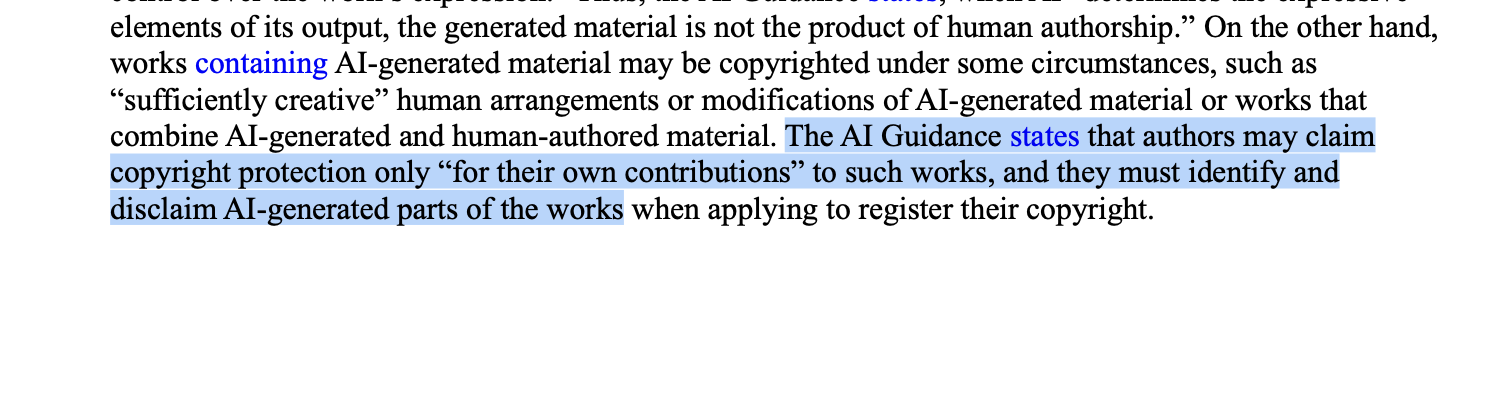
If you use AI-generated code, you currently cannot claim copyright on it in the US. If you fail to disclose/disclaim exactly which parts were not written by a human, you forfeit your copyright claim on *the entire codebase*.
This means copyright notices and even licenses folks are putting on their vibe-coded GitHub repos are unenforceable. The AI-generated code, and possibly the whole project, becomes public domain.
Source: https://www.congress.gov/crs_external_products/LSB/PDF/LSB10922/LSB10922.8.pdf
@jamie I wonder if that’ll kill the use of “AI” at work
-
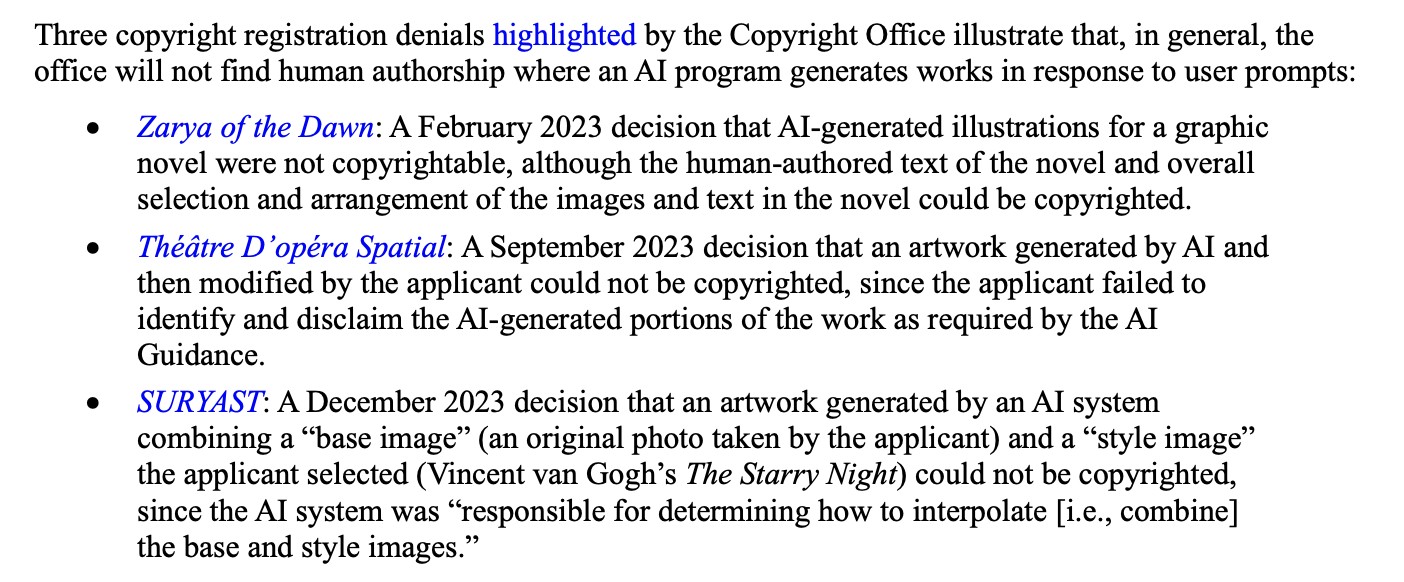
@xgranade @jamie @aeva I think it's a much stronger case for the example rejected registrations that they show on the next page, which are exclusively about copyrightability of images.
It's largely legally untested AFAICT but based on how eagerly US courts have swallowed up the fair-use arguments of the vendors of these models, I don't have a lot of faith they would play hard-ball with a litigant who has code that has been established to have been generated, but who argues sufficiency from a "trust me, bro" perspective. (IANAL either, of course)
I would *love* to be wrong about that though, and I'm glad that the Copyright Office has drawn a clear line in the sand on the general matter (and wish more people in tech had read either the publications themselves, or this CRS summary of same)
-
If you use AI-generated code, you currently cannot claim copyright on it in the US. If you fail to disclose/disclaim exactly which parts were not written by a human, you forfeit your copyright claim on *the entire codebase*.
This means copyright notices and even licenses folks are putting on their vibe-coded GitHub repos are unenforceable. The AI-generated code, and possibly the whole project, becomes public domain.
Source: https://www.congress.gov/crs_external_products/LSB/PDF/LSB10922/LSB10922.8.pdf
@jamie@zomglol.wtf and how do you know if something is AI?
-
@xgranade @jamie @aeva I think it's a much stronger case for the example rejected registrations that they show on the next page, which are exclusively about copyrightability of images.
It's largely legally untested AFAICT but based on how eagerly US courts have swallowed up the fair-use arguments of the vendors of these models, I don't have a lot of faith they would play hard-ball with a litigant who has code that has been established to have been generated, but who argues sufficiency from a "trust me, bro" perspective. (IANAL either, of course)
I would *love* to be wrong about that though, and I'm glad that the Copyright Office has drawn a clear line in the sand on the general matter (and wish more people in tech had read either the publications themselves, or this CRS summary of same)
-
@emma Oh yeah, shit's gonna get weird for a while and I think a lot of legislation going in during this administration as well as recent SCOTUS cases will need to be revisited. Ideally after also instituting laws around conflicts of interest with government officials that don't carve out exceptions for, oh I dunno, members of Congress, for example.
Basically, I want the different branches of the government to fight each other again rather than the different parties.
@jamie the US needs a new constitution, but the right wingers, the religious gooners, and the billionaires should have no say in it.
-
-
If you use AI-generated code, you currently cannot claim copyright on it in the US. If you fail to disclose/disclaim exactly which parts were not written by a human, you forfeit your copyright claim on *the entire codebase*.
This means copyright notices and even licenses folks are putting on their vibe-coded GitHub repos are unenforceable. The AI-generated code, and possibly the whole project, becomes public domain.
Source: https://www.congress.gov/crs_external_products/LSB/PDF/LSB10922/LSB10922.8.pdf
@jamie china is the main producer of models with open weights, open source ai, china is pushing the evolution of ai forward - what's next? probably 10x compute for smb sector
-
If you use AI-generated code, you currently cannot claim copyright on it in the US. If you fail to disclose/disclaim exactly which parts were not written by a human, you forfeit your copyright claim on *the entire codebase*.
This means copyright notices and even licenses folks are putting on their vibe-coded GitHub repos are unenforceable. The AI-generated code, and possibly the whole project, becomes public domain.
Source: https://www.congress.gov/crs_external_products/LSB/PDF/LSB10922/LSB10922.8.pdf
@jamie so… Windows is now fair game?
-
If you use AI-generated code, you currently cannot claim copyright on it in the US. If you fail to disclose/disclaim exactly which parts were not written by a human, you forfeit your copyright claim on *the entire codebase*.
This means copyright notices and even licenses folks are putting on their vibe-coded GitHub repos are unenforceable. The AI-generated code, and possibly the whole project, becomes public domain.
Source: https://www.congress.gov/crs_external_products/LSB/PDF/LSB10922/LSB10922.8.pdf
@jamie in the US, outside of the US exist, and when i don't like AI, until other country rules AI code is not copyrightable ... it remain copyrightable on the whole world BUT US.
so not it does not automatically become public domain
(And again i'm against AI).
-
FWIW I'm not a lawyer and I'm not recommending that you do this.
 Even if companies have no legal standing on copyright, their legal team will try it. It *will* cost you money.
But man, oh man, I'm gonna have popcorn ready for when someone inevitably pulls this move.
@jamie I *am* an IP lawyer and I (along with many others) have been saying it for a while, that if the position the “AI” co’s are taking with respect to the legality of scraping “publicly available” materials were true (that all “publicly available” materials are “public domain” free to be used as raw materials without consent required), then copyright ceases to exist and all their own materials will be free for everyone else to use the very first time they’re leaked. That’ll be fun for the co.
-
If you use AI-generated code, you currently cannot claim copyright on it in the US. If you fail to disclose/disclaim exactly which parts were not written by a human, you forfeit your copyright claim on *the entire codebase*.
This means copyright notices and even licenses folks are putting on their vibe-coded GitHub repos are unenforceable. The AI-generated code, and possibly the whole project, becomes public domain.
Source: https://www.congress.gov/crs_external_products/LSB/PDF/LSB10922/LSB10922.8.pdf
@jamie where does it say "the entire codebase"?
I reas it exactly opposite.Copyright on own contributions
-
If you use AI-generated code, you currently cannot claim copyright on it in the US. If you fail to disclose/disclaim exactly which parts were not written by a human, you forfeit your copyright claim on *the entire codebase*.
This means copyright notices and even licenses folks are putting on their vibe-coded GitHub repos are unenforceable. The AI-generated code, and possibly the whole project, becomes public domain.
Source: https://www.congress.gov/crs_external_products/LSB/PDF/LSB10922/LSB10922.8.pdf
@jamie win win for the creatives and for slop-craft
-
Stop whining. You and about seventy zillion terrified sheep running around here bleating about the Terrible AI monster under the bed.
@tuban_muzuru i hope you write a program some day
-
Stop whining. You and about seventy zillion terrified sheep running around here bleating about the Terrible AI monster under the bed.
@tuban_muzuru @jamie stop fighting! cant you see youre tearing us apart!!!
-
It'll be interesting to see what happens when a company pisses off an employee to the point where that person creates a public repo containing all the company's AI-generated code. I guarantee what's AI-generated and what's human-written isn't called out anywhere in the code, meaning the entire codebase becomes public domain.
While the company may have recourse based on the employment agreement (which varies in enforceability by state), I doubt there'd be any on the basis of copyright.
@jamie@zomglol.wtf Anthropic claims Claude coded the current version of Claude.
-
@tuban_muzuru You conduct yourself like a real asshole.
-
@jamie
Well, someone still needs to decide at some point whether to abolish copyright or start enforcing it again, and at that point it could become a huge problem for anyone who has incorporated stolen code into their code base.@leeloo Strong agree!
-
@jamie I wonder if that’ll kill the use of “AI” at work
@c0dec0dec0de I'm honestly surprised that startups take on this risk.
-
@jamie@zomglol.wtf and how do you know if something is AI?
@ulveon In the scenario I mentioned further down the thread where someone posts a company's code on a public git repo, they'll testify to that in court.
I have no doubt that companies will try to claim everything is artisanal, organic, ethically sourced, locally grown
For repos that are already public, that's a different topic and that code gets appropriated without attribution all the time as it is. I'm more interested in how this will impact risk factors in for-profit software development.