If you use AI-generated code, you currently cannot claim copyright on it in the US.
-
Shrug. Here's a tip - when you put up a para like this one: "It'll be interesting to see what happens when a company pisses off an employee to the point where that person creates a public repo containing all the company's AI-generated code. I guarantee what's AI-generated and what's human-written isn't called out anywhere in the code, meaning the entire codebase becomes public domain."
- I can make the observation you're being a Chicken Little. You guaranteed it.
@tuban_muzuru The guarantee is that the parts of the codebase that aren't written by humans are not called out. You can read into the rest however you like.
-
@tuban_muzuru The guarantee is that the parts of the codebase that aren't written by humans are not called out. You can read into the rest however you like.
.... how can you distinguish between 'em?
-
.... how can you distinguish between 'em?
@tuban_muzuru You came into my mentions with guns blazing, so you'll have to forgive me if I don't consider that to be an honest question.
-
@tuban_muzuru You came into my mentions with guns blazing, so you'll have to forgive me if I don't consider that to be an honest question.
Stop whining. You and about seventy zillion terrified sheep running around here bleating about the Terrible AI monster under the bed.
-
Stop whining. You and about seventy zillion terrified sheep running around here bleating about the Terrible AI monster under the bed.
@tuban_muzuru Buddy, you're the only one that's been whining this whole time. Whining about what I said, whining about "get a Claude subscription".
I was literally talking about "I'm gonna have popcorn ready". I don't know how you read fear from that.
It seems more like you feel attacked because someone criticized AI. You've been the only one alarmed in this whole thread.
-
FWIW I'm not a lawyer and I'm not recommending that you do this.
 Even if companies have no legal standing on copyright, their legal team will try it. It *will* cost you money.
But man, oh man, I'm gonna have popcorn ready for when someone inevitably pulls this move.
@jamie the corporations own the Supreme Court of the US who will cheerfully make up new law out of whatever Clarence Thomas shat that morning.
-
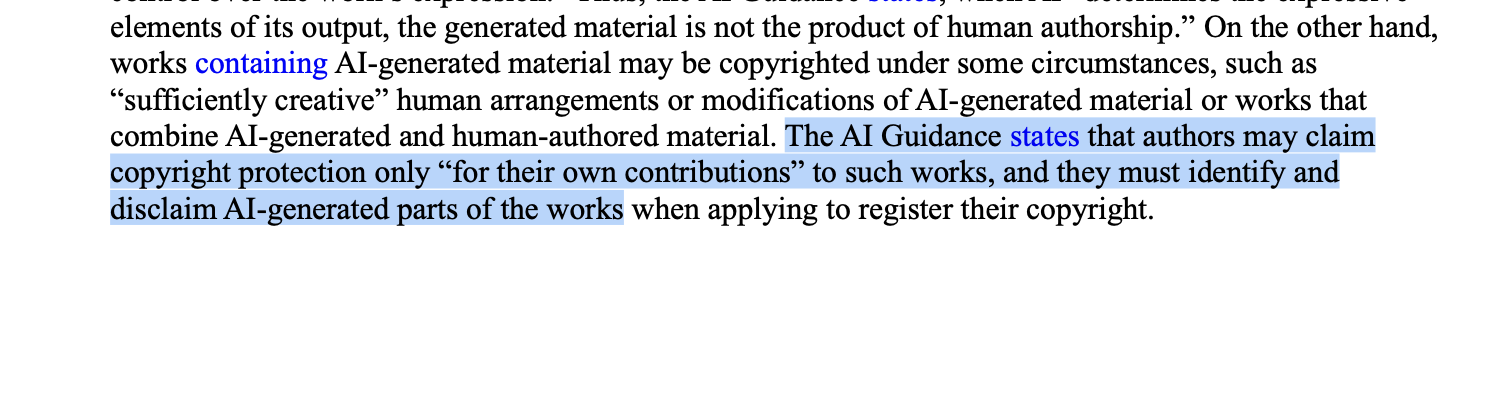
If you use AI-generated code, you currently cannot claim copyright on it in the US. If you fail to disclose/disclaim exactly which parts were not written by a human, you forfeit your copyright claim on *the entire codebase*.
This means copyright notices and even licenses folks are putting on their vibe-coded GitHub repos are unenforceable. The AI-generated code, and possibly the whole project, becomes public domain.
Source: https://www.congress.gov/crs_external_products/LSB/PDF/LSB10922/LSB10922.8.pdf
@jamie And Microsoft executives keep bragging about how much Windows code is being written by AIs?
Count me as one person NOT AT ALL interested in Windows, regardless of any copyright status.
-
If you use AI-generated code, you currently cannot claim copyright on it in the US. If you fail to disclose/disclaim exactly which parts were not written by a human, you forfeit your copyright claim on *the entire codebase*.
This means copyright notices and even licenses folks are putting on their vibe-coded GitHub repos are unenforceable. The AI-generated code, and possibly the whole project, becomes public domain.
Source: https://www.congress.gov/crs_external_products/LSB/PDF/LSB10922/LSB10922.8.pdf
@jamie
That doesn't sound quite right. The code "AI" generates are stolen from other people, presumably they still have their copyright.Also, even if we pretend that it is actually generated by a machine, so is the output of a compiler. Is Microsoft Office in the public domain, because the executable was generated by a compiler?
-
If you use AI-generated code, you currently cannot claim copyright on it in the US. If you fail to disclose/disclaim exactly which parts were not written by a human, you forfeit your copyright claim on *the entire codebase*.
This means copyright notices and even licenses folks are putting on their vibe-coded GitHub repos are unenforceable. The AI-generated code, and possibly the whole project, becomes public domain.
Source: https://www.congress.gov/crs_external_products/LSB/PDF/LSB10922/LSB10922.8.pdf
@jamie
 Microslop, allegedly, vibe coded up to 30% of the Windows 11 codebase using genAI. Theoretically anyone working for Microslop with access to the codebase can upload the whole codebase without recourse?
 -
@jamie the corporations own the Supreme Court of the US who will cheerfully make up new law out of whatever Clarence Thomas shat that morning.
@emma Oh yeah, shit's gonna get weird for a while and I think a lot of legislation going in during this administration as well as recent SCOTUS cases will need to be revisited. Ideally after also instituting laws around conflicts of interest with government officials that don't carve out exceptions for, oh I dunno, members of Congress, for example.
Basically, I want the different branches of the government to fight each other again rather than the different parties.
-
@jamie
That doesn't sound quite right. The code "AI" generates are stolen from other people, presumably they still have their copyright.Also, even if we pretend that it is actually generated by a machine, so is the output of a compiler. Is Microsoft Office in the public domain, because the executable was generated by a compiler?
@leeloo Last I heard, the holders of the copyrights on the material that the LLMs are trained on are being told to get fucked.
The class action lawsuit that Anthropic lost was decided not because they trained their models on stolen copyrighted material, but because they stored copies of that material to keep training their models on. My understanding is that it was the storage specifically that violated copyright and that, if they'd deleted that data they'd have been legally clear.
-
@jamie
Microslop, allegedly, vibe coded up to 30% of the Windows 11 codebase using genAI. Theoretically anyone working for Microslop with access to the codebase can upload the whole codebase without recourse?@macronaut Possibly. The next two posts in the thread have a little more detail on my understanding of the current state of affairs there.
Jamie Gaskins (@jamie@zomglol.wtf)
FWIW I'm not a lawyer and I'm not recommending that you do this. 😄 Even if companies have no legal standing on copyright, their legal team will try it. It *will* cost you money. But man, oh man, I'm gonna have popcorn ready for when someone inevitably pulls this move.

zomglol (zomglol.wtf)
-
R relay@relay.mycrowd.ca shared this topic
-
If you use AI-generated code, you currently cannot claim copyright on it in the US. If you fail to disclose/disclaim exactly which parts were not written by a human, you forfeit your copyright claim on *the entire codebase*.
This means copyright notices and even licenses folks are putting on their vibe-coded GitHub repos are unenforceable. The AI-generated code, and possibly the whole project, becomes public domain.
Source: https://www.congress.gov/crs_external_products/LSB/PDF/LSB10922/LSB10922.8.pdf
@jamie @aeva I suspect that courts would not be favorable to this reading, and would buy the (bullshit, IMO) argument that sufficient human interaction with the code "heals" the copyrightability of the result, and more importantly that they would not press the applicant to show much work when it comes to "sufficient" (that is, I suspect many judges would accept "I edited the code at all" as meeting the sufficiency criterion)
but we're only going to find out if and when it's tested. The Copyright Office is doing the best they can do and making it clear that they won't let "AI" waste their time with copyright registrations (which are not required to legally protect a work, they're just paperwork really)
-
@leeloo Last I heard, the holders of the copyrights on the material that the LLMs are trained on are being told to get fucked.
The class action lawsuit that Anthropic lost was decided not because they trained their models on stolen copyrighted material, but because they stored copies of that material to keep training their models on. My understanding is that it was the storage specifically that violated copyright and that, if they'd deleted that data they'd have been legally clear.
@jamie
Well, someone still needs to decide at some point whether to abolish copyright or start enforcing it again, and at that point it could become a huge problem for anyone who has incorporated stolen code into their code base. -
@jamie @aeva I suspect that courts would not be favorable to this reading, and would buy the (bullshit, IMO) argument that sufficient human interaction with the code "heals" the copyrightability of the result, and more importantly that they would not press the applicant to show much work when it comes to "sufficient" (that is, I suspect many judges would accept "I edited the code at all" as meeting the sufficiency criterion)
but we're only going to find out if and when it's tested. The Copyright Office is doing the best they can do and making it clear that they won't let "AI" waste their time with copyright registrations (which are not required to legally protect a work, they're just paperwork really)
-
R relay@relay.an.exchange shared this topic
-
-
R relay@relay.publicsquare.global shared this topic
-
If you use AI-generated code, you currently cannot claim copyright on it in the US. If you fail to disclose/disclaim exactly which parts were not written by a human, you forfeit your copyright claim on *the entire codebase*.
This means copyright notices and even licenses folks are putting on their vibe-coded GitHub repos are unenforceable. The AI-generated code, and possibly the whole project, becomes public domain.
Source: https://www.congress.gov/crs_external_products/LSB/PDF/LSB10922/LSB10922.8.pdf
@jamie I wonder if that’ll kill the use of “AI” at work
-
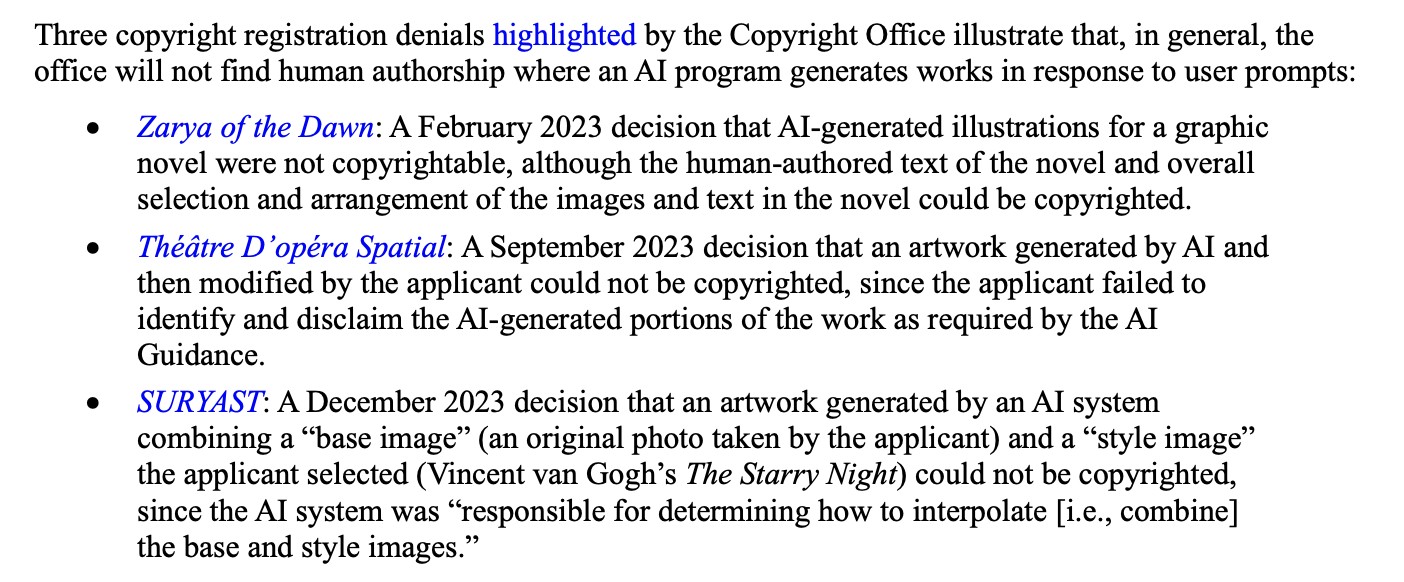
@xgranade @jamie @aeva I think it's a much stronger case for the example rejected registrations that they show on the next page, which are exclusively about copyrightability of images.
It's largely legally untested AFAICT but based on how eagerly US courts have swallowed up the fair-use arguments of the vendors of these models, I don't have a lot of faith they would play hard-ball with a litigant who has code that has been established to have been generated, but who argues sufficiency from a "trust me, bro" perspective. (IANAL either, of course)
I would *love* to be wrong about that though, and I'm glad that the Copyright Office has drawn a clear line in the sand on the general matter (and wish more people in tech had read either the publications themselves, or this CRS summary of same)
-
If you use AI-generated code, you currently cannot claim copyright on it in the US. If you fail to disclose/disclaim exactly which parts were not written by a human, you forfeit your copyright claim on *the entire codebase*.
This means copyright notices and even licenses folks are putting on their vibe-coded GitHub repos are unenforceable. The AI-generated code, and possibly the whole project, becomes public domain.
Source: https://www.congress.gov/crs_external_products/LSB/PDF/LSB10922/LSB10922.8.pdf
@jamie@zomglol.wtf and how do you know if something is AI?
-
@xgranade @jamie @aeva I think it's a much stronger case for the example rejected registrations that they show on the next page, which are exclusively about copyrightability of images.
It's largely legally untested AFAICT but based on how eagerly US courts have swallowed up the fair-use arguments of the vendors of these models, I don't have a lot of faith they would play hard-ball with a litigant who has code that has been established to have been generated, but who argues sufficiency from a "trust me, bro" perspective. (IANAL either, of course)
I would *love* to be wrong about that though, and I'm glad that the Copyright Office has drawn a clear line in the sand on the general matter (and wish more people in tech had read either the publications themselves, or this CRS summary of same)