Threat model escalation: AI agent runtimes
-
Threat model escalation: AI agent runtimes.
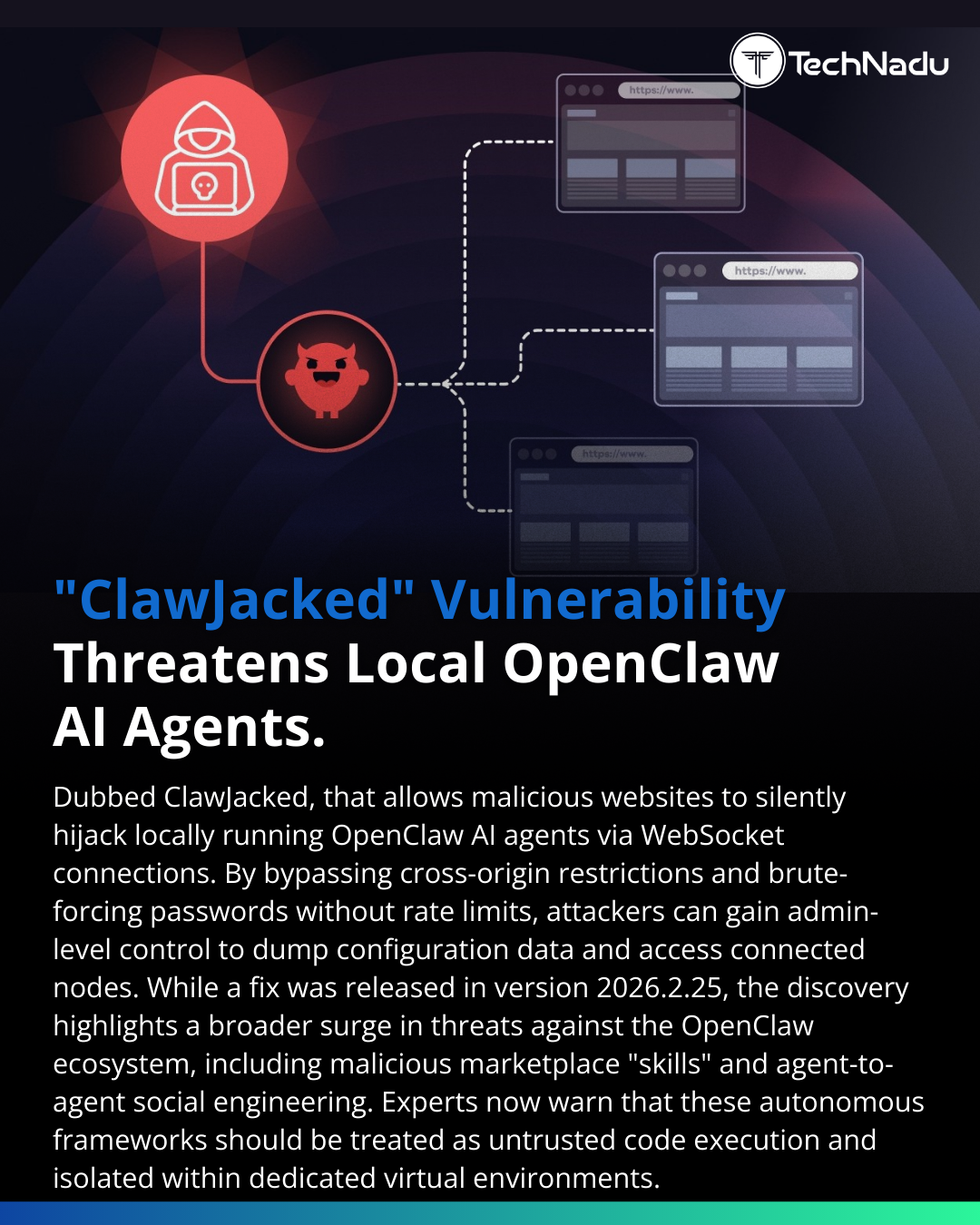
OpenClaw patched “ClawJacked,” a localhost WebSocket hijack enabling:
• Admin-level agent takeover
• Configuration exfiltration
• Log enumeration
• Integrated system abuse
Additional risks documented across the ecosystem:
– Log poisoning → indirect prompt injection
– CVEs spanning RCE, SSRF, auth bypass
– Marketplace-delivered malware (Atomic Stealer)
– Agent-to-agent crypto scams
Microsoft guidance: treat OpenClaw as untrusted code execution with persistent credentials. Deploy in isolated VMs. Avoid sensitive data exposure.
Core lesson:
Agentic systems expand blast radius due to cross-tool integrations and credential persistence.Question for defenders:
Are AI runtimes included in your EDR, credential rotation, and segmentation policies?Source: https://thehackernews.com/2026/02/clawjacked-flaw-lets-malicious-sites.html
Engage below.
Follow TechNadu for advanced AI security analysis.
Repost to amplify awareness.#Infosec #AIsecurity #OpenClaw #ClawJacked #ThreatModeling #ZeroTrust #CredentialManagement #SupplyChainSecurity #AgenticAI #CyberDefense #EDR #SecurityResearch
-
Threat model escalation: AI agent runtimes.
OpenClaw patched “ClawJacked,” a localhost WebSocket hijack enabling:
• Admin-level agent takeover
• Configuration exfiltration
• Log enumeration
• Integrated system abuse
Additional risks documented across the ecosystem:
– Log poisoning → indirect prompt injection
– CVEs spanning RCE, SSRF, auth bypass
– Marketplace-delivered malware (Atomic Stealer)
– Agent-to-agent crypto scams
Microsoft guidance: treat OpenClaw as untrusted code execution with persistent credentials. Deploy in isolated VMs. Avoid sensitive data exposure.
Core lesson:
Agentic systems expand blast radius due to cross-tool integrations and credential persistence.Question for defenders:
Are AI runtimes included in your EDR, credential rotation, and segmentation policies?Source: https://thehackernews.com/2026/02/clawjacked-flaw-lets-malicious-sites.html
Engage below.
Follow TechNadu for advanced AI security analysis.
Repost to amplify awareness.#Infosec #AIsecurity #OpenClaw #ClawJacked #ThreatModeling #ZeroTrust #CredentialManagement #SupplyChainSecurity #AgenticAI #CyberDefense #EDR #SecurityResearch
@technadu To your question: most orgs have zero coverage on AI runtimes.
This is why I built ClawGuard — the agent never holds real credentials. All API calls go through an approval gateway with human confirmation.
Even if ClawJacked takes over the agent, attacker gets nothing. Tokens live on a separate machine.
github.com/lombax85/clawguard
-
Threat model escalation: AI agent runtimes.
OpenClaw patched “ClawJacked,” a localhost WebSocket hijack enabling:
• Admin-level agent takeover
• Configuration exfiltration
• Log enumeration
• Integrated system abuse
Additional risks documented across the ecosystem:
– Log poisoning → indirect prompt injection
– CVEs spanning RCE, SSRF, auth bypass
– Marketplace-delivered malware (Atomic Stealer)
– Agent-to-agent crypto scams
Microsoft guidance: treat OpenClaw as untrusted code execution with persistent credentials. Deploy in isolated VMs. Avoid sensitive data exposure.
Core lesson:
Agentic systems expand blast radius due to cross-tool integrations and credential persistence.Question for defenders:
Are AI runtimes included in your EDR, credential rotation, and segmentation policies?Source: https://thehackernews.com/2026/02/clawjacked-flaw-lets-malicious-sites.html
Engage below.
Follow TechNadu for advanced AI security analysis.
Repost to amplify awareness.#Infosec #AIsecurity #OpenClaw #ClawJacked #ThreatModeling #ZeroTrust #CredentialManagement #SupplyChainSecurity #AgenticAI #CyberDefense #EDR #SecurityResearch
@technadu That “runtime escalation” angle is key. Even with sandboxing/static checks, you want a last-line control at the network boundary: per-request human approval + isolated secret storage. That’s the idea behind ClawGuard (agent has zero long-lived tokens).
-
@technadu To your question: most orgs have zero coverage on AI runtimes.
This is why I built ClawGuard — the agent never holds real credentials. All API calls go through an approval gateway with human confirmation.
Even if ClawJacked takes over the agent, attacker gets nothing. Tokens live on a separate machine.
github.com/lombax85/clawguard
@lombax85_clawguard Valid approach. Shifting from agent-held credentials to a request-broker model is the only way to mitigate the "privileged ghost in the machine" risk. Human-in-the-loop (HITL) for the approval gateway solves the persistence issue, but how are you handling session hijacking at the gateway level itself?
-
R relay@relay.infosec.exchange shared this topic