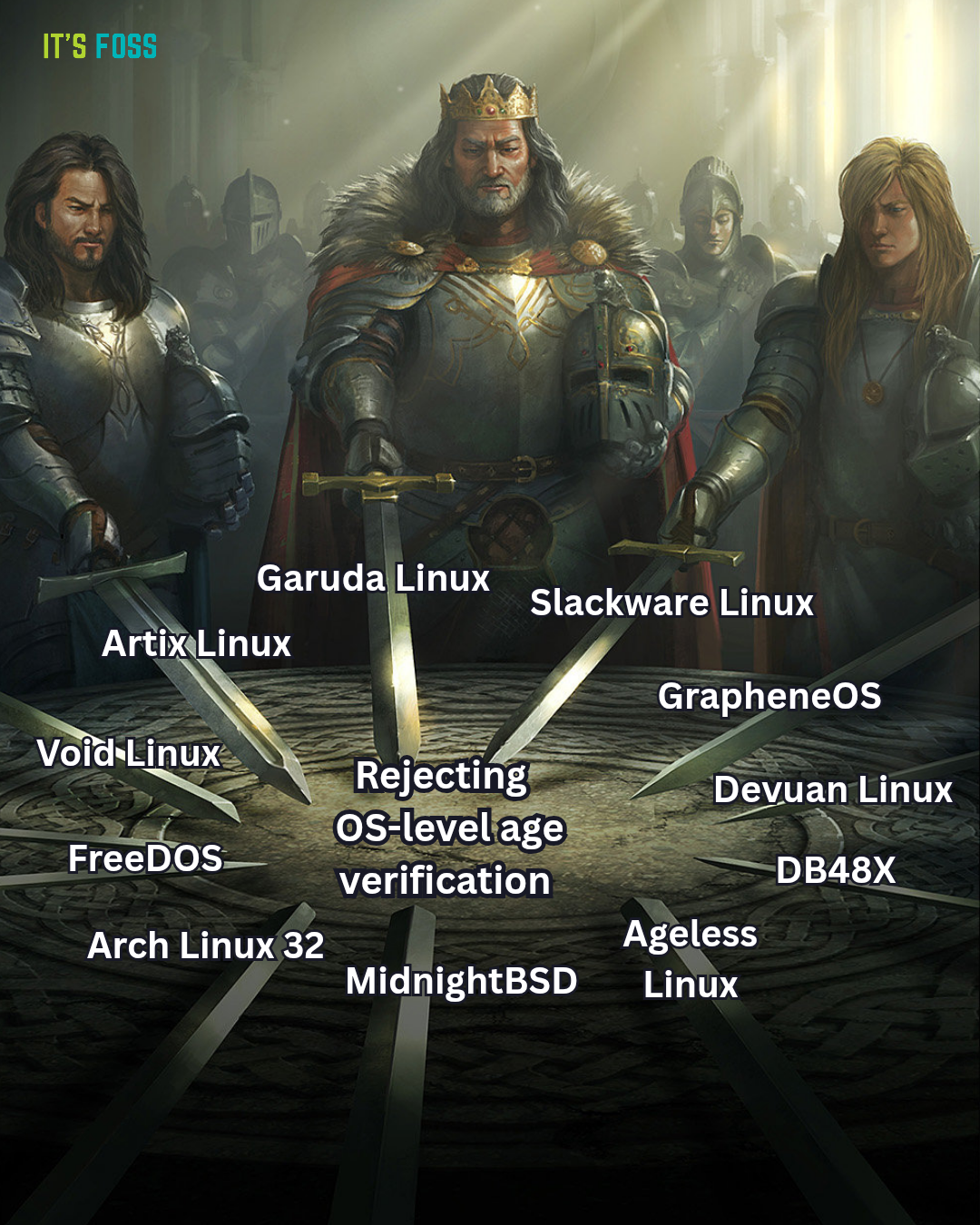
History will remember what they achieved here.
-
@itsfoss even when using a distro like debian can't you you just use a hard coded 99 yo? i dont see much of a problem with that.
-
@itsfoss let's hope mint and fedora join the party
-
@itsfoss MidnightBSD was one of the first to introduce age delcaration code. And Ageless is just Debian with the name changed. Might be a bit out of line to say they are doing anything against age verification.
Meanwhile System76 has actively pushed back against age verification laws and may have an exemption lined up in Colorado and is nowhere in this image.
The ageless project is a bit more ambitious then that, they're planning on handing out non compliant sbc devices to kids in California to force a test case on 1st amendment grounds. The distro may not be anything special, nevertheless the project is doing a heck of a lot more than most. Garuda, for instance won't patch the age verification fields out of systemd or move to liberated systemd and haven't committed to doing either down the road if systemd starts requiring the age fields be filled. They just said they won't build their own age verification system, unless the laws change where their developers live, but if that happened, then they absolutely would. That's not standing up to anything at all.
-
Your post is very misleading.
E.g., Garuda Linux has stated on March 9th they »will continue to comply with local regulations in Finland and Germany (where the servers are hosted and the donation funds are held)«, so their "resistance" is strictly limited to Californian law, not to OS-level age verification, per se.
MidnighBSD has already announced on March 9th »We've implemented about 1/3 of the california/colorado/illinois law.«
Please verify your statements, and retract this post.
-
@itsfoss *waves from Guix*
-
@itsfoss let's hope mint and fedora join the party
@GlitchGhost @itsfoss Mint is built on systemd and systemd is charging full steam ahead on complying in advance. Mint has experimented with rebasing on Debian to escape Canonical's clutches, but they haven't even tried getting rid of systemd at all yet as far as I know.
Honestly that's the biggest problem. Most Linux systems rely on something that was already fundamentally way out of scope and that thing itself has decided to do this...
-
@itsfoss I'm still completely in shock that one person in systemd has decided arbitrarily to do this, is just pushing PRs through all over the place, and pretty much only has Claude to decide whether or not to approve them. Any opposition gets silenced with the threads just being closed because they're too inconvenient to moderate even though this is a really really big decision that affects... practically everything Linux...
Honestly, systemd was already way out of scope. It's pretty much universally hated and it keeps taking it upon itself to do various things it shouldn't (like adding DNS handling for some reason. Why does something whose only purpose is to handle init and service starting/stopping running its own DNS handling?)
Time for systemd to go.
-
@itsfoss wrong approach, malicious compliance is the way to go when the governments enact stupid legislations. Now a law can be passed on top to make anyone using a non compliant OS a criminal, are these orgs going to help out any of their users who get caught out?.
-
@itsfoss I'm still completely in shock that one person in systemd has decided arbitrarily to do this, is just pushing PRs through all over the place, and pretty much only has Claude to decide whether or not to approve them. Any opposition gets silenced with the threads just being closed because they're too inconvenient to moderate even though this is a really really big decision that affects... practically everything Linux...
Honestly, systemd was already way out of scope. It's pretty much universally hated and it keeps taking it upon itself to do various things it shouldn't (like adding DNS handling for some reason. Why does something whose only purpose is to handle init and service starting/stopping running its own DNS handling?)
Time for systemd to go.
@nazokiyoubinbou
Should've never existed.
Thankfully there are alternatives.
@itsfoss -
@nazokiyoubinbou
Should've never existed.
Thankfully there are alternatives.
@itsfoss@0x0 @itsfoss Yeah, but the biggest problem is like 95% of the distros out there are built around systemd. A lot of things aren't even setup to work right without it. For example, Pipewire-Pulse and similar services aren't even setup to work that way. (MX Linux has its own implementation, but I think they setup a .desktop file for the DE to run or something? It's probably not 100% reliable, especially if you ever log into something else, but it's getting me by ok on a single user system.)
I have to figure out how to fix cdemu. Whatever it's doing, gcdemu freaks the F out and uses almost 40 watts of CPU power until I close the seizure-inducing freakout-mode icon. (I'll have to manually make a service?)
I do hope everyone see this as a time to switch, but until they do it will hurt
-
@0x0 @itsfoss Yeah, but the biggest problem is like 95% of the distros out there are built around systemd. A lot of things aren't even setup to work right without it. For example, Pipewire-Pulse and similar services aren't even setup to work that way. (MX Linux has its own implementation, but I think they setup a .desktop file for the DE to run or something? It's probably not 100% reliable, especially if you ever log into something else, but it's getting me by ok on a single user system.)
I have to figure out how to fix cdemu. Whatever it's doing, gcdemu freaks the F out and uses almost 40 watts of CPU power until I close the seizure-inducing freakout-mode icon. (I'll have to manually make a service?)
I do hope everyone see this as a time to switch, but until they do it will hurt
@nazokiyoubinbou
#Slackware, @Devuan, and #Antix are free by design.
#Gentoo, to me, had the best approach: gives you choice of init system.
@itsfoss -
@nazokiyoubinbou
#Slackware, @Devuan, and #Antix are free by design.
#Gentoo, to me, had the best approach: gives you choice of init system.
@itsfoss@0x0 @itsfoss Yes I am aware some do. That's why I mentioned one that does and said 95%, not 100%.
Unfortunately, the other 95% are heavily built around it.
And then, as I said, problems arise because so is a lot of software.
Options existing is great, but they're so underutilized and undersupported that right now, systemd has a lot of power in the Linux world. And that is a problem.
Linux can indeed, as a whole, move away fairly quickly if people put in the effort. But will they? You'd be surprised how many things just capitulate when a bit of effort might be involved in a thing. My bet is what we will see is a bunch deciding what it does right now is too small to fight and just let it happen, then it grows in increments over time, each too small to fight...
-
@nazokiyoubinbou
#Slackware, @Devuan, and #Antix are free by design.
#Gentoo, to me, had the best approach: gives you choice of init system.
@itsfoss@0x0 gentoo is the best linux distribution, hands down. It requires a little bit more knowledge to get fluent in it, but when you do, having the ability to modify use flags/tailor your system as you need to ... it's great. I've got my entire system wired up with debug flags, for instance, so if i hit something strange in my software, I just inspect it. I can patch it if needed and then push the change upstream ; it's great, and is what computing promised to be before it was locked down.
-
@itsfoss ¿FreeDOS "age verification"?

-
 G garuda@social.garudalinux.org shared this topic
-


 ️
️