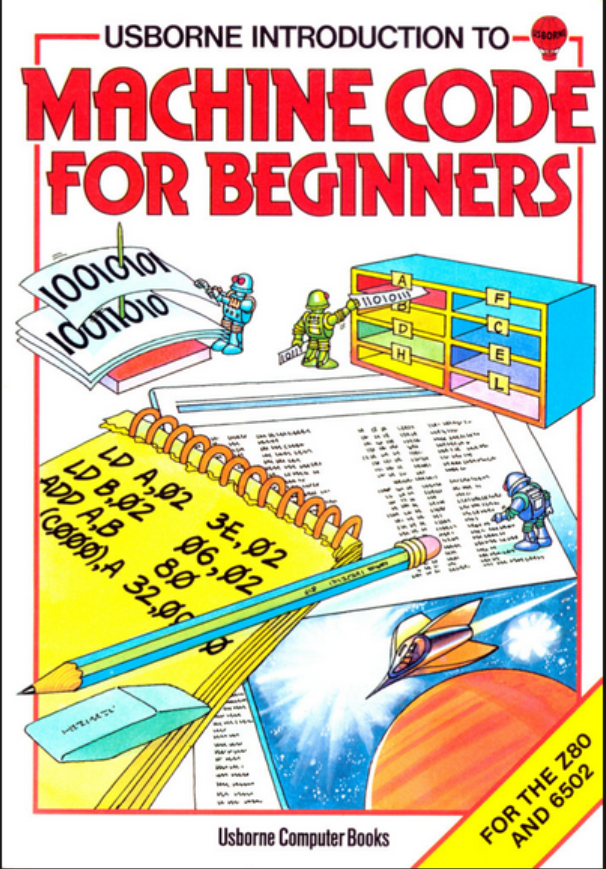
OMG. Can you imagine publishing Machine Code for Beginners today??
-
@paco Could you believe we had no problems expecting humans could write machine code, just for fun?

@gimulnautti @paco It is fun.
-
@GreenYesScotland @paco This is how I learned Fortran.
-
There are still one or two brave souls that program in Assembler


@simonzerafa My first, and perhaps most interesting, contribution to open source was assembly.
To play DOOM head to head over a modem, you needed a TSR that ran in DOS and basically translated a modem connection onto a network connection. My uni had these super fast digital modems (115K when the standard was 56K). The DOOM folks open-sourced this little serial adapter thingie. I rewrote some of the main loop in assembly to improve efficiency and emailed the patch.
Frankly, I was a 4th year student who had just taken his first assembly class. It’s entirely likely that I didn’t improve it much at all.
-
OMG. Can you imagine publishing Machine Code for Beginners today??
@paco Yes, but every page would start out “Ask your AI Assistant to…”
-
@paco Could you believe we had no problems expecting humans could write machine code, just for fun?
some of us did…

(and for small, simple architectures, I still find it kinda fun, but amd64 and ARM have gotten too big for me to find them fun/interesting) -
OMG. Can you imagine publishing Machine Code for Beginners today??
On the first computer I used with any regularity, I entered machine code via a hex keypad into its RAM--all 256 bytes of it.
That was an RCA COSMAC ELF single-board computer.
I was around 10 years old.
Assemblers and assembly language are luxury in comparison.
-
On the first computer I used with any regularity, I entered machine code via a hex keypad into its RAM--all 256 bytes of it.
That was an RCA COSMAC ELF single-board computer.
I was around 10 years old.
Assemblers and assembly language are luxury in comparison.
@johnlogic you got me beat. My first was a commodore VIC20. 20 Kb of memory. Of which 3600 or so was RAM.
-
Spent half my life on a 6502c but nobody wants to hear...
@bitchboss @paco
I built the "Junior Computer" with my dad, Germany, early 80s, this was 6502 based... I still have the books...

-
@bitchboss @paco
I built the "Junior Computer" with my dad, Germany, early 80s, this was 6502 based... I still have the books...Wonderful. A hexcoder. That was programming that really impressed people. Nowadays, you can program 6502 PCB boards with C (online) and download the binary to a PCB board with a 6502 no bigger than a pinhead.
The beauty of this is that if the world collapses, these types of computers are easy to put together with parts from... the scrapyard. You just have to dig a little deeper...
-
@johnlogic you got me beat. My first was a commodore VIC20. 20 Kb of memory. Of which 3600 or so was RAM.
@paco I don't know the VIC-20 that well. I moved up to an Atari 800 when they were sold fully loaded with 48 kiB of RAM. It also included 10 kiB of OS ROM, where 2 k was just the character set bitmaps.
-
Spent half my life on a 6502c but nobody wants to hear...
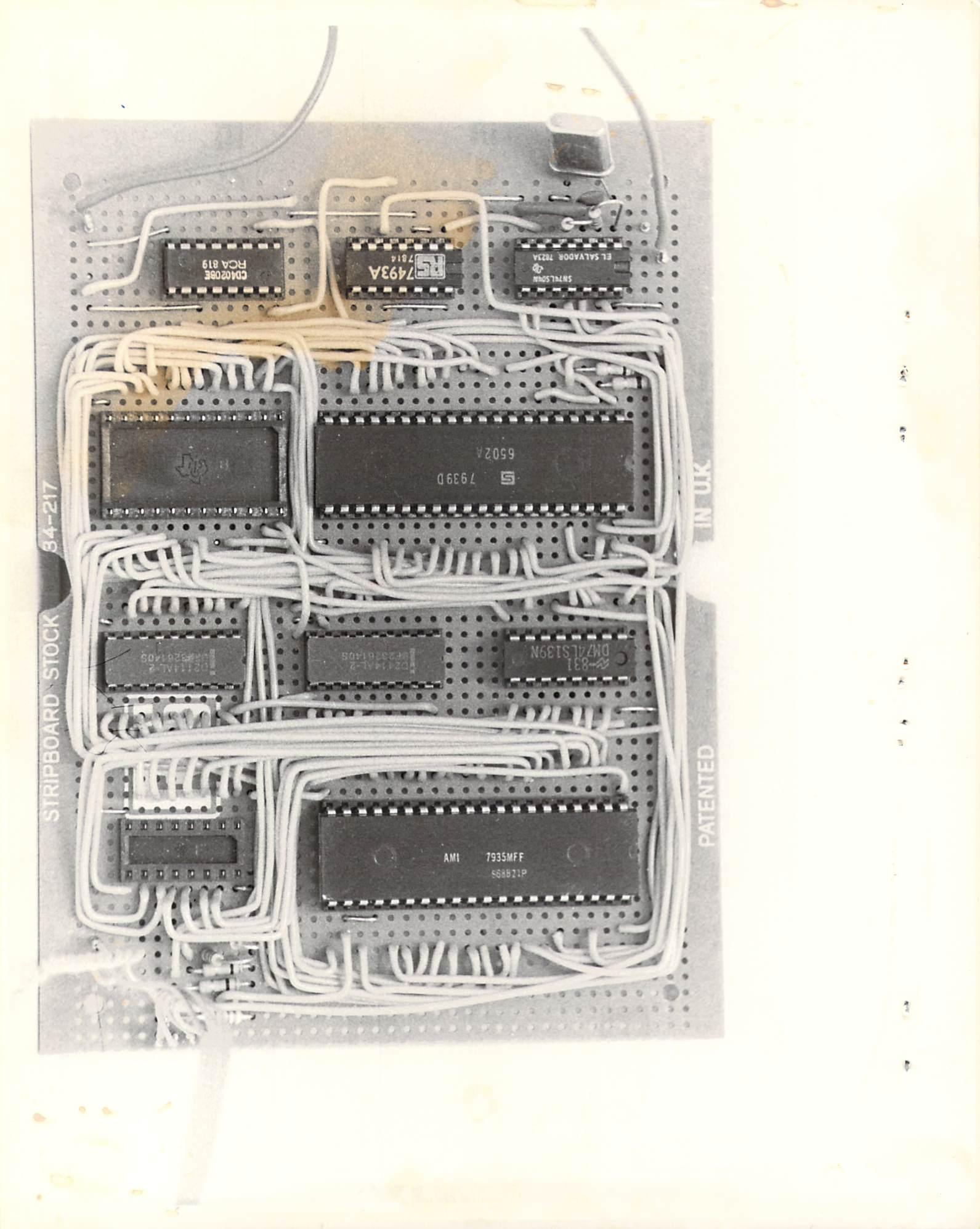
@bitchboss @paco Time well spent! This little homebrew board and a BBC micro to write code for it saved a very remotely-located experiment I was responsible for when its controller failed. Only made feasible by Sophie Wilson’s foresight to build a very capable 6502 assembler into the BBC’s Basic environment.
-
@bitchboss @paco Time well spent! This little homebrew board and a BBC micro to write code for it saved a very remotely-located experiment I was responsible for when its controller failed. Only made feasible by Sophie Wilson’s foresight to build a very capable 6502 assembler into the BBC’s Basic environment.
Oh wow! The last time I saw wiring like that was when Gould was building spy satellites. And yes, an inline assembler to be envious of. I believe Turbo Basic 8088 and its successors also have an inline assembler. Very special.
-
@bitchboss @paco
 wouldn’t recommended it unless it’s the only way available!
 -
R relay@relay.infosec.exchange shared this topic