Skip to content
  • Categories
  • Recent
  • Tags
  • Popular
  • World
  • Users
  • Groups
Skins
  • Light
  • Brite
  • Cerulean
  • Cosmo
  • Flatly
  • Journal
  • Litera
  • Lumen
  • Lux
  • Materia
  • Minty
  • Morph
  • Pulse
  • Sandstone
  • Simplex
  • Sketchy
  • Spacelab
  • United
  • Yeti
  • Zephyr
  • Dark
  • Cyborg
  • Darkly
  • Quartz
  • Slate
  • Solar
  • Superhero
  • Vapor

  • Default (Cyborg)
  • No Skin
Collapse
Brand Logo

CIRCLE WITH A DOT

  1. Home
  2. Uncategorized
  3. Happy Mainframe Day

Happy Mainframe Day

Scheduled Pinned Locked Moved Uncategorized
30 Posts 13 Posters 0 Views
  • Oldest to Newest
  • Newest to Oldest
  • Most Votes
Reply
  • Reply as topic
Log in to reply
This topic has been deleted. Only users with topic management privileges can see it.
  • aka_pugs@mastodon.socialA This user is from outside of this forum
    aka_pugs@mastodon.socialA This user is from outside of this forum
    aka_pugs@mastodon.social
    wrote last edited by
    #1

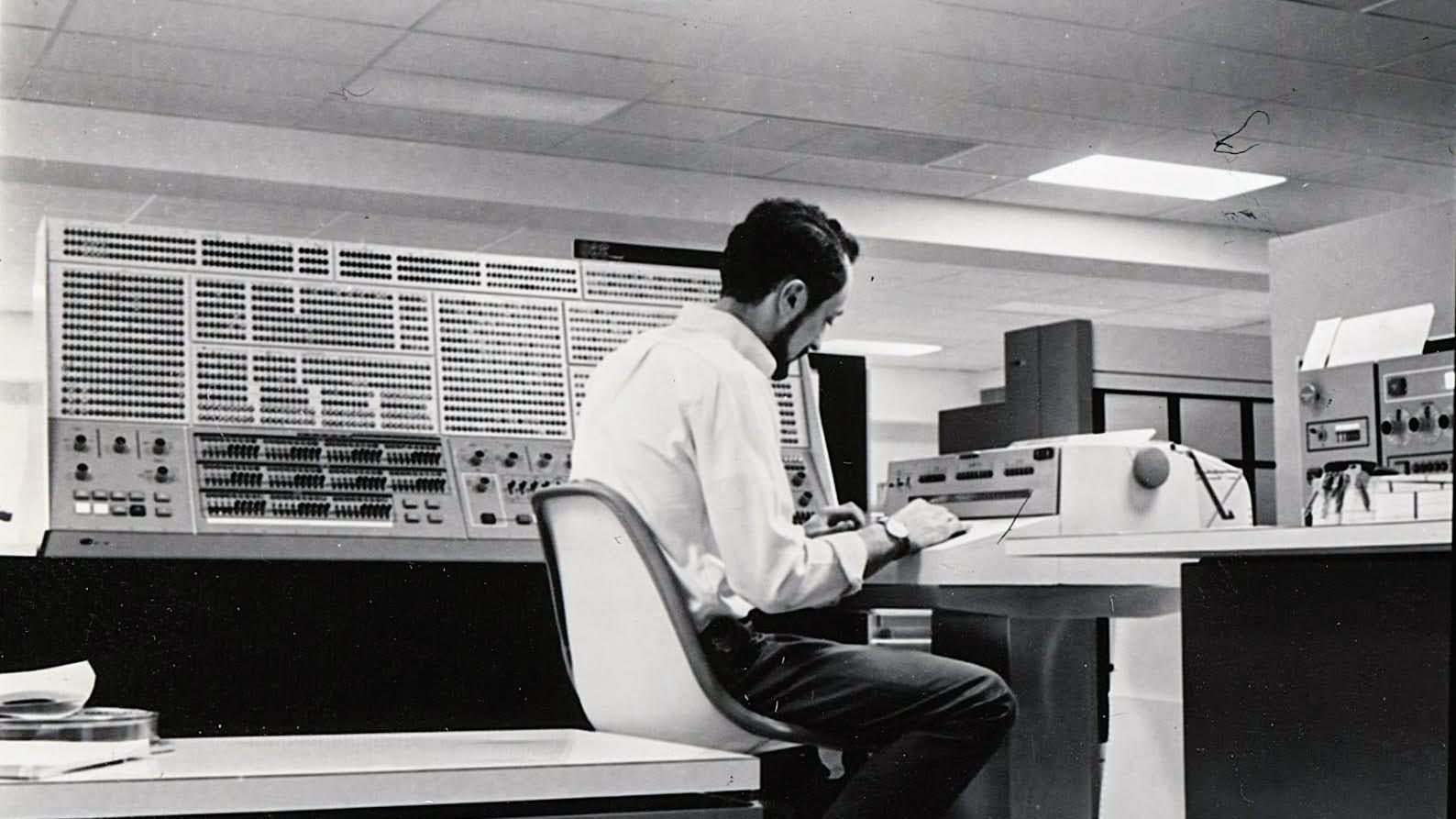
    Happy Mainframe Day!
    OTD 1964: IBM announces the System/360 family. 8-bit bytes ftw!

    Shown: Operator at console of Princeton's IBM/360 Model 91.
    Link Preview Image
    darkuncle@infosec.exchangeD mappingsupport@m.ai6yr.orgM lemgandi@mastodon.socialL markd@hachyderm.ioM debaer@23.socialD 5 Replies Last reply
    0
    • aka_pugs@mastodon.socialA aka_pugs@mastodon.social

      Happy Mainframe Day!
      OTD 1964: IBM announces the System/360 family. 8-bit bytes ftw!

      Shown: Operator at console of Princeton's IBM/360 Model 91.

      Link Preview Image
      darkuncle@infosec.exchangeD This user is from outside of this forum
      darkuncle@infosec.exchangeD This user is from outside of this forum
      darkuncle@infosec.exchange
      wrote last edited by
      #2

      @aka_pugs I wonder if we're going to see this kind of nostalgia in another 40-50 years but for the initial rollout of quantum computing hardware ❤

      1 Reply Last reply
      0
      • aka_pugs@mastodon.socialA aka_pugs@mastodon.social

        Happy Mainframe Day!
        OTD 1964: IBM announces the System/360 family. 8-bit bytes ftw!

        Shown: Operator at console of Princeton's IBM/360 Model 91.

        Link Preview Image
        mappingsupport@m.ai6yr.orgM This user is from outside of this forum
        mappingsupport@m.ai6yr.orgM This user is from outside of this forum
        mappingsupport@m.ai6yr.org
        wrote last edited by
        #3

        @aka_pugs The high school I went to had several terminals connected to an IBM 360 at the University of Minnesota. I started to learn how to code using those terminals. This was in the late '60s.

        M 1 Reply Last reply
        0
        • mappingsupport@m.ai6yr.orgM mappingsupport@m.ai6yr.org

          @aka_pugs The high school I went to had several terminals connected to an IBM 360 at the University of Minnesota. I started to learn how to code using those terminals. This was in the late '60s.

          M This user is from outside of this forum
          M This user is from outside of this forum
          mike805@noc.social
          wrote last edited by
          #4

          @mappingsupport @aka_pugs What sort of terminals? Teletypes? And they had leased lines to the university?

          360/91 was the high end mainframe at the time, that thing could have megabytes of RAM made by people manually stringing cores on wires.

          aka_pugs@mastodon.socialA mappingsupport@m.ai6yr.orgM 2 Replies Last reply
          0
          • aka_pugs@mastodon.socialA aka_pugs@mastodon.social

            Happy Mainframe Day!
            OTD 1964: IBM announces the System/360 family. 8-bit bytes ftw!

            Shown: Operator at console of Princeton's IBM/360 Model 91.

            Link Preview Image
            lemgandi@mastodon.socialL This user is from outside of this forum
            lemgandi@mastodon.socialL This user is from outside of this forum
            lemgandi@mastodon.social
            wrote last edited by
            #5

            @aka_pugs

            So Awesome!!! I got to play on a 370 when I was an undergrad, it was pretty awesome for the time. Rexx was my first exposure to scripting languages, it was clunky but really cool. You could emulate a terminal in it by stacking commands into storage in reverse order and then playing 'em back IIRC.

            1 Reply Last reply
            0
            • M mike805@noc.social

              @mappingsupport @aka_pugs What sort of terminals? Teletypes? And they had leased lines to the university?

              360/91 was the high end mainframe at the time, that thing could have megabytes of RAM made by people manually stringing cores on wires.

              aka_pugs@mastodon.socialA This user is from outside of this forum
              aka_pugs@mastodon.socialA This user is from outside of this forum
              aka_pugs@mastodon.social
              wrote last edited by
              #6

              @mike805 @mappingsupport Princeton's 360 was purely batch - no terminals other than the operator console (IBM 3215?). But there was a 370 in the same room running time-sharing. IBM's native terminals were the 3277 (weird-ass CRT) and the 2741 (printer/keyboard based on the Selectric typewriter). But as time went on, ASCII CRTs were dominant.

              And the model 91 had a whopping 2 (two!) megabytes of core.

              M 1 Reply Last reply
              0
              • aka_pugs@mastodon.socialA aka_pugs@mastodon.social

                @mike805 @mappingsupport Princeton's 360 was purely batch - no terminals other than the operator console (IBM 3215?). But there was a 370 in the same room running time-sharing. IBM's native terminals were the 3277 (weird-ass CRT) and the 2741 (printer/keyboard based on the Selectric typewriter). But as time went on, ASCII CRTs were dominant.

                And the model 91 had a whopping 2 (two!) megabytes of core.

                M This user is from outside of this forum
                M This user is from outside of this forum
                mike805@noc.social
                wrote last edited by
                #7

                @aka_pugs @mappingsupport So you could use ASCII character terminals with a mainframe?

                I know the 3270s were more like a browser where you got a whole screenful at a time, and the response was only sent back when you pressed enter or a function key.

                I ran into one of those IBM block terminals at a university library once, and it's still one of the fastest interactive query systems I've ever seen. They had that optimized.

                1 Reply Last reply
                0
                • M mike805@noc.social

                  @mappingsupport @aka_pugs What sort of terminals? Teletypes? And they had leased lines to the university?

                  360/91 was the high end mainframe at the time, that thing could have megabytes of RAM made by people manually stringing cores on wires.

                  mappingsupport@m.ai6yr.orgM This user is from outside of this forum
                  mappingsupport@m.ai6yr.orgM This user is from outside of this forum
                  mappingsupport@m.ai6yr.org
                  wrote last edited by
                  #8

                  @mike805 @aka_pugs The terminals were teletype. My recollection is 30cps. Saved hardcopy of my work on 1" wide yellow paper tape.

                  1 Reply Last reply
                  0
                  • aka_pugs@mastodon.socialA aka_pugs@mastodon.social

                    Happy Mainframe Day!
                    OTD 1964: IBM announces the System/360 family. 8-bit bytes ftw!

                    Shown: Operator at console of Princeton's IBM/360 Model 91.

                    Link Preview Image
                    markd@hachyderm.ioM This user is from outside of this forum
                    markd@hachyderm.ioM This user is from outside of this forum
                    markd@hachyderm.io
                    wrote last edited by
                    #9

                    @aka_pugs Really was the beginning of the modern era of computing, starting with the normalisation of 8-bit bytes and character addressable architecture.

                    Well, that's all true so long as we don't mention EBCDIC 🙂

                    aka_pugs@mastodon.socialA olbohlen@norden.socialO gerardo@mast.hpc.socialG 3 Replies Last reply
                    0
                    • markd@hachyderm.ioM markd@hachyderm.io

                      @aka_pugs Really was the beginning of the modern era of computing, starting with the normalisation of 8-bit bytes and character addressable architecture.

                      Well, that's all true so long as we don't mention EBCDIC 🙂

                      aka_pugs@mastodon.socialA This user is from outside of this forum
                      aka_pugs@mastodon.socialA This user is from outside of this forum
                      aka_pugs@mastodon.social
                      wrote last edited by
                      #10

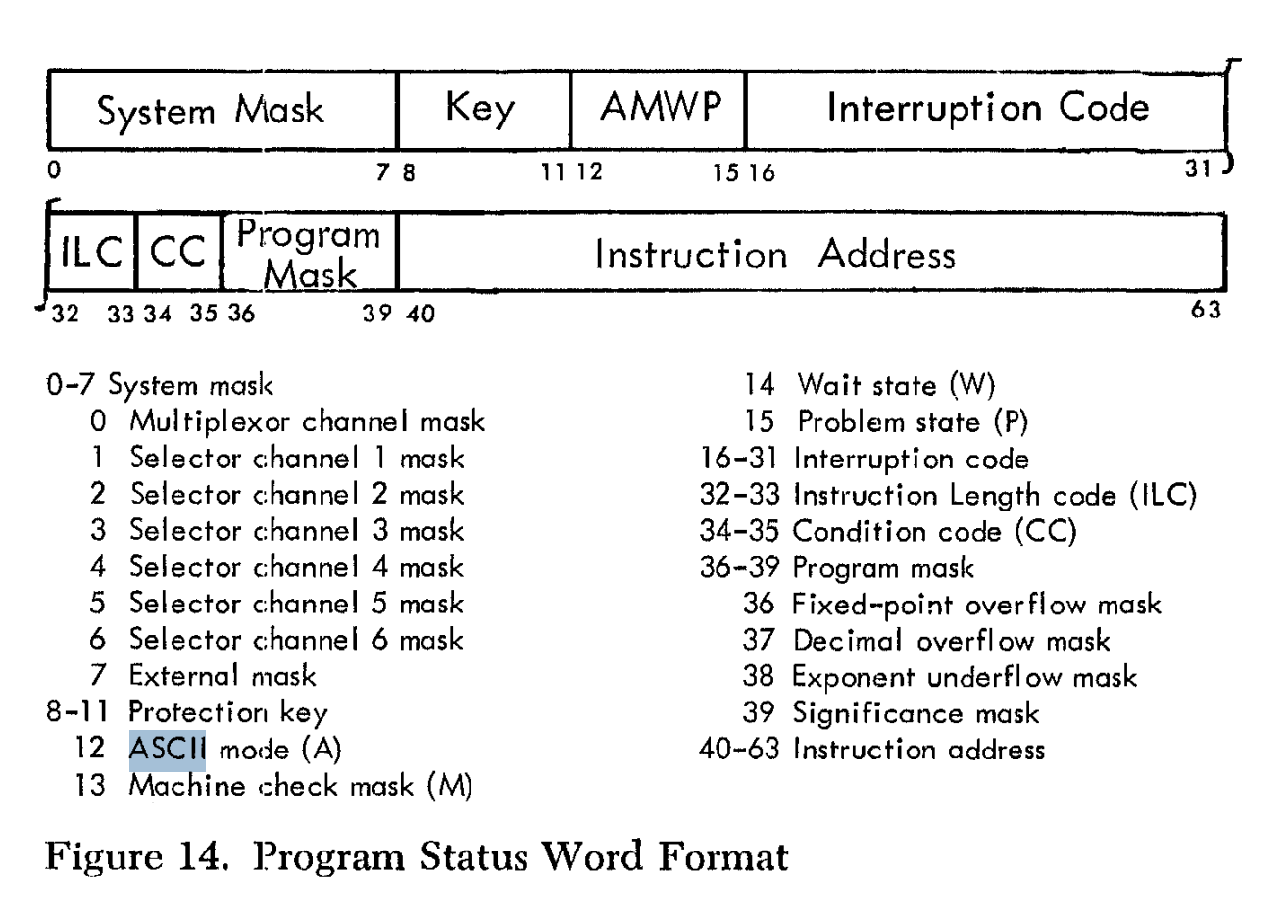
                      @markd They had ASCII mode, but the peripherals never got the memo.
                      Link Preview Image
                      stevebellovin@infosec.exchangeS 1 Reply Last reply
                      0
                      • aka_pugs@mastodon.socialA aka_pugs@mastodon.social

                        Happy Mainframe Day!
                        OTD 1964: IBM announces the System/360 family. 8-bit bytes ftw!

                        Shown: Operator at console of Princeton's IBM/360 Model 91.

                        Link Preview Image
                        debaer@23.socialD This user is from outside of this forum
                        debaer@23.socialD This user is from outside of this forum
                        debaer@23.social
                        wrote last edited by
                        #11

                        @aka_pugs Only 8 bits per word? That will never be enough for anyone! 18 bit words like the PDP-1 or 12 bit words like the PDP-8, now that's serious computing! Also, 8 bit words make octal representation quite pointless…

                        1 Reply Last reply
                        0
                        • aka_pugs@mastodon.socialA aka_pugs@mastodon.social

                          @markd They had ASCII mode, but the peripherals never got the memo.

                          Link Preview Image
                          stevebellovin@infosec.exchangeS This user is from outside of this forum
                          stevebellovin@infosec.exchangeS This user is from outside of this forum
                          stevebellovin@infosec.exchange
                          wrote last edited by
                          #12

                          @aka_pugs @markd ASCII mode was only about how some of the decimal arithmetic instructions behaved. For the printers, the character set was pretty arbitrary, and the Translate instruction would have allowed for easy compatibility no matter what. The real EBCDIC issue was the card reader—and per Fred Brooks, IBM wanted to go with ASCII but their big data processing customers talked them out of it.. But that's a story for another post. (And 8-bit bytes? Brooks felt that 8-bit bytes and 32-bit words was one of the most important innovations in the S/360 line. It wasn't a foregone conclusion—many scientific computing folks really wanted to stick with 36-bit words, for extra precision. IBM ran *lots* of simulations to assure everyone that 32 bit floating point was ok.)

                          Why yes, in grad school I did take computer architecture from Brooks…

                          markd@hachyderm.ioM 1 Reply Last reply
                          1
                          0
                          • R relay@relay.infosec.exchange shared this topic
                          • markd@hachyderm.ioM markd@hachyderm.io

                            @aka_pugs Really was the beginning of the modern era of computing, starting with the normalisation of 8-bit bytes and character addressable architecture.

                            Well, that's all true so long as we don't mention EBCDIC 🙂

                            olbohlen@norden.socialO This user is from outside of this forum
                            olbohlen@norden.socialO This user is from outside of this forum
                            olbohlen@norden.social
                            wrote last edited by
                            #13

                            @markd a former colleague of mine used to joke that EBCDIC was the first strong crypto algorithm to be exported from the US 😉

                            1 Reply Last reply
                            0
                            • markd@hachyderm.ioM markd@hachyderm.io

                              @aka_pugs Really was the beginning of the modern era of computing, starting with the normalisation of 8-bit bytes and character addressable architecture.

                              Well, that's all true so long as we don't mention EBCDIC 🙂

                              gerardo@mast.hpc.socialG This user is from outside of this forum
                              gerardo@mast.hpc.socialG This user is from outside of this forum
                              gerardo@mast.hpc.social
                              wrote last edited by
                              #14

                              @markd: Or, as my computing mentor, Harold V. McIntosh, called it, "Moby Dick".

                              @aka_pugs

                              1 Reply Last reply
                              0
                              • stevebellovin@infosec.exchangeS stevebellovin@infosec.exchange

                                @aka_pugs @markd ASCII mode was only about how some of the decimal arithmetic instructions behaved. For the printers, the character set was pretty arbitrary, and the Translate instruction would have allowed for easy compatibility no matter what. The real EBCDIC issue was the card reader—and per Fred Brooks, IBM wanted to go with ASCII but their big data processing customers talked them out of it.. But that's a story for another post. (And 8-bit bytes? Brooks felt that 8-bit bytes and 32-bit words was one of the most important innovations in the S/360 line. It wasn't a foregone conclusion—many scientific computing folks really wanted to stick with 36-bit words, for extra precision. IBM ran *lots* of simulations to assure everyone that 32 bit floating point was ok.)

                                Why yes, in grad school I did take computer architecture from Brooks…

                                markd@hachyderm.ioM This user is from outside of this forum
                                markd@hachyderm.ioM This user is from outside of this forum
                                markd@hachyderm.io
                                wrote last edited by
                                #15

                                @SteveBellovin @aka_pugs If you were on the non-EBCDIC side of the fence you got the impression that IBM sales pushed EBCDIC pretty hard as a competitive advantage - even if their engineering covertly preferred ASCII.

                                The 32-bit word must have been a harder-sell for the blue suits since the competition were selling 60bit and 36bit amongst other oddballs.

                                Fortunately the emergence of commercial customers marked the declining relevance of scientific computing... Did IBM get lucky or were they prescient?

                                But yeah, the S/360 definitely marked the end of the beginning of computing in multiple ways.

                                aka_pugs@mastodon.socialA stevebellovin@infosec.exchangeS 2 Replies Last reply
                                0
                                • markd@hachyderm.ioM markd@hachyderm.io

                                  @SteveBellovin @aka_pugs If you were on the non-EBCDIC side of the fence you got the impression that IBM sales pushed EBCDIC pretty hard as a competitive advantage - even if their engineering covertly preferred ASCII.

                                  The 32-bit word must have been a harder-sell for the blue suits since the competition were selling 60bit and 36bit amongst other oddballs.

                                  Fortunately the emergence of commercial customers marked the declining relevance of scientific computing... Did IBM get lucky or were they prescient?

                                  But yeah, the S/360 definitely marked the end of the beginning of computing in multiple ways.

                                  aka_pugs@mastodon.socialA This user is from outside of this forum
                                  aka_pugs@mastodon.socialA This user is from outside of this forum
                                  aka_pugs@mastodon.social
                                  wrote last edited by
                                  #16

                                  @markd @SteveBellovin IBM had a huge lead in commercial data processing because of their punch card business. And that world did not care about floating point. The model 91 was an ego-relief product, not a real business. IMO.

                                  Data processing and HPC markets never converged - until maybe AI.

                                  johnmashey@mstdn.socialJ 1 Reply Last reply
                                  0
                                  • aka_pugs@mastodon.socialA aka_pugs@mastodon.social

                                    @markd @SteveBellovin IBM had a huge lead in commercial data processing because of their punch card business. And that world did not care about floating point. The model 91 was an ego-relief product, not a real business. IMO.

                                    Data processing and HPC markets never converged - until maybe AI.

                                    johnmashey@mstdn.socialJ This user is from outside of this forum
                                    johnmashey@mstdn.socialJ This user is from outside of this forum
                                    johnmashey@mstdn.social
                                    wrote last edited by
                                    #17

                                    @aka_pugs @markd @SteveBellovin
                                    But still, FORTRAN IV got lots of use especially on 360/50…85 in universities & R&D labs. i suspect not much on /30 /40.
                                    I still think of 360 as a huge bet to consolidate the chaos of the 701…7094 36-bit path and the 702…7074 &1401 variable-string paths.
                                    And for fun: I asked both Gene Amdahl & Fred Brooks why they used 24-bit addressing, ignoring high 8-bits… which caused a lot of problems/complexity later.
                                    A: save hardware on 360/30, w/8-bit data paths.

                                    aka_pugs@mastodon.socialA hyc@mastodon.socialH stevebellovin@infosec.exchangeS 3 Replies Last reply
                                    0
                                    • johnmashey@mstdn.socialJ johnmashey@mstdn.social

                                      @aka_pugs @markd @SteveBellovin
                                      But still, FORTRAN IV got lots of use especially on 360/50…85 in universities & R&D labs. i suspect not much on /30 /40.
                                      I still think of 360 as a huge bet to consolidate the chaos of the 701…7094 36-bit path and the 702…7074 &1401 variable-string paths.
                                      And for fun: I asked both Gene Amdahl & Fred Brooks why they used 24-bit addressing, ignoring high 8-bits… which caused a lot of problems/complexity later.
                                      A: save hardware on 360/30, w/8-bit data paths.

                                      aka_pugs@mastodon.socialA This user is from outside of this forum
                                      aka_pugs@mastodon.socialA This user is from outside of this forum
                                      aka_pugs@mastodon.social
                                      wrote last edited by
                                      #18

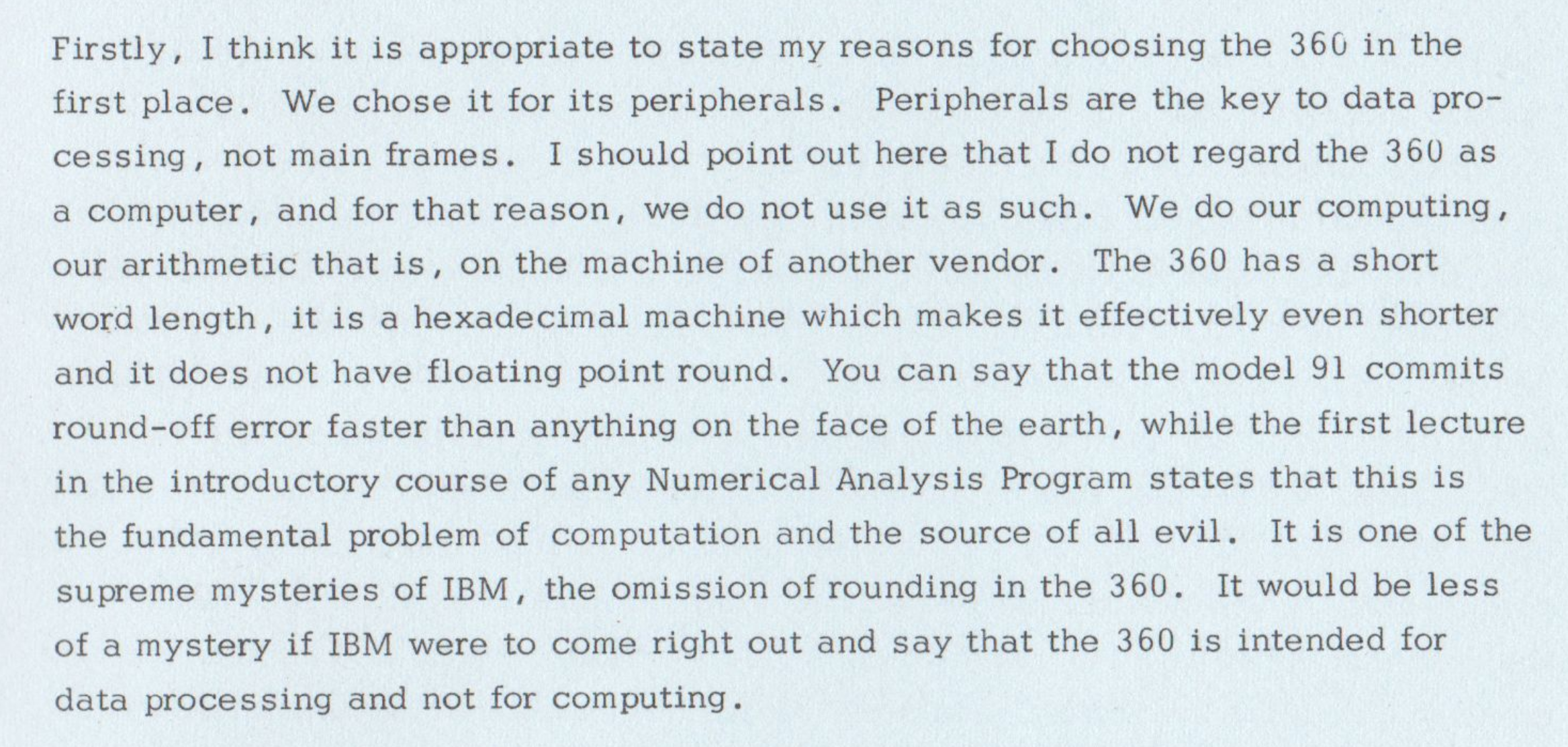
                                      @JohnMashey @markd @SteveBellovin I love this quote from Boeing about the 360.
                                      See https://drive.google.com/file/d/1Zb6s_Ti7ON-6DNGg8VB2VvLSbh72_bgM/view?usp=sharing
                                      Link Preview Image
                                      stuartmarks@mastodon.socialS 1 Reply Last reply
                                      0
                                      • aka_pugs@mastodon.socialA aka_pugs@mastodon.social

                                        @JohnMashey @markd @SteveBellovin I love this quote from Boeing about the 360.
                                        See https://drive.google.com/file/d/1Zb6s_Ti7ON-6DNGg8VB2VvLSbh72_bgM/view?usp=sharing

                                        Link Preview Image
                                        stuartmarks@mastodon.socialS This user is from outside of this forum
                                        stuartmarks@mastodon.socialS This user is from outside of this forum
                                        stuartmarks@mastodon.social
                                        wrote last edited by
                                        #19

                                        @aka_pugs @JohnMashey @markd @SteveBellovin Huh, interesting comment on hex floating point. I’ve long thought that a controversial choice. I remember hearing an IBM numerical analyst claim that the hex floating point was “cleaner” than competing formats (this predated IEEE 754) but much literature today echoes the criticism given here that the hex format effectively shortens the significand.

                                        stevebellovin@infosec.exchangeS 2 Replies Last reply
                                        0
                                        • johnmashey@mstdn.socialJ johnmashey@mstdn.social

                                          @aka_pugs @markd @SteveBellovin
                                          But still, FORTRAN IV got lots of use especially on 360/50…85 in universities & R&D labs. i suspect not much on /30 /40.
                                          I still think of 360 as a huge bet to consolidate the chaos of the 701…7094 36-bit path and the 702…7074 &1401 variable-string paths.
                                          And for fun: I asked both Gene Amdahl & Fred Brooks why they used 24-bit addressing, ignoring high 8-bits… which caused a lot of problems/complexity later.
                                          A: save hardware on 360/30, w/8-bit data paths.

                                          hyc@mastodon.socialH This user is from outside of this forum
                                          hyc@mastodon.socialH This user is from outside of this forum
                                          hyc@mastodon.social
                                          wrote last edited by
                                          #20

                                          @JohnMashey @aka_pugs @markd @SteveBellovin sounds like Motorola copied their reasoning years later, with the MC68000.

                                          For us UMich folks, the 360/67 was the machine that mattered...

                                          johnmashey@mstdn.socialJ 1 Reply Last reply
                                          0
                                          Reply
                                          • Reply as topic
                                          Log in to reply
                                          • Oldest to Newest
                                          • Newest to Oldest
                                          • Most Votes


                                          • Login

                                          • Login or register to search.
                                          • First post
                                            Last post
                                          0
                                          • Categories
                                          • Recent
                                          • Tags
                                          • Popular
                                          • World
                                          • Users
                                          • Groups