The teacher said "In English a double negative forms a positive.
-
The teacher said "In English a double negative forms a positive. In some languages, though, such as Russian, a double negative is still a negative. However, there is no language wherein a double positive can form a negative."
A voice from the back of the room piped up, "Yeah, right."@kibcol1049 In American Ebonics double negatives denoting positive is a real rule (one of the rules that differentiates it from common american english). I really appreciate how language is living and is able to adjust to time, place, and context.
-
@eleder @jack @Wolf_Baginski @kibcol1049
That's opening a totally different can of worm about how to respond to a negative question!!!
"Are you not finishing that?"
Does "yes" means "I will finish it" or "your statement is correct, I will not finish it".
I've learnt recently that French uses "si" (I will finish it) instead of "yes" (your statement is correct, i will not finish it) to answer a negative question. Native French speaker myself, I feel a bit ashamed about not knowing it before.
@Lily_and_frog @eleder @jack @Wolf_Baginski @kibcol1049
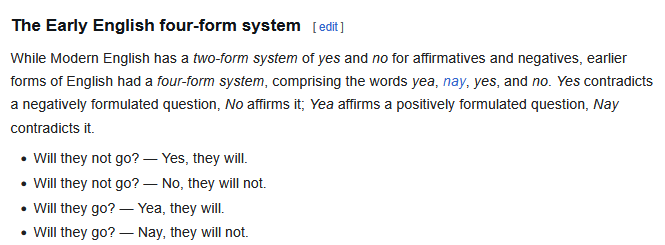
English used to have a 4 form system - Yes contradicts a negatively formulated question, No affirms it; Yea affirms a positively formulated question, Nay contradicts it.
-
English is my second language and phrases like
"we don't want no education"
always bother me.
@rzeta0 @kibcol1049 It is a dialect form in the bits of the North of England that I grew up in. Maybe other parts of the UK too.
As in:
"We don't need nothing from you."
Which in more standard English would have been:
"We don't need anything from you.".
It has always seemed to me to be the interchangebility of anything/nothing and any/no as a reinforcement of the negative rather than necessarily a use of double negatives as is normally practiced in UK English.
-
The teacher said "In English a double negative forms a positive. In some languages, though, such as Russian, a double negative is still a negative. However, there is no language wherein a double positive can form a negative."
A voice from the back of the room piped up, "Yeah, right." -
@sibrosan @kibcol1049 Of course it could be. Also husband and husband, wife and wife, spy and spy...
I think it is, in general, not that simple.
A joke like this starts out with setting a scene that sounds familiar enough for people to easily picture in their mind.
The humorous element is in the unexpected turn of events in the punch line.
For most people, the gender role reversal in my version will be already somewhat unexpected, which interferes with the punch line effect.
-
@rzeta0 @kibcol1049 It is a dialect form in the bits of the North of England that I grew up in. Maybe other parts of the UK too.
As in:
"We don't need nothing from you."
Which in more standard English would have been:
"We don't need anything from you.".
It has always seemed to me to be the interchangebility of anything/nothing and any/no as a reinforcement of the negative rather than necessarily a use of double negatives as is normally practiced in UK English.
-
This line is using a children choir and voicing the children's point of view, playing on the double meaning.
They say they don't need education in such a clunky way, confirming that they clearly need education.
@Lily_and_frog @rzeta0 @kibcol1049 I think you're missing the point entirely. it's not that they need education, it's that they're rejecting it.
-
@kibcol1049 California has also triple positive meaning "No". But there "Yes" often means "No" like in "If you want..." (I'd do it for you) Or "Maybe". ("Not really")
"Oh yeah for sure, yes" and more are very typical there. And Bavarian has quadruple negatives that stay negative. "Naa, koane Masern hob I no nia net gehabt!" for example. stays negative, the speaker never has caught the measles. @chillicampari can confirm -
-
The teacher said "In English a double negative forms a positive. In some languages, though, such as Russian, a double negative is still a negative. However, there is no language wherein a double positive can form a negative."
A voice from the back of the room piped up, "Yeah, right." -
@kibcol1049
Be careful in Germany:
"yes, yes" means "kiss my ass".("Ja, ja" heißt "leck mich am Arsch".)
@ard_the_rich @kibcol1049 I read it was believed that showing someone (or some entity) the naked butt was a magical protection. Like Bart Simpson: "eat my shorts!". Maybe germans are just lazy (or efficient) and shortened it to "yes, yes" to ward of evil.
-
@Lily_and_frog @rzeta0 @kibcol1049 I think you're missing the point entirely. it's not that they need education, it's that they're rejecting it.
-
@jack @eleder @Wolf_Baginski @kibcol1049
In Canada we sometimes say "Yeah, No, yeah. "
@TrueNorthSpice I thought that was a California thing! (I have never been to Canada) “Yeah, no.” And “No, yeah.”
 We all knew what we meant but when I came back East people looked at me funny.
 -
@kibcol1049 California has also triple positive meaning "No". But there "Yes" often means "No" like in "If you want..." (I'd do it for you) Or "Maybe". ("Not really")
"Oh yeah for sure, yes" and more are very typical there. And Bavarian has quadruple negatives that stay negative. "Naa, koane Masern hob I no nia net gehabt!" for example. stays negative, the speaker never has caught the measles. @chillicampari can confirm@mfeilner @kibcol1049 @chillicampari Then there is "jo" in Norwegian which (among other uses) is a "Yes" that preceeds the other person first affirming and then disagreeing with you in some way.
"Kan jeg ta bussen herfra til Ullevaal?"
"Can I get to Ullevaal from here by bus?"
"Jo, men det er lettere å ta en taxi"
"Yes, but it is easier to take a taxi".
-
@TrueNorthSpice I thought that was a California thing! (I have never been to Canada) “Yeah, no.” And “No, yeah.”
We all knew what we meant but when I came back East people looked at me funny.Nope, it started here, sorry.
-
@eleder @Wolf_Baginski @kibcol1049 In German, you can express something analogous with "Ja, nee, klar" ("Yes, naa, sure"), i.e. yes-no-yes.
What do you make of that?
@jack @eleder @Wolf_Baginski @kibcol1049 Yeah, nah, bro.
-
The teacher said "In English a double negative forms a positive. In some languages, though, such as Russian, a double negative is still a negative. However, there is no language wherein a double positive can form a negative."
A voice from the back of the room piped up, "Yeah, right."@kibcol1049 Fucking Bastard...
-
@AlexanderVI @rzeta0 @kibcol1049 disagree. The taught rule is, based on the mathematical rule but it is not actually the case. Even QI klaxoned it! The context defines whether it applies or not.
Admittedly it is seen as poor form and it can usually be avoided but the taught adsolute rule is not correct.
-
@AlexanderVI @rzeta0 @kibcol1049 disagree. The taught rule is, based on the mathematical rule but it is not actually the case. Even QI klaxoned it! The context defines whether it applies or not.
Admittedly it is seen as poor form and it can usually be avoided but the taught adsolute rule is not correct.
@AlexanderVI @rzeta0 @kibcol1049 even though the article is clear as mud, it does explain https://en.wikipedia.org/wiki/Double_negative