Several years of Deutsche Bahn business travel taught me something unexpected: eventually you stop fighting the system and start learning its moods, failure domains, and hidden virtues.
-
@Larvitz I would add the recommendation - screenshots of the QR Codes of any card that might be controlled - Apps may stop working because of no network connection and the urgency to re-download something when opening the control view ... in my experience DB Navigator is happy to fail, especially when the ticket is booked with a Bahncard.
Instead of printing I add the calendar entries for the trip to my calendar and attach the PDFs.
but I also have a powerbank for emergencies in my bag.
@yrrsinn I always have a printout of the ticket and the printout code for the BahnCard in my laptop sleeve. (Plus the obligatory power bank and a charging brick in my backpack)
For the Bahncard, you can download a PDF in the bahn.de customer area that can be used instead of the app.
-
@yrrsinn I always have a printout of the ticket and the printout code for the BahnCard in my laptop sleeve. (Plus the obligatory power bank and a charging brick in my backpack)
For the Bahncard, you can download a PDF in the bahn.de customer area that can be used instead of the app.
@Larvitz sure - for me would the dead phone break more processes, e.g. calling or texting updates for an appointment - thus phone must not run out of power.
Not sure if it's already on your list: https://bahn.bingo/, it's also a great starter for smalltalk, when one has not managed to catch a single seat and has to interact with fellow travelers -
Several years of Deutsche Bahn business travel taught me something unexpected: eventually you stop fighting the system and start learning its moods, failure domains, and hidden virtues.
I wrote down the practical folklore that actually helps: apps, routing habits, delay survival, seat choices, fallback lines, and the strange civilisation of the Bordrestaurant at 250 km/h.
“A Field Manual for Three Years on Deutsche Bahn”: https://blog.hofstede.it/a-field-manual-for-three-years-on-deutsche-bahn/
@Larvitz @WiseWoman My own DB traveling needs are much simpler (Berlin-Hamburg, mainly), so much of this does not apply to me, but it does sound like sage advice. I always have a printed ticket with me (unless I forget it in the printer), usually some water, and I always book 1st class single seat. The battery of my noise-cancelling headphones usually lasts long enough, though.
And *sometimes* the 1st-class waiter actually comes along and I can have a beer brought to me. I like that.
-
Several years of Deutsche Bahn business travel taught me something unexpected: eventually you stop fighting the system and start learning its moods, failure domains, and hidden virtues.
I wrote down the practical folklore that actually helps: apps, routing habits, delay survival, seat choices, fallback lines, and the strange civilisation of the Bordrestaurant at 250 km/h.
“A Field Manual for Three Years on Deutsche Bahn”: https://blog.hofstede.it/a-field-manual-for-three-years-on-deutsche-bahn/
@Larvitz eine (schaltbare) Steckdose mit Schuko-Stecker hilft gegen die ausgeleierten Steckdosen im ICE. Damit hat das eigene USB Ladegerät einen festen Sitz. Bonus: bei einem Mehrfachstecker hat auch die Sitznachbatin etwas davon.
-
@alison The Xerox C230 Just Works, it's a normal PostScript printer. (Never tried a multifunction, I don't really need scanning at home.) Mine is connected via USB to my FreeBSD desktop but macOS clients on wireless didn't even need configuration. It replaced a 10yo Xerox color laser which I only got rid of because the paper feed started jamming constantly.
@wollman Thanks, I'll have a look.
-
@Larvitz Thanks for this useful information, which I will assuredly consult. I'm curious how you print paper tickets.
Do you have a printer at home which works with BSD? If so, what kind is it?
For 3 or 4 years, I had a nice laser printer which I used with Debian and @kde . Unfortunately, when Plasma6 dropped, there was no longer a driver, and after wasting several hours trying to get it to work, I gave up. -
Several years of Deutsche Bahn business travel taught me something unexpected: eventually you stop fighting the system and start learning its moods, failure domains, and hidden virtues.
I wrote down the practical folklore that actually helps: apps, routing habits, delay survival, seat choices, fallback lines, and the strange civilisation of the Bordrestaurant at 250 km/h.
“A Field Manual for Three Years on Deutsche Bahn”: https://blog.hofstede.it/a-field-manual-for-three-years-on-deutsche-bahn/
@Larvitz where can I find this "Verbindung im Live-Tracking" screen? As far as I know only bahn.expert's "Letzte Positionsmeldung" shows an actual GPS based position of trains
-
Several years of Deutsche Bahn business travel taught me something unexpected: eventually you stop fighting the system and start learning its moods, failure domains, and hidden virtues.
I wrote down the practical folklore that actually helps: apps, routing habits, delay survival, seat choices, fallback lines, and the strange civilisation of the Bordrestaurant at 250 km/h.
“A Field Manual for Three Years on Deutsche Bahn”: https://blog.hofstede.it/a-field-manual-for-three-years-on-deutsche-bahn/
@Larvitz
Are you an LLM or have you perfected writing like one? -
@Larvitz where can I find this "Verbindung im Live-Tracking" screen? As far as I know only bahn.expert's "Letzte Positionsmeldung" shows an actual GPS based position of trains
@networkexception @Larvitz Same question !
-
@Larvitz
Are you an LLM or have you perfected writing like one?@andrzej I write my blog posts myself, but use a small local LLM (Ministral 14B from Mistral on my laptop) to enhance the style and grammar when writing in English, which is a foreign language for me. I use AI to give the text an editorial pass before publishing.
-
@networkexception @Larvitz Same question !
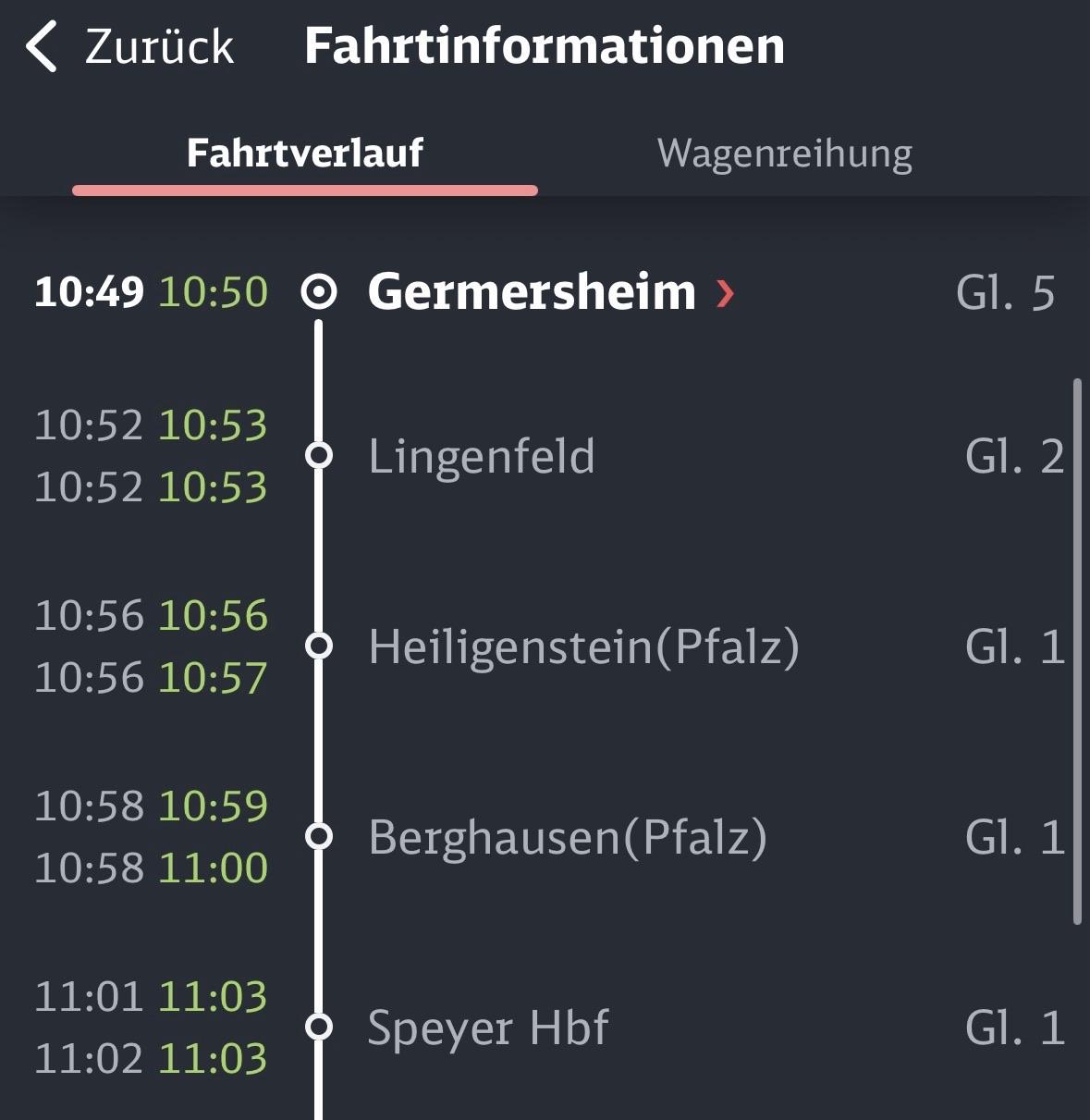
If you open a trains detail view, then you see it‘s journeys history and see how punctual it was at the previous stops. That’s open more reliable than the LCD screens on the station. Like this here (I use it all the time)
-
If you open a trains detail view, then you see it‘s journeys history and see how punctual it was at the previous stops. That’s open more reliable than the LCD screens on the station. Like this here (I use it all the time)
@Larvitz @networkexception Btw, has DB navigator any way of looking up trains by number ?
-
@Larvitz @networkexception Btw, has DB navigator any way of looking up trains by number ?
@Sobex @networkexception unfortunately I’m not aware. It’s always a bit finicky to look the trains up via the connection search or the booked ticket.
-
Several years of Deutsche Bahn business travel taught me something unexpected: eventually you stop fighting the system and start learning its moods, failure domains, and hidden virtues.
I wrote down the practical folklore that actually helps: apps, routing habits, delay survival, seat choices, fallback lines, and the strange civilisation of the Bordrestaurant at 250 km/h.
“A Field Manual for Three Years on Deutsche Bahn”: https://blog.hofstede.it/a-field-manual-for-three-years-on-deutsche-bahn/
@Larvitz Important on some routes (eg Dresden-Berlin, Köln-Aachen): The "Zugbindung Aufgehoben"-Magic only works for DB trains (and RJ, EC, ...). You still cannot take long distance trains from private operators (EN, SJ, ...) without booking a new ticket first.
-
@Larvitz Important on some routes (eg Dresden-Berlin, Köln-Aachen): The "Zugbindung Aufgehoben"-Magic only works for DB trains (and RJ, EC, ...). You still cannot take long distance trains from private operators (EN, SJ, ...) without booking a new ticket first.
@ysegrim yes. That’s offen announced in the trains via loudspeaker. I fell into that myself when I had a Eurostar ticket from SNCB and couldn’t use the ICE train to Köln one day, because DB didn’t accept the ticket for that one.
-
@andrzej I write my blog posts myself, but use a small local LLM (Ministral 14B from Mistral on my laptop) to enhance the style and grammar when writing in English, which is a foreign language for me. I use AI to give the text an editorial pass before publishing.
@Larvitz Interesting. I often try the same. Just to fix grammar and spelling. Mostly to avoid embarrassments. And I find it genuinely challenging not to leak the LLM-personality in. I do prompt the model to not change the tone, and I think it mostly obeys, but I am obsessing that it leaves a bigger footprint than I would like to. Perhaps this is why I became so sensitive. Your text is strongly LLMy though. I tried mistral yesterday for a similar task and kicked the results out. qwen-3.5 did a better job for me (also run locally). Some say Qwen is less confident in English (i wouldn't have an idea) but maybe this makes it less pushy over style?
-
@Larvitz Interesting. I often try the same. Just to fix grammar and spelling. Mostly to avoid embarrassments. And I find it genuinely challenging not to leak the LLM-personality in. I do prompt the model to not change the tone, and I think it mostly obeys, but I am obsessing that it leaves a bigger footprint than I would like to. Perhaps this is why I became so sensitive. Your text is strongly LLMy though. I tried mistral yesterday for a similar task and kicked the results out. qwen-3.5 did a better job for me (also run locally). Some say Qwen is less confident in English (i wouldn't have an idea) but maybe this makes it less pushy over style?
@andrzej Same observation here. The LLM does change the style in noticeable ways, and I accept that trade-off on a personal blog as long as the information is conveyed clearly.
having a somewhat „LLM-y“ text is still better than having the text suffering from my sometimes suboptimal English. I care more for the content than for my individual voice here. Guess that’s a matter of preference.
-
Several years of Deutsche Bahn business travel taught me something unexpected: eventually you stop fighting the system and start learning its moods, failure domains, and hidden virtues.
I wrote down the practical folklore that actually helps: apps, routing habits, delay survival, seat choices, fallback lines, and the strange civilisation of the Bordrestaurant at 250 km/h.
“A Field Manual for Three Years on Deutsche Bahn”: https://blog.hofstede.it/a-field-manual-for-three-years-on-deutsche-bahn/
@Larvitz I might add one more useful website for DB travellers: https://strecken-info.de/
Ther you can see the official reasons for a blockage and perhaps even route FAR around it.Another thing I always use on train: A self-inlfatable cushion - only half way filled. That simulates "dynamic seating" and helps my lower back quite substantially,
Btw: I am a long distances commuter (one way 800km) for the last 14 years quite across the country....
Thanks for your insights!
-
Several years of Deutsche Bahn business travel taught me something unexpected: eventually you stop fighting the system and start learning its moods, failure domains, and hidden virtues.
I wrote down the practical folklore that actually helps: apps, routing habits, delay survival, seat choices, fallback lines, and the strange civilisation of the Bordrestaurant at 250 km/h.
“A Field Manual for Three Years on Deutsche Bahn”: https://blog.hofstede.it/a-field-manual-for-three-years-on-deutsche-bahn/
@Larvitz Auf der Strecke von Bielefeld nach Kiel (Familie) habe ich mich so oft über doch nicht ohne Umstieg von Hannover nach Kiel durchfahrende ICEs geärgert, dass ich stattdessen neuerdings gleich mit meinem #Deutschlandticket und dem Regionalverkehr plane/fahre.
-
Several years of Deutsche Bahn business travel taught me something unexpected: eventually you stop fighting the system and start learning its moods, failure domains, and hidden virtues.
I wrote down the practical folklore that actually helps: apps, routing habits, delay survival, seat choices, fallback lines, and the strange civilisation of the Bordrestaurant at 250 km/h.
“A Field Manual for Three Years on Deutsche Bahn”: https://blog.hofstede.it/a-field-manual-for-three-years-on-deutsche-bahn/
@Larvitz das erinnert mich an meinen Blogpost vor Jahren. Nicht so ausführlich wie bei dir, aber selbe Richtung.

Bahnfahren wie die Profis – Holger Hellingers' Polente
Wenn du wie ich in früheren Jahren 40.000km oder mehr im Jahr Bahn gefahren bist, dann hast du ein System wie du Strecken buchst um eigentlich immer anzukommen.…

Holger Hellingers' Polente (polente.de)