I've been making a linguistics puzzle game where you decipher a language (which happens to be German) using shared etymology, shared cultural knowledge and pattern matching.
-
I've been making a linguistics puzzle game where you decipher a language (which happens to be German) using shared etymology, shared cultural knowledge and pattern matching.
It's called German Is A̶w̶f̶u̶l̶ Easy and the first five levels are up! No German knowledge necessary, and feedback is very welcome.
German Is A̶w̶f̶u̶l̶ Easy
Personal website for Michelle Fullwood, NLP scientist and linguistic tinkerer. Language tools, maps, miscellany.

(michellefullwood.com)
#etymology #linguistics #puzzles #LearnGerman
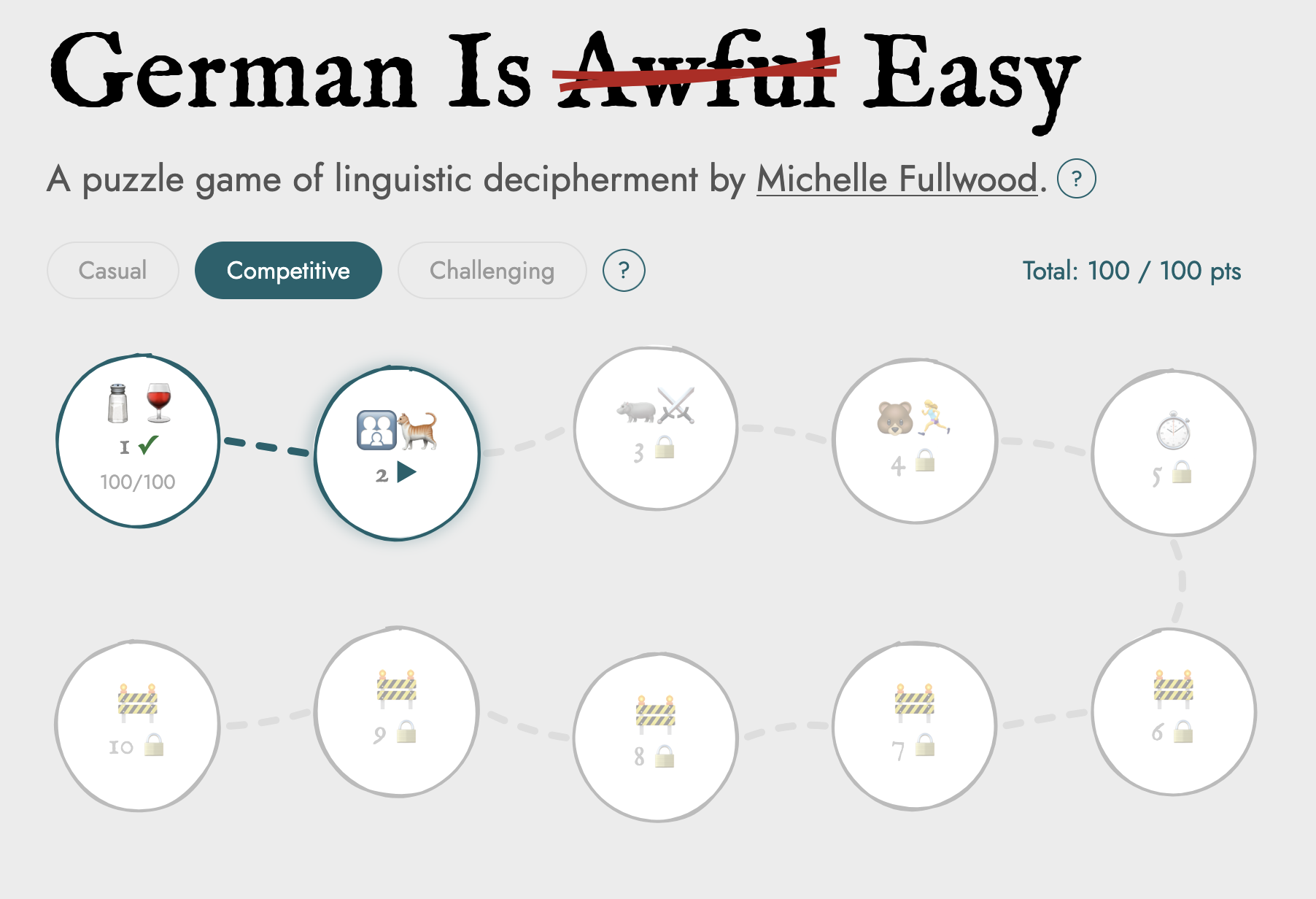
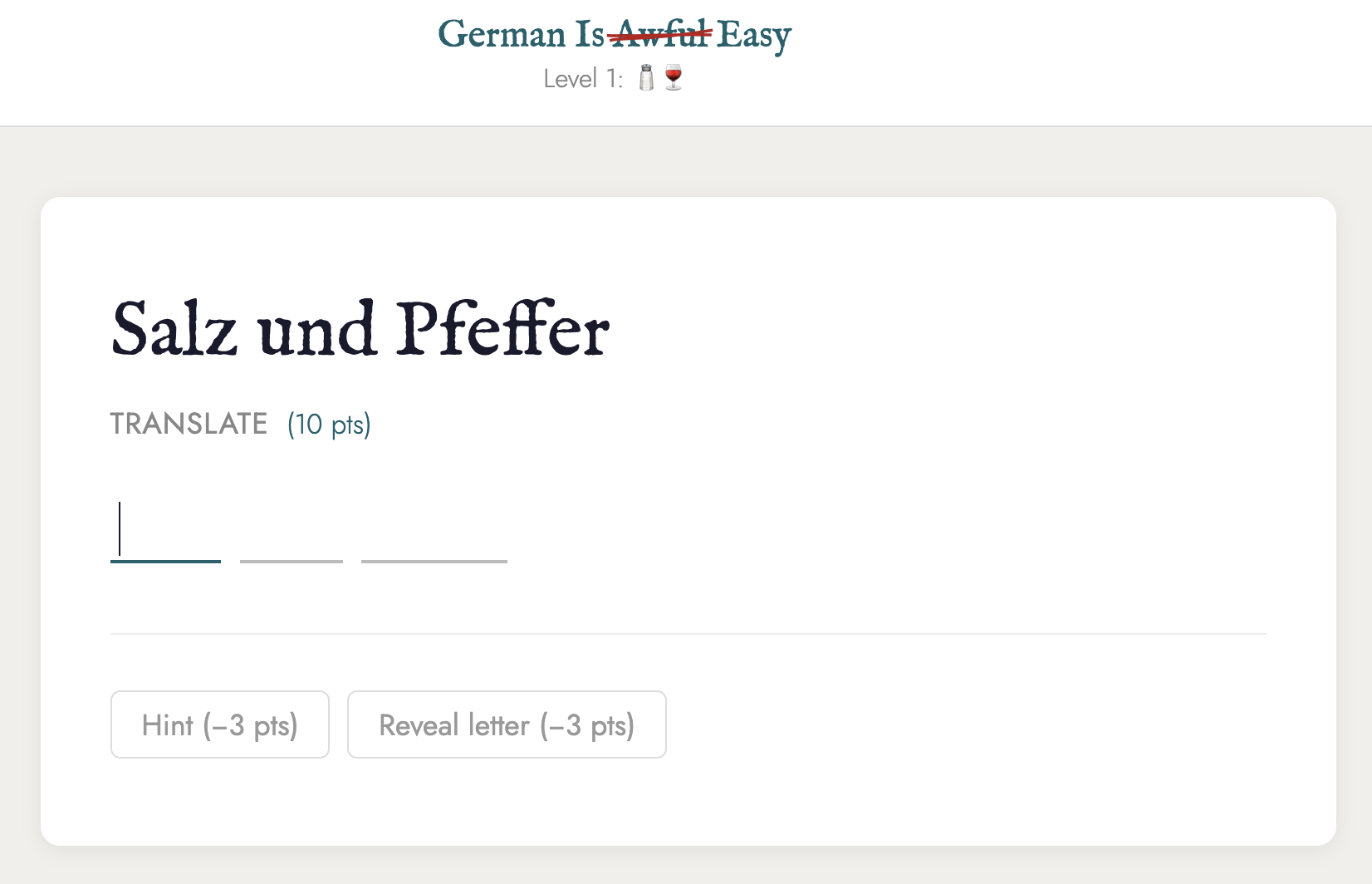 @michelleful@scicomm.xyz As a German, I can't tell how well it works, as it's clearly too obvious to me at first. If I could skip to the end, I could maybe better see how well it works, but indeed, it doesn't surprise me at all, as the languages are kinda close, especially when including English anachronisms like "thou" and even "hast".
Also, virtually every English verb ending in "-ate" is actually a Latin verb ending in "-are" in its infinitive, and often common with German where the suffix usually becomes "-ieren". As such, you can immediately translate words like "instigieren", "dehydrieren", "aktivieren". For some words the translation to English is a bit more complex such, as "akzeptieren", "alkoholisieren", "subtrahieren" (which, of course, is "subtrahere" in Latin, which shows that the German "-ieren" is ambiguous about its origin, and even can occur entirely non Latin related, like in "verschmieren" or "den Haustieren"). -
I've been making a linguistics puzzle game where you decipher a language (which happens to be German) using shared etymology, shared cultural knowledge and pattern matching.
It's called German Is A̶w̶f̶u̶l̶ Easy and the first five levels are up! No German knowledge necessary, and feedback is very welcome.
German Is A̶w̶f̶u̶l̶ Easy
Personal website for Michelle Fullwood, NLP scientist and linguistic tinkerer. Language tools, maps, miscellany.
(michellefullwood.com)
#etymology #linguistics #puzzles #LearnGerman
@michelleful
@mosgaard this seems like something you could enjoy with your recent rediscovery of the German language. -
@michelleful Such a great idea! But I seem to be stuck here. Am I meant to progress? Have I got it wrong. Am I meant to just click Levels to return?

@rubyjones @michelleful I have the same issue, but awesome game otherwise!
-
I've been making a linguistics puzzle game where you decipher a language (which happens to be German) using shared etymology, shared cultural knowledge and pattern matching.
It's called German Is A̶w̶f̶u̶l̶ Easy and the first five levels are up! No German knowledge necessary, and feedback is very welcome.
German Is A̶w̶f̶u̶l̶ Easy
Personal website for Michelle Fullwood, NLP scientist and linguistic tinkerer. Language tools, maps, miscellany.
(michellefullwood.com)
#etymology #linguistics #puzzles #LearnGerman
@michelleful I'm no linguist and my German is rusty, if it was ever very good. This though is a lot of fun.
-
I've been making a linguistics puzzle game where you decipher a language (which happens to be German) using shared etymology, shared cultural knowledge and pattern matching.
It's called German Is A̶w̶f̶u̶l̶ Easy and the first five levels are up! No German knowledge necessary, and feedback is very welcome.
German Is A̶w̶f̶u̶l̶ Easy
Personal website for Michelle Fullwood, NLP scientist and linguistic tinkerer. Language tools, maps, miscellany.
(michellefullwood.com)
#etymology #linguistics #puzzles #LearnGerman
@michelleful Das ist sehr toll!
-
@michelleful Such a great idea! But I seem to be stuck here. Am I meant to progress? Have I got it wrong. Am I meant to just click Levels to return?
@rubyjones you need to put another noun in the first positions! Click on the current noun to return and try a different one! Same for both clauses
-
@rubyjones @michelleful I have the same issue, but awesome game otherwise!
@Oelnbod you need to put another noun in the first positions! Click on the current noun to return and try a different one! Same for both clauses.

-
I've been making a linguistics puzzle game where you decipher a language (which happens to be German) using shared etymology, shared cultural knowledge and pattern matching.
It's called German Is A̶w̶f̶u̶l̶ Easy and the first five levels are up! No German knowledge necessary, and feedback is very welcome.
German Is A̶w̶f̶u̶l̶ Easy
Personal website for Michelle Fullwood, NLP scientist and linguistic tinkerer. Language tools, maps, miscellany.
(michellefullwood.com)
#etymology #linguistics #puzzles #LearnGerman
@michelleful Hi Michelle - I enjoyed and learnt from level one (I'm tertiary educated and speak only English but enjoy words and etymology - I played on competitive). I've bookmarked the rest for later but here's my feedback after level 1:
"Competitive" seems like a strange name for a difficulty tier - it implies a different mode in which players compete (like ranked or multiplayer).
-
@michelleful Hi Michelle - I enjoyed and learnt from level one (I'm tertiary educated and speak only English but enjoy words and etymology - I played on competitive). I've bookmarked the rest for later but here's my feedback after level 1:
"Competitive" seems like a strange name for a difficulty tier - it implies a different mode in which players compete (like ranked or multiplayer).
@michelleful
The Coleridge puzzle bugged me because of course I quote it "nor any drop to drink" - that's how he wrote it! Is it common to misquote it like that?! Not big deal at all, just a minor annoyance for me, personally.
-
@michelleful
The Coleridge puzzle bugged me because of course I quote it "nor any drop to drink" - that's how he wrote it! Is it common to misquote it like that?! Not big deal at all, just a minor annoyance for me, personally.@michelleful
For the "I drank beer" puzzle, the explanation talks about why "have" gets moved to the second slot, but that doesn't seem like what happened to me. I feel like "I have drunk beer" would be the English order of those words (not "I beer have drunk"), so the weirdness to me is that in German "drunk" comes after "beer", not that "have" comes before "beer". -
I've been making a linguistics puzzle game where you decipher a language (which happens to be German) using shared etymology, shared cultural knowledge and pattern matching.
It's called German Is A̶w̶f̶u̶l̶ Easy and the first five levels are up! No German knowledge necessary, and feedback is very welcome.
German Is A̶w̶f̶u̶l̶ Easy
Personal website for Michelle Fullwood, NLP scientist and linguistic tinkerer. Language tools, maps, miscellany.
(michellefullwood.com)
#etymology #linguistics #puzzles #LearnGerman
@michelleful @bobthomson70 i fear the level with all the -zeug words… prob the big boss level…
-
I've been making a linguistics puzzle game where you decipher a language (which happens to be German) using shared etymology, shared cultural knowledge and pattern matching.
It's called German Is A̶w̶f̶u̶l̶ Easy and the first five levels are up! No German knowledge necessary, and feedback is very welcome.
German Is A̶w̶f̶u̶l̶ Easy
Personal website for Michelle Fullwood, NLP scientist and linguistic tinkerer. Language tools, maps, miscellany.
(michellefullwood.com)
#etymology #linguistics #puzzles #LearnGerman
@michelleful I couldn’t get the 6th question to play and it wouldn’t move on from there. Tried casual and competitive. The one with fill in the blanks “I drink beer, you drink milk”
Would like to play another time. -
@michelleful
@mosgaard this seems like something you could enjoy with your recent rediscovery of the German language.@ClemensPitschke @michelleful thanks, it looks really nice, but I’m afraid it got a little too language-technical for me as a not native english speaker.
But I really liked the refreshing take on language learning!
-
I've been making a linguistics puzzle game where you decipher a language (which happens to be German) using shared etymology, shared cultural knowledge and pattern matching.
It's called German Is A̶w̶f̶u̶l̶ Easy and the first five levels are up! No German knowledge necessary, and feedback is very welcome.
German Is A̶w̶f̶u̶l̶ Easy
Personal website for Michelle Fullwood, NLP scientist and linguistic tinkerer. Language tools, maps, miscellany.
(michellefullwood.com)
#etymology #linguistics #puzzles #LearnGerman
@michelleful @libreleah I think you might find this interesting!
-
@michelleful I couldn’t get the 6th question to play and it wouldn’t move on from there. Tried casual and competitive. The one with fill in the blanks “I drink beer, you drink milk”
Would like to play another time.@Sharonybaloney if you tap on a word (e.g. ich) and then the first blank, does it move?
-
@michelleful
For the "I drank beer" puzzle, the explanation talks about why "have" gets moved to the second slot, but that doesn't seem like what happened to me. I feel like "I have drunk beer" would be the English order of those words (not "I beer have drunk"), so the weirdness to me is that in German "drunk" comes after "beer", not that "have" comes before "beer".@pentup Thanks for your feedback! I'm using a simplified version of what I believe to be the standard syntactic analysis. Where it may seem not to be explanatory is the fact that "beer" is currently stipulated to be before "drunk". We can tell that that's the case when we start looking at the subordinate clauses where the verb doesn't move at all, though. We haven't gotten there yet! I'm not sure if this entirely addresses your question, but I think I get where you're coming from
-
@michelleful Hi Michelle - I enjoyed and learnt from level one (I'm tertiary educated and speak only English but enjoy words and etymology - I played on competitive). I've bookmarked the rest for later but here's my feedback after level 1:
"Competitive" seems like a strange name for a difficulty tier - it implies a different mode in which players compete (like ranked or multiplayer).
@pentup You're probably right there that people might think that there'll be a leaderboard for competitive. I was just looking for a C word that fit in between haha. Maybe "classic"? I will wait for more feedback before changing it but thank you for flagging it!
-
@michelleful@scicomm.xyz As a German, I can't tell how well it works, as it's clearly too obvious to me at first. If I could skip to the end, I could maybe better see how well it works, but indeed, it doesn't surprise me at all, as the languages are kinda close, especially when including English anachronisms like "thou" and even "hast".
Also, virtually every English verb ending in "-ate" is actually a Latin verb ending in "-are" in its infinitive, and often common with German where the suffix usually becomes "-ieren". As such, you can immediately translate words like "instigieren", "dehydrieren", "aktivieren". For some words the translation to English is a bit more complex such, as "akzeptieren", "alkoholisieren", "subtrahieren" (which, of course, is "subtrahere" in Latin, which shows that the German "-ieren" is ambiguous about its origin, and even can occur entirely non Latin related, like in "verschmieren" or "den Haustieren").@divVerent Thank you! I'm not sure about the "how well it works" either, but teaching German isn't the main goal, it's to have fun exploring a new language without needing to memorise a lot of words and having a bunch of little epiphanies along the way
Thanks for the -ieren examples, I should definitely include some of those cognates in a future level! -
@michelleful
The Coleridge puzzle bugged me because of course I quote it "nor any drop to drink" - that's how he wrote it! Is it common to misquote it like that?! Not big deal at all, just a minor annoyance for me, personally.@pentup Ah yeah, I was looking for a more direct translation of the German I had there, and I think that's how most English speakers quote it! I might say "Translate word by word" or something like that and be less snarky about how no one says "nor any", because clearly someone does!
-
@pentup You're probably right there that people might think that there'll be a leaderboard for competitive. I was just looking for a C word that fit in between haha. Maybe "classic"? I will wait for more feedback before changing it but thank you for flagging it!
@michelleful @pentup
Maybe challenging?Well, in fact it was easy for me. Got
 points!