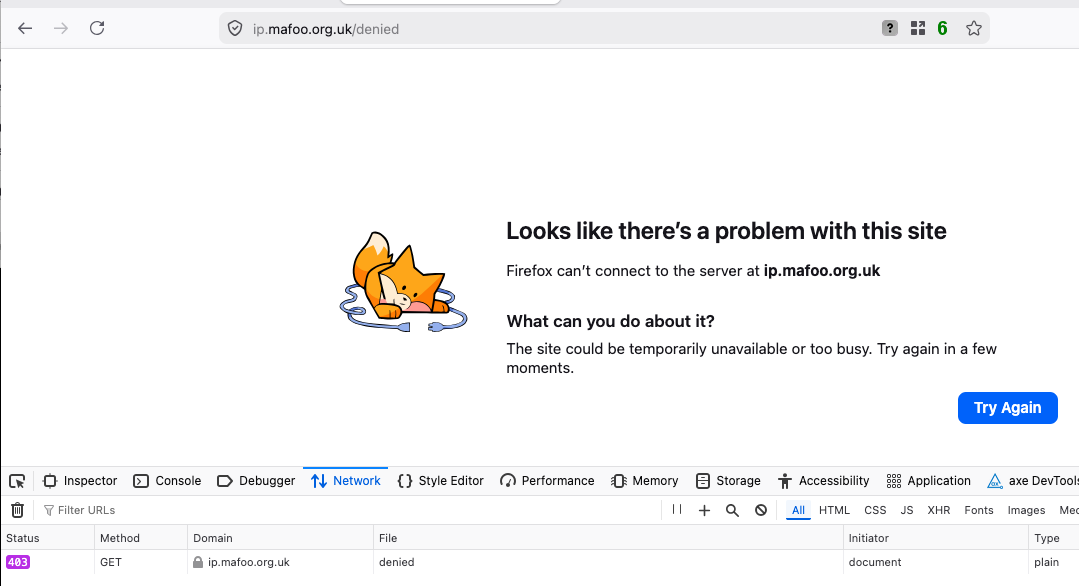
Latest #firefox #ESR (v149.0) appears to have stopped reporting the HTTP error code when something goes wrong… in this case for a 403.
-
Latest #firefox #ESR (v149.0) appears to have stopped reporting the HTTP error code when something goes wrong… in this case for a 403. It used to include the HTTP code and some useful words.
In this error, it looks like the connection just didn't work rather than we got an error from the server.
Is there a way to turn this back on?
@fooflington “there’s a problem with the site” for a 4xx error is really galling!
-
@fooflington “there’s a problem with the site” for a 4xx error is really galling!
@neilmadden yes! It took me a moment to realise it wasn't telling me the whole truth…!
"Something went wrong" would have been better words… but I still want to know what's going on underneath, even if it's on a "Show more..." button.
-
Latest #firefox #ESR (v149.0) appears to have stopped reporting the HTTP error code when something goes wrong… in this case for a 403. It used to include the HTTP code and some useful words.
In this error, it looks like the connection just didn't work rather than we got an error from the server.
Is there a way to turn this back on?
@fooflington Yeah, I've had this for a while, it's really annoying.
-
Latest #firefox #ESR (v149.0) appears to have stopped reporting the HTTP error code when something goes wrong… in this case for a 403. It used to include the HTTP code and some useful words.
In this error, it looks like the connection just didn't work rather than we got an error from the server.
Is there a way to turn this back on?
@fooflington I assume Moz are looking to make error pages less confusing/intimidating for less technical users - which is probably reasonable.
What's not reasonable is that this page gives wholly incorrect advice - "try again in a few moments" is not gonna work for a 403 or indeed any 4XX since they're all client/request errors.
FWIW/tangentially related, I'd still love an "I'm technical, show me all the details" setting on web browsers/software/OSs.
-
R relay@relay.mycrowd.ca shared this topic
-
Latest #firefox #ESR (v149.0) appears to have stopped reporting the HTTP error code when something goes wrong… in this case for a 403. It used to include the HTTP code and some useful words.
In this error, it looks like the connection just didn't work rather than we got an error from the server.
Is there a way to turn this back on?
@fooflington the cherry on top is that the wording of different parts of the UI is contradictory.
When I visit a page on 127.0.0.1 (via plain http) that returns 404, it says that there's a problem with the website and that Firefox couldn't connect.
The security shield icon in the URL bar shows a check mark though, and if i click it, it says there's a connection error and if I click that error, it says that I'm connected securely.
-
@fooflington I assume Moz are looking to make error pages less confusing/intimidating for less technical users - which is probably reasonable.
What's not reasonable is that this page gives wholly incorrect advice - "try again in a few moments" is not gonna work for a 403 or indeed any 4XX since they're all client/request errors.
FWIW/tangentially related, I'd still love an "I'm technical, show me all the details" setting on web browsers/software/OSs.
@tdp_org @fooflington there is no good reason whatsoever to do this over providing a plain english (or whatever localisation) explanation of the main codes and to still show the error code
This perpetual dumbing down is not required, at all, we just have to meet users where they are, not expect/treat them as too stupid to understand *anything*
-
@tdp_org @fooflington there is no good reason whatsoever to do this over providing a plain english (or whatever localisation) explanation of the main codes and to still show the error code
This perpetual dumbing down is not required, at all, we just have to meet users where they are, not expect/treat them as too stupid to understand *anything*
@tdp_org @fooflington “oopsie poopsie something went wrong try again maybe?” as an error message paradigm needs to die in a fire and every product manager - surely no actual developer is suggesting this - who thinks it appropriate needs to find a new career running a children’s soft play centre
-
@tdp_org @fooflington “oopsie poopsie something went wrong try again maybe?” as an error message paradigm needs to die in a fire and every product manager - surely no actual developer is suggesting this - who thinks it appropriate needs to find a new career running a children’s soft play centre
@tdp_org @fooflington I cannot even begin to fathom the shortsightedness on display here
can ai slop generators not code switch statements or something, or did it keep inventing error codes that didn’t exist?
-
@fooflington the cherry on top is that the wording of different parts of the UI is contradictory.
When I visit a page on 127.0.0.1 (via plain http) that returns 404, it says that there's a problem with the website and that Firefox couldn't connect.
The security shield icon in the URL bar shows a check mark though, and if i click it, it says there's a connection error and if I click that error, it says that I'm connected securely.
@guenther oh, joy!
-
Latest #firefox #ESR (v149.0) appears to have stopped reporting the HTTP error code when something goes wrong… in this case for a 403. It used to include the HTTP code and some useful words.
In this error, it looks like the connection just didn't work rather than we got an error from the server.
Is there a way to turn this back on?
@fooflington
@firefoxwebdevs can probably help. Hopefully. -
@fooflington I assume Moz are looking to make error pages less confusing/intimidating for less technical users - which is probably reasonable.
What's not reasonable is that this page gives wholly incorrect advice - "try again in a few moments" is not gonna work for a 403 or indeed any 4XX since they're all client/request errors.
FWIW/tangentially related, I'd still love an "I'm technical, show me all the details" setting on web browsers/software/OSs.
@tdp_org @fooflington This advice doesn't seem unreasonable. It's like that a normal user encountering a 403 is a website configuration issue where it has a broken link or they messed up authorization on an endpoint, both of which may be fixed in the future