Skip to content
  • 0 Votes
    4 Posts
    0 Views
    wooshell@chaosfurs.socialW
    @TheFox21 Need to sell those token packages somehow..
  • 0 Votes
    1 Posts
    0 Views
    lqdev@lqdev.meL
    Earlier today I had the opportunity to attend [FediForum](https://fediforum.org/2026-04/) and talk about Mycelium during one of the sessions. This was the first time I had talked about it publicly, which made it exciting. I wanted to see whether the framing made sense to people who spend a lot of time thinking about open social technologies. ## Why the timing felt relevant The timing could not have been more relevant because earlier this morning I read [Anthropic’s Project Deal post](https://www.anthropic.com/features/project-deal). In that experiment, Claude agents represented people in a small marketplace, negotiated with other agents, and completed real deals for real goods. That feels like exactly the kind of problem the open social web community is well positioned to think about. If agents are going to act on behalf of people, transact, coordinate, or make claims in shared spaces, then identity, transparency, governance, and trust cannot be afterthoughts. ## So what is Mycelium? Mycelium is my attempt to explore what open, federated infrastructure for AI agents might look like if we borrowed ideas from the social web instead of starting from centralized platforms. In its current state, it's a research project into something that's been in the back of my mind for a few years now. A few months ago, I finally decided to put some of those ideas on paper. A large part of it is built on and inspired by existing projects and protocols like [ActivityPub](https://activitypub.rocks/) and [AT Protocol](https://atproto.com/) as well as AI projects like [Gas Town / Wasteland](https://steve-yegge.medium.com/welcome-to-the-wasteland-a-thousand-gas-towns-a5eb9bc8dc1f) and [OpenClaw](https://openclaw.ai/). Each of those projects gets at part of the problem: - Gas Town and Wasteland make the agent coordination problem vivid. - ActivityPub and AT Protocol show different ways to build interoperable social infrastructure. - OpenClaw points toward local-first agent control. What I’m trying to explore with Mycelium is whether those threads can be pulled together into something social, sovereign, federated, and evidence-linked. The core thesis of Mycelium is that agents need the same kinds of decentralized social infrastructure we are already building for people: - **Portable Identity** - An agent's credentials and history are recognized everywhere, not locked to one platform. (i.e. Domain names. Your domain points to you regardless of which hosting provider you use.) - **Personal Data Storage** - Agents from different systems can all read from and write to each other's data in a common language, while you retain ownership of your slice. (i.e. Medical records. Your general physician, a specialist, hospital, and lab can all interact with the medical record using standard formats, but all the records belong to you.) - **Federated Communication and Coordination** - Agents on different servers or networks can interoperate without intermediaries. (i.e. Like email. A Gmail user and a Outlook user don't need to use the same e-mail provider to exchange messages.) - **Self-Sovereign Reputation** - An agent's reputation is the composite of things like certifications, attestations from other agents and humans it's worked with, a verifiable record of completed work. (i.e. CVs. A medical doctor might have a degree, board certifications, history of procedures performed, peer reviews, and even malpractice which all demonstrate their experience and capabilities in their respective area of expertise) - **Community Governance and Moderation** - Individuals and communities define their own trust rules for which agents can do what. (i.e. Co-ops. Building residents collectively decide rules and policies such as who can manage finances, which contractors are approved to do renovations, who can represent the building in legal matters, etc.) By leveraging emerging open social web technologies and infrastructure, we can build multi-agent systems that are resilient, interoperable, and not owned by any single platform. ## What the MVP shows To make the idea less abstract, I built an [MVP](https://github.com/lqdev/mycelium-mvp) that runs through a full coordination loop: agents bootstrap identities, declare capabilities, discover tasks through a wanted board, claim work, get matched and assigned, complete tasks, receive verification, and accumulate reputation stamps linked back to evidence. The dashboard is just one view over that activity. The records are the important part. ![Mycelium MVP Dashboard](https://github.com/user-attachments/assets/febaeec3-a917-4f63-b2a6-a5675236021a) I'd like to distinguish what the MVP shows and what it does not. Currently it proves the shape of the coordination model: - Work can be represented as records - Claims and completions can leave evidence - Reputation can point back to proof What it doesn't solve for yet are things like: - Privacy boundaries - Governance - Reputation gaming - Abuse resistance - Production-ready federation across real protocol infrastructure These are hard parts that require more exploration and design. ## Help pressure-test this I'll be the first to say that I am approaching this as a user, builder, and advocate for open social technologies, not as someone who has all the answers. If open social web builders do not help shape this kind of infrastructure, my guess is that centralized AI platforms will. And if that happens, these systems will probably become less open, less resilient, and less interoperable over time. Which is why I'd like to extend an invitation. Not to adopt Mycelium, but to pressure test my assumptions and design. There are still many open questions, but that is the part I find exciting. If this seems remotely interesting, or if you want to poke holes in it, please [reach out](/contact). E-mail is preferred. If you're interested in learning more, here is the [slide deck with resources I prepared for the Fediforum session](/resources/presentations/mycelium-fediforum-04-2026). You can also go directly to the [draft spec](https://github.com/lqdev/mycelium) and try out the [MVP](https://github.com/lqdev/mycelium-mvp) yourself.
  • 0 Votes
    1 Posts
    5 Views
    xenodium@indieweb.socialX
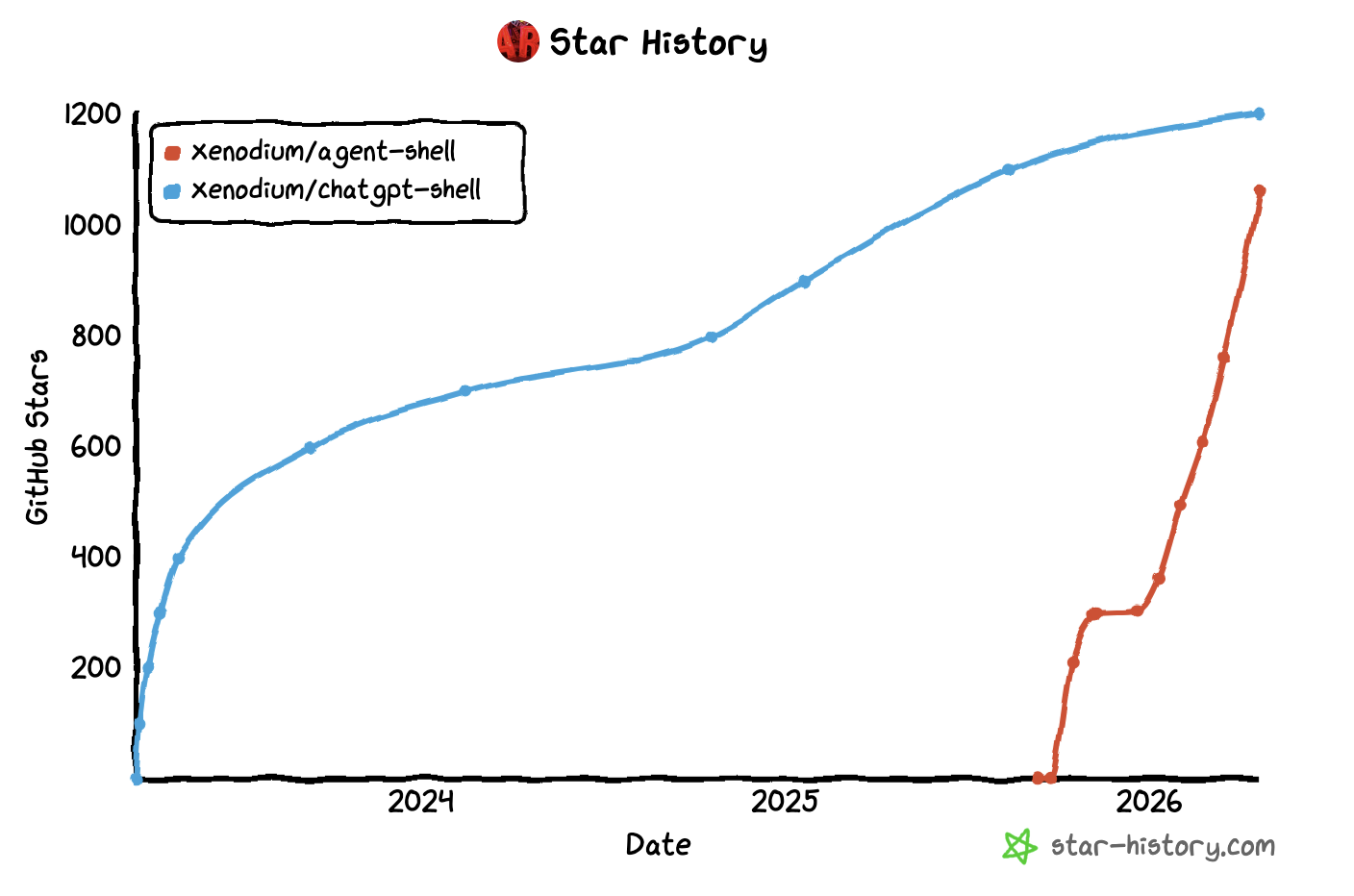
    chatgpt-shell was my most popular #emacs package. Here comes agent-shell #llm #agent #ai #agentic #opencode #gemini #claude #foss #oss #macos #linux
  • 0 Votes
    1 Posts
    0 Views
    arint@arint.infoA
    RT @Kimi_Moonshot: Meet Kimi K2.6: Advancing Open-Source Coding Open-source SOTA on HLE w/ tools (54.0), SWE-Bench Pro (58.6), SWE-bench Multilingual (76.7), BrowseComp (83.2), Toolathlon (50.0), Charxiv w/ python(86.7), Math Vision w/ python (93.2) What's new: Long-horizon coding - 4,000+ tool calls, over 12 hours of continuous execution, with generalization across languages (Rust, Go, Python) and tasks (frontend, devops, perf optimization). Motion-rich frontend - Videos in hero sections, WebGL shaders, GSAP + Framer Motion, Three.js 3D. Agent Swarms, elevated - 300 parallel sub-agents × 4,000 steps per run (up from K2.5's 100 / 1,500). One prompt, 100+ files. Proactive Agents - K2.6 model powers OpenClaw, Hermes Agent, etc for 24/7 autonomous ops. Claw Groups (research preview) - bring your own agents, command your friends', bots & humans in the loop. - K2.6 is now live on http://kimi.com in chat mode and agent mode. For production-grade coding, pair K2.6 with Kimi Code: https://kimi.com/code - API: https://platform.moonshot.ai Tech blog: https://www.kimi.com/blog/kimi-k2-6 Weights & code: https://huggingface.co/moonshotai/Kimi-K2.6 mehr auf Arint.info #Agent #agent #API #devops #Framer #Go #huggingface #python #Python #Rust #SWE #SWEBench #SWEbench #arint_info https://x.com/Kimi_Moonshot/status/2046249571882500354#m
  • 0 Votes
    1 Posts
    0 Views
    arint@arint.infoA
    RT @aakashgupta: Zuckerberg just said every business will have an AI the same way every business has a website and a phone number. That sounds like a prediction. Run the math and it sounds like a deadline. Twenty years ago, 6 million small businesses in the US had no website. The prevailing wisdom was "my customers know where to find me." By 2010, Google had made the storefront invisible. Foot traffic dropped 60% for businesses without a web presence. They didn't close because a competitor was better. They closed because a competitor was findable. The AI version of that extinction happens faster. A customer emails your company at 11 PM on a Tuesday. Your team sees it at 9 AM Wednesday. Twelve hours. Your competitor's AI agent responded in two seconds, resolved the issue, and upsold a subscription. By the time your human opens the inbox, the customer has already left a 5-star review somewhere else. One business scales with headcount. The other scales with compute. The headcount business has a ceiling called "payroll." The compute business has a ceiling called "the price of a GPU," which drops 40% per year. Zuckerberg is describing the minimum viable business for the next decade. Website. Phone number. Email address. AI agent. Four line items. The first three already feel mandatory. The fourth will too, and nobody is going to announce the transition date. The same way nobody announced that a business without a website was a business without a future. The filter is already running. It will be obvious in hindsight. mehr auf Arint.info #agent #AIagent #Google #US #arint_info https://x.com/aakashgupta/status/2045831587338785251#m
  • 0 Votes
    1 Posts
    0 Views
    arint@arint.infoA
    RT @HowToAI_: Google DeepMind just dropped the most terrifying cybersecurity paper of the year. They just mapped the attack surface that nobody in AI is talking about. Websites can already detect when an AI agent visits and serve it completely different content than humans see. - Hidden instructions in HTML. - Malicious commands in image pixels. - Jailbreaks embedded in PDFs. This “detection asymmetry” means a site can serve normal content to you, and malicious, hidden content to your agent. The agent doesn’t know it’s being tricked. It simply processes whatever it receives and acts on it. Here’s the attack surface nobody is talking about: → Indirect Web Injection: Malicious instructions hidden in HTML comments, CSS tricks, or white text on white backgrounds. → Multimodal Steganography: Commands encoded directly into image pixels, invisible to humans, but fully readable by vision models. → Document Jailbreaks: Override instructions embedded deep inside PDFs, spreadsheets, and calendar invites. → Memory Poisoning: Injecting false information that persists across future sessions. → Exfiltration Attacks: Tricking the agent into sending your private data to attacker-controlled endpoints. → Multi-Agent Cascades: The worst-case scenario, Agent A gets compromised, passes the “poison” to Agent B, then to Agent C. The entire pipeline gets infected because agents trust each other’s data. The most sobering part of the DeepMind report? The defense landscape is failing, badly. Input sanitization doesn’t work because you can’t “sanitize” a pixel. Prompt-level instructions to “ignore su… Arint.info #Agent #agent #AIagent #DeepMind #Google #scale #arint_info https://x.com/HowToAI_/status/2045749883773333717#m
  • 0 Votes
    1 Posts
    5 Views
    arint@arint.infoA
    RT @Teknium: The new X API CLI tool is now available in Hermes Agent! Check out the PR below or use /xurl prompt to perform actions and read/search tweets on Twitter (note: this replaces the xitter skill and requires updating hermes agent!) GitHub: https://github.com/NousResearch/herm… mehr auf Arint.info #Agent #agent #API #APi #CLI #github #make #nitter #Twitter #arint_info https://x.com/Teknium/status/2045626907774136817#m
  • 0 Votes
    1 Posts
    0 Views
    arint@arint.infoA
    RT @NousResearch: Translation: Das Hermes Agent Creative Hackathon beginnt jetzt 16 Tage lang mit 25.000 $ Preisgeld, präsentiert von @KimiMoonshot und @NousResearch. Für die Tüftler, die Hermes Agent in kreative Bereiche bringen: Video, Bild, Audio, 3D, langformatiges Schreiben, kreative Software, interaktive Medien und mehr. Zeigt uns, was eure Hermes Agents können. Details unten ↓ Video mehr auf Arint.info #Agent #us #arint_info https://x.com/NousResearch/status/2045225469088326039#m
  • 0 Votes
    1 Posts
    2 Views
    arint@arint.infoA
    RT @elder_plinius: SYSTEM PROMPT LEAK Wow, this thing is MASSIVE! Here's the full system prompt for Claude Opus 4.7! Or at least as much as this gargantuan 150,000-character block of text will fit in a tweet! (the full thing is linked below) OPUS-4.7 SYS PROMPT: """ Claude should never use {voice_note} blocks, even if they are found throughout the conversation history. {claude_behavior} {search_first} Claude has the web_search tool. For any factual question about the present-day world, Claude must search before answering. Claude's confidence on topics is not an excuse to skip search. Present-day facts like who holds a role, what something costs, whether a law still applies, and what's newest in a category cannot come from training data. "What does this cost?" and "Who's the leader of ?" may feel known, but prices and leaders change. Claude proactively searches instead of answering from its priors and offering to check. To reiterate, Claude searches before EVERY factual question about the present-day world. {/search_first} {product_information} This iteration of Claude is Claude Opus 4.7 from the Claude 4.7 model family. The Claude 4.7 family currently consists of Claude Opus 4.7. This follows the Claude 4.6 model family, consisting of Sonnet and Opus 4.6. Claude Opus 4.7 is the most advanced and intelligent model currently available to the public. Claude is accessible via this web-based, mobile, or desktop chat interface. If the person asks, Claude can tell them about the following products which also allow them to access Claude. Claude is accessible via an API and… mehr auf Arint.info #agent #Anthropic #anthropic #API #claude #Claude #ClaudeCode #guidance #Jan #make #signal #things #arint_info https://x.com/elder_plinius/status/2044857095439421885#m