What's the most surprising fact you've learned in the last couple of weeks?
-
What's the most surprising fact you've learned in the last couple of weeks? I don't mind if it's quite technical. I just want to hear what you folks are being surprised by!
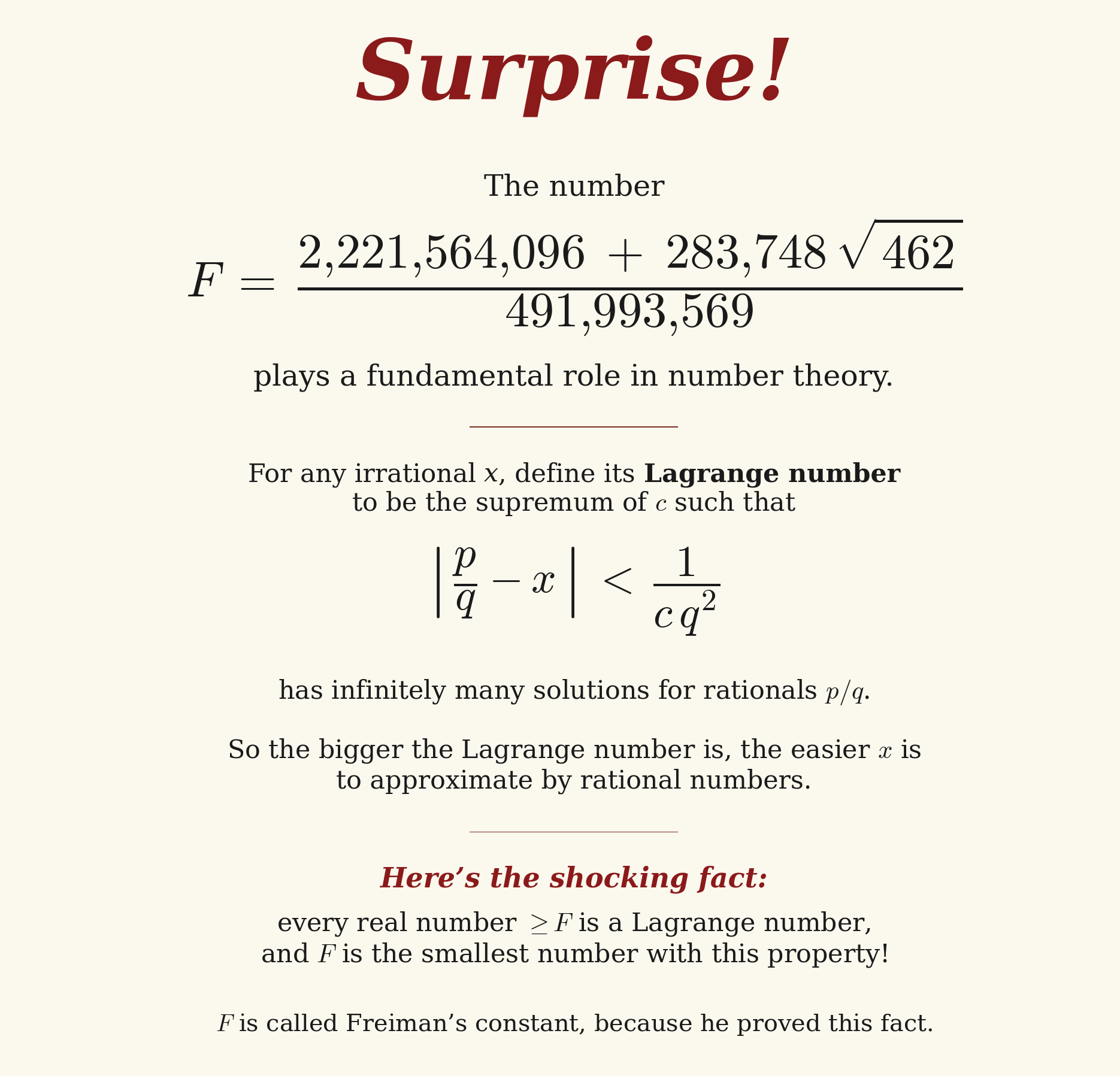
Here's my big recent surprise: the number
F = (2221564096 + 283748 sqrt(462)) / 491993569
plays a fundamental role in number theory!
For any irrational x, we define its 'Lagrange number' to be the supremum of c such that
|(p/q) - x| < 1/cq²
has infinitely many solutions for rationals p/q. So, the bigger the Lagrange number is, the easier x is to approximate by rational numbers. Quite famously, the golden ratio has the smallest possible Lagrange number, namely √5.
Here's the shocking fact: every real number ≥ F is a Lagrange number, and F is the smallest number with this property!
F is called 'Freiman's constant', because he proved this fact. His proof is 100 pages, and I don't want to read it... but some people have.
There's a lot more crazy stuff about the set of all Lagrange numbers. A tiny bit is here:
-
Here's my big recent surprise: the number
F = (2221564096 + 283748 sqrt(462)) / 491993569
plays a fundamental role in number theory!
For any irrational x, we define its 'Lagrange number' to be the supremum of c such that
|(p/q) - x| < 1/cq²
has infinitely many solutions for rationals p/q. So, the bigger the Lagrange number is, the easier x is to approximate by rational numbers. Quite famously, the golden ratio has the smallest possible Lagrange number, namely √5.
Here's the shocking fact: every real number ≥ F is a Lagrange number, and F is the smallest number with this property!
F is called 'Freiman's constant', because he proved this fact. His proof is 100 pages, and I don't want to read it... but some people have.
There's a lot more crazy stuff about the set of all Lagrange numbers. A tiny bit is here:
@johncarlosbaez
Somehow I missed this in the past. It's believable, but not particularly intuitive. -
What's the most surprising fact you've learned in the last couple of weeks? I don't mind if it's quite technical. I just want to hear what you folks are being surprised by!
@johncarlosbaez I learned in Korea recently that North Korea is much more worried about the influence of K-Culture (music, drama, etc) than about military interventions or poverty. And that (South) Korea is the number one per capita consumer of garlic.
-
Here's my big recent surprise: the number
F = (2221564096 + 283748 sqrt(462)) / 491993569
plays a fundamental role in number theory!
For any irrational x, we define its 'Lagrange number' to be the supremum of c such that
|(p/q) - x| < 1/cq²
has infinitely many solutions for rationals p/q. So, the bigger the Lagrange number is, the easier x is to approximate by rational numbers. Quite famously, the golden ratio has the smallest possible Lagrange number, namely √5.
Here's the shocking fact: every real number ≥ F is a Lagrange number, and F is the smallest number with this property!
F is called 'Freiman's constant', because he proved this fact. His proof is 100 pages, and I don't want to read it... but some people have.
There's a lot more crazy stuff about the set of all Lagrange numbers. A tiny bit is here:
@johncarlosbaez It looks like the continued fraction expansion of the Friedman constant has period 66754.

Simple continued fraction of Freiman's constant
The quadratic irrational $\frac{2221564096+283748\sqrt{462}}{491993569}$ is known as Freiman's constant and arises in the theory of continued fractions. I'm curious as to its simple continued frac...
MathOverflow (mathoverflow.net)
It would be nice if there is a geometric interpretation of this constant.
-
@saltywizard - I feel there should be YouTube videos about this....
@johncarlosbaez @saltywizard
Shhh don't tell anyone yet, but soon we will run a public experimental instance of @peertube at @tibhannover , inviting researchers to publish explain videos about virtually everything, spreading those right here on the Fediverse... So please keep your good ideas in mind! (TIB - same place where we run the full backup of arXiv etc) -
What's the most surprising fact you've learned in the last couple of weeks? I don't mind if it's quite technical. I just want to hear what you folks are being surprised by!
@johncarlosbaez Stretching the “couple of weeks” timeframe a bit, but I haven’t been able to stop thinking about the first paragraph of this article:
Katherine Rundell · Consider the Greenland Shark
I am glad not to be a Greenland shark; I don’t have enough thoughts to fill five hundred years. But I find the very...

London Review of Books (www.lrb.co.uk)
-
@johncarlosbaez I learned in Korea recently that North Korea is much more worried about the influence of K-Culture (music, drama, etc) than about military interventions or poverty. And that (South) Korea is the number one per capita consumer of garlic.
@jer_gib - both surprising! I wonder if the North Koreans would eat just as much garlic if they could afford it.
-
@johncarlosbaez Stretching the “couple of weeks” timeframe a bit, but I haven’t been able to stop thinking about the first paragraph of this article:
Katherine Rundell · Consider the Greenland Shark
I am glad not to be a Greenland shark; I don’t have enough thoughts to fill five hundred years. But I find the very...
London Review of Books (www.lrb.co.uk)
@normalmode - Wow! For those who don't click:
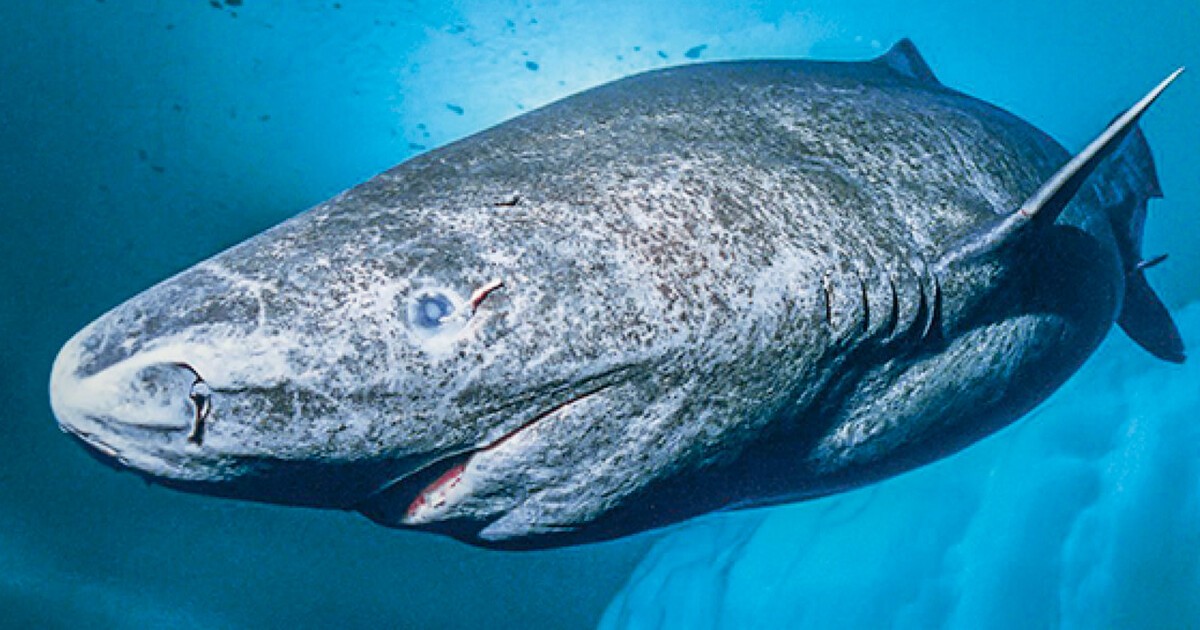
"In 1606 a devastating pestilence swept through London; the dying were boarded up in their homes with their families, and a decree went out that the theatres, the bear-baiting yards and the brothels be closed. It was then that Shakespeare wrote one of his very few references to the plague, catching at our precarity: ‘The dead man’s knell/Is there scarce asked for who, and good men’s lives/Expire before the flowers in their caps/Dying or ere they sicken.’ As he wrote, a Greenland shark who is still alive today swam untroubled through the waters of the northern seas. Its parents would have been old enough to have lived alongside Dante; its great-great-grandparents alongside Julius Caesar. For thousands of years Greenland sharks have swum in silence, as above them the world has burned, rebuilt, burned again."
-
@johncarlosbaez @saltywizard
Shhh don't tell anyone yet, but soon we will run a public experimental instance of @peertube at @tibhannover , inviting researchers to publish explain videos about virtually everything, spreading those right here on the Fediverse... So please keep your good ideas in mind! (TIB - same place where we run the full backup of arXiv etc)@Lambo - I like this idea a lot!
-
@jer_gib - both surprising! I wonder if the North Koreans would eat just as much garlic if they could afford it.
@johncarlosbaez @jer_gib north korean recipes actually tend to be less heavy on the garlic, although whether this predates their food shortages I'm not sure. I suspect it does though, and even a well-fed NK would not use as much, because the really famous strong-flavoured Korean food is more from southern regions like Jeolla-do.
-
@Lambo got here first with my top fact, so i'll go with this one:
transit operators in the u.s. are not authorized to question the pedigree of your 'service animal.'
as long as you identify the animal as such, you are permitted to bring it on the bus.
*any* animal.
@saltywizard @johncarlosbaez this is deeply misleading and materially harmful to legitimate service animal handlers. Business owners, public transit operators etc are legally allowed by federal law to ask "is that a service animal" and "what tasks has the animal been trained to perform" and they are allowed to deny access to animals that pose a threat or disruption to normal operations regardless of supposed certification or training. What animals are allowed to be used in public spaces as service animals varies somewhat by state. But "pedigree" matters not at all and is not germaine to an animal's service as an assistance animal in the same way that businesses cannot deny access to wheelchair users based on the manufacturer of their chairs. Proprietors of public spaces cannot say "your cane/chair is homemade so you cant use it in here". But if the assistive device is causing damage or other disruptions, the user can legally be asked to take it outside. Do better by the disabled than to spread harmful misinformarion based on shitty clickbait. @Lambo
-
What's the most surprising fact you've learned in the last couple of weeks? I don't mind if it's quite technical. I just want to hear what you folks are being surprised by!
@johncarlosbaez That there are unified formalisms for describing hybrids of reversible (eg. Hamiltonian) dynamics and irreversible dynamics (eg. friction) in which the role of energy (for the former) and entropy (for the latter) are formally very similar.
I'm not sure whether this is something deep or just a bit of bookkeeping for people writing simulations with the "entropy" being a useful fiction.
Eg. the metriplectic and GENERIC formalisms.
Anyway, you asked, so...
-
What's the most surprising fact you've learned in the last couple of weeks? I don't mind if it's quite technical. I just want to hear what you folks are being surprised by!
@johncarlosbaez Chromosomes often get knots in; and there are enzymes that among other things, unknot them.
-
@johncarlosbaez That distilled water is completely safe to drink (contrary to what I learned in school)!
@pschwahn @johncarlosbaez (putting on my chemist's hat) drinking distilled water is completely fine (and the osmosis thing mentioned in another response is utter bunk; by the time it's gone down the hatch, it would have some stuff dissolved in it that makes it less hypotonic). It's just that distilled water doesn't really taste all that good; it's the dissolved minerals and gases that make water tasty. (Personally, I find it slightly bitter.)
-
R relay@relay.infosec.exchange shared this topic