Lots of people talking about buying solar panels.
-
@vgarzareyna cos commercial solar panel efficiency is about 20%. Some manufacturers claim closer to 25%, but they typically lose some of that efficiency in the first few weeks of operation. As a ballpark for judging if a panel is too good to be true. 20% works and makes for easy maths.
@quixoticgeek that's really cool! thanks for the info. as I mentioned in a different response, i thought efficiency was way higher, but the cool part is we have a lot of margin for improvement
-
@quixoticgeek that's really cool! thanks for the info. as I mentioned in a different response, i thought efficiency was way higher, but the cool part is we have a lot of margin for improvement
@vgarzareyna we're doing better than photosynthesis. That's about 1% efficient...
-
@annantidote @disorderlyf No, there are standard test conditions for which panels are rated. As @quixoticgeek says it assumes insolation of 1 kW/m², also a specific spectrum of light (corresponding to a panel standing on flat dusty red ground in Texas with the sun at a particular elevation IIRC) and particular temperatures for the ambient air.
But, yes, panels can produce more than the “peak” output quoted. E.g., when a cloud has just blown away so the panel is cooler and therefore operating more efficiently and there's also more sunlight because of the reflections from the cloud just out of the line of sight. So “peak” would be better called ”nominal” output.
@edavies @disorderlyf @quixoticgeek i used to do solar (cells research), literally 30 years ago, and things changed. For the better. The yields nowadays are.. unexpected better than predicted back then, and oil companies buying solar companies did not kill solar.
While i did research on solar, i know very little on the hardware around it and prices and brands.
I see the kw price tumbling down and many exciting posts like this one, probably still below the cut line for me: i live in a rented flat in germany (sun, what is that?) so without possibility to feed the network, only feeding computers, fridge, radios, or batteries. If anybody wants to point me to a "get started" thing to read on conventional panel instalation, costs and what to buy (inverter? batteries?)
There used to be also these polymer solar cells with low yield that were light, translucid and good looking and one could use as curtains. Are they still around?
-
@edavies @disorderlyf @quixoticgeek i used to do solar (cells research), literally 30 years ago, and things changed. For the better. The yields nowadays are.. unexpected better than predicted back then, and oil companies buying solar companies did not kill solar.
While i did research on solar, i know very little on the hardware around it and prices and brands.
I see the kw price tumbling down and many exciting posts like this one, probably still below the cut line for me: i live in a rented flat in germany (sun, what is that?) so without possibility to feed the network, only feeding computers, fridge, radios, or batteries. If anybody wants to point me to a "get started" thing to read on conventional panel instalation, costs and what to buy (inverter? batteries?)
There used to be also these polymer solar cells with low yield that were light, translucid and good looking and one could use as curtains. Are they still around?
@edavies @disorderlyf @quixoticgeek i actually never checked the real insolation in berlin for a fact. Never bothered becausevshort days in the winter and shitty cloudy weather in the summer. Will do now.
Edit: leave it here (global) for whoever needs.
Edit 2: expected much worse.
Global Solar Atlas
The Global Solar Atlas provides a summary of solar power potential and solar resources globally. It is provided by the World Bank Group as a free service to governments, developers and the general public, and allows users to quickly obtain data and carry out a simple electricity output calculation for any location covered by the solar resource database.
(globalsolaratlas.info)
-
@edavies @disorderlyf @quixoticgeek i used to do solar (cells research), literally 30 years ago, and things changed. For the better. The yields nowadays are.. unexpected better than predicted back then, and oil companies buying solar companies did not kill solar.
While i did research on solar, i know very little on the hardware around it and prices and brands.
I see the kw price tumbling down and many exciting posts like this one, probably still below the cut line for me: i live in a rented flat in germany (sun, what is that?) so without possibility to feed the network, only feeding computers, fridge, radios, or batteries. If anybody wants to point me to a "get started" thing to read on conventional panel instalation, costs and what to buy (inverter? batteries?)
There used to be also these polymer solar cells with low yield that were light, translucid and good looking and one could use as curtains. Are they still around?
@annantidote @edavies @disorderlyf you're in Germany? Goto IKEA. No really. You can get plugging balcony solar installs from IKEA. I believe even Lidl/Aldi offer something similar. Max is 800w. So you're not going full solar independence, but it can offset some usage.
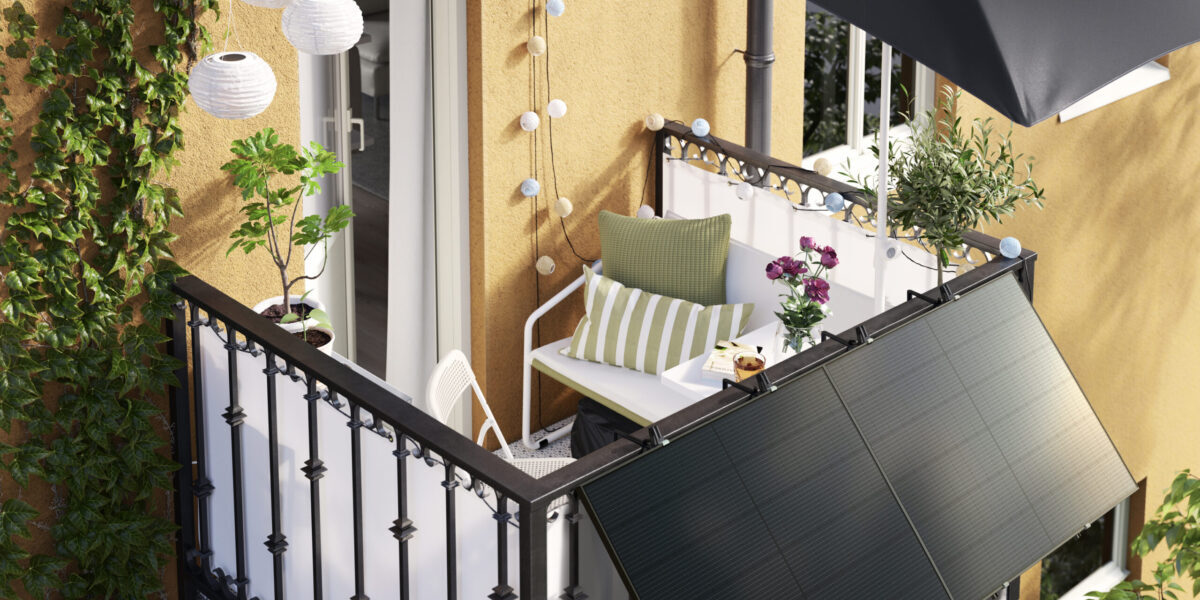
Ikea begins offering balcony solar kits
Swedish furniture retailer Ikea is selling plug-in solar kits in Germany, with storage-inclusive systems starting at €1,229 ($1,425) and reaching €2,800 for versions featuring four 520 W panels. The kits are designed for residential self-consumption and vary by capacity and configuration.
pv magazine International (www.pv-magazine.com)
-
@TerryBTwo it depends a lot on what your usage is like, how big a battery you can afford, do you want to charge an EV? Power a heat pump? Etc... There's a lot of variables. I think with a modern solar install, the average household is likely to pay back a suitable solar install in 3-5 years. But it does depend a lot. Gone are the days where ROI was double digits years.
@quixoticgeek For our panels it’s a fairly simple equation. What we used to use in mains electricity compared to what we can realistically get from solar + what we can earn in selling back. But the battery is a much more complex estimate. The problem is that second value- an estimate of how much annual generation is realistic.
-
@annantidote @edavies @disorderlyf you're in Germany? Goto IKEA. No really. You can get plugging balcony solar installs from IKEA. I believe even Lidl/Aldi offer something similar. Max is 800w. So you're not going full solar independence, but it can offset some usage.
Ikea begins offering balcony solar kits
Swedish furniture retailer Ikea is selling plug-in solar kits in Germany, with storage-inclusive systems starting at €1,229 ($1,425) and reaching €2,800 for versions featuring four 520 W panels. The kits are designed for residential self-consumption and vary by capacity and configuration.
pv magazine International (www.pv-magazine.com)
@quixoticgeek @annantidote @edavies British Columbia, Canada. There's an Ikea either in or around Vancouver, I forget where, but it's close enough to me that getting things shipped from there is trivial.
-
@quixoticgeek @annantidote @edavies British Columbia, Canada. There's an Ikea either in or around Vancouver, I forget where, but it's close enough to me that getting things shipped from there is trivial.
@disorderlyf @quixoticgeek @annantidote @edavies
The regulations for "balcony solar" in Canada might be different to Germany.

Plug-in balcony solar panels could mean cheaper power. But Canada needs to get on board first | CBC News
How would you like to lower your electricity bill and help power your home using an abundant renewable energy source — the sun? There is an affordable, do-it-yourself solution for people who own houses, apartment renters and condo dwellers, that doesn't cost buckets of money or require any sort of tedious installation. But, it's not widely available or permitted in Canada yet.
CBC (www.cbc.ca)
-
@quixoticgeek that's really cool! thanks for the info. as I mentioned in a different response, i thought efficiency was way higher, but the cool part is we have a lot of margin for improvement
Depends.

The theoretical maximum efficiency for a single layer silicon solar cell is about 32%. So getting a 23-24% efficiency isn't bad.
https://en.wikipedia.org/wiki/Shockley%E2%80%93Queisser_limit
-
@disorderlyf @quixoticgeek @annantidote @edavies
The regulations for "balcony solar" in Canada might be different to Germany.
Plug-in balcony solar panels could mean cheaper power. But Canada needs to get on board first | CBC News
How would you like to lower your electricity bill and help power your home using an abundant renewable energy source — the sun? There is an affordable, do-it-yourself solution for people who own houses, apartment renters and condo dwellers, that doesn't cost buckets of money or require any sort of tedious installation. But, it's not widely available or permitted in Canada yet.
CBC (www.cbc.ca)
@billiglarper @quixoticgeek @annantidote @edavies Basically, what I want to do is instead of it hanging out from the window, I want it to be affixed to the window from the inside and have the panel directly plugged into what I've seen referred to as a "solid state generator". My understanding is I don't need anything other than permission from my landlord and I've already floated the idea by them and their response was more or less as long as I don't affix it with anything that would damage the windowsill, like nails.
-
@billiglarper @quixoticgeek @annantidote @edavies Basically, what I want to do is instead of it hanging out from the window, I want it to be affixed to the window from the inside and have the panel directly plugged into what I've seen referred to as a "solid state generator". My understanding is I don't need anything other than permission from my landlord and I've already floated the idea by them and their response was more or less as long as I don't affix it with anything that would damage the windowsill, like nails.
@disorderlyf @billiglarper @annantidote @edavies Inside a window, assume 50% losses over the rated max power of the panel.
-
@disorderlyf @billiglarper @annantidote @edavies Inside a window, assume 50% losses over the rated max power of the panel.
@quixoticgeek @billiglarper @annantidote @edavies It's sounding like until solar balconies are more of a thing here, it's not useful to me for more than a backup source of power in an emergency.
-
@quixoticgeek Are you saying solar panel manufacturers are underreporting the max wattage of their panels? Because when I read the first part of this, I assumed you meant the inverse
@disorderlyf probably this panel is just less than 20% efficient (300 watts is power of the sun on that area)
-
@BoydStephenSmithJr @quixoticgeek That's the approximate peak illumination at the peak of the day. 9am-3pm have reasonable illumination but most commercial panels have efficiencies in the low 20 percent it's a reasonable way of telling if they're bullshitting. You probably won't get that much because of the effect of heat on efficiency mind you.
@ariaflame @BoydStephenSmithJr @quixoticgeek
Ireland
We get close to rated o/p on a sunny day May to August, peak in June / July.December and Jan you need a smart meter, at least 15 kWH of batteries and charge at night. About 1/20th output then.
I might get 35 to 50W from a pair of 100W transportable panels on a good March / April day 10 am to 3 pm.
The main panels are all "200 W". We can see the W/sq m on our weather station and that is an accurate guide if the batteries are not full.
-
@vgarzareyna cos commercial solar panel efficiency is about 20%. Some manufacturers claim closer to 25%, but they typically lose some of that efficiency in the first few weeks of operation. As a ballpark for judging if a panel is too good to be true. 20% works and makes for easy maths.
@quixoticgeek @vgarzareyna
I doubt any single sides panel at summer temps is more than 22%. The 19% to 21% is realistic.There are double sided panels (no opaque back) which can make it seem like more than 21%,
It's physics. Note voltage is much higher if bright & -20 °C and batteries charged. Do the sum and make sure the MPPT doesn't have over voltage! Voltage drops with load and rising temperature.
-
Lots of people talking about buying solar panels. Alas if you look online there's a lot of retailers with all sorts of panels for sale, not all of which are honest. Want an easy way to check if the listed power output is plausible?
Example using a 50w panel listed on Amazon. It's 370x820mm.
Step 1 calculate the area in square meters. (0.37*0.82=0.3034)
Step 2 multiply by 1000w. (0.3034*1000=303.4)
Step 3 assume 20% efficiency and multiply (303.4x0.2=60.68)60.68>50w. It's Plausible.
another way of saying this
there are about 200W/square meterwhich for those of us with rudimentary math, is a lot cleaner expression ??
-
another way of saying this
there are about 200W/square meterwhich for those of us with rudimentary math, is a lot cleaner expression ??
@failedLyndonLaRouchite yep. But if I jump to that, someone will moan.
-
@failedLyndonLaRouchite yep. But if I jump to that, someone will moan.
oh god, that is so true . .
-
@quixoticgeek @billiglarper @annantidote @edavies It's sounding like until solar balconies are more of a thing here, it's not useful to me for more than a backup source of power in an emergency.
@disorderlyf @quixoticgeek @billiglarper @annantidote @edavies
Ours is actually a Solar and grid charged UPS.
We run all the core stuff, 3x freezers, big fridge, server, WAN/LAN/Satellite, PCs etc 24x7 off it. No feed to grid, so no cert or smart meter. We have a dumb meter & pay cash when the bill arrives.
In emergency we can swap plug socket and finish wash cycle of clothes or dishes, or even add airfry/uWave.
Halved the bill.
Save more in winter if smart meter by charge at night for daytime. -
Lots of people talking about buying solar panels. Alas if you look online there's a lot of retailers with all sorts of panels for sale, not all of which are honest. Want an easy way to check if the listed power output is plausible?
Example using a 50w panel listed on Amazon. It's 370x820mm.
Step 1 calculate the area in square meters. (0.37*0.82=0.3034)
Step 2 multiply by 1000w. (0.3034*1000=303.4)
Step 3 assume 20% efficiency and multiply (303.4x0.2=60.68)60.68>50w. It's Plausible.
@quixoticgeek Great post. Distilling info into self-contained useful advice is a rare skill.