We like animals.
-
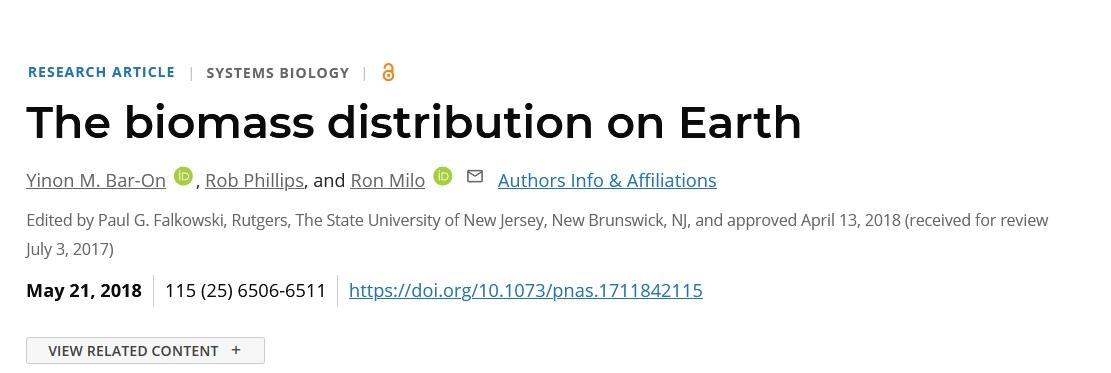
We like animals. But the entire animal kingdom - every insect, fish, bird, mammal, worm, crustacean, etc. - counts for less than 0.4% of global biomass!
 By mass, plants rule.
 Plants: ~450 gigatonnes of carbon
Bacteria: ~70 Gt C
Fungi: ~12 Gt C
Archaea: ~7 Gt C
Protists: ~4 Gt C
Animals: ~2 Gt C -
We like animals. But the entire animal kingdom - every insect, fish, bird, mammal, worm, crustacean, etc. - counts for less than 0.4% of global biomass!
By mass, plants rule. Plants: ~450 gigatonnes of carbon
Bacteria: ~70 Gt C
Fungi: ~12 Gt C
Archaea: ~7 Gt C
Protists: ~4 Gt C
Animals: ~2 Gt C@johncarlosbaez
By coincidence, yesterday I asked Claude about the most common form of life.By Number of Individuals: Bacteria (domain Prokaryota) dwarf everything else on Earth. Estimates put the total number of bacterial cells at around 10³⁰ (one nonillion) — that's more than the number of stars in the observable universe.
But viruses outnumber bacterial cells 10 to 1.
-
We like animals. But the entire animal kingdom - every insect, fish, bird, mammal, worm, crustacean, etc. - counts for less than 0.4% of global biomass!
By mass, plants rule. Plants: ~450 gigatonnes of carbon
Bacteria: ~70 Gt C
Fungi: ~12 Gt C
Archaea: ~7 Gt C
Protists: ~4 Gt C
Animals: ~2 Gt C@johncarlosbaez makes sense, since animals have evolved possibly the most effective methods for *consuming* other biomass.
-
@johncarlosbaez
By coincidence, yesterday I asked Claude about the most common form of life.By Number of Individuals: Bacteria (domain Prokaryota) dwarf everything else on Earth. Estimates put the total number of bacterial cells at around 10³⁰ (one nonillion) — that's more than the number of stars in the observable universe.
But viruses outnumber bacterial cells 10 to 1.
@BartoszMilewski - There are so many viruses that they don't need to be individually smart to evolve around our defense systems. Luckily most of them are focused on eating bacteria, especially in the oceans.
-
@johncarlosbaez
By coincidence, yesterday I asked Claude about the most common form of life.By Number of Individuals: Bacteria (domain Prokaryota) dwarf everything else on Earth. Estimates put the total number of bacterial cells at around 10³⁰ (one nonillion) — that's more than the number of stars in the observable universe.
But viruses outnumber bacterial cells 10 to 1.
Pelagibacter communis could be one of the most common ones:
https://en.wikipedia.org/wiki/Pelagibacter_communis -
R relay@relay.infosec.exchange shared this topic