Skip to content
  • Categories
  • Recent
  • Tags
  • Popular
  • World
  • Users
  • Groups
Skins
  • Light
  • Brite
  • Cerulean
  • Cosmo
  • Flatly
  • Journal
  • Litera
  • Lumen
  • Lux
  • Materia
  • Minty
  • Morph
  • Pulse
  • Sandstone
  • Simplex
  • Sketchy
  • Spacelab
  • United
  • Yeti
  • Zephyr
  • Dark
  • Cyborg
  • Darkly
  • Quartz
  • Slate
  • Solar
  • Superhero
  • Vapor

  • Default (Cyborg)
  • No Skin
Collapse
Brand Logo

CIRCLE WITH A DOT

  1. Home
  2. Uncategorized
  3. ‪We like animals.

‪We like animals.

Scheduled Pinned Locked Moved Uncategorized
5 Posts 4 Posters 0 Views
  • Oldest to Newest
  • Newest to Oldest
  • Most Votes
Reply
  • Reply as topic
Log in to reply
This topic has been deleted. Only users with topic management privileges can see it.
  • johncarlosbaez@mathstodon.xyzJ This user is from outside of this forum
    johncarlosbaez@mathstodon.xyzJ This user is from outside of this forum
    johncarlosbaez@mathstodon.xyz
    wrote last edited by
    #1

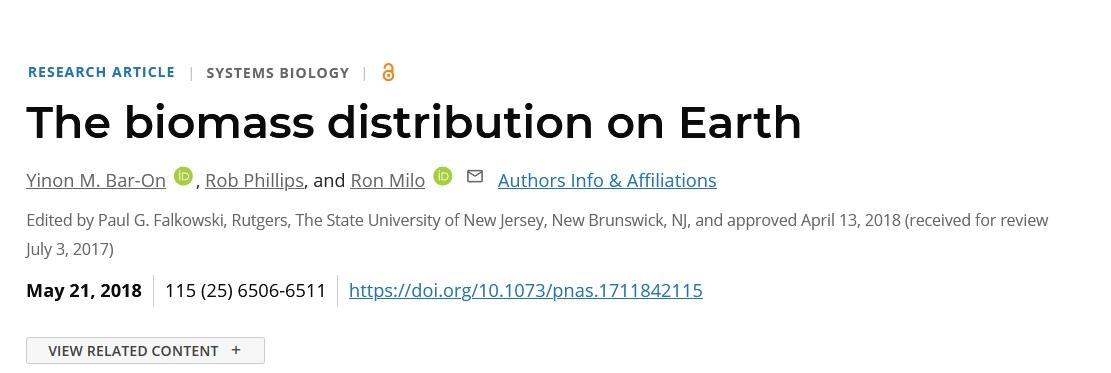
    ‪We like animals. But the entire animal kingdom - every insect, fish, bird, mammal, worm, crustacean, etc. - counts for less than 0.4% of global biomass!

    🌱 By mass, plants rule. 🌱

    Plants: ~450 gigatonnes of carbon
    Bacteria: ~70 Gt C
    Fungi: ~12 Gt C
    Archaea: ~7 Gt C
    Protists: ~4 Gt C
    Animals: ~2 Gt C

    https://doi.org/10.1073/pnas.1711842115

    bartoszmilewski@mathstodon.xyzB zenben@c.imZ 2 Replies Last reply
    1
    0
    • johncarlosbaez@mathstodon.xyzJ johncarlosbaez@mathstodon.xyz

      ‪We like animals. But the entire animal kingdom - every insect, fish, bird, mammal, worm, crustacean, etc. - counts for less than 0.4% of global biomass!

      🌱 By mass, plants rule. 🌱

      Plants: ~450 gigatonnes of carbon
      Bacteria: ~70 Gt C
      Fungi: ~12 Gt C
      Archaea: ~7 Gt C
      Protists: ~4 Gt C
      Animals: ~2 Gt C

      https://doi.org/10.1073/pnas.1711842115

      bartoszmilewski@mathstodon.xyzB This user is from outside of this forum
      bartoszmilewski@mathstodon.xyzB This user is from outside of this forum
      bartoszmilewski@mathstodon.xyz
      wrote last edited by
      #2

      @johncarlosbaez
      By coincidence, yesterday I asked Claude about the most common form of life.

      By Number of Individuals: Bacteria (domain Prokaryota) dwarf everything else on Earth. Estimates put the total number of bacterial cells at around 10³⁰ (one nonillion) — that's more than the number of stars in the observable universe.

      But viruses outnumber bacterial cells 10 to 1.

      johncarlosbaez@mathstodon.xyzJ leonardom@mathstodon.xyzL 2 Replies Last reply
      0
      • johncarlosbaez@mathstodon.xyzJ johncarlosbaez@mathstodon.xyz

        ‪We like animals. But the entire animal kingdom - every insect, fish, bird, mammal, worm, crustacean, etc. - counts for less than 0.4% of global biomass!

        🌱 By mass, plants rule. 🌱

        Plants: ~450 gigatonnes of carbon
        Bacteria: ~70 Gt C
        Fungi: ~12 Gt C
        Archaea: ~7 Gt C
        Protists: ~4 Gt C
        Animals: ~2 Gt C

        https://doi.org/10.1073/pnas.1711842115

        zenben@c.imZ This user is from outside of this forum
        zenben@c.imZ This user is from outside of this forum
        zenben@c.im
        wrote last edited by
        #3

        @johncarlosbaez makes sense, since animals have evolved possibly the most effective methods for *consuming* other biomass.

        1 Reply Last reply
        0
        • bartoszmilewski@mathstodon.xyzB bartoszmilewski@mathstodon.xyz

          @johncarlosbaez
          By coincidence, yesterday I asked Claude about the most common form of life.

          By Number of Individuals: Bacteria (domain Prokaryota) dwarf everything else on Earth. Estimates put the total number of bacterial cells at around 10³⁰ (one nonillion) — that's more than the number of stars in the observable universe.

          But viruses outnumber bacterial cells 10 to 1.

          johncarlosbaez@mathstodon.xyzJ This user is from outside of this forum
          johncarlosbaez@mathstodon.xyzJ This user is from outside of this forum
          johncarlosbaez@mathstodon.xyz
          wrote last edited by
          #4

          @BartoszMilewski - There are so many viruses that they don't need to be individually smart to evolve around our defense systems. Luckily most of them are focused on eating bacteria, especially in the oceans.

          1 Reply Last reply
          0
          • bartoszmilewski@mathstodon.xyzB bartoszmilewski@mathstodon.xyz

            @johncarlosbaez
            By coincidence, yesterday I asked Claude about the most common form of life.

            By Number of Individuals: Bacteria (domain Prokaryota) dwarf everything else on Earth. Estimates put the total number of bacterial cells at around 10³⁰ (one nonillion) — that's more than the number of stars in the observable universe.

            But viruses outnumber bacterial cells 10 to 1.

            leonardom@mathstodon.xyzL This user is from outside of this forum
            leonardom@mathstodon.xyzL This user is from outside of this forum
            leonardom@mathstodon.xyz
            wrote last edited by
            #5

            @BartoszMilewski

            Pelagibacter communis could be one of the most common ones:
            https://en.wikipedia.org/wiki/Pelagibacter_communis

            1 Reply Last reply
            0
            • R relay@relay.infosec.exchange shared this topic

            Reply
            • Reply as topic
            Log in to reply
            • Oldest to Newest
            • Newest to Oldest
            • Most Votes


            • Login

            • Login or register to search.
            • First post
              Last post
            0
            • Categories
            • Recent
            • Tags
            • Popular
            • World
            • Users
            • Groups