Skip to content
  • Categories
  • Recent
  • Tags
  • Popular
  • World
  • Users
  • Groups
Skins
  • Light
  • Brite
  • Cerulean
  • Cosmo
  • Flatly
  • Journal
  • Litera
  • Lumen
  • Lux
  • Materia
  • Minty
  • Morph
  • Pulse
  • Sandstone
  • Simplex
  • Sketchy
  • Spacelab
  • United
  • Yeti
  • Zephyr
  • Dark
  • Cyborg
  • Darkly
  • Quartz
  • Slate
  • Solar
  • Superhero
  • Vapor

  • Default (Cyborg)
  • No Skin
Collapse
Brand Logo

CIRCLE WITH A DOT

  1. Home
  2. Uncategorized
  3. Don't make me regret this ...

Don't make me regret this ...

Scheduled Pinned Locked Moved Uncategorized
92 Posts 26 Posters 0 Views
  • Oldest to Newest
  • Newest to Oldest
  • Most Votes
Reply
  • Reply as topic
Log in to reply
This topic has been deleted. Only users with topic management privileges can see it.
  • colinthemathmo@mathstodon.xyzC colinthemathmo@mathstodon.xyz

    Don't make me regret this ...

    I'm thinking of making a timeline of characters and events from history that school children might know of and be interested in. Most timelines you find are overly complex, or overly simplistic.

    Who and what would you include?

    I'm interested in connecting science people with historical context, and pulling in non-(old dead white dude)s.

    1/n

    mpark@mathstodon.xyzM This user is from outside of this forum
    mpark@mathstodon.xyzM This user is from outside of this forum
    mpark@mathstodon.xyz
    wrote last edited by
    #21

    @ColinTheMathmo Top two I don't see on your list -

    Hypatia (feminism, science vs religion)
    Eratosthenes (I get so sick of hearing that Columbus proved the Earth was round)

    1 Reply Last reply
    0
    • colinthemathmo@mathstodon.xyzC colinthemathmo@mathstodon.xyz

      This list has mostly (but not entirely!) exactly them, but here are a few.

      Which of your favourites are missing? In particular, what major historical events would school children know, to allow these to be put into some sort of historical context?

      And yes, I am thinking of asking some school kids for "Famous Things".

      Galileo
      Nelson (Trafalgar)
      Wellington (Waterloo)
      Newton
      Macchiavelli
      Shakespeare
      Pythagoras
      Socrates
      Plato
      Aristotle
      Alexander the Great
      Archimedes
      Al-Khwarizmi
      Ibn Al-Haytham
      Babbage
      Turing
      Omar Khayyam
      Jabir Ibn Haiyan
      Ramanujan

      2/n

      spacemagick@mastodon.socialS This user is from outside of this forum
      spacemagick@mastodon.socialS This user is from outside of this forum
      spacemagick@mastodon.social
      wrote last edited by
      #22

      @ColinTheMathmo
      The guy who made stripy pyjamas cool.
      #maths

      Link Preview Image
      1 Reply Last reply
      0
      • colinthemathmo@mathstodon.xyzC colinthemathmo@mathstodon.xyz

        Don't make me regret this ...

        I'm thinking of making a timeline of characters and events from history that school children might know of and be interested in. Most timelines you find are overly complex, or overly simplistic.

        Who and what would you include?

        I'm interested in connecting science people with historical context, and pulling in non-(old dead white dude)s.

        1/n

        M This user is from outside of this forum
        M This user is from outside of this forum
        mathematicalsynesthesia@hachyderm.io
        wrote last edited by
        #23

        @ColinTheMathmo Colin, I teach a course at my institution called “Hi(dden)story of Mathematics” and I would be happy to share the outline of my course (and even some notes) and you could adapt some of it for your purposes.

        The course is divided into units.

        Unit 1 relates to ways in which our ancestors counted. We discussed the Babylonian (base 60) enumeration system, the Roman numerals, the Maya numerals (base 20), the Inca quipu (knot counting) and yupana (Inca abacus/calculator) the enumeration system of the ancient people of India, how it was adapted by the Arabs and the abacus and the Chinese counting rods.

        Unit 2 relates to how ancient cultures develop ways to measure time (why does a circle have 360 degrees) along with storytelling exploring the significance/mysticism surrounding the numbers 7 and 12 (twelve tribes in Israel, twelve disciples of Jesus, twelve gods living in Olympus, twelve animals running the race for the jade emperor, twelve sons of Ishmael) why 13 is unlucky in Europe but not elsewhere, and how 13 is a sacred number instead for the Maya and the Egyptians for example. We also discuss the Maya calendar, the Jewish calendar and discuss how to convert between dates in those calendars and the Gregorian one.

        Unit 3 relates to the origins on combinatorics and we discuss Acharya Pingala’s rules for enumerating verse structures in Sanskrit and realize Pingala described the binary enumerating system, the binomial coefficients and the Fibonacci numbers all based on verse structure of poetry. We connect this discovery (which happened in 400 BCE) to Fibonacci’s liber abaci and Blaise Pascal’s triangle and have a discussion on why we call them today Pascal’s triangle and Fibonacci numbers instead of Pingala’s triangle and numbers. In the end we decide that we should call them the Fibonacci-Pingala numbers and the Pascal-Pingala triangle (this eventually gets further renamed to Khayam-Pascal-Pingala triangle)

        I will continue later…

        colinthemathmo@mathstodon.xyzC 1 Reply Last reply
        0
        • kat@is.burntout.orgK kat@is.burntout.org

          @ColinTheMathmo

          Emmy Noether ?

          robertjackson58585858@masto.aiR This user is from outside of this forum
          robertjackson58585858@masto.aiR This user is from outside of this forum
          robertjackson58585858@masto.ai
          wrote last edited by
          #24

          @kat @ColinTheMathmo

          Absolutely!!

          Emma Noether!

          1 Reply Last reply
          0
          • colinthemathmo@mathstodon.xyzC colinthemathmo@mathstodon.xyz

            Don't make me regret this ...

            I'm thinking of making a timeline of characters and events from history that school children might know of and be interested in. Most timelines you find are overly complex, or overly simplistic.

            Who and what would you include?

            I'm interested in connecting science people with historical context, and pulling in non-(old dead white dude)s.

            1/n

            xanna@mastodon.ieX This user is from outside of this forum
            xanna@mastodon.ieX This user is from outside of this forum
            xanna@mastodon.ie
            wrote last edited by
            #25

            @ColinTheMathmo names like artists and composers come up all the time with no inherent way to connect them to an era. I'd pop Mozart, Bach, Van Gogh, Picasso etc etc on there, since kids (and adults) are still expected to know who they are without anyone bothering to tell them.

            colinthemathmo@mathstodon.xyzC 1 Reply Last reply
            0
            • colinthemathmo@mathstodon.xyzC colinthemathmo@mathstodon.xyz

              Don't make me regret this ...

              I'm thinking of making a timeline of characters and events from history that school children might know of and be interested in. Most timelines you find are overly complex, or overly simplistic.

              Who and what would you include?

              I'm interested in connecting science people with historical context, and pulling in non-(old dead white dude)s.

              1/n

              pascaline@mastodon.nlP This user is from outside of this forum
              pascaline@mastodon.nlP This user is from outside of this forum
              pascaline@mastodon.nl
              wrote last edited by
              #26

              @ColinTheMathmo

              I see Grace Hopper and Ada Lovelace are already mentioned, but not Melba Roy Mouton yet.

              colinthemathmo@mathstodon.xyzC 1 Reply Last reply
              0
              • colinthemathmo@mathstodon.xyzC This user is from outside of this forum
                colinthemathmo@mathstodon.xyzC This user is from outside of this forum
                colinthemathmo@mathstodon.xyz
                wrote last edited by
                #27

                @mike Ooo ... nice one.

                The classic "nano-second"

                1 Reply Last reply
                0
                • e7_87@mathstodon.xyzE e7_87@mathstodon.xyz

                  @ColinTheMathmo Oh I keep getting "pop" sounds from Mastodon... This is a hot thread. 😀
                  ---
                  For ancient mathematics, I would choose these 6 events/concepts, which some non-western heroes appeared:

                  * π (See Zu Chongzhi 429-500 from ancient China, https://en.wikipedia.org/wiki/Liu_Hui%27s_%CF%80_algorithm)

                  * Quadratic Equation (many non-western mathematicians worked out the quadratic formula)

                  * Zeno's paradoxes ( you can see some mentions of Chinese philosophers on https://en.wikipedia.org/wiki/Zeno's_paradoxes#Similar_paradoxes )

                  * Prime Numbers

                  * trigonometry (https://en.wikipedia.org/wiki/History_of_trigonometry)

                  * Euclid's 'Elements' (have to say it is a great work in human math history)

                  I think a grand human history is hard not to be biased, so why not first test on our specialization and leave behind "Macchiavelli", "Shakespeare", "Alexander the Great", ....

                  ---

                  Let me have some time for a partial list of important modern female heroines (and important non-binary)! 😀

                  colinthemathmo@mathstodon.xyzC This user is from outside of this forum
                  colinthemathmo@mathstodon.xyzC This user is from outside of this forum
                  colinthemathmo@mathstodon.xyz
                  wrote last edited by
                  #28

                  @e7_87 I'd like to have "Well known characters" included to help some people make the cross-connections.

                  Knowing that X was at the same time as Y can be a useful connection.

                  Example: Knowing that Alexander the Great was tutored by Aristotle, and that Aristotle was in Plato's Academy, is a nice connection.

                  e7_87@mathstodon.xyzE 2 Replies Last reply
                  0
                  • xanna@mastodon.ieX xanna@mastodon.ie

                    @ColinTheMathmo names like artists and composers come up all the time with no inherent way to connect them to an era. I'd pop Mozart, Bach, Van Gogh, Picasso etc etc on there, since kids (and adults) are still expected to know who they are without anyone bothering to tell them.

                    colinthemathmo@mathstodon.xyzC This user is from outside of this forum
                    colinthemathmo@mathstodon.xyzC This user is from outside of this forum
                    colinthemathmo@mathstodon.xyz
                    wrote last edited by
                    #29

                    @xanna Exactly ... helping kids understand something of the connections between names they know, and names they could know, is part of the aim.

                    Thank you ...

                    1 Reply Last reply
                    0
                    • colinthemathmo@mathstodon.xyzC This user is from outside of this forum
                      colinthemathmo@mathstodon.xyzC This user is from outside of this forum
                      colinthemathmo@mathstodon.xyz
                      wrote last edited by
                      #30

                      @mike 😆

                      1 Reply Last reply
                      0
                      • colinthemathmo@mathstodon.xyzC This user is from outside of this forum
                        colinthemathmo@mathstodon.xyzC This user is from outside of this forum
                        colinthemathmo@mathstodon.xyz
                        wrote last edited by
                        #31

                        @vulturus Absolutely Emmy Noether.

                        1 Reply Last reply
                        0
                        • colinthemathmo@mathstodon.xyzC colinthemathmo@mathstodon.xyz

                          Don't make me regret this ...

                          I'm thinking of making a timeline of characters and events from history that school children might know of and be interested in. Most timelines you find are overly complex, or overly simplistic.

                          Who and what would you include?

                          I'm interested in connecting science people with historical context, and pulling in non-(old dead white dude)s.

                          1/n

                          ompaul@mathstodon.xyzO This user is from outside of this forum
                          ompaul@mathstodon.xyzO This user is from outside of this forum
                          ompaul@mathstodon.xyz
                          wrote last edited by
                          #32

                          @ColinTheMathmo Sophie Germain, Sofya Vasilievna Kovalevskaya

                          1 Reply Last reply
                          0
                          • colinthemathmo@mathstodon.xyzC colinthemathmo@mathstodon.xyz

                            Don't make me regret this ...

                            I'm thinking of making a timeline of characters and events from history that school children might know of and be interested in. Most timelines you find are overly complex, or overly simplistic.

                            Who and what would you include?

                            I'm interested in connecting science people with historical context, and pulling in non-(old dead white dude)s.

                            1/n

                            ompaul@mathstodon.xyzO This user is from outside of this forum
                            ompaul@mathstodon.xyzO This user is from outside of this forum
                            ompaul@mathstodon.xyz
                            wrote last edited by
                            #33

                            @ColinTheMathmo this thread contains three brilliant stories and if you include the mathematics it is amazing

                            ompaul@mathstodon.xyzO 1 Reply Last reply
                            0
                            • pascaline@mastodon.nlP pascaline@mastodon.nl

                              @ColinTheMathmo

                              I see Grace Hopper and Ada Lovelace are already mentioned, but not Melba Roy Mouton yet.

                              colinthemathmo@mathstodon.xyzC This user is from outside of this forum
                              colinthemathmo@mathstodon.xyzC This user is from outside of this forum
                              colinthemathmo@mathstodon.xyz
                              wrote last edited by
                              #34

                              @pascaline Good shout:

                              Melba Roy Mouton
                              Katherine Johnson
                              Dorothy Vaughan
                              Mary Jackson

                              But the problem becomes one of the timeline and database becoming "too complete", and hence "overly complex" and thereby effectively inaccessible.

                              But absolutely, if choices are to be made, these people should be close to the top.

                              pascaline@mastodon.nlP 1 Reply Last reply
                              0
                              • colinthemathmo@mathstodon.xyzC colinthemathmo@mathstodon.xyz

                                Don't make me regret this ...

                                I'm thinking of making a timeline of characters and events from history that school children might know of and be interested in. Most timelines you find are overly complex, or overly simplistic.

                                Who and what would you include?

                                I'm interested in connecting science people with historical context, and pulling in non-(old dead white dude)s.

                                1/n

                                davidsuculum@mathstodon.xyzD This user is from outside of this forum
                                davidsuculum@mathstodon.xyzD This user is from outside of this forum
                                davidsuculum@mathstodon.xyz
                                wrote last edited by
                                #35

                                @ColinTheMathmo Omar Khayyam, mathematician and author of the great poem "Rubaiyat". I love how he tried to solve the algebraic 3rd degree equation, failed, but recognised that someone would do it in the future. In "Samarkanda", by Amin Maalouf, he's one of the main characters, I recommend that book as well.

                                1 Reply Last reply
                                0
                                • colinthemathmo@mathstodon.xyzC colinthemathmo@mathstodon.xyz

                                  To some extent, I'd like people in general, children in particular, to hear of someone, then be able to put them into context.

                                  I think this is an impossible task, so in some senses I'm looking to see why and how it's impossible, perhaps then to decrease the scope and ambition, possibly to make something useful.

                                  Eventually.

                                  4/n, n=4

                                  teakayb@mathstodon.xyzT This user is from outside of this forum
                                  teakayb@mathstodon.xyzT This user is from outside of this forum
                                  teakayb@mathstodon.xyz
                                  wrote last edited by
                                  #36

                                  @ColinTheMathmo
                                  Eratosthenes' prime number sieve is a common teaching tool in British schools, though mention of that name is less common.

                                  Florence Nightingale is someone that almost every schoolchild in the UK knows of, though vanishingly few encounter her as a mathematical figure.

                                  The 'Rhind' papyrus is one of the mathematical historical objects that is more likely to be encountered by folk who do not consider themselves as 'maths people'. That presents an opportunity to discuss whether there might be better ways to name such things, and introduce them to Ahmes.

                                  teakayb@mathstodon.xyzT 1 Reply Last reply
                                  0
                                  • colinthemathmo@mathstodon.xyzC colinthemathmo@mathstodon.xyz

                                    Don't make me regret this ...

                                    I'm thinking of making a timeline of characters and events from history that school children might know of and be interested in. Most timelines you find are overly complex, or overly simplistic.

                                    Who and what would you include?

                                    I'm interested in connecting science people with historical context, and pulling in non-(old dead white dude)s.

                                    1/n

                                    brunogirin@mastodon.me.ukB This user is from outside of this forum
                                    brunogirin@mastodon.me.ukB This user is from outside of this forum
                                    brunogirin@mastodon.me.uk
                                    wrote last edited by
                                    #37

                                    @ColinTheMathmo
                                    You could include:
                                    Zheng Yi Sao: https://en.wikipedia.org/wiki/Zheng_Yi_Sao
                                    Joséphine Baker: https://en.wikipedia.org/wiki/Josephine_Baker
                                    Toussaint Louverture: https://en.wikipedia.org/wiki/Toussaint_Louverture

                                    One way to do this would be to consider historical events outside of Europe and the US. Even if you restrict it to Western history, there are so many intersections with the rest of the world, looking at the other side of those intersections should bring interesting historical figures.

                                    1 Reply Last reply
                                    0
                                    • teakayb@mathstodon.xyzT teakayb@mathstodon.xyz

                                      @ColinTheMathmo
                                      Eratosthenes' prime number sieve is a common teaching tool in British schools, though mention of that name is less common.

                                      Florence Nightingale is someone that almost every schoolchild in the UK knows of, though vanishingly few encounter her as a mathematical figure.

                                      The 'Rhind' papyrus is one of the mathematical historical objects that is more likely to be encountered by folk who do not consider themselves as 'maths people'. That presents an opportunity to discuss whether there might be better ways to name such things, and introduce them to Ahmes.

                                      teakayb@mathstodon.xyzT This user is from outside of this forum
                                      teakayb@mathstodon.xyzT This user is from outside of this forum
                                      teakayb@mathstodon.xyz
                                      wrote last edited by
                                      #38

                                      @ColinTheMathmo
                                      Sir Christopher Wren is another well-known historical figure whose mathematical connections are almost unheard of amongst the population at large.

                                      A certain someone will give me another funny look if I don't mention Mary Somerville.

                                      On that note, I created some resources for @mathsweek.scot that aim to help people explore some Scottish mathematical figures: https://mathsweek.scot/schools/learning-resources/finn-finity-meets

                                      teakayb@mathstodon.xyzT 2 Replies Last reply
                                      0
                                      • teakayb@mathstodon.xyzT teakayb@mathstodon.xyz

                                        @ColinTheMathmo
                                        Sir Christopher Wren is another well-known historical figure whose mathematical connections are almost unheard of amongst the population at large.

                                        A certain someone will give me another funny look if I don't mention Mary Somerville.

                                        On that note, I created some resources for @mathsweek.scot that aim to help people explore some Scottish mathematical figures: https://mathsweek.scot/schools/learning-resources/finn-finity-meets

                                        teakayb@mathstodon.xyzT This user is from outside of this forum
                                        teakayb@mathstodon.xyzT This user is from outside of this forum
                                        teakayb@mathstodon.xyz
                                        wrote last edited by
                                        #39

                                        @ColinTheMathmo
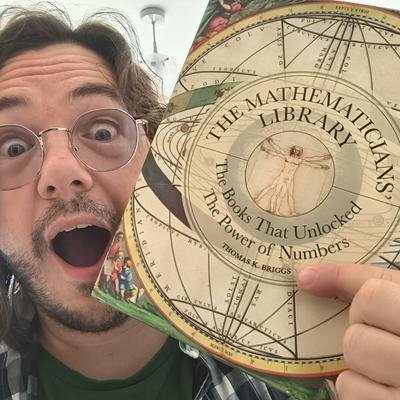
                                        People interested in this thread might also be interested in the fact that the British Society for the History of Mathematics' _Research in Progress_ meeting is in Oxford next Saturday (7th March). Booking is technically closed, but there is a waitlist: https://bshm.ac.uk/event/research-in-progress/

                                        There are quite a few figures mentioned in a certain book which I know you have access to 😉 In that I've tried to draw attention to some (as you've put it elsewhere) non-(white dead dudes), but as you've also said elsewhere, I'm the product of a similar educational system which almost exclusively presented old white dead dudes.

                                        teakayb@mathstodon.xyzT 1 Reply Last reply
                                        0
                                        • colinthemathmo@mathstodon.xyzC colinthemathmo@mathstodon.xyz

                                          Don't make me regret this ...

                                          I'm thinking of making a timeline of characters and events from history that school children might know of and be interested in. Most timelines you find are overly complex, or overly simplistic.

                                          Who and what would you include?

                                          I'm interested in connecting science people with historical context, and pulling in non-(old dead white dude)s.

                                          1/n

                                          rzeta0@mathstodon.xyzR This user is from outside of this forum
                                          rzeta0@mathstodon.xyzR This user is from outside of this forum
                                          rzeta0@mathstodon.xyz
                                          wrote last edited by
                                          #40

                                          @ColinTheMathmo

                                          In no expert but this is a good idea so I thought I'd contribute in a tiny way

                                          * The women who did much of the crystallography for the discovery of DNA but didn't receive the credit that Crick and Watson did

                                          * The cowpox-chickenpox person. It's a cool story that I still remember from childhood.

                                          * Was it Archimedes who was killed for challenging prevailing notions of finiteness ? Or was he the one killed protecting his diagrams?

                                          * Sophie Germain and how she pretended to be male for so long.

                                          1 Reply Last reply
                                          0
                                          Reply
                                          • Reply as topic
                                          Log in to reply
                                          • Oldest to Newest
                                          • Newest to Oldest
                                          • Most Votes


                                          • Login

                                          • Login or register to search.
                                          • First post
                                            Last post
                                          0
                                          • Categories
                                          • Recent
                                          • Tags
                                          • Popular
                                          • World
                                          • Users
                                          • Groups