Fossil gas is a feedstock for the Haber-Bosch process used to make fertiliser (but invented for making early 20th Century munitions).
-
…The next bit gets into military asymmetry and dependencies.
“In ecology and economics, stocks are what’s accumulated and flows are what moves through them.
The problem is that flows feel infinite right up until the stock runs out. And I refer to this as the slurping sound with respect to oil extraction.
Stocks and flows apply to military capacity as well…
…“The US has historically had the most impressive offensive flow, capacity: shock and awe, precision strikes, the ability to put bombs on target anywhere on earth, within hours.
But the stocks, particularly the stocks of things like interceptor missiles maybe getting dangerously low.
I’m told by people who follow this closely that the US and Israel have been firing 5 to 7 interceptors for every incoming Iranian missile…
-
…“And food inflation in import-dependent nations that have very thin fiscal reserves like Egypt or Pakistan or Turkey, becomes political quite quickly. A recent guest on TGS, Craig Tindale, labeled this situation as a potential globalized Arab Spring…
@urlyman Any current shortages are just profiteering.
But if the current stupidity goes on for some months, then yes, there will be a simultaneous uptick in energy prices and fertiliser prices. Anywhere dictatorial that relies on rural voters to outweigh urban voters (hello, Turkey, Pakistan) will be in trouble.
Don’t forget the recursive effect of oil price increases on shipping which affects costs of everything being shipped. Hello, inflation.
-
…“The US has historically had the most impressive offensive flow, capacity: shock and awe, precision strikes, the ability to put bombs on target anywhere on earth, within hours.
But the stocks, particularly the stocks of things like interceptor missiles maybe getting dangerously low.
I’m told by people who follow this closely that the US and Israel have been firing 5 to 7 interceptors for every incoming Iranian missile…
…“And by the way, each of those interceptors cost millions of dollars and takes months to manufacture.
A PAC-3 interceptor costs like $4 million. In contrast, a Shahed drone made in Iran costs around $50K. That’s a cost-exchange ratio of about nearly 100:1 in Iran’s favor. So Iran doesn't need to win the Air War outright. They probably just need to keep up intermittent launches long enough to limit what the US can shoot back with…
-
…“And by the way, each of those interceptors cost millions of dollars and takes months to manufacture.
A PAC-3 interceptor costs like $4 million. In contrast, a Shahed drone made in Iran costs around $50K. That’s a cost-exchange ratio of about nearly 100:1 in Iran’s favor. So Iran doesn't need to win the Air War outright. They probably just need to keep up intermittent launches long enough to limit what the US can shoot back with…
…“And Secretary of State Rubio said publicly that Iran is producing offensive weapons faster than the US and its allies can manufacture interceptors to stop them. And the Secretary of War suggested this war may go on for months.
The US is historically structured for periodic high intensity bursts, not
sustained engagement. The assumption has always been overwhelming force, short duration, then restock. But that model does not hold if a conflict drags on. Especially a large conflict.” -
…“And sulfur’s the feedstock for sulfuric acid and sulfuric acid is what we use to leach copper and cobalt out of the ground in places like the DRC and Zambia. The two of those countries together supply over a sixth of global copper and more than 70% of global cobalt.
So the little oil snafu in the Straits of Hormuz could lead to no marginal copper or cobalt.
No transformers, no grid expansion. No grid expansion, no data centers, which means no EV charging infrastructure, no AI build out, etc…
@urlyman Copper as a conductor is in many places readily replaceable by aluminium - and often already is, for price reasons.
-
…“And Secretary of State Rubio said publicly that Iran is producing offensive weapons faster than the US and its allies can manufacture interceptors to stop them. And the Secretary of War suggested this war may go on for months.
The US is historically structured for periodic high intensity bursts, not
sustained engagement. The assumption has always been overwhelming force, short duration, then restock. But that model does not hold if a conflict drags on. Especially a large conflict.”…If there’s a single sentence to take away from the above, it’s:
“Flows feel infinite right up until the stock runs out”.
- - -
But that’s enough for now. If it’s too much for you, then sorry, mute or block me.
I’m not going to be not interested in this stuff.
-
@violetmadder Yesss!
-
@urlyman Copper as a conductor is in many places readily replaceable by aluminium - and often already is, for price reasons.
-
…“And Secretary of State Rubio said publicly that Iran is producing offensive weapons faster than the US and its allies can manufacture interceptors to stop them. And the Secretary of War suggested this war may go on for months.
The US is historically structured for periodic high intensity bursts, not
sustained engagement. The assumption has always been overwhelming force, short duration, then restock. But that model does not hold if a conflict drags on. Especially a large conflict.”@urlyman and with the US stock of weapons quickly depleting, what will happen in other regions? North Korea against South Korea? China and Taiwan? Russia in Europe? Who will use this opportunity to use force?
-
@urlyman and with the US stock of weapons quickly depleting, what will happen in other regions? North Korea against South Korea? China and Taiwan? Russia in Europe? Who will use this opportunity to use force?
-
…“And by the way, each of those interceptors cost millions of dollars and takes months to manufacture.
A PAC-3 interceptor costs like $4 million. In contrast, a Shahed drone made in Iran costs around $50K. That’s a cost-exchange ratio of about nearly 100:1 in Iran’s favor. So Iran doesn't need to win the Air War outright. They probably just need to keep up intermittent launches long enough to limit what the US can shoot back with…
@urlyman One should obviously compare with the cost of the damage the incoming drone or missile is likely to do, not with the cost of it.
-
@urlyman One should obviously compare with the cost of the damage the incoming drone or missile is likely to do, not with the cost of it.
@tml Sure.
My point of the above thread is not to cast false certainties or wash away complexity. It’s to try and bring to the fore the fragile interconnectedness that the Secretary of War and his dick-swinging colleagues are blowing up
-
@tml Sure.
My point of the above thread is not to cast false certainties or wash away complexity. It’s to try and bring to the fore the fragile interconnectedness that the Secretary of War and his dick-swinging colleagues are blowing up
-
@martinvermeer the Straits of Hormuz are the epicentre of the mother of all flows. Nothing in that context is about one thing only. Everything has nth-order effects.
-
…“And Secretary of State Rubio said publicly that Iran is producing offensive weapons faster than the US and its allies can manufacture interceptors to stop them. And the Secretary of War suggested this war may go on for months.
The US is historically structured for periodic high intensity bursts, not
sustained engagement. The assumption has always been overwhelming force, short duration, then restock. But that model does not hold if a conflict drags on. Especially a large conflict.”They are producing defensive weapons. The USA is firing on their homes.
Typical of a US pol to use language to spin the narrative.
They are , amazingly enough, permitted to produce weapons to defend themselves, and to strike at the people who struck at them first, including if those persons are based in someone else's country, because their own country is too far away, which in turn begs the question, WHY DID THE US START DROPPING BOMBS?
The rant took over: I decided to let it run -
…If there’s a single sentence to take away from the above, it’s:
“Flows feel infinite right up until the stock runs out”.
- - -
But that’s enough for now. If it’s too much for you, then sorry, mute or block me.
I’m not going to be not interested in this stuff.
…People who have read the entire thread (most of it are not my words) may have noticed:
“about one third of the world’s fertiliser demand” is me voicing James Meadway on the podcast linked at he top.
“Over 40% of internationally traded nitrogen fertilizers” is me quoting Nate Hagens.
Obviously, whatever the actual numbers are matter and are consequential. But for the purposes of this thread, please treat them as a heuristic, a window into astonishing complexity and fragility focused into…
-
Fossil gas is a feedstock for the Haber-Bosch process used to make fertiliser (but invented for making early 20th Century munitions).
Gas has been plentiful and cheap in the Persian Gulf and so it has made sense to build out decades of infrastructure to make fertiliser at point of source.
Consequently, about one third of the world’s fertiliser demand has been met by moving it through the Gulf and out into the wider world.
And now that’s not happening…
@urlyman funny how as we have an excess of animals and dung was used to enrich the soils, plus crop rotation, now usurped in favour of man made stuff shipped half way around the world to feed plants bred specifically for yield over quality, sprayed with man made pesticides and herbicides, because profit is more important over quality and health. We live in a sick world.
-
…People who have read the entire thread (most of it are not my words) may have noticed:
“about one third of the world’s fertiliser demand” is me voicing James Meadway on the podcast linked at he top.
“Over 40% of internationally traded nitrogen fertilizers” is me quoting Nate Hagens.
Obviously, whatever the actual numbers are matter and are consequential. But for the purposes of this thread, please treat them as a heuristic, a window into astonishing complexity and fragility focused into…
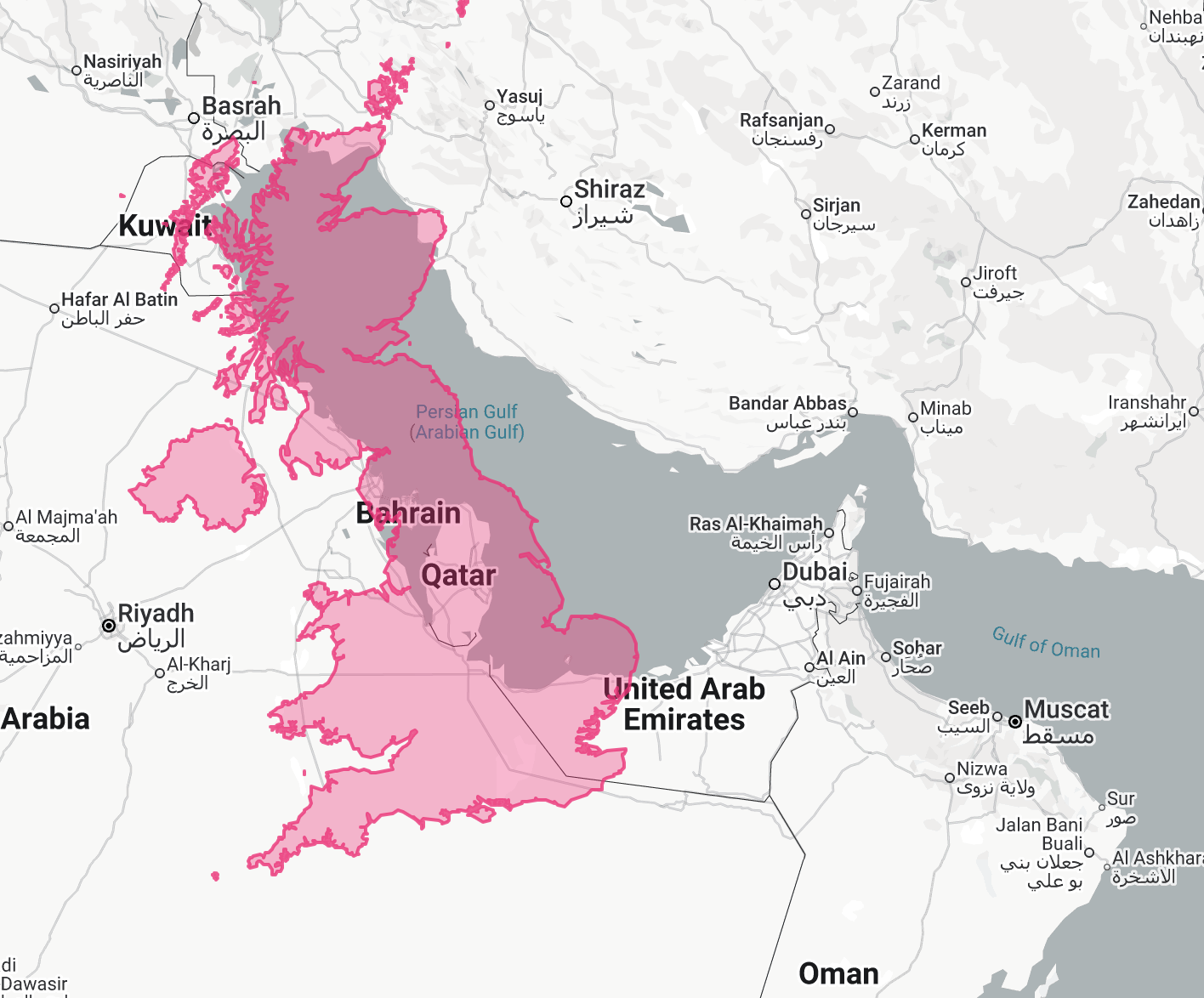
…the Persian Gulf and the Gulf of Oman, bodies of water 200 miles wide at their widest and about 750 miles from Basra in the north to Muscat in the south.
Which makes it roughly the area of the UK.
Map courtesy of https://thetruesize.com
-
…If it’s not already obvious, we need to be instituting a Dig For Victory style programme, except it won’t be about ‘victory’, it will be Grow Food To Live.
We need national communal regenerative farming started now. Which means compulsory land orders on wasteful tracts of privately owned land.
But I guess we’ll wait until hunger ravages because we have one of the stupidest governments of my lifetime in power
On this, I recommend listening to relevant experts like @sarahtaber : https://mastodon.online/@sarahtaber/116233564682293022
Donald Trump's disrupting global fertilizer supplies by tariffs and by war is one of the many many reasons he needs to be stopped & removed from power.
But this is not a matter of not being able to feed everyone.