Study (N=2,689) of men (18-34) finds 95.1% reported using strategies to get a woman to have sex who they knew did not want sex & had not consented; 65% successful.
-
Study (N=2,689) of men (18-34) finds 95.1% reported using strategies to get a woman to have sex who they knew did not want sex & had not consented; 65% successful. Consistent physical pressure & verbal coercion common; overt force, physical restraint, pain also used. https://journals.sagepub.com/doi/10.1177/08862605261432630
@amydiehl of heterosexual men, right?
-
@gabriel That is a misreading, IMO. The criteria for participation was "Men were eligible if they self-identified as men, were in the age range 18 to 34 years, and reported having had a sexual encounter with a woman in the past 2 years."
Also, if it were only for those who admittedly coerced, etc., then the percentage would have been 100, not 95.1.
@LeslieBurns @gabriel @amydiehl
I believe you are correct. There are some language issues with the writing, imho, that may cause some confusion, but the paper clearly states that:
"Of the final sample of 2,689 men, 95.1% reported having recently used at least one of the strategies to force a woman to have sex" (Results section, para 1)
They then say that the ones who did not were demographically indistinguishable from the 95% group.
Likely the 95% group then received follow up questions.
-
@LeslieBurns @gabriel @amydiehl
I believe you are correct. There are some language issues with the writing, imho, that may cause some confusion, but the paper clearly states that:
"Of the final sample of 2,689 men, 95.1% reported having recently used at least one of the strategies to force a woman to have sex" (Results section, para 1)
They then say that the ones who did not were demographically indistinguishable from the 95% group.
Likely the 95% group then received follow up questions.
@LeslieBurns @gabriel @amydiehl
Certainly, the wording of the original request for participants may have turned off many men who would never use the strategies --- the wording was basically "let's hear the men's side of the story". If you have never been in a he-said / she-said situation, you may not have signed up for the research.
My feeling is that this is important research, and further research is needed.
-
@LeslieBurns @gabriel @amydiehl
Certainly, the wording of the original request for participants may have turned off many men who would never use the strategies --- the wording was basically "let's hear the men's side of the story". If you have never been in a he-said / she-said situation, you may not have signed up for the research.
My feeling is that this is important research, and further research is needed.
I think is really valuable work, and it is important to document in the literature the strategies that are used by aggressors to force woman to have sex.
But I also think that in this particular instance finding information towards their RQ1 (what % of men..) is in conflict with their other RQ (how effective are the strategies, etc).
-
@LeslieBurns @gabriel @amydiehl
Certainly, the wording of the original request for participants may have turned off many men who would never use the strategies --- the wording was basically "let's hear the men's side of the story". If you have never been in a he-said / she-said situation, you may not have signed up for the research.
My feeling is that this is important research, and further research is needed.
@LeslieBurns @gabriel @amydiehl
Let me emphasize the "may not have signed up". We don't know. (So, more research.)
BUT, the number of men who do these things should be as close to zero as nature / nurture allows. There will always be some who are willing to hurt others for their own selfish reasons. However, there is no ethically acceptable reason for the # in any given society to be in double digits, much less 60, 80, or 95%.
We can do better. Seems like we could barely do worse.
-
Study (N=2,689) of men (18-34) finds 95.1% reported using strategies to get a woman to have sex who they knew did not want sex & had not consented; 65% successful. Consistent physical pressure & verbal coercion common; overt force, physical restraint, pain also used. https://journals.sagepub.com/doi/10.1177/08862605261432630
RE: https://mstdn.social/@MaryAustinBooks/116398194960868150
No further comment is necessary
-
Study (N=2,689) of men (18-34) finds 95.1% reported using strategies to get a woman to have sex who they knew did not want sex & had not consented; 65% successful. Consistent physical pressure & verbal coercion common; overt force, physical restraint, pain also used. https://journals.sagepub.com/doi/10.1177/08862605261432630
@amydiehl @janeishly That's shocking. On the other hand, 100% of women that I know well enough to have this sort of conversation with report being sexually assaulted at some point. So maybe this shouldn't shock me as much as it does.
-
As I say, not me, is what the paper says. You can read it yourself and make up your mind.
I think we need to understand the literature to be able to have strategies to curve this situation. It would be very different if we are talking of 95% of the population or if it the number is different.
Therefore it is important to clarify, in my mind, what the study actually claims.
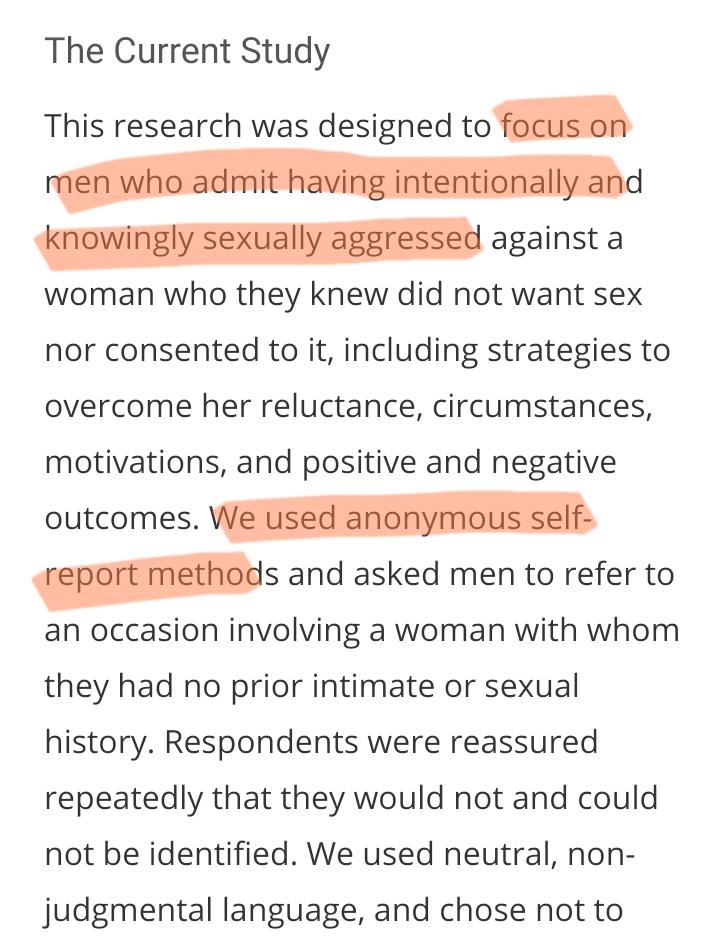
@gabriel @TomasHradcky The nuance is important indeed. And this has nothing to do with "not all men". The study is not just about perpetrators' modus operandi, it's also about methodology (anonymity and non-judgemental approach), which are essential to understand if one is to grasp the fact that these men know what they're doing (otherwise they'd confess by accident, which they obviously don't). This tells volumes about their line of defense ("oh I lost control"). They don't lose control at all.
-
As I say, not me, is what the paper says. You can read it yourself and make up your mind.
I think we need to understand the literature to be able to have strategies to curve this situation. It would be very different if we are talking of 95% of the population or if it the number is different.
Therefore it is important to clarify, in my mind, what the study actually claims.
Again, you don't know it's not also 95% of all men. A number you claim is shocking to you.
And yet, you continue to insist 95% is too broad an assumption that upsets you because women might be asserting it's all men or a lot of men. No one except you brought up 100% all men. Then you got upset about it.
Sealion much?
I love that you insist on being blocked. Like 95% of all #Replyguys who responded to this post.

-
Study (N=2,689) of men (18-34) finds 95.1% reported using strategies to get a woman to have sex who they knew did not want sex & had not consented; 65% successful. Consistent physical pressure & verbal coercion common; overt force, physical restraint, pain also used. https://journals.sagepub.com/doi/10.1177/08862605261432630
@amydiehl my daughter and her two college age friends went to a restaurant where they were each offered a free drink twice. And they felt the need to explain why they refused it.
-
@amydiehl Looking at the survey questions, it strikes me that Pharrell Williams and Robin Thicke's song "Blurred Lines" advocates for a fair number of the strategies here.
This is absurdly awful.
@deadwisdom i always hated that song. @amydiehl
-
Again, you don't know it's not also 95% of all men. A number you claim is shocking to you.
And yet, you continue to insist 95% is too broad an assumption that upsets you because women might be asserting it's all men or a lot of men. No one except you brought up 100% all men. Then you got upset about it.
Sealion much?
I love that you insist on being blocked. Like 95% of all #Replyguys who responded to this post.
If it is 95% of all men, then this would also imply that _at least_ 95% of all men who had sex in the last two years had multiple sexual partners. I find this figure to be quite strange, given what other studies of sexual behavior of younger generations show.
Now, I am answering in good faith, because I think we are having a conversation. But if you feel differently, feel free to block, I do not need the validation of your attention.


-
@deadwisdom i always hated that song. @amydiehl
@Joy_intl @deadwisdom @amydiehl Incel pop 🤮
-
Study (N=2,689) of men (18-34) finds 95.1% reported using strategies to get a woman to have sex who they knew did not want sex & had not consented; 65% successful. Consistent physical pressure & verbal coercion common; overt force, physical restraint, pain also used. https://journals.sagepub.com/doi/10.1177/08862605261432630
This is so, so sad. Important study, yes! Horrendous behavior, yes!
But just so frickin' pathetic.
Sex with someone who actually wants to be with you -- that is sublime.
-
Study (N=2,689) of men (18-34) finds 95.1% reported using strategies to get a woman to have sex who they knew did not want sex & had not consented; 65% successful. Consistent physical pressure & verbal coercion common; overt force, physical restraint, pain also used. https://journals.sagepub.com/doi/10.1177/08862605261432630
@amydiehl holy crap.
-
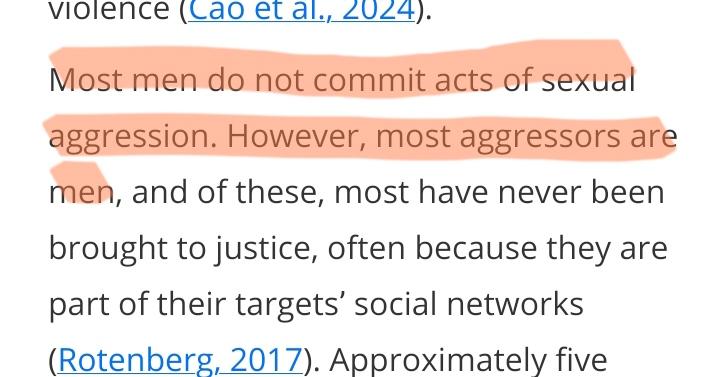
I'm not coming to argue "not all men", but from reading the tooth one walks away with the idea that 95% of men force women to have sex, and that is not what the article says at all. What it claims is that of a population that admits to intentionally sexually aggressed woman, 95% report to use strategies to get a woman to have sex when she hasn't consented.
I mean, clearly the paper itself claims "not all men".
@gabriel i just want to say that i appreciate that you took the time to read it and post the clarification
-
If it is 95% of all men, then this would also imply that _at least_ 95% of all men who had sex in the last two years had multiple sexual partners. I find this figure to be quite strange, given what other studies of sexual behavior of younger generations show.
Now, I am answering in good faith, because I think we are having a conversation. But if you feel differently, feel free to block, I do not need the validation of your attention.
What does having multiple partners have to do with this at all? Rape can happen in monogamous relationships too, you ghoul.
-
@amydiehl OK, but the paper was focused on that demographic:
"This research was designed to focus on men who admit having intentionally and knowingly sexually aggressed against a woman who they knew did not want sex nor consented to it, including strategies to overcome her reluctance, circumstances, motivations, and positive and negative outcomes."
-
Study (N=2,689) of men (18-34) finds 95.1% reported using strategies to get a woman to have sex who they knew did not want sex & had not consented; 65% successful. Consistent physical pressure & verbal coercion common; overt force, physical restraint, pain also used. https://journals.sagepub.com/doi/10.1177/08862605261432630
@amydiehl Shocking numbers, hoo boy. And that's even with expectation bias being a major reducing factor for the "more violent" actions.
Unveiling how violent human (and specifically male!) sexuality is will hopefully help our species and societies become better and make things safer... (especially for women, who receive and suffer through the vast majority of this violence)
Reading the article, I have semantic questions - basically:
- Where does persuasion end and non-consent begin?
- Where does privacy end and isolation begin?This may be a language barrier thing (not a native English speaker), but what is the EXACT question for the "telling whatever she wanted to hear" item? Because (simplified example) if she says she'll have sex with a man if "he's gentle" or "he uses protection", and he /actually/ does, I don't think this should show up in the survey as violent, it should only count as a violent act if the things said were disingenuous.
It might be good if the verbatim survey questions and layouts used to display them were part of the supplementary material.
And given that sex is usually illegal in public, making privacy a prerequisite, of course one partner taking the other(s) somewhere private and controlled (where nobody can walk in unexpectedly) is to be expected for pretty much any sexual act? (I would distinguish this from men doing this to isolate/"impress"/intimidate, but I am not sure the study questionnaire would provide this distinction, or provide clarification for men answering the question)
Lastly, and I hate to say it given how it sounds, would love to see the same survey done with women. (because difference in differences can be a useful metric here to show us what is wrong qualitatively - same as for domestic violence, stating the ratio of transgressions can shut up whataboutists and their ilk)
Quote:
The most common strategy was telling a woman whatever she wanted to hear and this was used by the majority (78.1%) of the 2,557 men reporting any history of forced sex. The following strategies were reported by order of frequency: asked her repeatedly to have sex (48.6%); had a friend, partner, or group of friends help you get what you want (46.6%), had a female friend make the woman feel safe and convince her (43.8%), told her you knew she wanted it (39.3%), focused on a stranger to have sex with (37.9%), had a female friend bring her to you (37.6%), and got her away from everyone to somewhere private and under your control (37.5%). -
@gabriel @TomasHradcky The nuance is important indeed. And this has nothing to do with "not all men". The study is not just about perpetrators' modus operandi, it's also about methodology (anonymity and non-judgemental approach), which are essential to understand if one is to grasp the fact that these men know what they're doing (otherwise they'd confess by accident, which they obviously don't). This tells volumes about their line of defense ("oh I lost control"). They don't lose control at all.
@gabriel @TomasHradcky Yet actually I'm quite surprised to read that "most men don't". For I'm afraid most men do. So my opinion on this is "while I think most men do, I also think that these study says the opposite (in which case I think it's interesting for the reasons stated above) , but at the same time it seems to say that most men are prepetrators". So honestly I don't know what to think ABOUT THIS STUDY (as far as masculinity is concerned I know what to think, unfortunately).