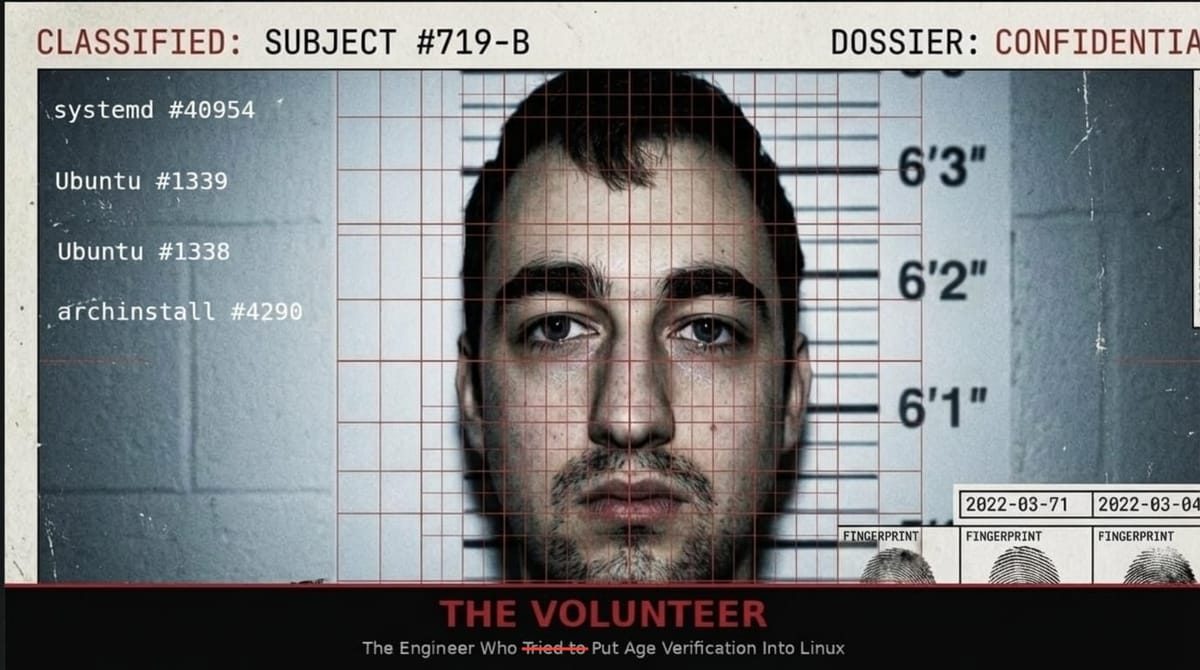
The Engineer Who Tried to Put Age Verification Into Linux
-
The Engineer Who Tried to Put Age Verification Into Linux
The Engineer Who Tried to Put Age Verification Into Linux
Dylan, useful idiot with commit access, pushed age verification PRs to systemd, Ubuntu & Arch, got 2 Microslop employees to merge it, called it 'hilariously pointless' in the PR itself, then watched Lennart personally block the revert. Unpaid compliance simp.

Sam Bent (www.sambent.com)
The lasting damage was knowing it could happen at all: that a single contributor with no stated organizational backing could submit compliance infrastructure for surveillance law directly into the software that boots your computer, get it merged by two Microsoft employees, and have the creator of systemd personally block the removal.
@Khrys@mamot.fr needlessly dramatic for what was an entirely unsurprising development. wake me up if they do anything beyond a glorified text field, something almost all other OSs have had for decades.
I mean I agree that the sentiment is bad. but do we need the entire linux community to explode over this? hardly
-
I don't understand what the fuss is about. This is exactly the right way to comply with that law: an optional birth date field. You don't want to have to submit an idea to your OS or implement facial recognition, and you certainly don't want to tie account creation to external services for those things, but now parents can fill in the birth date for their kids, and everybody else can ignore it. This kind of thing needs to be in the hands of parents, not external companies.
So I don't really see the problem here.
-
The Engineer Who Tried to Put Age Verification Into Linux
The Engineer Who Tried to Put Age Verification Into Linux
Dylan, useful idiot with commit access, pushed age verification PRs to systemd, Ubuntu & Arch, got 2 Microslop employees to merge it, called it 'hilariously pointless' in the PR itself, then watched Lennart personally block the revert. Unpaid compliance simp.
Sam Bent (www.sambent.com)
The lasting damage was knowing it could happen at all: that a single contributor with no stated organizational backing could submit compliance infrastructure for surveillance law directly into the software that boots your computer, get it merged by two Microsoft employees, and have the creator of systemd personally block the removal.
@Khrys let’s be completely honest here. The choices are:
- Non compliance resulting in everyone complaining that your device is “broken”
- Non compliance (this option)
- Full compliance with outside verification (a horrible option)If a mandated API is made called, then easiest option is just to return “adult” and move on, rather than the millions of people complaining that “it doesn’t work”
I really don’t get what the point of this hit piece is.
-
@Khrys let’s be completely honest here. The choices are:
- Non compliance resulting in everyone complaining that your device is “broken”
- Non compliance (this option)
- Full compliance with outside verification (a horrible option)If a mandated API is made called, then easiest option is just to return “adult” and move on, rather than the millions of people complaining that “it doesn’t work”
I really don’t get what the point of this hit piece is.
@jonathankoren @Khrys The point is that you don’t just give away your freedom because it’s easier. You *at least* say ‘fuck you, make me’ first.
There are way more people for who this is NOT law than for who it IS. So much for the land of the free and the home of the brave.
-
@jonathankoren @Khrys The point is that you don’t just give away your freedom because it’s easier. You *at least* say ‘fuck you, make me’ first.
There are way more people for who this is NOT law than for who it IS. So much for the land of the free and the home of the brave.
-
@Khrys (disclaimer: IANALAIDEPOOTV)
One remark and one comment:
Remark: the title says "tried to", the article says did -- and Poettering blocked a revert.
Comment: in countries where the GDPR applies, the feature appears contrary to article 5 as overbroad, even probably purposeless *per se* ; maybe also contrary to recent European decisions against generalized citizen data collection, too.
@aaribaud
«in countries where the GDPR applies» <- you got this wrong, GDPR applies everywhere as soon as you are an European Union citizen.Edit: correction «European citizen» -> «European Union citizen»
-
-
@Khrys is it just me or is the article a bit weird? Weird repetitions, weird (fully animated) graphics and a weird quiz at the end. It smells vaguely like slop, but is it?
@eobet @Khrys Based on the rest of the articles on the platform, the ones I've peeked over are written in a similar style: They are technically true, I'm not sure if the framing is known or even intentional. As if somebody fed research into an LLM, seriously proofread the outgoing article and also generated "top facts" as well as the graphics out of it
-
@eobet @Khrys Based on the rest of the articles on the platform, the ones I've peeked over are written in a similar style: They are technically true, I'm not sure if the framing is known or even intentional. As if somebody fed research into an LLM, seriously proofread the outgoing article and also generated "top facts" as well as the graphics out of it
@eobet@oldbytes.space @Khrys@mamot.fr I'm split on how to tackle the overall situation. This is, effectively, a rage bait and a hit piece violating the ages-old rule of "attempt collaboration and dialog before engaging in conflict" as the stage of trying to educate or letting the PR author explain their perspective is straight up skipped. Possibly this is unknown to the author who just wanted something that attracts attention
-
-
-
I don't understand what the fuss is about. This is exactly the right way to comply with that law: an optional birth date field. You don't want to have to submit an idea to your OS or implement facial recognition, and you certainly don't want to tie account creation to external services for those things, but now parents can fill in the birth date for their kids, and everybody else can ignore it. This kind of thing needs to be in the hands of parents, not external companies.
So I don't really see the problem here.
Say there's a law requiring collection of people's ethnicity. Or of their gender, allowing only two options. Or of their religion. Or legal, government issued names and id numbers. Oh, they're all optional in most jurisdictions and in fact defined in ways that are noncompliant with other laws. But what's the big deal? We'll just add an optional field name to standardize the schema. There's no mandatory mechanism or verification. Just making the data cleaner.
@mcv @Khrys -
-
-
Di you understand that we're talking about an optional field on your own, local computer that you control, and which already has similar fields for your real name, your email and your location?
I understand people are wary to paranoid about privacy, and you should be, but it's misplaced here. This is the wrong battle to be fighting. There are many worthy battles out there that could use this energy.
-
@Khrys @nblr @doingfedtime What kind of bullshit hit piece is this?
We’re now blaming developers for contributing to FOSS projects?
Great job everyone, you can be really proud of yourselves!
 /s
/s@joschi @nblr @doingfedtime @Khrys
That's my real worry. People are piling on long-standing open source contributors and pretending they're nazi collaborators. These are people who donate their time writing software that everybody can use for free.
-
@jonathankoren @Khrys The point is that you don’t just give away your freedom because it’s easier. You *at least* say ‘fuck you, make me’ first.
There are way more people for who this is NOT law than for who it IS. So much for the land of the free and the home of the brave.
This is not giving away your freedom.
-
-
We've long depended on software maintained by fewer people than that.
The point is: anyone can contribute, committers review and approve. If that has always been a reasonable process, why not now? There are lots of open source projects where the creator of the project has more power than that, and we've always accepted it because we trust the maintainers, and when they break that trust, the community forks, which has also happened plenty of times.
But at the end of the day, it seems to me most people here are irrationally panicking about this. Isn't the field optional? Isn't what goes in the field entirely under the user's control?
By all means discuss this honestly, but I don't see anything here that justifies the hype and panic.
-
@Khrys we like to think of FOSS as some sort of anarchist collective°. it never has been.
it's run by a series of people with absolute power, for the most part. the benefit is that it's a lot of tiny dictators rather than a few big ones; that in theory anyone can become one, you don't need to be rich; and that these dictators tend to have technical knowledge.
but they can still be arseholes.
° i mean, we might not CALL it that.
@fishidwardrobe
I'm glad most tend to be BDFLs.
@Khrys