Here's a thought experiment.
-
Here's a thought experiment.
Imagine a stamp mark with the words "Made with #AI" on it.
If you see this mark on a picture, illustration, mobile app, song, movie, or story - do you get the notion that this product is of higher, lower or unchanged quality?
If you see two identical products for the same price, where one has an AI mark and the other doesn't - which one would you buy?
At this point in the discourse "Made with AI" is more is a dogwhistle than a mark of good or bad quality. I wouldn't want to give my money to someone proud of using genAI at this point in the timeline.
-
 E em0nm4stodon@infosec.exchange shared this topic
-
@sjn
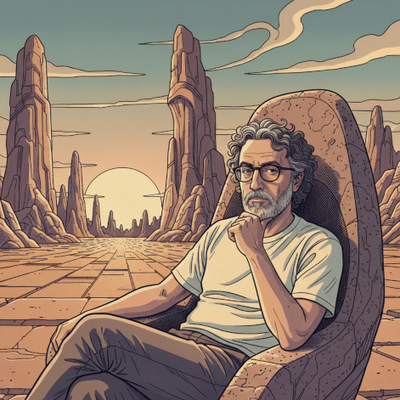
Ah nice example the image. Let me explain. Incidentally, I'm perfectly able to draw a self-portrait of myself in Moebius style. But I had no intention to do that for a series of reason, including the time to dedicate to use ink and colors for that (I'm an old fashioned amateur comic book artist). I deliberately choose to not doing that. So the use of AI says exactly nothing about me (i.e, it is not relevant) which is the point. Did you draw your avatar personally? -
Here's a thought experiment.
Imagine a stamp mark with the words "Made with #AI" on it.
If you see this mark on a picture, illustration, mobile app, song, movie, or story - do you get the notion that this product is of higher, lower or unchanged quality?
If you see two identical products for the same price, where one has an AI mark and the other doesn't - which one would you buy?
@sjn "Quality" doesn't even enter the equation when it's AI. Similar to how pseudoscientific nonsense is said to be "not even wrong".
-
Here's a thought experiment.
Imagine a stamp mark with the words "Made with #AI" on it.
If you see this mark on a picture, illustration, mobile app, song, movie, or story - do you get the notion that this product is of higher, lower or unchanged quality?
If you see two identical products for the same price, where one has an AI mark and the other doesn't - which one would you buy?
-
@gisgeek I think that strictly within the software development field, you may have a point - under the right circumstances.
Sadly, these tools aren't _only_ used for supporting highly skilled software developers.
Just take a look at your profile photo - clearly generated! What do you think this tells people about yourself?
This is what I'm asking in the poll: Does the next person seeing that image associate it with a positive, negative, or no change in quality?
Makes you think, no?
-
@sjn
Ah nice example the image. Let me explain. Incidentally, I'm perfectly able to draw a self-portrait of myself in Moebius style. But I had no intention to do that for a series of reason, including the time to dedicate to use ink and colors for that (I'm an old fashioned amateur comic book artist). I deliberately choose to not doing that. So the use of AI says exactly nothing about me (i.e, it is not relevant) which is the point. Did you draw your avatar personally?It says, you want a Moebius style portrait as a profile picture (to grab our attention or say something about yourself), but it wasn't worth your time to draw it yourself.
Indeed, I'd say this tells us something about you and/or your relationship to us.
-
@jwildeboer @sjn struggling hard to remember the last time I saw nearly 2K people online agreeing on something so unanimously!
(98% right now)
-
@glitzersachen @sjn You have an anonymous generic icon and a clearly fake profile. That says a lot about you, too.
-
@sjn I understand the point of view of artists and creators. Being used for neural net training is not something many of them have ever contemplated. Which is fine, but licenses and copyright exist for that.
But it's a totally different matter. Again, it is not about quality, and I could cite that photography was not considered art in the old days. At that time, a drawing was art, a photo a mere reproduction of reality. Perceptions of such things change a lot. We live in interesting times.licenses and copyright exist for that.
Yes, they do. One of my big frustrations with LLMs is that AI companies violated licenses and copyrights on a vast scale.
Yet, when creators seek recompense for that, we're told that can't be allowed to happen because it would destroy the AI industry.
-
licenses and copyright exist for that.
Yes, they do. One of my big frustrations with LLMs is that AI companies violated licenses and copyrights on a vast scale.
Yet, when creators seek recompense for that, we're told that can't be allowed to happen because it would destroy the AI industry.
@rpbook @sjn
Clearly, a lot of training has been conducted in violation of third-party rights. But note that the violation, in most cases, has been recognized not for the digitalization — processing—destroying part, but for the use of a clearly pirated repository of digital content (see the Anthropic case). Like it or not, the training part is not, if not explicitly introduced as an exclusion in the license, a violation.
The same for FOSS code. -
@rpbook @sjn
Clearly, a lot of training has been conducted in violation of third-party rights. But note that the violation, in most cases, has been recognized not for the digitalization — processing—destroying part, but for the use of a clearly pirated repository of digital content (see the Anthropic case). Like it or not, the training part is not, if not explicitly introduced as an exclusion in the license, a violation.
The same for FOSS code.@rpbook @sjn
Also, for the GPL use, note that 'derivation' cannot be confused with a set of billions of weights. The key point is the possible use of non-FOSS code in training again. But all that needs to be demonstrated.
Of course, IANAL, but I see very little possibility of seeing such points in a judgment. -
@rpbook @sjn
Clearly, a lot of training has been conducted in violation of third-party rights. But note that the violation, in most cases, has been recognized not for the digitalization — processing—destroying part, but for the use of a clearly pirated repository of digital content (see the Anthropic case). Like it or not, the training part is not, if not explicitly introduced as an exclusion in the license, a violation.
The same for FOSS code.@rpbook @sjn
This is, unfortunately, also the main reason the so-called ripping off of artists' creations is pointless. If you buy a book with pictures of original creations, one can use them for training, exactly as a reader can study such portraits for their own goals, make hand copies for their own use, and so on. Like it or not, licenses and copyrights are something more specific than what it seems the idea of many people. -
@rpbook @sjn
This is, unfortunately, also the main reason the so-called ripping off of artists' creations is pointless. If you buy a book with pictures of original creations, one can use them for training, exactly as a reader can study such portraits for their own goals, make hand copies for their own use, and so on. Like it or not, licenses and copyrights are something more specific than what it seems the idea of many people. -
@rpbook @sjn
Clearly, a lot of training has been conducted in violation of third-party rights. But note that the violation, in most cases, has been recognized not for the digitalization — processing—destroying part, but for the use of a clearly pirated repository of digital content (see the Anthropic case). Like it or not, the training part is not, if not explicitly introduced as an exclusion in the license, a violation.
The same for FOSS code.@gisgeek @sjn I'm very aware of the Anthropic case, I'm a part of it.
Part of their defence has been that if they have to pay damages for everything they pirated, they'd go out of business. And now governments are talking about adding AI exceptions to copyright laws.
Telling people to not share things so they don't get stolen is not a solution. It's simple victim blaming.
-
@gisgeek @sjn I'm very aware of the Anthropic case, I'm a part of it.
Part of their defence has been that if they have to pay damages for everything they pirated, they'd go out of business. And now governments are talking about adding AI exceptions to copyright laws.
Telling people to not share things so they don't get stolen is not a solution. It's simple victim blaming.
@rpbook @sjn
The truth is that copyright and licenses cannot be used to avoid abuses per se. They need to be defended in court, and I'm quite sure copyright laws will change, but you know that such laws vary from country to country, so the problem was there before and will be there in the future as well. In the past, changes in law always followed changes in technology. I see no signs of something better for the future. -
Here's a thought experiment.
Imagine a stamp mark with the words "Made with #AI" on it.
If you see this mark on a picture, illustration, mobile app, song, movie, or story - do you get the notion that this product is of higher, lower or unchanged quality?
If you see two identical products for the same price, where one has an AI mark and the other doesn't - which one would you buy?
@sjn rn rn? The third. In the future? The 2nd & maybe eventually the 1st.
-
@sjn rn rn? The third. In the future? The 2nd & maybe eventually the 1st.
@hopland I would agree, though if we allow ourselves to predict the future, we have to take #AI alignment issues into account.
To me, this particular timeline looks quite undesirable given the current state of the art. #AGI #ASI
(I'd even argue that #AIalignment is fundamentally unreachable, but that's a longer discussion)
-
Here's a thought experiment.
Imagine a stamp mark with the words "Made with #AI" on it.
If you see this mark on a picture, illustration, mobile app, song, movie, or story - do you get the notion that this product is of higher, lower or unchanged quality?
If you see two identical products for the same price, where one has an AI mark and the other doesn't - which one would you buy?
@sjn@chaos.social I am tempted to push the answer "higher quality" for honeypot reasons, so AI products voluntarily unmask.
-
@sjn@chaos.social I am tempted to push the answer "higher quality" for honeypot reasons, so AI products voluntarily unmask.
@daswarkeinhuhn If you also have a surefire way of killing the thing after having tricked it to reveal itself, then I'd wholeheartedly agree with your strategy!

-
@gisgeek I think that strictly within the software development field, you may have a point - under the right circumstances.
Sadly, these tools aren't _only_ used for supporting highly skilled software developers.
Just take a look at your profile photo - clearly generated! What do you think this tells people about yourself?
This is what I'm asking in the poll: Does the next person seeing that image associate it with a positive, negative, or no change in quality?
Makes you think, no?
@sjn @gisgeek "I think that strictly within the software development field, you may have a point - under the right circumstances." hard disagree, and honestly, people thinking that putting bits of already existing code together until it looks like it working is the same as software development is insulting to say the least.
Like, I can heap a lot of actual shit together in a river until stuff can pass to the other side and call it a bridge... but that doesn't make me an engineer.