Wow: you can knock out a plant with anesthetics - the same anesthetics that work on people!
-
Wow: you can knock out a plant with anesthetics - the same anesthetics that work on people!
It's easist to see for plants that move, like a Venus fly trap. But experiments have shown it's true for others too.
We're still struggling to figure out what this means. We don't really know how anesthetics work, but here's a clue: you don't need to have neurons to get anesthetized!
-
Wow: you can knock out a plant with anesthetics - the same anesthetics that work on people!
It's easist to see for plants that move, like a Venus fly trap. But experiments have shown it's true for others too.
We're still struggling to figure out what this means. We don't really know how anesthetics work, but here's a clue: you don't need to have neurons to get anesthetized!
@johncarlosbaez I hadn't taken a look at the screenshot of the paper and I knew it had something to do with ion channels. There is a key advantage to study plants in the lesser complexity of their mechanisms, since most of plant's physiology is water and ion fluxes.
-
@jesusmargar - I'm mainly talking about anesthetic gases that you breathe, not stuff you inject. The fact that argon and xenon - inert gases! - serves as an anesthetic disproved some theories of how these work. Here's what Wikipedia says:
"The full mechanism of action of volatile anaesthetic agents is unknown and has been the subject of intense debate. "Anesthetics have been used for 160 years, and how they work is one of the great mysteries of neuroscience," says anaesthesiologist James Sonner of the University of California, San Francisco. Anaesthesia research "has been for a long time a science of untestable hypotheses," notes Neil L. Harrison of Cornell University.
"Most of the injectable anesthetics appear to act on a single molecular target," says Sonner. "It looks like inhaled anesthetics act on multiple molecular targets. That makes it a more difficult problem to pick apart."
The possibility of anaesthesia by the inert gas argon in particular (even at 10 to 15 bar) suggests that the mechanism of action of volatile anaesthetics is an effect best described by physical chemistry, and not a chemical bonding action. However, the agent may bind to a receptor with a weak interaction. A physical interaction such as swelling of nerve cell membranes from gas solution in the lipid bilayer may be operative. Notably, the gases hydrogen, helium, and neon have not been found to have anaesthetic properties at any pressure."
But plants don't have nerve cells and the anesthetics still work on them!
-
Wow: you can knock out a plant with anesthetics - the same anesthetics that work on people!
It's easist to see for plants that move, like a Venus fly trap. But experiments have shown it's true for others too.
We're still struggling to figure out what this means. We don't really know how anesthetics work, but here's a clue: you don't need to have neurons to get anesthetized!
>...inhibit long-distance electrical and Ca2+ signalling probably through inhibition of GLUTAMATE RECEPTOR-LIKE
glutamate is the main excitatory neurotransmitter in vertebrate nervous system. https://en.wikipedia.org/wiki/Glutamate_(neurotransmitter)
My understanding is that plants cells do membrane depolarization just like animals and create action potentials for signaling trough fluid transport. They just use calcium instead of sodium and the speed of the signal is much slower (seconds or minutes).
When a plant is stressed somehow (touched, or damaged) its cell membranes depolarize. I think the most common reaction is to create toxins against insects and may direct healing.
-
R relay@relay.publicsquare.global shared this topic
-
Wow: you can knock out a plant with anesthetics - the same anesthetics that work on people!
It's easist to see for plants that move, like a Venus fly trap. But experiments have shown it's true for others too.
We're still struggling to figure out what this means. We don't really know how anesthetics work, but here's a clue: you don't need to have neurons to get anesthetized!
@johncarlosbaez
This is so interesting !! -
Wow: you can knock out a plant with anesthetics - the same anesthetics that work on people!
It's easist to see for plants that move, like a Venus fly trap. But experiments have shown it's true for others too.
We're still struggling to figure out what this means. We don't really know how anesthetics work, but here's a clue: you don't need to have neurons to get anesthetized!
@johncarlosbaez And that’s my yearly trigger to recall Michael Levin’s talk at NeurIPS 2018 - https://youtu.be/RjD1aLm4Thg
-
@zanchey - Yikes, the ultimate oral exam nightmare!
I should find out how aspirin works.
-
Wow: you can knock out a plant with anesthetics - the same anesthetics that work on people!
It's easist to see for plants that move, like a Venus fly trap. But experiments have shown it's true for others too.
We're still struggling to figure out what this means. We don't really know how anesthetics work, but here's a clue: you don't need to have neurons to get anesthetized!
@johncarlosbaez It suggests that the mechanism involved in blocking sensation dates back to the common ancestor of both plants and animals. (Not ruling out the possibility that this mechanism evolved more than once!) What’s also cool is that our photoreceptors and those of plants are chemically the same.
A recent book that tries to figure out how plants see the world is The Light Eaters, but What a Plant Knows is more tightly focused on sensory mechanisms and is a fun, quick read.
-
>...inhibit long-distance electrical and Ca2+ signalling probably through inhibition of GLUTAMATE RECEPTOR-LIKE
glutamate is the main excitatory neurotransmitter in vertebrate nervous system. https://en.wikipedia.org/wiki/Glutamate_(neurotransmitter)
My understanding is that plants cells do membrane depolarization just like animals and create action potentials for signaling trough fluid transport. They just use calcium instead of sodium and the speed of the signal is much slower (seconds or minutes).
When a plant is stressed somehow (touched, or damaged) its cell membranes depolarize. I think the most common reaction is to create toxins against insects and may direct healing.
@maxpool - I know very little about this stuff, so I think it's a clue that xenon and argon work as anesthetics but not neon or helium: they're chemically inert so it limits the number of possible mechanisms, and it seems the atomic weight matters.
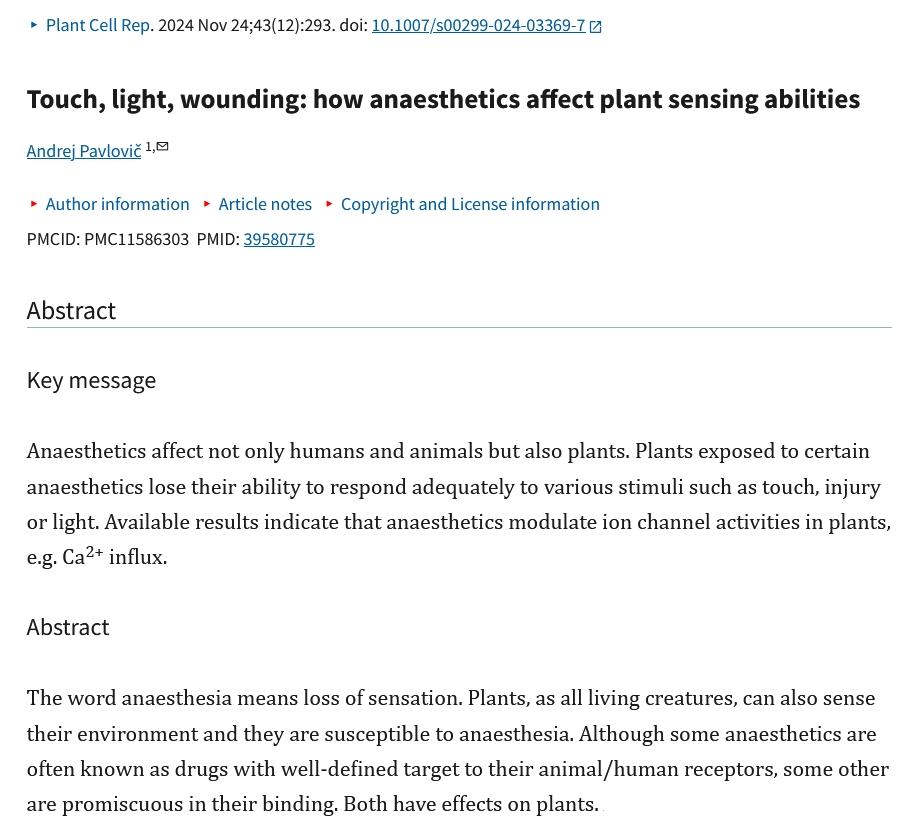
Regarding that Ca2+ signalling, which is way outside my knowledge base, I read this in the paper:
"Recent success in the transformation of the Venus flytrap with calcium reporter system GCaMP6f (Suda et al. 2020) has allowed monitoring of spatio-temporal dynamics of intracellular calcium ion ([Ca2+]cyt), one of the components of action potential in the Venus flytrap (Scherzer et al. 2022a). Mechanical stimulation of a trigger hair causes an increase in cytosolic [Ca2+]cyt starting in the podium cells of trigger hair and spreading concentrically to the trap blade. Using these plants, Scherzer et al. (2022b) showed that Ca2+ signal from the leaf blade was inhibited by diethyl ether anaesthesia but the signal from podium cells was not. This indicates that the plant can sense mechanical stimulation under diethyl ether anaesthesia probably through the stretch-activated channels (e.g. HYPEROSMOLARITY-GATED CALCIUM-PERMEABLE CHANNEL, OSCA) but is not able to send electrical and Ca2+ signals to the effector – trap lobes, thus trap closing response is blocked."
-
Wow: you can knock out a plant with anesthetics - the same anesthetics that work on people!
It's easist to see for plants that move, like a Venus fly trap. But experiments have shown it's true for others too.
We're still struggling to figure out what this means. We don't really know how anesthetics work, but here's a clue: you don't need to have neurons to get anesthetized!
@johncarlosbaez that's a rough thing to contemplate while mowing the (unanaesthetized) lawn
-
@johncarlosbaez that's a rough thing to contemplate while mowing the (unanaesthetized) lawn
@djm62 - spray it with chloroform!

Even better: get rid of the lawn, grow native plants, and make pollinators and other life forms happy.
-
@johncarlosbaez It suggests that the mechanism involved in blocking sensation dates back to the common ancestor of both plants and animals. (Not ruling out the possibility that this mechanism evolved more than once!) What’s also cool is that our photoreceptors and those of plants are chemically the same.
A recent book that tries to figure out how plants see the world is The Light Eaters, but What a Plant Knows is more tightly focused on sensory mechanisms and is a fun, quick read.
I also came here to recommend Zoe Schlanger's "The Light Eaters" (which presents a range of evidence of plant capabilities that we would associate with sentience).
I'll have to check out "What a Plant Knows" now too.
-
Wow: you can knock out a plant with anesthetics - the same anesthetics that work on people!
It's easist to see for plants that move, like a Venus fly trap. But experiments have shown it's true for others too.
We're still struggling to figure out what this means. We don't really know how anesthetics work, but here's a clue: you don't need to have neurons to get anesthetized!
@johncarlosbaez Michael Pollan discusses this in his recent book on consciousness, A World Appears. Floored me. Are plants conscious?
-
Wow: you can knock out a plant with anesthetics - the same anesthetics that work on people!
It's easist to see for plants that move, like a Venus fly trap. But experiments have shown it's true for others too.
We're still struggling to figure out what this means. We don't really know how anesthetics work, but here's a clue: you don't need to have neurons to get anesthetized!
@johncarlosbaez in fact, there has been some research on "plant nervous systems", in that even though plants do not have full-blown neurons like animals do, they display traits like depolarization waves, neurotransmitter analogues, etc.; see for instance the work of Brenner et al. (https://doi.org/10.1016/j.tplants.2006.06.009) and Sibaoka (https://doi.org/10.1007/BF02493405). On that note, I wonder if these anesthetics would also influence the drooping of Mimosa pudica:
-
I also came here to recommend Zoe Schlanger's "The Light Eaters" (which presents a range of evidence of plant capabilities that we would associate with sentience).
I'll have to check out "What a Plant Knows" now too.
@jmcclure @ClimateJenny - thanks, Jenny and Jesse! The research on anesthetics has caused a controversy on whether plants are "conscious". I didn't want to mention that in my main post because I find most discussions of consciousness very irritating: people don't define their terms and some treat consciousness, sentience and awareness as the same while others don't, etc., and it become just as bad as "interpretations of quantum mechanics". But I enjoy learning actual facts about how animals and plants behave!
-
@johncarlosbaez in fact, there has been some research on "plant nervous systems", in that even though plants do not have full-blown neurons like animals do, they display traits like depolarization waves, neurotransmitter analogues, etc.; see for instance the work of Brenner et al. (https://doi.org/10.1016/j.tplants.2006.06.009) and Sibaoka (https://doi.org/10.1007/BF02493405). On that note, I wonder if these anesthetics would also influence the drooping of Mimosa pudica:
@tpfto -
"The angular displacement in Mimosa and in Venus was measured to compare the drugged groups with control groups. Assumed p-value = 0,01, amlodipine showed have no significant effects vs. control in mimosa and Venus flytrap (p > 0,10) with 118 degrees of freedom. In the same way ketamine had no significant effects vs. control in mimosa and Venus flytrap (p > 0,10). Lidocaine had significant effect vs. control group in mimosa causing strong immobilization of the petioles (p < 0,001) and spontaneous closing of leaflets, but not in Venus Flytrap (0,02 > p > 0,01). Ether had an evident effect in Mimosa and Venus Flytrap (p < 0,001) causing almost total immobilization."
Ether is in the group of anesthetic vapors whose functioning is mysterious, along with chloroform and even argon and xenon. These are the ones that seem to work on plants as well as animals.
-
@tpfto -
"The angular displacement in Mimosa and in Venus was measured to compare the drugged groups with control groups. Assumed p-value = 0,01, amlodipine showed have no significant effects vs. control in mimosa and Venus flytrap (p > 0,10) with 118 degrees of freedom. In the same way ketamine had no significant effects vs. control in mimosa and Venus flytrap (p > 0,10). Lidocaine had significant effect vs. control group in mimosa causing strong immobilization of the petioles (p < 0,001) and spontaneous closing of leaflets, but not in Venus Flytrap (0,02 > p > 0,01). Ether had an evident effect in Mimosa and Venus Flytrap (p < 0,001) causing almost total immobilization."
Ether is in the group of anesthetic vapors whose functioning is mysterious, along with chloroform and even argon and xenon. These are the ones that seem to work on plants as well as animals.
@johncarlosbaez very interesting, thanks for pulling that one up! It's wild that lidocaine actually works on plants that move. Indeed, the inhalational anesthetics are poorly understood with respect to their mechanism of action, but we at least know that their being lipophilic (i.e., how well they dissolve in fats and other non-aqueous media) correlates well with their potency.
-
@maxpool - I know very little about this stuff, so I think it's a clue that xenon and argon work as anesthetics but not neon or helium: they're chemically inert so it limits the number of possible mechanisms, and it seems the atomic weight matters.
Regarding that Ca2+ signalling, which is way outside my knowledge base, I read this in the paper:
"Recent success in the transformation of the Venus flytrap with calcium reporter system GCaMP6f (Suda et al. 2020) has allowed monitoring of spatio-temporal dynamics of intracellular calcium ion ([Ca2+]cyt), one of the components of action potential in the Venus flytrap (Scherzer et al. 2022a). Mechanical stimulation of a trigger hair causes an increase in cytosolic [Ca2+]cyt starting in the podium cells of trigger hair and spreading concentrically to the trap blade. Using these plants, Scherzer et al. (2022b) showed that Ca2+ signal from the leaf blade was inhibited by diethyl ether anaesthesia but the signal from podium cells was not. This indicates that the plant can sense mechanical stimulation under diethyl ether anaesthesia probably through the stretch-activated channels (e.g. HYPEROSMOLARITY-GATED CALCIUM-PERMEABLE CHANNEL, OSCA) but is not able to send electrical and Ca2+ signals to the effector – trap lobes, thus trap closing response is blocked."
The weird thing is that plant cells have discrete action potentials, but C. elegans (the roundworm) does not[1].
C. elegans has a nervous system made of 302 neurons with graded potentials (no spikes, meaning they are 'analog') and no myelin to work as wire insulation. Its signaling is slow. C. Elegans cognition is mix of of mechanical, chemical and electrical signals.
Mechanical stetching opens ion channels in the neurons, generating signals. Neurons can react external touching or internal movement. Internal mechanical feedback is part of its thinking and movement.
[1]: as far as I know.
-
@djm62 - spray it with chloroform!
Even better: get rid of the lawn, grow native plants, and make pollinators and other life forms happy.
@johncarlosbaez @djm62 I got the joke ;), but possibly contaminating the water table with chloroform can be problematic, and people actually are concerned about chloroform contamination in drinking water. This is because chloroform is often a product of the chlorine used to disinfect water reacting with organic material that has not been carefully removed by filtration or other means (cf. https://doi.org/10.1080/15287390252807957 and https://www.who.int/docs/default-source/wash-documents/wash-chemicals/trihalomethanes.pdf)
-
@johncarlosbaez Michael Pollan discusses this in his recent book on consciousness, A World Appears. Floored me. Are plants conscious?
@IzzyChambers @johncarlosbaez consciousness is still a very different matter and not something we even would know how to measure. we can only go off what seems to produce it in humans and how other living things might act similarly. plants don't just lack nerve cells, they also lack something analogous to a central nervous system to integrate information. far as I understand it if plants possess consciousness we're either very very wrong about the prerequisites and purpose of consciousness or very very wrong about how plants function. and we wouldn't really be able to test it either way.