sure this is all very bad for activitypub but this is truly amazing content
-
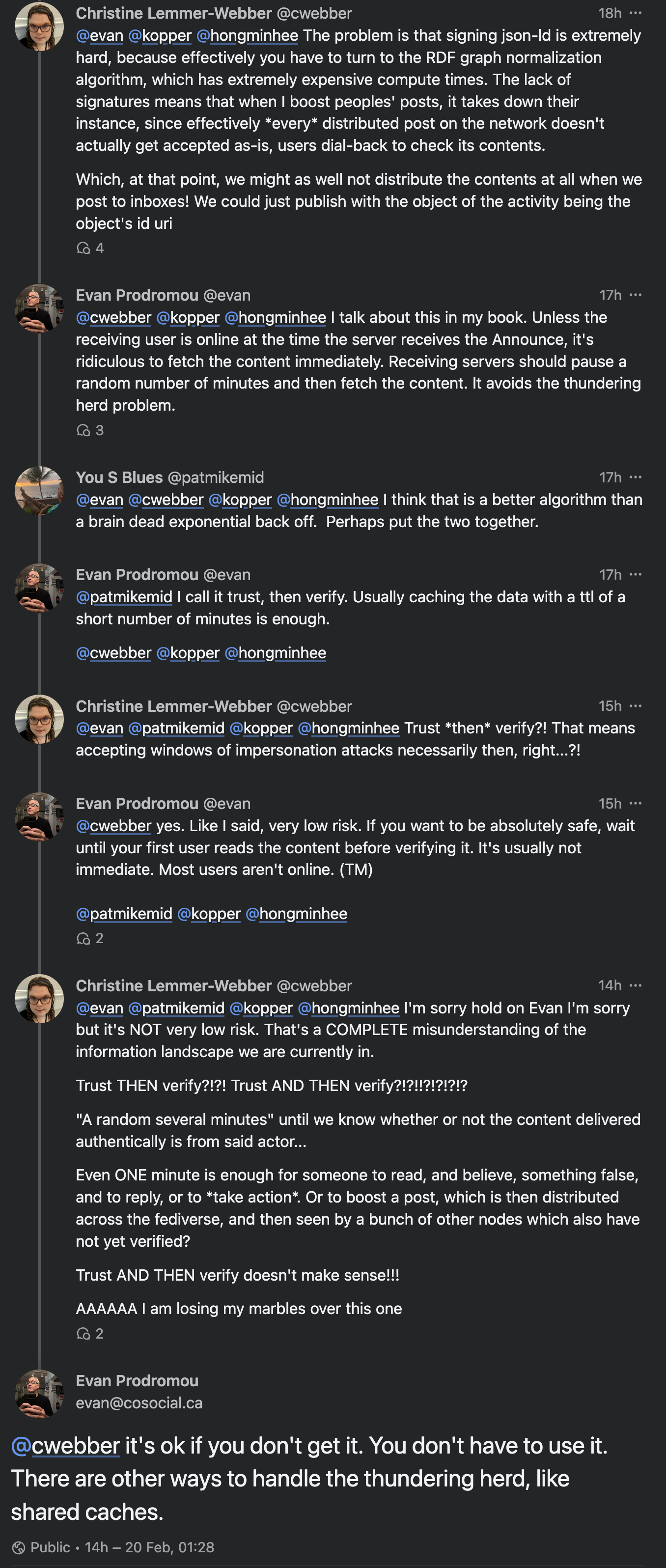
@cwebber @promovicz @laurenshof @evan I think this whole exchange is a good look, honestly!
You appear frustrated, about a technical problem that is important to you (one that resonates with me!), you don’t fall back on any weird personal attacks, just get loud.
Evan takes it in step and responds nicely.
I could have gasped when i read Evan’s reply and it’s so nice. That’s not how internet exchanges work!
Anyway, this thread reads like real people having a heated and respectful discussion about stuff they feel strongly about. Well done.
@anders Thanks, those are nice comments.
I should also note that I'm not averse to Christine's ideas around using digital signatures for verifying content. They can improve performance by short-circuiting some verification that would require fetching the content over HTTP.
I do disagree that they are the *only* way to improve that performance, and that it's worth breaking backwards compatibility of the network in order to enable digital signatures.
-
@promovicz @laurenshof It's "entertaining content" for sure, but what it also gets at is not just the technical side of things, but the social one, and how we are caught between both, and our systems are the output of the conflicts between technical goals and social dynamics.
@evan is my friend, and I'm not super proud of that exchange, because I lost patience publicly, because this is a sore issue for me. But of course, you tear things back, and Evan and I had a nice chat afterwards, and actually have hung out quite a bit before and since, and behind all of that, both of us were going through things in our personal lives.
And yet the decisions we make in these messy social dynamics influence the kinds of technical systems which in turn influence the kinds of social systems we can have!
Nah, I think you had the right to pop off a bit there. I'm no network engineer, but even I thought verifying upon first read was an insane take. In this age with agentic AI writing goddamn hit-pieces on people and how dangerous things are getting, security has to be a priority. Dis/misinformation is spreading at unprecedented rates, and I think a place like the decentralized web needs to do whatever it can to limit that spread if it wants to actually be a viable alternative/replacement.
-
@thomasfuchs @laurenshof ATProto is the result of corporate minded techbros, to produce yet another #DTBO #SocialMedia aiming at making people a product.
Thinking ATProto is anything else is deeply naive.
I'll yake ActivityPub with its *features* of no algorithm tracking me. Every tracker is a bad idea, every collection should be made a liability, so they stop seeing us as meta data cows.
Long live the #fediverse, free of #bluesky and ALL corporate walled gardens
@faraiwe @thomasfuchs @laurenshof i hope you're aware that activitypub is just as public as atproto and that there is nothing stopping someone from creating/running the "tracking algorithms" you claim atproto does by default on this network
-
@faraiwe @thomasfuchs @laurenshof i hope you're aware that activitypub is just as public as atproto and that there is nothing stopping someone from creating/running the "tracking algorithms" you claim atproto does by default on this network
@esm I hope you are aware that anything shoved down our throats by techbros is to be seen as toxic and harmful, to their exclusive gain, and aligning yourself with their interests is stupid to the point of suicidal.
Don't let me know.
-
@anders Thanks, those are nice comments.
I should also note that I'm not averse to Christine's ideas around using digital signatures for verifying content. They can improve performance by short-circuiting some verification that would require fetching the content over HTTP.
I do disagree that they are the *only* way to improve that performance, and that it's worth breaking backwards compatibility of the network in order to enable digital signatures.
@evan @anders @promovicz @laurenshof It doesn't need to break backwards compatibility tho
But anyway
Long conversation potentially
-
@laurenshof I didn't think it was that bad at all.
@evan As a newbie to the tech end of decentralized spaces, I’m curious as to why you don’t think it should be “verify, then trust” or other alternatives that don’t allow bad actors to get at people who are not tech-savvy.
-
@faraiwe @thomasfuchs @laurenshof i hope you're aware that activitypub is just as public as atproto and that there is nothing stopping someone from creating/running the "tracking algorithms" you claim atproto does by default on this network
apparently i was blocked for saying this, reminder that pointing out that a bad thing that's possible on the "bad" network is also possible on the "good" network is not an endorsement of said bad thing in any way
cognitive dissonance and putting your head in the sand are not good strategies to handle potential threats
-
@evan As a newbie to the tech end of decentralized spaces, I’m curious as to why you don’t think it should be “verify, then trust” or other alternatives that don’t allow bad actors to get at people who are not tech-savvy.
@trishalynn Sure! So, there are two main events that happen here:
- The server receives the third-party data
- One of the server's users reads the third-party dataThere are usually at least a few minutes, and sometimes a few hours or even days between these two events.
-
@trishalynn Sure! So, there are two main events that happen here:
- The server receives the third-party data
- One of the server's users reads the third-party dataThere are usually at least a few minutes, and sometimes a few hours or even days between these two events.
@trishalynn The question is, when should the server *verify* the third-party data?
To be conservative, at the very least, the third party data should be verified before one of the server's users reads it.
-
@trishalynn The question is, when should the server *verify* the third-party data?
To be conservative, at the very least, the third party data should be verified before one of the server's users reads it.
@trishalynn If the user is online when the data is received, there may be no time between the time the data is received and when the user reads it.
However, most users aren't online most of the time. There's a strong chance that there are minutes, hours, or days between when the data is received and when it is read.
-
@trishalynn If the user is online when the data is received, there may be no time between the time the data is received and when the user reads it.
However, most users aren't online most of the time. There's a strong chance that there are minutes, hours, or days between when the data is received and when it is read.
@evan I should think that the server should verify first even if the user is not active online.
-
@trishalynn If the user is online when the data is received, there may be no time between the time the data is received and when the user reads it.
However, most users aren't online most of the time. There's a strong chance that there are minutes, hours, or days between when the data is received and when it is read.
@trishalynn Most ActivityPub implementations today lean waaaaaay into the early part of this gap -- verifying the data as soon as it is received.
The problem with this is that sometimes hundreds or even thousands of servers receive the data within a few seconds -- and if they all verify the data with the third-party server immediately, it can swamp that server with requests.
-
@evan I should think that the server should verify first even if the user is not active online.
@trishalynn Before it's read by a user, yes.
-
@trishalynn Most ActivityPub implementations today lean waaaaaay into the early part of this gap -- verifying the data as soon as it is received.
The problem with this is that sometimes hundreds or even thousands of servers receive the data within a few seconds -- and if they all verify the data with the third-party server immediately, it can swamp that server with requests.
@trishalynn One way to relieve this pressure on the third party server is to space out all these requests by seconds or even minutes. There are a couple of ways to do this.
-
@trishalynn One way to relieve this pressure on the third party server is to space out all these requests by seconds or even minutes. There are a couple of ways to do this.
@trishalynn One is to wait until the first reader reads the data. That event is going to vary wildly across servers, so it will spread out the requests and lower the load on the third-party server. The downside of this technique is that it introduces some extra time for that first read. Usually not a lot, but some.
-
@trishalynn One is to wait until the first reader reads the data. That event is going to vary wildly across servers, so it will spread out the requests and lower the load on the third-party server. The downside of this technique is that it introduces some extra time for that first read. Usually not a lot, but some.
@trishalynn Another is for the receiving server to wait a random number of seconds or minutes before doing the verification request. This spaces out the requests, and hopefully avoids the little delay for the user on first read. At worst, if a user tries to read the data before the verification timeout, you can do the verification then -- it's no worse than the previous method, and will usually be better.
-
@trishalynn One is to wait until the first reader reads the data. That event is going to vary wildly across servers, so it will spread out the requests and lower the load on the third-party server. The downside of this technique is that it introduces some extra time for that first read. Usually not a lot, but some.
@evan (Could you please let me know when you’re done explaining? I don’t want to jump in with clarifying Qs till you’re done.)
-
@trishalynn Another is for the receiving server to wait a random number of seconds or minutes before doing the verification request. This spaces out the requests, and hopefully avoids the little delay for the user on first read. At worst, if a user tries to read the data before the verification timeout, you can do the verification then -- it's no worse than the previous method, and will usually be better.
@trishalynn So, the last part, which I think is most controversial, is showing the unverified data to the user -- doing the verification *after* the first read.
This requires a lot of trust between the actors. But if a sending actor has sent 10 or 1000 or 10,000 shares, all of which have previously verified correctly, there's a very good chance that share number 10001 is also going to verify correctly.
-
@trishalynn So, the last part, which I think is most controversial, is showing the unverified data to the user -- doing the verification *after* the first read.
This requires a lot of trust between the actors. But if a sending actor has sent 10 or 1000 or 10,000 shares, all of which have previously verified correctly, there's a very good chance that share number 10001 is also going to verify correctly.
@trishalynn This requires a lot more tracking on the receiving server's part. I'm not even sure the performance benefits are that great, compared to waiting for first-read instead of verifying on receipt. But for high-volume servers, it might be a valuable strategy in the future.
-
@evan (Could you please let me know when you’re done explaining? I don’t want to jump in with clarifying Qs till you’re done.)
@trishalynn I think I'm done!