
@ColinTheMathmo
Oops, missed him on there: couldn't see Birnam wood for the moving trees!
Yes - plenty of literary links in Sarah Hart's stuff!
 T
T
@ColinTheMathmo
Oops, missed him on there: couldn't see Birnam wood for the moving trees!
Yes - plenty of literary links in Sarah Hart's stuff!
I don't think I've seen anyone else mention him, but in terms of situating developments in maths alongside more well-known historical events, then... Shakespeare. Born in between publication of Robert Recorde's two important books that helped to embed an entirely new number system into British life, industry, and commerce. He and his own father would have learnt not just different algorithms for calculating in their respective school careers, but entirely different number _systems_, and there's evidence of Bill playing with this new-fangled system throughout his famous works.
@ColinTheMathmo
Absolutely. I find with many 'arguments' about maths education, both sides are arguing the same point, but from slightly different angles and with differing understandings of seemingly common vocabulary.
@ColinTheMathmo
This is partly why we decided to set up a network rather than producing a collection of resources; connecting people (including but not limited to teachers of mathematics and history) who are already interested and want to explore further to develop *themselves*, rather than firing some PowerPoint slides into the ether and saying 'break your lesson-flow and slot this script in'.
@ColinTheMathmo
Keep your eyes peeled for a paper about a project I did on this with a research partner just over a year ago. Currently in peer-review.
I was/am similarly resistant to the "make it relevant" stuff, largely because it often feels contrived or bolted-on, precisely because we (as maths teachers) are told to do these things with little-to-no training or resources to enable us to do it properly.
Exhortations to "make it {fun, interesting, relevant}" strongly imply that these things are not intrinsic, and _that_ is where we lose people with contrived relevance and context.
@ColinTheMathmo
Also, there exists a fledgling network for people interested in the history of maths (and the maths of history) and exploring how each might enrich the other in educational settings: https://historyand.mathsy.space/
@ColinTheMathmo
People interested in this thread might also be interested in the fact that the British Society for the History of Mathematics' _Research in Progress_ meeting is in Oxford next Saturday (7th March). Booking is technically closed, but there is a waitlist: https://bshm.ac.uk/event/research-in-progress/
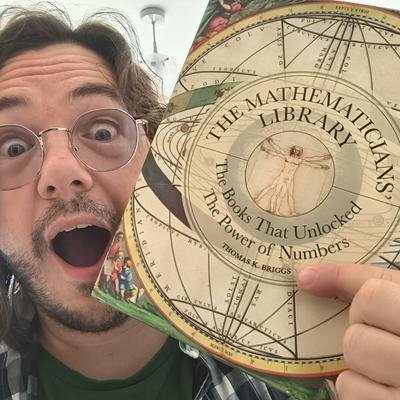
There are quite a few figures mentioned in a certain book which I know you have access to  In that I've tried to draw attention to some (as you've put it elsewhere) non-(white dead dudes), but as you've also said elsewhere, I'm the product of a similar educational system which almost exclusively presented old white dead dudes.
@ColinTheMathmo
Sir Christopher Wren is another well-known historical figure whose mathematical connections are almost unheard of amongst the population at large.
A certain someone will give me another funny look if I don't mention Mary Somerville.
On that note, I created some resources for @mathsweek.scot that aim to help people explore some Scottish mathematical figures: https://mathsweek.scot/schools/learning-resources/finn-finity-meets
@ColinTheMathmo
Eratosthenes' prime number sieve is a common teaching tool in British schools, though mention of that name is less common.
Florence Nightingale is someone that almost every schoolchild in the UK knows of, though vanishingly few encounter her as a mathematical figure.
The 'Rhind' papyrus is one of the mathematical historical objects that is more likely to be encountered by folk who do not consider themselves as 'maths people'. That presents an opportunity to discuss whether there might be better ways to name such things, and introduce them to Ahmes.