Skip to content
  • Categories
  • Recent
  • Tags
  • Popular
  • World
  • Users
  • Groups
Skins
  • Light
  • Brite
  • Cerulean
  • Cosmo
  • Flatly
  • Journal
  • Litera
  • Lumen
  • Lux
  • Materia
  • Minty
  • Morph
  • Pulse
  • Sandstone
  • Simplex
  • Sketchy
  • Spacelab
  • United
  • Yeti
  • Zephyr
  • Dark
  • Cyborg
  • Darkly
  • Quartz
  • Slate
  • Solar
  • Superhero
  • Vapor

  • Default (Cyborg)
  • No Skin
Collapse
Brand Logo

CIRCLE WITH A DOT

apod@reentry.codl.frA

apod@reentry.codl.fr

@apod@reentry.codl.fr
About
Posts
4
Topics
4
Shares
0
Groups
0
Followers
0
Following
0

View Original

Posts

Recent Best Controversial

  • Tails of Comet WierzchośImage Credit & Copyright: José J. Chambó;Text: Cecilia Chirenti (NASA GSFC, UMCP, CRESST II)
    apod@reentry.codl.frA apod@reentry.codl.fr

    Tails of Comet Wierzchoś
    Image Credit & Copyright: José J. Chambó;
    Text: Cecilia Chirenti (NASA GSFC, UMCP, CRESST II)

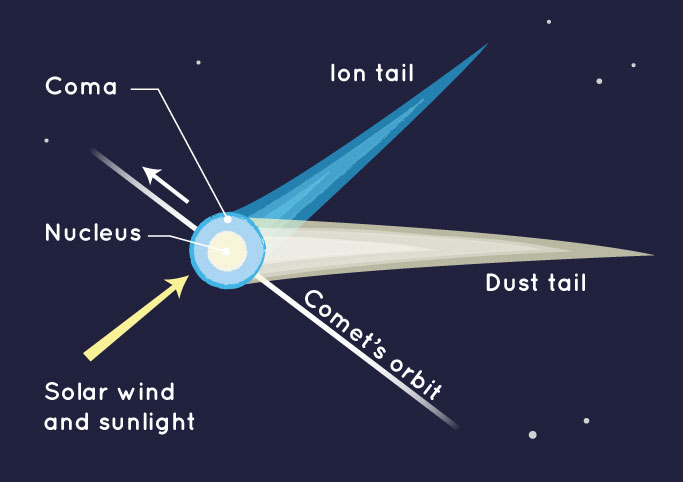
    Explanation: Some comets are regular guests of our solar neighborhood; others come by only once, never to return. We won’t have another chance to see Comet C/2024 E1 (Wierzchoś), which is currently making its way through the inner Solar System. The hyperbolic orbit of this comet indicates that it will likely become an interstellar traveler. Comet Wierzchoś is today near its closest approach to the Earth, passing roughly the same distance from the Earth as is the Sun. The featured 30-minute exposure was taken last week in Chile and shows a 5-degree long ion tail as well as three shorter dust tails. The green hue of the coma comes from the breakdown of dicarbon molecules by sunlight, but that process does not last long enough to also tinge the tails. On the far right lies a spiral galaxy far in the distance: NGC 300.

    https://apod.nasa.gov/apod/ap260217.html #apod

    Uncategorized apod

  • To Fly Free in SpaceImage Credit: NASA, STS-41B
    apod@reentry.codl.frA apod@reentry.codl.fr

    To Fly Free in Space
    Image Credit: NASA, STS-41B

    Explanation: What would it be like to fly free in space? About 100 meters from the cargo bay of a space shuttle, Bruce McCandless II was living the dream -- floating farther out than anyone had ever been before. Guided by a Manned Maneuvering Unit (MMU), astronaut McCandless, pictured, was floating free in space. During Space Shuttle mission 41-B in 1984, McCandless and fellow NASA astronaut Robert Stewart were the first to experience such an "untethered space walk". The MMU worked by shooting jets of nitrogen and was used to help deploy and retrieve satellites. With a mass over 140 kilograms, an MMU is heavy on Earth, but, like everything, is weightless when drifting in orbit. The MMU was later replaced with the SAFER backpack propulsion unit.

    https://apod.nasa.gov/apod/ap260215.html #apod

    Link Preview Image
    Uncategorized apod

  • NGC 147 and NGC 185Image Credit & Copyright: Chuck Ayoub
    apod@reentry.codl.frA apod@reentry.codl.fr

    NGC 147 and NGC 185
    Image Credit & Copyright: Chuck Ayoub

    Explanation: Dwarf galaxies NGC 147 (left) and NGC 185 stand side by side in this deep telescopic portrait. The two are not-often-imaged satellite galaxies of M31, the great spiral Andromeda Galaxy, some 2.5 million light-years away. Their separation on the sky, less than one degree across a pretty field of view toward the constellation Cassiopeia, translates to only about 35 thousand light-years at Andromeda's distance, but Andromeda itself is found well outside this frame. Brighter and more famous satellite galaxies of Andromeda, M32 and M110, are seen much closer to the great spiral. NGC 147 and NGC 185 have been identified as binary galaxies, forming a gravitationally stable binary system. But recently discovered faint dwarf galaxy Cassiopeia II also seems to be part of their system, forming a gravitationally bound group within Andromeda's intriguing population of small satellite galaxies.

    https://apod.nasa.gov/apod/ap260213.html #apod

    Uncategorized apod

  • In Green Company: Aurora over NorwayImage Credit & Copyright: Max Rive
    apod@reentry.codl.frA apod@reentry.codl.fr

    In Green Company: Aurora over Norway
    Image Credit & Copyright: Max Rive

    Explanation: Raise your arms if you see an aurora. With those instructions, two nights went by with, well, clouds -- mostly. On the third night of returning to same peaks, though, the sky not only cleared up but lit up with a spectacular auroral display. Arms went high in the air, patience and experience paid off, and the creative featured image was captured as a composite from three separate exposures. The setting is a summit of the Austnesfjorden fjord close to the town of Svolvear on the Lofoten islands in northern Norway. The year was 2014. This year, our Sun is just passing solar maximum, the peak in its 11-year surface activity cycle. As expected, some spectacular aurora have recently resulted.

    https://apod.nasa.gov/apod/ap260210.html #apod

    Link Preview Image
    Uncategorized apod
  • Login

  • Login or register to search.
  • First post
    Last post
0
  • Categories
  • Recent
  • Tags
  • Popular
  • World
  • Users
  • Groups